Anxiety Symptom Tracker How to Build One That Works
You wake up already braced. Your chest is tight before you've opened your laptop. By noon, the feeling has changed shape twice. First it was dread, then irritability, then a strange wired restlessness after coffee and a work message you can barely remember reading. By the time you try to explain it that evening, your brain rounds the whole day into one fuzzy sentence: “I was anxious all day.”
That's the problem an anxiety symptom tracker solves. Not by turning your life into homework, but by replacing guesswork with a record you can use. You don't need more self-awareness in the abstract. You need to know what happened, when it shifted, what seemed to trigger it, what they tried, and whether anything helped.
A good tracker gives you that without asking for long journal entries or perfect compliance. It helps you spot patterns that memory blurs, separates a rough hour from a rough week, and makes therapy, medication follow-up, or self-directed coping work much more concrete.
Table of Contents
- Why Tracking Anxiety Changes Everything
- What to Track and How Often to Log It
- Choosing the Right Format for Your Tracker
- Building Your Template and Logging Real Entries
- Turning Logs Into Patterns You Can Act On
- Using Your Tracker Safely With Privacy and Therapy in Mind
Why Tracking Anxiety Changes Everything
Morning anxiety often feels global. It tells you the whole day is bad, your coping isn't working, and nothing has changed. Then you log it for a couple of weeks and something more precise appears. The spike isn't all day. It's strongest before meetings, after poor sleep, or during long gaps without food. The breathing exercise didn't “fail.” It helped on some days but not when you were already overstimulated.
That kind of clarity matters because anxiety is common and persistent. The World Health Organization reports that anxiety disorders affected 470 million people worldwide in 2023 and estimates that 5.8% of the global population currently experience an anxiety disorder. WHO also reported a 25% increase in the prevalence of anxiety and depression during the first year of the COVID-19 pandemic, which shows how quickly symptom burden can change in real life, not just in a clinic (World Health Organization anxiety disorders fact sheet).

What a useful tracker does differently
A generic mood diary often creates clutter. You get pages of feelings and almost no signal. A useful anxiety symptom tracker does a smaller job, but does it well.
- It captures timing: Was the anxiety worst on waking, midafternoon, or at night?
- It ties symptoms to context: What happened before the shift? Coffee, conflict, scrolling, skipped lunch, travel?
- It records response: Did you pace, avoid, breathe, text someone, go for a walk, or push through?
- It makes comparison possible: This week versus last week. Before a medication change versus after. Workdays versus weekends.
That's why structured logging works better than trying to remember later. If you've ever sat in therapy saying, “I know there was a pattern, I just can't reconstruct it,” you already understand the value. The same basic principle shows up in other forms of self-monitoring too, especially when logs are consistent and short. If you want a broader look at why repeated logging changes what you notice, this piece on the benefits of logging is a useful companion.
Practical rule: If a tracker takes too long, people stop using it. If it's too vague, they keep using it and learn nothing.
What changes once you stop relying on memory
When tracking is done well, people usually notice three shifts. They stop treating every anxious moment like a crisis. They stop assuming every bad day has one cause. They start seeing early warning signs before things peak.
That last one is the biggest. Once you can recognize your own sequence, such as jaw tension, faster thoughts, urge to cancel, checking behavior, you get a small window to intervene earlier.
By the end of this guide, you'll have a simple anxiety symptom tracker you can keep up with, a rhythm for logging that won't take over your day, and a weekly review method that turns raw entries into decisions.
What to Track and How Often to Log It
An anxiety tracker built on day one with too many fields, scales, and goals often collapses within a week. A better tracker is narrow enough to sustain and rich enough to explain change.
Start with symptoms, not theories
Track what you can notice directly. Don't start with “Why am I like this?” Start with “What happened in my body and behavior?”
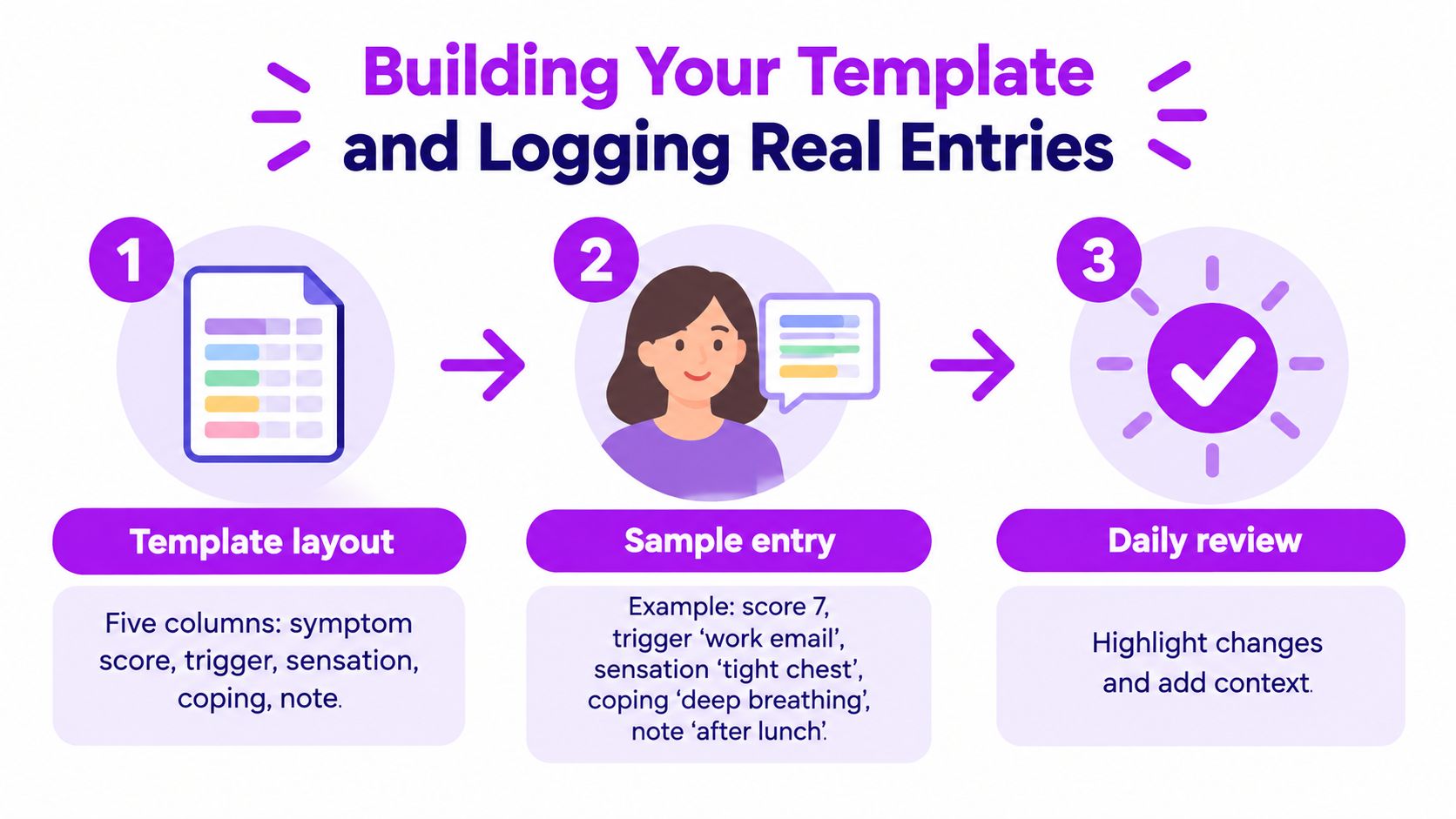
The most useful daily fields are usually:
- Anxiety intensity on a simple scale.
- Main trigger or context, if known.
- Physical sensations such as chest tightness, nausea, jaw clenching, shakiness, stomach drop, racing heart.
- Mental symptoms such as looping thoughts, dread, irritability, hypervigilance, trouble concentrating.
- What you did next including coping skills, avoidance, reassurance seeking, movement, food, rest, medication taken as prescribed, or nothing.
- Brief note for anything unusual.
If you want a simple numeric anchor, the GAD-7 is still one of the best reference points for structuring symptom tracking. It's a 7-item screener that asks adults to rate symptoms over the previous two weeks on a 0 to 3 scale, where 0 = not at all, 1 = several days, 2 = more than half the days, and 3 = nearly every day, with a total score ranging from 0 to 21 (University of Washington GAD-7 overview). One peer-reviewed source also notes that it takes about 1 to 2 minutes to administer, which is part of why it translates well into repeated self-monitoring (peer-reviewed summary of GAD-7 administration time).
Use two layers of tracking
Your daily tracker and your periodic screen should do different jobs.
| Tracking Layer | What It Captures | Best Use |
|---|---|---|
| Quick daily log | Moment-to-moment symptom shifts and context | Spot triggers and responses |
| GAD-7 style check-in | Broader symptom severity over the prior two weeks | Compare overall baseline over time |
That combination keeps you from making one common mistake. People often confuse a bad afternoon with a worsening overall trend. The two-layer approach helps you hold both.
A practical way to implement that is to use a fast daily rating system and then compare it to a broader structured scale. If you need a simple framework for choosing a day-to-day score, this guide to a daily mood rating scale gives a clean starting point.
Here's a short video that fits well if you want to see a low-friction approach in action:
Intensity and instability are not the same
Many trackers become much more useful. Intensity is how strong anxiety feels at a given moment. Instability is how much it swings.
Someone can have moderate but steady anxiety. Someone else can look “fine” on a daily average but swing sharply across the day. Those are different clinical pictures and usually need different responses.
Research using repeated same-day sampling supports this distinction. One EMA study of adults used five prompts per day for seven consecutive days, and found that negative affect instability predicted heightened generalized anxiety symptoms even after controlling for affect intensity. A 2023 youth EMA validation study also found stronger psychometric performance in participants with anxiety disorders than in those without a diagnosis, which is a reminder that sparse or low-variability data can look deceptively flat (Frontiers review on EMA and anxiety dynamics).
If your rating is “6” every evening because you're averaging the day in your head, your tracker is hiding the real story.
How often should you log
For many, the sweet spot is brief entries done consistently. A smartphone EMA validation study with 99 participants over 6 months found strong within-person and between-person reliability, along with moderate correlation between EMA anxiety scores and endline anxiety on the DASS-21-A (r = .473, p < .001) and stress symptoms (r = .549, p < .001). The practical takeaway is simple: frequent, low-burden entries can produce better signal than occasional retrospective summaries (smartphone EMA anxiety tracker validation study).
In practice, that usually means:
- Once daily minimum: Good for people who'll quit if prompted more often.
- Two to five quick check-ins on rough days: Better if your anxiety shifts quickly.
- Same prompts each time: Consistency matters more than creativity.
Track enough to notice movement. Don't track so much that the tracker becomes another anxiety ritual.
Choosing the Right Format for Your Tracker
The format matters less than people think, but friction matters a lot. The right system is the one you'll still use when you're tired, busy, or already activated. For some people that's paper. For others it's a spreadsheet. For others it's an app with reminders and charts.
Anxiety Tracker Format Comparison
| Format | Best For | Trade Offs |
|---|---|---|
| Paper journal | People who think better by writing and want privacy without notifications | Harder to search, summarize, and spot time-based patterns |
| Spreadsheet | People who like structure, customization, and manual review | More setup, less convenient in the moment, easier to abandon |
| Dedicated app | People who want low-friction logging, reminders, and trend views | Requires trust in the app's privacy model and feature design |
Paper works best when simplicity beats insight depth
A notebook is excellent if screens make you more agitated or you want a private ritual. It's also good for people who freeze when given too many options. One page per day, a few repeated fields, and a weekly glance can be enough.
The downside shows up later. Paper is poor at retrieval. You remember writing “bad after lunch” somewhere, but not when or how often. That makes it harder to build a therapist-ready summary unless you're willing to do manual review.
Spreadsheets suit analytical brains
Spreadsheets shine when you want full control. You can create columns for intensity, trigger, physical sensation, coping, and outcome. You can sort by time of day, filter for work-related entries, and mark changes after a treatment adjustment.
They're less helpful for real-time capture. Opening a sheet on your phone while anxious isn't always realistic. People who love data often underestimate this and end up with a beautiful system they rarely use.
The best tracker isn't the one with the most fields. It's the one you can complete while your nervous system is busy.
Apps lower friction if they stay out of the way
A dedicated app is often the most practical middle ground. It can prompt short entries, preserve consistency, and make trends easier to review. The design details matter a lot here. Flexible entries, searchable history, and simple visual summaries help. Heavy gamification, streak pressure, or too many forced categories often backfire for anxious users.
One example is MicroTrack, which supports a 10-point mood scale, flexible two-phase entries, searchable history, CSV export, trend views across weeks and months, and calendar overrides for missed or changed days. Used this way, an app isn't replacing reflection. It's reducing friction around capture and review.
A fast decision filter
Choose your format by answering three questions:
- When will you log? If it's mostly in the moment, phone-based wins.
- Who will review it? If a therapist or prescriber may see it, exports help.
- What derails you? If customization becomes procrastination, avoid spreadsheets.
If you're torn, start smaller than you think. You can always migrate later. Rebuilding from a system you used is much easier than salvaging one you abandoned.
Building Your Template and Logging Real Entries
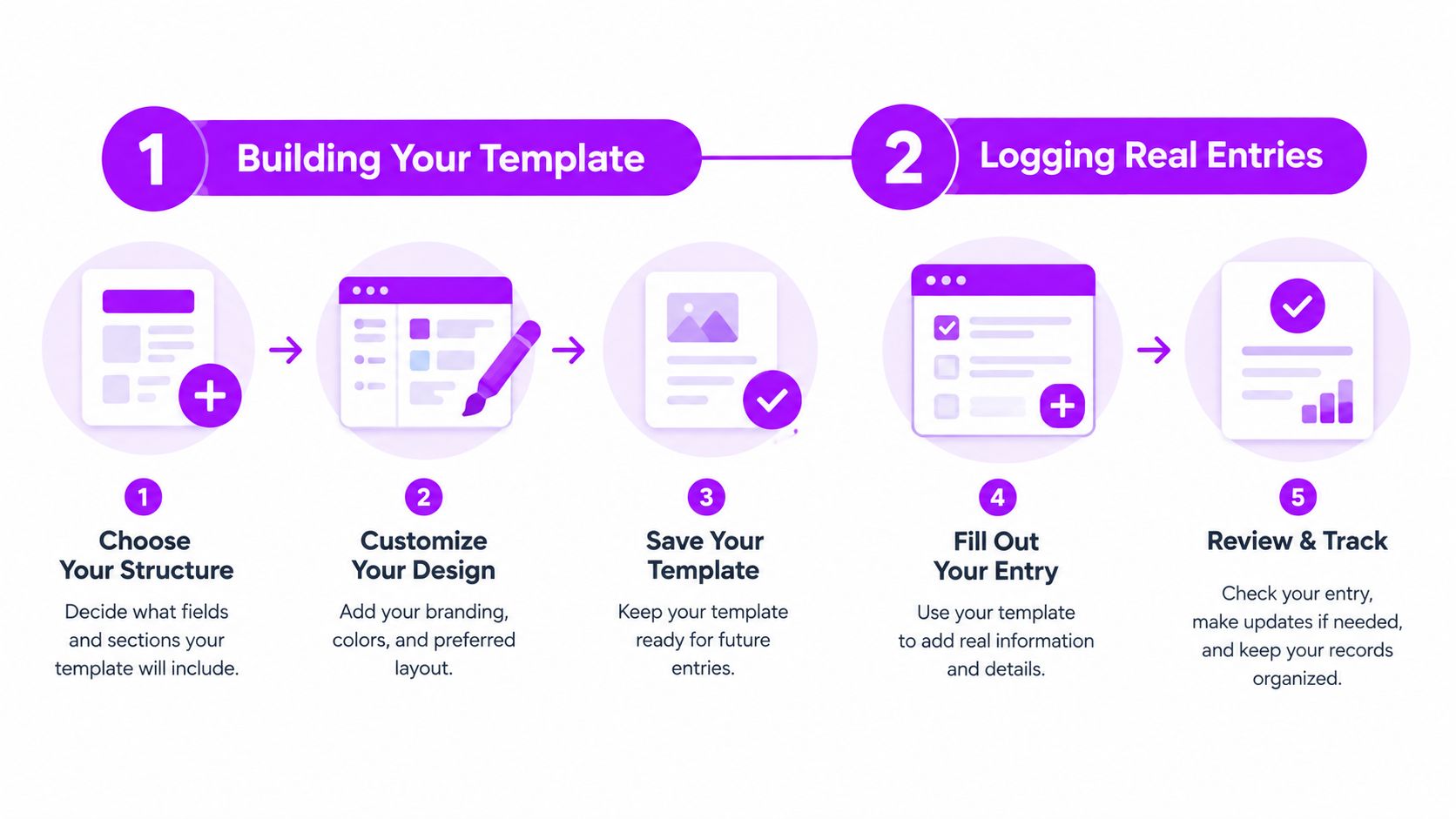
A working template should fit on one screen or one notebook line. If it sprawls, it won't survive a stressful week. Keep the structure tight and the language plain.
A copy-ready daily template
Use five core columns and one optional field:
| Time | Anxiety Score | Trigger or Context | Sensation and Thought | What I Did | Outcome Note |
|---|---|---|---|---|---|
| 8:10 am | 6 | Opened email | Tight chest, dread, “I'm behind” | Ate breakfast, delayed reply, 3 slow breaths | Dropped slightly after eating |
| 2:40 pm | 3 | Walk after lunch | Looser shoulders, fewer loops | Walked outside, no phone | Felt steadier |
That's enough for many users. If you want one extra field, add sleep or caffeine note only if those regularly affect you. Don't add ten lifestyle variables just because they might matter.
Use two-phase logging
The most sustainable method is quick capture now, reflection later.
Phase one happens in the moment. Enter the time, a score, a trigger if obvious, and one or two words for sensation. This should take well under two minutes.
Phase two happens later, usually once that evening or the next day. Add what you did and whether it helped. Anxious states distort interpretation. In the moment, everything can feel equally urgent. Later, you can sort reaction from result.
Two examples show the difference.
- Calm day entry: “11:30 am, score 2, long meeting, mild tension in shoulders, drank water and stretched, stayed functional.”
- High-anxiety day entry: “7:50 am, score 8, text from boss, nausea and racing thoughts, checked inbox repeatedly, skipped breakfast, anxiety stayed high until after lunch.”
The second entry is useful not because it's dramatic, but because it contains behavior. Repeated checking and skipping breakfast are the kinds of details that become actionable later.
Keep missed days boring
People abandon trackers because they turn gaps into meaning. One missed day becomes “I'm bad at this,” then the whole system dies.
Use a neutral rule:
- If you miss a log, resume at the next entry.
- If you missed the whole day, mark it missed and move on.
- If memory is fuzzy, don't reconstruct with confidence you don't have.
Clinical shortcut: A mostly honest tracker beats a perfectly completed one that's half guessed.
What makes entries therapist-ready
Therapists and prescribers usually don't need every raw note. They need patterns, examples, and response over time. Your template becomes much more useful when entries are searchable by trigger, body symptom, or coping attempt.
To make that possible, use repeated wording where you can. Write “work email” the same way most times. Pick one term for a sensation instead of rotating between five similar phrases. Standardized language makes patterns easier to find.
A good entry isn't literary. It's specific enough to review later. If you can scan your week and quickly find “nighttime spikes,” “driving anxiety,” or “jaw clenching after caffeine,” your template is doing its job.
Turning Logs Into Patterns You Can Act On
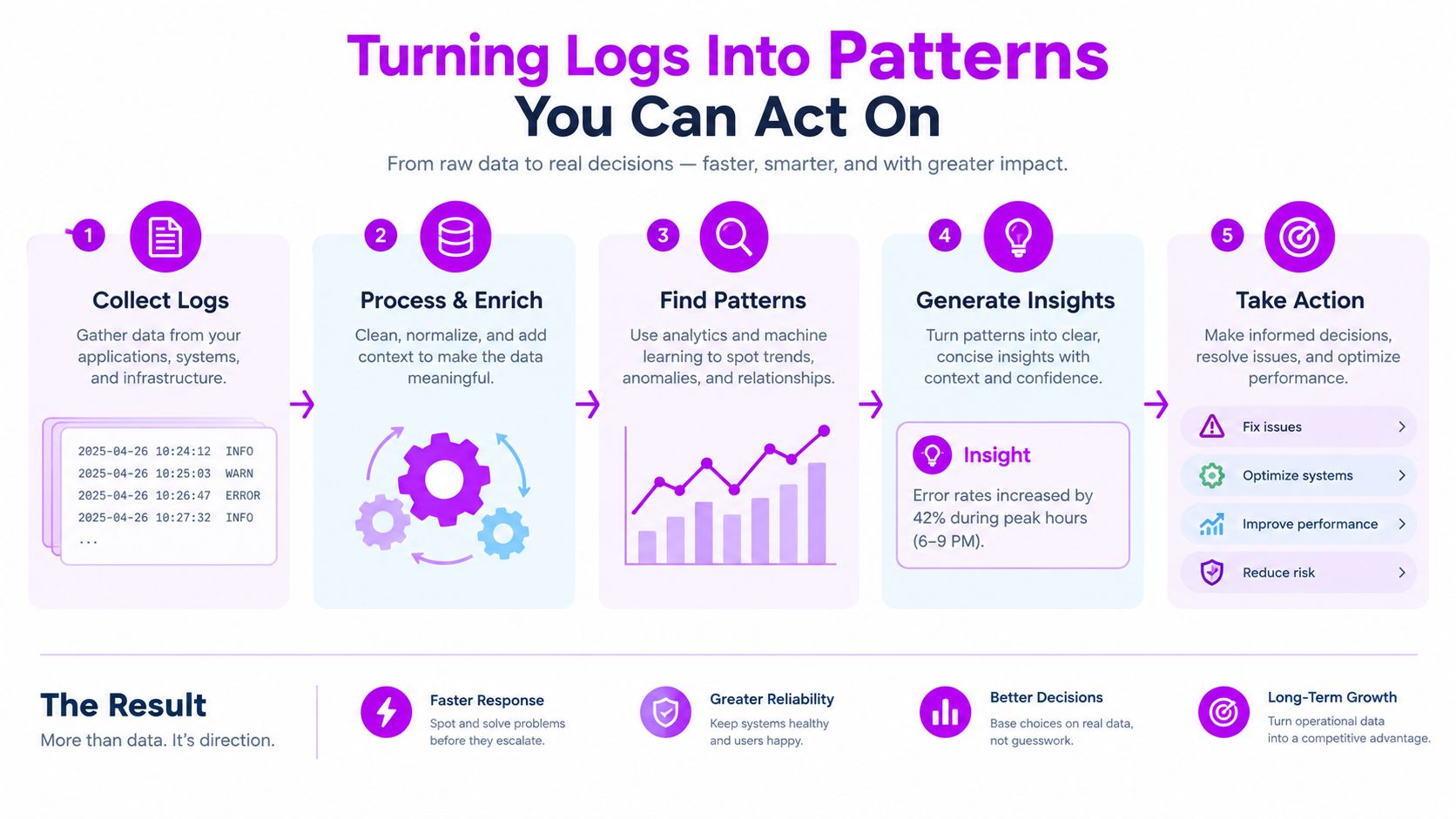
Raw entries don't help much until you review them with restraint. Many either never look back or overread every spike. The useful middle ground is a short weekly review that focuses on trends, variability, and response.
Read for patterns, not verdicts
One rough entry doesn't prove decline. One calm day doesn't prove recovery. Look for repetition.
A useful weekly review asks:
- When did anxiety show up most often?
- What tended to happen before the spike?
- What actions consistently helped, did nothing, or made it worse?
- Was the week high-intensity, high-instability, or both?
That last question matters. A person whose scores bounce sharply may need earlier interruption strategies and more in-the-moment regulation. A person with steady high symptoms may need broader treatment review, routine changes, or a closer look at persistent stressors.
If you want a framework for reading time-based changes without overreacting to noise, this guide to trend analysis is a helpful reference.
The weekly views that actually help
You don't need fancy analytics. Three views are enough.
| Review View | What to Look For | Why It Helps |
|---|---|---|
| Weekly average | General symptom level across the week | Prevents overreacting to one bad day |
| Time-of-day pattern | Morning, afternoon, evening clustering | Reveals predictable windows for prevention |
| Variability view | Sharp swings versus steady baseline | Distinguishes instability from consistently high anxiety |
Averages help, but they can hide instability. That's why repeated same-day data is useful. As noted earlier, denser sampling can reveal clinically meaningful shifts that once-daily recall misses. If your mornings are consistently difficult but evenings settle, the intervention target changes.
Don't ask, “How anxious am I?” Ask, “What shape does my anxiety take across time?”
Separate signal from wearable noise
Wearables can help, but many people give them too much authority. Heart rate that is high can be a meaningful clue. Reduced physical activity can also line up with worsening symptoms. But not every metric deserves equal weight.
A review of real-world anxiety detection methods found that combining multiple signals outperformed single-signal approaches, with pooled accuracy of 81.94% versus 76.85%, while also noting that real-world evidence remains limited by small studies, inconsistent methods, and weak validation (review of real-world anxiety detection methods). That means multi-signal tracking is promising, but current confidence should stay modest.
A separate 2026 review found that lower physical activity and increased heart rate were associated with greater anxiety symptoms, while meta-analyses found no association for several sleep metrics including sleep onset latency, total sleep time, sleep efficiency, and wake after sleep onset (2026 review of wearable-derived biomarkers for anxiety). So if your app tells you to obsess over nightly sleep efficiency as a proxy for anxiety, be careful. It may create noise without helping you act.
Turn patterns into decisions
Your review should end with one or two adjustments, not ten.
Examples:
- Morning spike pattern: Put food, light, and reduced phone exposure before email.
- Conflict-related surge: Add a brief decompression walk before going back to work tasks.
- Repeated checking loop: Replace inbox refreshing with a timed check window.
- Caffeine-linked agitation: Compare days with and without it before changing anything permanently.
The tracker becomes useful when each pattern suggests a next step. If review only increases self-surveillance, tighten the process. Fewer metrics. Shorter notes. More attention to what changes outcomes.
Using Your Tracker Safely With Privacy and Therapy in Mind
An anxiety symptom tracker should increase clarity, not vulnerability. That means protecting your data, setting limits around review, and knowing what belongs in a therapy conversation versus what can stay private.
Privacy needs to be practical
If you use paper, store it where you'd store any private health information. If you use a spreadsheet, think about device security and backup habits. If you use an app, check whether entries are encrypted, whether you can export them, whether deletion is straightforward, and whether the company says your data is sold or shared.
Those details matter because anxiety logs often include sensitive material. Not just symptoms, but relationship conflict, work stress, health fears, substance use, or medication side effects. You don't need a perfect system, but you do need an intentional one.
Bring summaries, not a data dump
Therapy works better when the tracker supports collaboration instead of flooding the session. Don't arrive with pages of unsorted notes and expect your clinician to excavate meaning in real time.
Bring a one-page summary with:
- Top recurring triggers
- Most common body symptoms
- Time windows that stand out
- Coping responses that helped
- Questions you want help answering
That gives your therapist something to work with. It also keeps the log from becoming a performance of self-monitoring.
Tracking should support treatment. It shouldn't become another way to judge yourself.
Watch for over-tracking and rumination
The line between self-observation and self-surveillance is thin for some people. If logging makes you check your body constantly, rehearse worst-case interpretations, or review entries over and over, the tracker needs boundaries.
Useful boundaries include:
- Fixed review windows: Once daily for logging cleanup, once weekly for pattern review.
- Short entry limits: A few words, not a full narrative, when you're activated.
- No score-chasing: Don't keep re-rating every few minutes unless your clinician has asked for dense sampling.
- Pause rules: If tracking consistently escalates distress, simplify it or stop and discuss it with a professional.
Know when the data suggests more support
A tracker can't diagnose you, and it can't tell you by itself what treatment you need. It can show that symptoms are persistent, worsening, increasingly impairing, or not responding to the strategies you're trying. That's often the moment to bring the record to a licensed mental health professional or prescribing clinician.
The most effective trackers are iterative. Review the system every month. Remove fields you never use. Add one context field if it keeps proving relevant. Keep the process calm, brief, and private enough that you can stay honest.
If your current system feels noisy, heavy, or guilt-inducing, that isn't a sign you've failed. It usually means the tracker is asking too much and teaching you too little. Tighten it until it becomes usable again.
MicroTrack gives you a calm place to do this kind of tracking without turning it into a streak game. You can log quick in-the-moment entries, add reflections later, review trends over time, and export your data when you want a therapist-ready summary. If you want a structured, low-friction way to build your own anxiety symptom tracker, visit MicroTrack.