DMT vs LSD: A Practical Comparison Guide for Curious Minds
What if the most important difference in DMT vs LSD isn't which one feels more intense, mystical, or “powerful,” but whether you can responsibly hold the experience that follows? The practical comparison is less a contest of subjective depth and more a question of duration, setting, route, preparation, and integration.
LSD can occupy most of a day, while smoked DMT compresses an overwhelming experience into a short window. Oral DMT with an MAOI creates a third profile rather than a simple midpoint. Both compounds act on serotonin systems, including 5-HT2A, yet their kinetics and receptor behavior shape how quickly the experience arrives, how long it remains demanding, and how much room you have to work with your intentions.
The useful way to approach this topic is as a cautious researcher. Compare pharmacology and timelines first, treat dosing as calibration rather than bravado, understand receptor binding and interaction risks, then choose based on your available time and setting. Finally, track what happened and integrate it instead of ranking the experience by intensity.
Table of Contents
- Why People Compare DMT and LSD
- Pharmacology and Duration at a Glance
- Subjective Effects and Timeline Differences
- Dosing Ranges and Microdosing Considerations
- Receptor Binding and Why Onset Feels Different
- Safety, Interactions, and Harm Reduction
- Therapeutic Research and Legal Context
- Choosing Between DMT and LSD and Tracking the Results
Why People Compare DMT and LSD
Most DMT versus LSD discussions begin with the wrong question: Which one is stronger? People often compare breakthrough potential, mystical meaning, visual intensity, or the possibility of ego dissolution. Those subjects matter to some users, but they don't provide a reliable decision rule. A more useful question is: Which time course and setting can you manage safely?
Smoked DMT typically produces a short, highly compressed experience. LSD creates a long session with a slower rise, a sustained middle period, and a recovery window that can extend into the same day. That difference changes everything around the compound, including who can supervise you, whether you can sleep afterward, how much emotional processing is possible, and whether you have enough time to return to ordinary responsibilities.
Practical rule: Choose the experience you can contain, not the one that sounds most impressive.
Both compounds are classic serotonergic psychedelics and engage 5-HT2A receptors, but receptor activation alone doesn't explain the felt contrast. DMT's rapid metabolism and smoked route produce a sharp entry and exit. LSD's longer exposure creates a more extended arc in which thoughts, sensory changes, and emotional material can develop gradually. The result can feel categorically different even when discussions reduce the comparison to “potency.”
The distinction also changes with route. Vaporized DMT isn't equivalent to oral DMT taken with an MAOI, commonly associated with ayahuasca. The latter lasts much longer and introduces additional interaction concerns, so treating all DMT experiences as one category is a serious analytical mistake.
This comparison will examine pharmacology and duration, subjective timelines, dosing and microdosing, receptor binding, safety, therapeutic research, legal context, and practical decision-making. The recommendation throughout is simple: cautious adults should evaluate context, monitor effects, and leave room for integration rather than chase a mystical ranking.
Pharmacology and Duration at a Glance
Is duration and setting the actual difference between DMT and LSD, rather than subjective intensity? For planning, that is the more useful question. A controlled human study found that 100 micrograms of LSD reached onset at 0.8 ± 0.4 hours, with offset at 9.0 ± 2.0 hours and a mean effect duration of 8.2 ± 2.1 hours. At 200 micrograms, mean effect duration increased to 11.2 ± 4.2 hours. These findings are summarized in the Merck Manual overview of hallucinogens.
Smoked DMT follows a compressed curve. It usually begins within 2 to 5 minutes and lasts about 20 to 60 minutes. LSD's time course is roughly 10 to 20 times longer than smoked DMT, depending on dose and route. That difference matters more for supervision, recovery, and integration than any claim about which compound is “deeper.”
| Property | LSD (oral) | DMT (vaporized) | DMT + MAOI (ayahuasca) |
|---|---|---|---|
| Typical route | Swallowed or held under the tongue | Vaporized or smoked | Oral DMT combined with an MAOI |
| Onset | About 0.8 hours in a controlled 100 microgram study | Usually within 2 to 5 minutes | About 1 hour |
| Peak | Around 2.8 hours at 100 micrograms, 2.5 hours at 200 micrograms | Rapid, compressed peak | Not uniform across preparations |
| Mean or typical duration | 8.2 hours at 100 micrograms, 11.2 hours at 200 micrograms | About 20 to 60 minutes | About 4 to 6 hours |
| Exposure considerations | Extended session and longer practical recovery | Rapid metabolism and short acute window | MAOI-related interaction and duration concerns |
Route changes the compound's profile
DMT is an indole alkaloid found in many plants and produced endogenously in trace amounts. Smoked or vaporized DMT commonly bypasses first-pass MAO-A metabolism, helping explain its brief acute window. Modern reviews describe smoked doses commonly around 40 to 50 milligrams, with documented doses up to 100 milligrams, although an unregulated product's stated dose is not automatically verified. These route and dose details appear in the NCBI Bookshelf review of DMT and related pharmacology.
Oral DMT combined with an MAOI is a different pharmacological case. Effects begin within about 1 hour and last about 4 to 6 hours, so “DMT duration” needs a route attached to it. For a practical explanation of a vaporized preparation, see what changa is and how it differs from other DMT routes.
Detection is not the same as intoxication
LSD and its metabolites can be detectable in urine for up to 4 days after ingestion, while DMT's acute effects reflect rapid metabolism and a much shorter active window. Detection should not be used as a proxy for how long you feel altered. The exposure and metabolism comparison is discussed in this pharmacology review of psychedelic compounds. Track the actual timeline, after-effects, sleep, and emotional response instead. That record supports safer planning and later integration better than a mystical ranking.
Subjective Effects and Timeline Differences
Is the key difference between DMT and LSD subjective intensity, or the time and setting each one demands? For harm reduction, duration is the more useful starting point. A short experience can be extremely intense, while a long one gives you more time to recognize rising anxiety and apply grounding strategies.
Smoked or vaporized DMT may begin producing noticeable effects within roughly 2 to 5 minutes. The experience can move quickly into geometric visual changes, weakened ordinary self-boundaries, and reports of apparently autonomous entities. Those themes are common in psychedelic accounts, not guaranteed outcomes. The compressed timeline leaves little opportunity to orient, change direction, or ask for help.
A rapid return toward baseline does not make the experience harmless. Short-lived acute effects can still leave strong memories, emotional reactions, or difficulty processing what happened. Record the onset, peak, return to baseline, sleep, and next-day mood rather than judging the experience by how “deep” it felt.
Oral DMT creates a different session
DMT taken orally with an MAOI becomes a longer, more demanding session. Effects generally begin in roughly 1 hour and last around 4 to 6 hours. The MAOI changes DMT metabolism, and the combination may involve nausea, purgative effects, and sustained inward focus.
Plan for several uninterrupted hours in a calm, familiar setting. Medication and food interactions also require more attention than smoked DMT. Anyone discussing “DMT” should specify the route, because vaporized and oral preparations create very different practical conditions.
LSD gives you more time, for better and worse
At 100 micrograms, controlled research found peak effects around 2.8 ± 0.8 hours, with a mean effect duration of 8.2 ± 2.1 hours. At 200 micrograms, peak effects occurred around 2.5 ± 1.2 hours, mean effect duration rose to 11.2 ± 4.2 hours, and the observed range extended up to 19.3 hours. These figures provide context for planning, not a reason to increase exposure.
LSD's gradual onset can make emerging anxiety easier to notice before the peak. Its longer tail can also mean sleep loss, fatigue, and a larger recovery burden. Higher doses may intensify ego-boundary changes and bodily strain, but greater intensity does not prove better insight or integration.
Use this phase-by-phase guide to how long acid trips last when planning time, support, transport, and sleep. Track the full timeline and your response afterward. The practical choice depends on whether your setting, health context, and support can accommodate the entire experience.
Dosing Ranges and Microdosing Considerations
Dosing should be treated as a personal calibration problem, not a universal target. Unregulated materials can be misidentified or inaccurately measured, and route changes the experience substantially. The figures below are orientation points, not a reason to increase dose or combine substances.
| Substance | Threshold | Common | Strong | Microdose |
|---|---|---|---|---|
| Smoked or vaporized DMT | 5 to 10 mg | 15 to 30 mg | 30 to 40 mg or higher | Not standardized |
| DMT with an MAOI | Not reliably comparable | 50 to 100 mg DMT plus an MAOI | Higher combinations increase uncertainty and risk | Not standardized |
| LSD | 50 micrograms | 75 to 150 micrograms | 200 micrograms | 5 to 15 micrograms |
Smoked DMT
A threshold range of 5 to 10 milligrams may produce a perceptual touch, while a full breakthrough range is often described around 30 to 40 milligrams or higher. Vaped ayahuasca-style preparations may sit lower, around 5 to 15 milligrams, but preparation strength and delivery efficiency make labels unreliable. These amounts are drawn from the specific dosing ranges in the brief's verified research context, not a guarantee of effect.
The practical recommendation is conservative: don't use a breakthrough label as a goal. Test your response to a lower exposure only in a controlled environment, and don't redose just because the first moments feel manageable.
Oral DMT and LSD
Oral DMT combined with an MAOI is commonly discussed around 50 to 100 milligrams of DMT plus a reversible MAOI, but the MAOI component expands both duration and interaction risk. This isn't a casual extension of smoked DMT. Anyone taking prescription medication or managing a cardiovascular or psychiatric condition should consult a qualified clinician rather than self-experiment.
For LSD, a light reference point is 50 micrograms, common full-dose discussions often sit around 75 to 150 micrograms, and 200 micrograms is a strong range. The longer LSD timeline means a dose decision commits you to many more hours of altered perception and reduced ordinary functioning.
Microdosing conventions for LSD often use roughly 5 to 15 micrograms every third day, but that pattern isn't proof of efficacy. DMT microdosing is much less standardized. Vaped sub-perceptual DMT and low-dose oral DMT plus MAOI protocols exist, but the evidence base is thinner than the popular discussion suggests.
Log the dose, route, time, setting, intention, baseline mood, sleep, and next-day effects. A record helps you identify repeatable patterns instead of turning one memorable session into a general rule.
Receptor Binding and Why Onset Feels Different
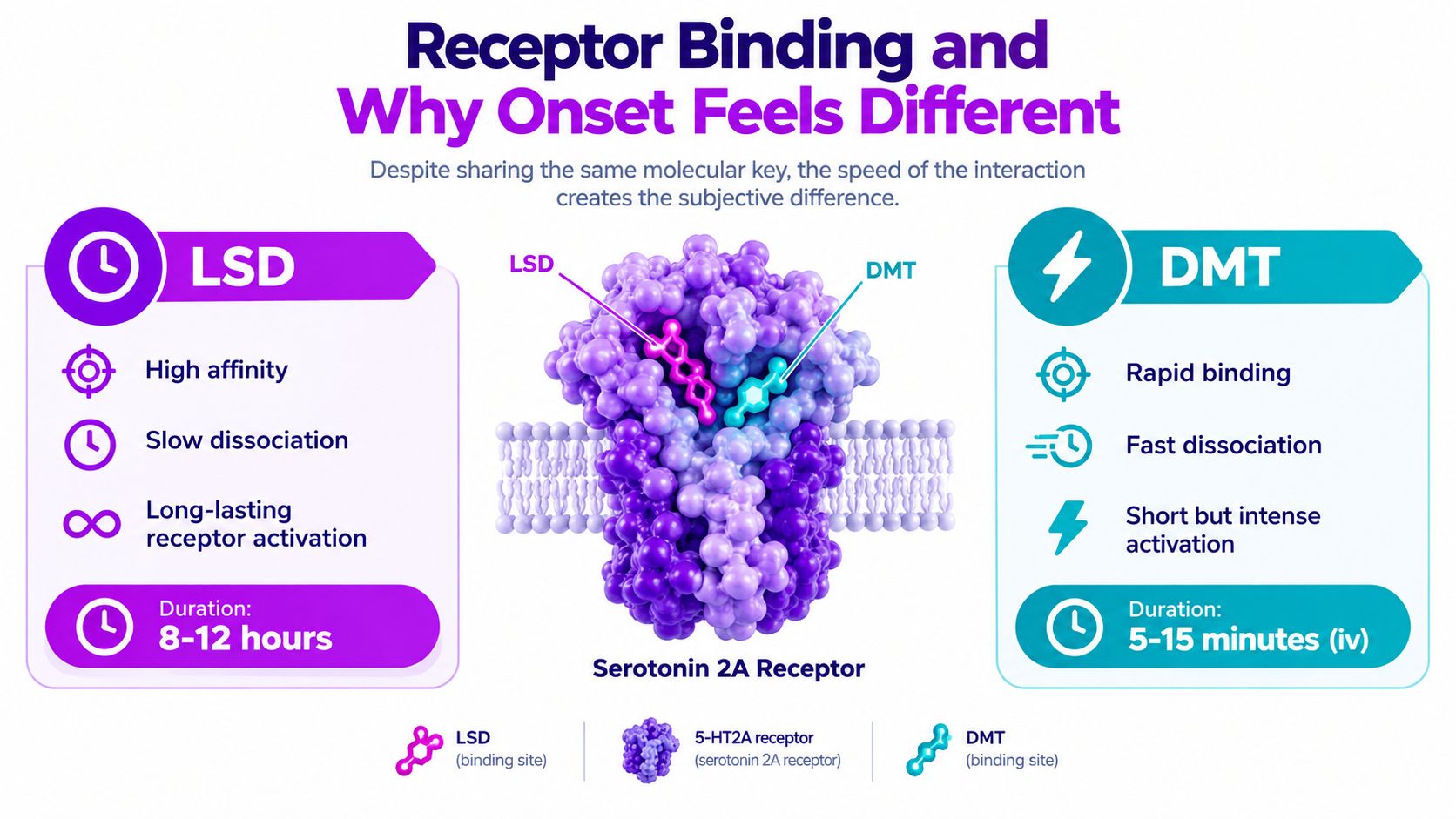
DMT and LSD both act at serotonin 5-HT2A receptors, but their binding profiles aren't interchangeable. A comparative meta-analysis reports DMT's highest affinity at 5-HT1A at about 75 nM, with much lower affinity at 5-HT2C around 420 nM. The same analysis found LSD is significantly less selective than DMT for 5-HT2C relative to 5-HT1A, indicating a meaningful receptor-subtype difference. See the Frontiers in Pharmacology comparative analysis.
Binding is only part of the story
DMT's rapid metabolism by monoamine oxidase helps produce a fast rise and short acute window when smoked. LSD remains active across a much longer practical exposure period, and its receptor kinetics and broader pharmacology contribute to a more extended, stimulating, and cognitively layered experience.
DMT also interacts meaningfully with other targets, including sigma-1 receptors and trace amine-associated receptors. LSD modulates dopamine D1 and D2 receptors in addition to serotonergic targets. These off-target activities may influence autonomic sensations, cognitive stimulation, emotional texture, and the way each substance enters and leaves awareness.
The cleanest conclusion is not that one molecule is deeper by nature. It is that speed of interaction, metabolism, receptor selectivity, and exposure duration combine to produce different handling requirements.
Recent comparative brain-imaging work points toward another useful correction. Reviews suggest that DMT and LSD may converge on some shared brain-activity patterns despite different chemistries, while no consistent non-dose-related subjective differences have been established beyond duration. That makes “which trip is better?” a weaker scientific question than “which route and setting produce an experience I can understand and integrate?” The comparative findings are discussed in this preprint on shared psychedelic brain effects.
Safety, Interactions, and Harm Reduction
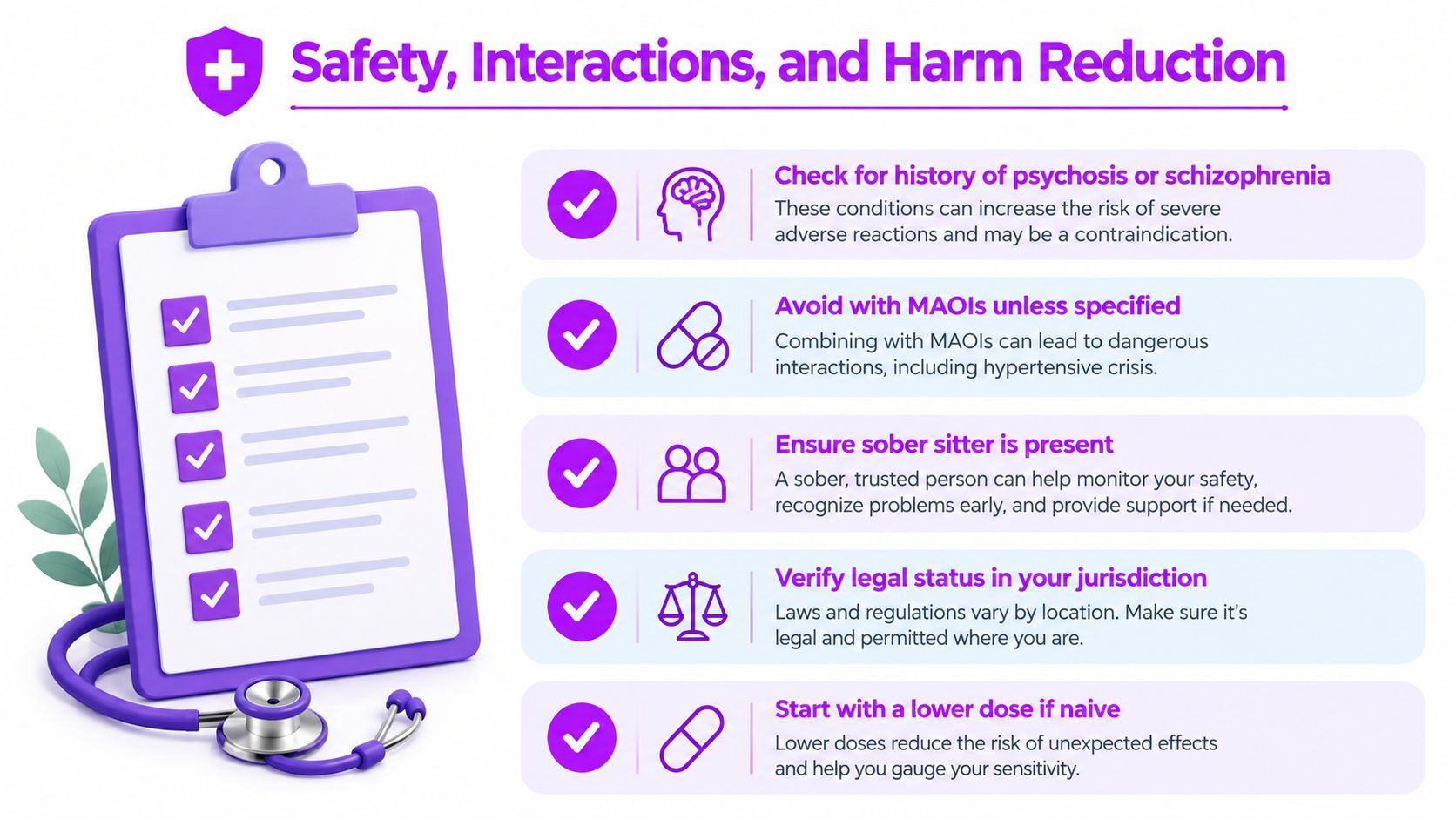
Safety begins before a substance is chosen. If you have a personal or family history of psychosis, schizophrenia-spectrum disorders, bipolar mania, a recent destabilizing psychiatric event, pregnancy, or uncontrolled cardiovascular disease such as arrhythmias or uncontrolled hypertension, the responsible recommendation is not to self-experiment.
Medication review matters even more with an MAOI. Combining MAOIs with SSRIs, SNRIs, tyramine-rich foods, stimulants, tramadol, or certain opioids can create serious interaction risks, including serotonin syndrome. Don't assume that a plant-based preparation is pharmacologically gentle.
Build the setting before the dose
A sober companion should be present for a full-dose session, particularly when the person's reaction, product strength, or route is uncertain. Choose a physically safe place with no driving, swimming, climbing, traffic, or other hazards. Keep a charged phone available for emergencies, but don't use it as entertainment during the experience.
Never combine LSD or DMT with alcohol or other recreational drugs. Polydrug use makes it harder to interpret symptoms and can increase cardiovascular, psychological, or behavioral risk. A sitter should know what was taken, when it was taken, and whom to contact if the person becomes medically distressed.
The MicroTrack harm-reduction guide can complement, but not replace, medical advice and a properly planned setting.
Compare risk honestly
Smoked DMT generally has little association with physical dependence or overdose mortality, but that doesn't make it benign. A rapid, overwhelming state can produce panic, unsafe movement, or psychological distress. LSD adds a longer burden on sleep, mood, posture, and ordinary judgment because the altered period is extended.
Emergency symptoms such as chest pain, severe breathing difficulty, seizure, dangerously high temperature, loss of consciousness, or persistent severe agitation require urgent medical help. Tell responders what was taken. Concealing the substance can delay appropriate care.
Therapeutic Research and Legal Context
The research question is shifting from molecular identity to route, duration, dosing model, and clinical support. LSD has a deeper published clinical footprint and is further along in late-stage development for anxiety. DMT research is younger, with promising earlier-stage signals for depression and anxiety and growing interest in extended-infusion formats rather than only the classic smoked experience. The emerging comparison is summarized in this overview of LSD and DMT research directions.
That difference in maturity should shape how you interpret headlines. A promising signal isn't a personal treatment recommendation, and findings from supervised clinical protocols don't transfer neatly to unsupervised use. Researchers control screening, preparation, dosing, monitoring, and follow-up in ways that private settings usually can't reproduce.
| Dimension | DMT / Ayahuasca | LSD |
|---|---|---|
| Research maturity | Younger evidence base with interest in depression, anxiety, and extended-infusion formats | Deeper clinical trial footprint and later-stage anxiety research |
| Key practical variable | Route strongly changes duration and interaction profile | Long exposure window shapes supervision and integration |
| Clinical design interest | Short or repeat-dosing models may be useful for research | Longer sessions require extended clinical containment |
| Legal position | Controlled in the United States and widely restricted elsewhere, with narrow religious-use exceptions in some settings | Controlled in the United States and widely restricted elsewhere, with narrow research exemptions |
| Personal relevance | Route and MAOI status can alter both duration and risk | Medication, sleep, and time commitments become central |
Legal status is local and consequential
LSD is Schedule I in the United States and controlled in most jurisdictions, with narrow research exemptions. DMT is also Schedule I in the United States and controlled in most countries. Ayahuasca may receive religious-use protection in Brazil and through United States Religious Freedom Restoration Act cases involving União do Vegetal and Santo Daime, but an exception for a specific organization or context isn't a general personal-use exemption.
Detectability also has practical consequences. Urine immunoassays may flag LSD metabolites for roughly 1 to 3 days and DMT metabolites for under 24 hours, while extended panels can shift those windows. These figures come from the plan's legal and research context and shouldn't be treated as a guarantee for any individual test.
Check the law where you live before possessing, transporting, preparing, or consuming either substance. Legal exposure, employment testing, custody issues, and medication access can outweigh any theoretical benefit from experimentation.
Choosing Between DMT and LSD and Tracking the Results
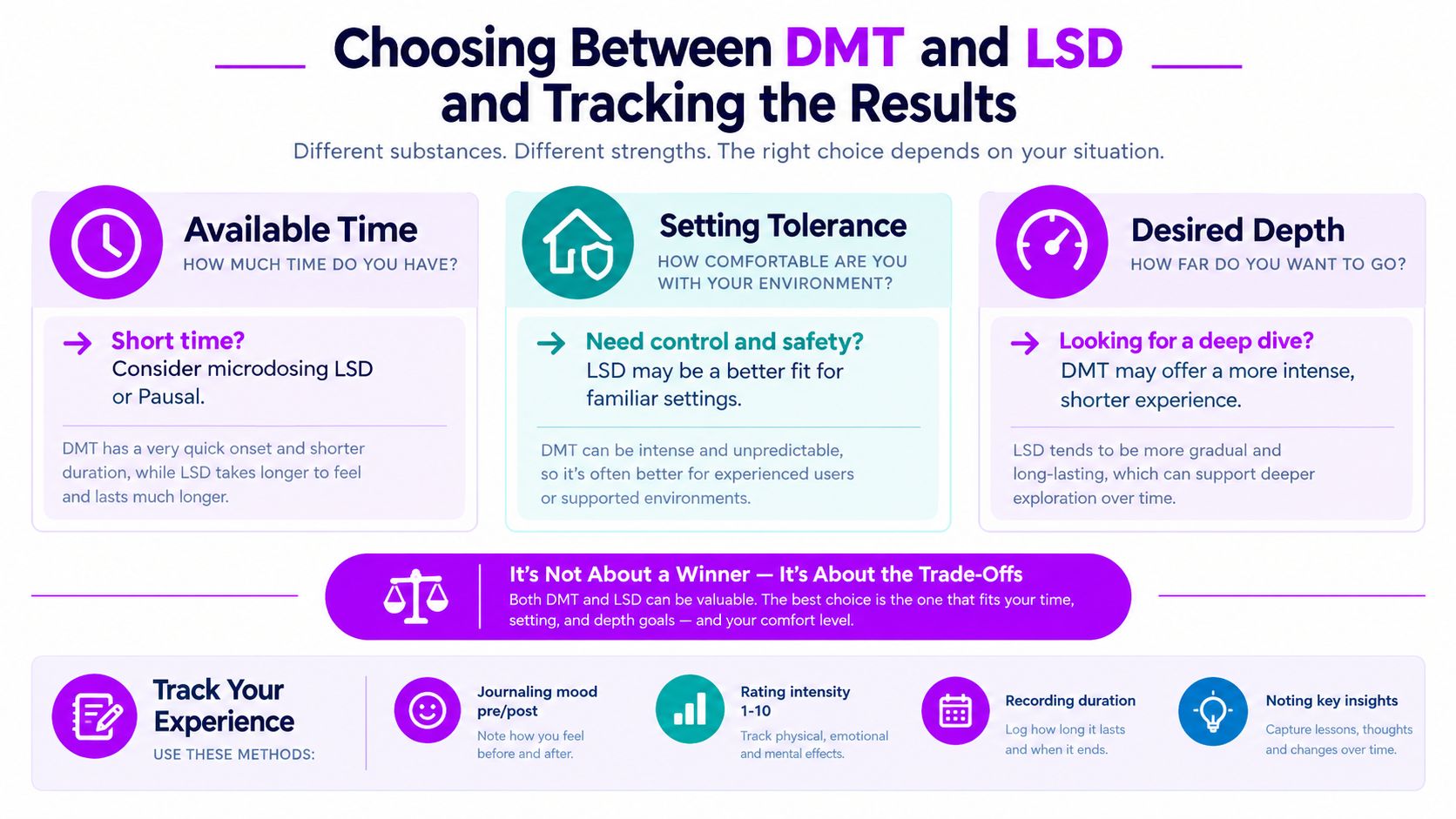
There isn't a universal winner. My recommendation is to choose based on three variables: available time, tolerance for rapid intensity, and purpose.
A person with a full day available, a stable setting, and a desire for a long arc of emotional processing may find 75 to 125 micrograms of LSD more coherent than a compressed DMT experience. That range still carries substantial uncertainty and shouldn't be treated as a safe default. Someone curious about a contained, high-intensity episode may prefer smoked DMT, but only with a sober, prepared companion and a physically secure environment.
A short evening doesn't automatically make oral DMT with an MAOI appropriate. Its 4 to 6 hour duration and interaction surface can be more demanding than expected. If the primary goal is observation rather than a dramatic experience, a low LSD exposure may be easier to track than an abrupt DMT launch, though neither option is risk-free and neither should be selected without considering health, medication, and legality.
Track the whole context
Intensity isn't quality. Record the dose and route, but also note your sleep, baseline mood, intention, location, companion, onset, peak, difficult moments, and next-day state. A single session can be memorable without being representative.
MicroTrack provides a structured journal with a 10-point mood scale, two-phase entries, customizable schedules, protocol options such as Fadiman's 1-on/2-off and the Stamets 4-on/3-off approach, calendar overrides, trend visualizations, searchable history, and CSV export. Its relevance here is practical: a consistent log can help separate route effects, expectation, sleep debt, and dose from the story you tell yourself afterward.
Integrate before deciding again
Write down what changed, what didn't, and what needs follow-up. Protect sleep, avoid making major life decisions during the afterglow, and revisit the notes when your baseline has returned. If difficult emotions persist, discuss them with a qualified mental-health professional who understands psychedelic experiences.
The best answer to DMT vs LSD is usually not a ranking. It is a measured choice followed by honest observation, careful integration, and enough restraint to stop when the data says the practice isn't helping.
MicroTrack gives you a private place to log dose details, mood, timing, reflections, and protocol schedules so you can compare DMT or LSD experiences with more discipline than memory allows. Start building a personal record and visit MicroTrack to see whether structured tracking fits your approach.