Fadiman Protocol: A Practical Guide to Microdosing Safely

The Fadiman protocol is a repeating one-day-on, two-days-off microdosing schedule, typically run for about a month, designed to create comparison data between dose days and off-days rather than to deliver a clinical benefit on its own. In calendar terms, that pattern produces roughly 10 dosing days during a 30-day month, depending on the start date and any skipped entries.
Why do many explanations treat the two off-days as empty space? They're the part of the schedule that makes comparison possible. If you only record how you feel after dosing, you can't easily separate a substance-related change from ordinary variation in sleep, workload, caffeine, expectations, or mood.
The useful way to approach the Fadiman protocol is as a structured self-observation framework. It gives you a repeatable rhythm, but it doesn't prove that the rhythm is biologically optimal, medically effective, or safe for every person. The guide below focuses on how the schedule works, how to log meaningful comparisons, what controlled research does and doesn't show, and when pausing or seeking clinical advice matters.
Table of Contents
- What the Fadiman Protocol Actually Is
- Where the Schedule Came From
- How to Run the First 30 Days
- Fadiman Schedule vs Stamets Stack vs Custom Rhythms
- What the Research Actually Shows
- Building a Log That Actually Compares Days
- Safety, Contraindications, and When to Pause
- Putting It Together Into a One-Month Plan
What the Fadiman Protocol Actually Is
The Fadiman protocol is a one-day-on, two-days-off cycle. You take a sub-perceptual psychedelic dose on day one, take no dose on days two and three, then repeat on day four. The schedule is generally associated with James Fadiman's 2011 book, The Psychedelic Explorer's Guide, which helped turn microdosing from an informal practice into a clearly described routine (academic review of microdosing schedules).
“Sub-perceptual” means the intended amount is below a conventional psychedelic experience. It doesn't mean the effect is guaranteed to be invisible, predictable, or harmless. The term microdose is relative rather than a universally standardized quantity, and potency can vary substantially by substance, preparation, and source. The schedule therefore shouldn't be treated as a dose prescription.
The simplest mental model is a repeating calendar:
- Day 1: Dose and record what happens.
- Day 2: Take no dose and observe.
- Day 3: Take no dose and observe.
- Day 4: Repeat the cycle.
The off-days create a comparison window. They can show whether a perceived change continues beyond the dose day, disappears quickly, or appears just as often during baseline conditions. They also separate experiences and avoid turning every day into an assumed treatment day.
Practical rule: Treat dose days and non-dose days as equally important observations.
This distinction matters because the protocol isn't an established clinical treatment schedule. It hasn't been shown to reliably treat depression, anxiety, PTSD, creativity problems, or productivity concerns. It's better understood as a repeatable self-tracking structure that can help you ask more disciplined questions about your own experience.
The rest of this guide won't tell you that the protocol works for everyone, provide a universal dose, or replace medical care. It will show you how to understand the rhythm, compare it with other commonly discussed schedules, build a useful journal, and interpret personal trends without confusing correlation with proof.
Where the Schedule Came From
Where did the familiar one-day-on, two-days-off rhythm come from? Its roots look less like a clinical protocol approved after dose-finding trials and more like a practical routine that took shape among people already experimenting with very small psychedelic doses, then got codified through James Fadiman's writing and public teaching.

A useful way to understand the history is to separate the schedule from the evidence. The schedule spread because it was simple to remember and easy to repeat. Fadiman's book, The Psychedelic Explorer's Guide, helped give that routine a recognizable shape, and his later public-facing materials kept reinforcing the same cadence as a workable self-observation pattern rather than a medically settled formula (James Fadiman publication record).
That distinction matters. The every-third-day cadence emerged as a practical convention. People could take a dose day, then compare it with two non-dose days before repeating the cycle. That makes the rhythm more like a notebook design than a proven biological optimum. The off-days were useful because they created contrast. Without contrast, any unusually good, bad, productive, distracted, or emotional day can start to look meaningful just because it was noticed.
This is also why the history of the protocol is tied so closely to journaling. Fadiman-associated observational projects asked participants to report their experiences regularly, and that reporting habit became part of the method itself. Once you see the protocol this way, the two off-days stop looking like empty recovery days and start functioning as comparison data. They help a person ask, “Did anything continue, fade, or show up just as often when I took nothing?”
Why the Journal Became Part of the Protocol
The journal was central from the start because repeated entries make the schedule interpretable. A single memorable day proves very little. Several cycles of dose day, off-day, off-day can at least give a more disciplined personal record.
A useful entry might track:
- Whether the day was a dose day or an off-day
- What time the dose was taken
- Mood, energy, focus, sleep, and unwanted effects
- Context such as workload, caffeine, exercise, stress, or medication changes
Controlled research still has to answer questions that self-reports cannot settle on their own. People in observational projects choose whether to participate, choose their substances, and judge their own outcomes. That kind of evidence can suggest patterns worth testing, but it cannot by itself show whether reported changes came from pharmacology, expectation, routine changes, or some mix of those factors.
The historical takeaway is straightforward. The protocol began as an organized framework for repeated self-observation, not as a clinically validated prescription.
How to Run the First 30 Days
Start by treating the calendar as a repeating pattern, not as a promise of improvement. Day one is the dose day, days two and three are observation days, and day four begins the next cycle. The same sequence continues through the month, producing roughly 10 dosing days in a 30-day month, although the exact count depends on when you start and whether you skip or change entries (review of the three-day schedule).
A common implementation recommends taking the dose before 10 a.m.. Keeping the timing consistent can make daytime effects easier to distinguish from sleep-related effects and gives you a more comparable reference point for your entries (discussion of the Fadiman schedule and morning timing).
A calendar example
| Calendar day | Status | What to observe |
|---|---|---|
| Day 1 | Dose day | Record timing, mood, energy, focus, and any noticeable effects |
| Day 2 | Off-day | Check whether changes remain after dosing |
| Day 3 | Off-day | Compare with the previous day and note sleep or delayed effects |
| Day 4 | Dose day | Begin the next cycle and compare with the previous dose day |
| Day 5 | Off-day | Continue the same measures |
| Day 6 | Off-day | Record context and unwanted effects |
| Day 7 | Dose day | Start another cycle |
The two off-days aren't a reason to stop paying attention. They're where you can test whether the pattern has any persistence. For example, if focus appears better on day one but returns to baseline on day two, that's a different observation from a gradual change that remains present on both off-days.
A one-month window is commonly used as a practical observation period. It gives you repeated cycles without requiring you to interpret a single event. If you miss a planned day, don't rewrite the calendar behind the scenes. Mark it as skipped, record why, and continue only when your situation is stable enough to observe clearly.
Illness, travel, major sleep disruption, or a medication change can make an entry difficult to interpret. You can mark the day as an interruption rather than forcing it into the dose or off-day comparison. The protocol's value comes from clean context, not from maintaining an unbroken streak.
The same principle applies at month-end. The calendar doesn't need to restart on a particular date. Review the completed entries, preserve the actual dates, and begin another cycle only if the observations and your safety criteria support continuing.
Use the visual schedule below as a calendar anchor, then rely on your own log for the details that a simple pattern can't capture.
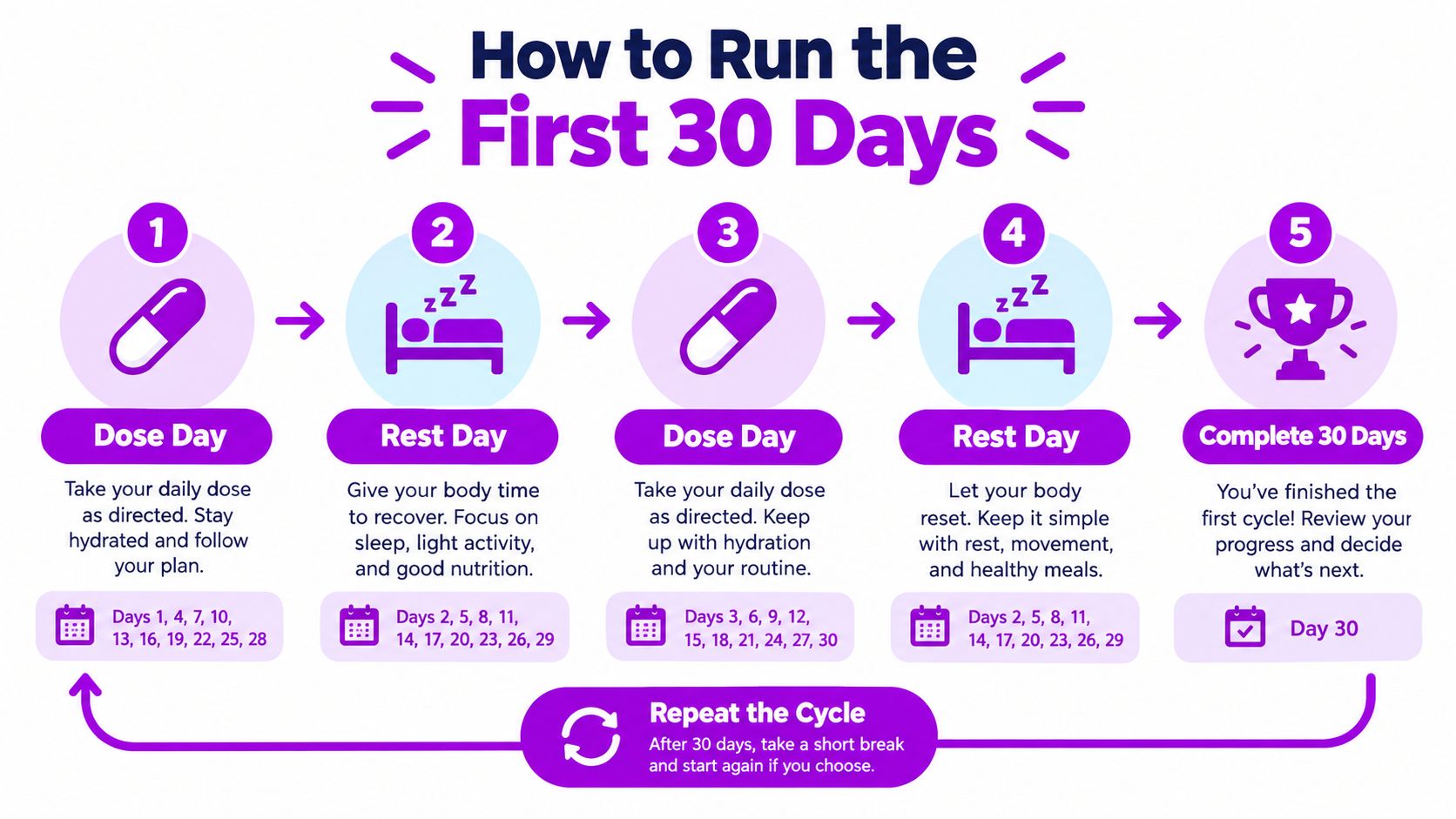
A short visual explanation can also help if you're still confusing the cycle with daily dosing.
Fadiman Schedule vs Stamets Stack vs Custom Rhythms
The Fadiman schedule isn't the only pattern people discuss. The right comparison isn't “Which protocol is proven?” None of these informal rhythms should automatically be treated as a validated clinical treatment. The more useful question is which pattern gives you interpretable observations and fits your circumstances.
| Schedule | Cadence | Cycle length | Best fit |
|---|---|---|---|
| Fadiman protocol | One day on, two days off | Repeating three-day cycle | A structured month of comparing dose days with adjacent off-days |
| Stamets stack | Four days on, three days off | Repeating weekly cycle | People interested in a longer weekly rhythm involving a Lion's Mane and niacin pairing |
| Custom rhythm | Decided around personal needs | Flexible | People whose work calendar, cycle, travel, or treatment plan makes fixed timing impractical |
The Fadiman protocol creates frequent comparison points. It's a reasonable framework for someone who wants a clear distinction between a dose day and two non-dose days, especially during an initial observation period.
The Stamets stack is a different pattern, commonly described around four dosing days followed by three days off, with a Lion's Mane and niacin pairing. The cadence and combination make it a separate approach, not a small variation of Fadiman's schedule. You can read a focused overview of the Paul Stamets stack before deciding whether comparing the two is useful.
Custom schedules can be practical, but flexibility comes with a measurement cost. If you change the cadence whenever you expect a demanding day, you may no longer know whether an outcome relates to the substance, the event, or the expectation. A custom plan works best when you record every override and define why you changed it.
What the Research Actually Shows
The strongest early quantitative evidence related to Fadiman-style microdosing came from observational research. A 2019 PLOS One study analyzed daily reports from 98 participants who microdosed a serotonergic psychedelic (the 2019 PLOS One study). Those participants selected themselves, chose their own substances and schedules, and weren't assigned to a placebo-controlled Fadiman regimen.
That design can capture repeated experiences across dosing and non-dosing days. It can't cleanly determine whether the substance caused reported changes. Participants may differ from non-participants, may choose a schedule that already suits them, and may notice improvement because they expect it.
Why feeling better doesn't settle the question
Expectation is one of the hardest variables to remove from self-tracking. Prospective observational research found that positive expectations before a four-week microdosing period predicted later improvements in well-being, anxiety, and depressive symptoms, despite the absence of a placebo-control group (Scientific Reports research on expectations).
That doesn't mean every perceived benefit is imaginary. It means an improvement can have several plausible explanations, and a personal journal usually can't isolate them by itself. Sleep may improve, routines may become more intentional, or a person may pay closer attention to their mood after beginning the practice.
Controlled research has remained comparatively limited. Recent reviews describe randomized-trial evidence as inconclusive, with minimal consistent improvements in cognition, creativity, sustained mood, anxiety, or depression. Several apparent benefits weren't significantly different from placebo, so the exact one-day-on, two-days-off rhythm hasn't been shown to produce a reliable therapeutic effect (recent systematic review of controlled evidence).
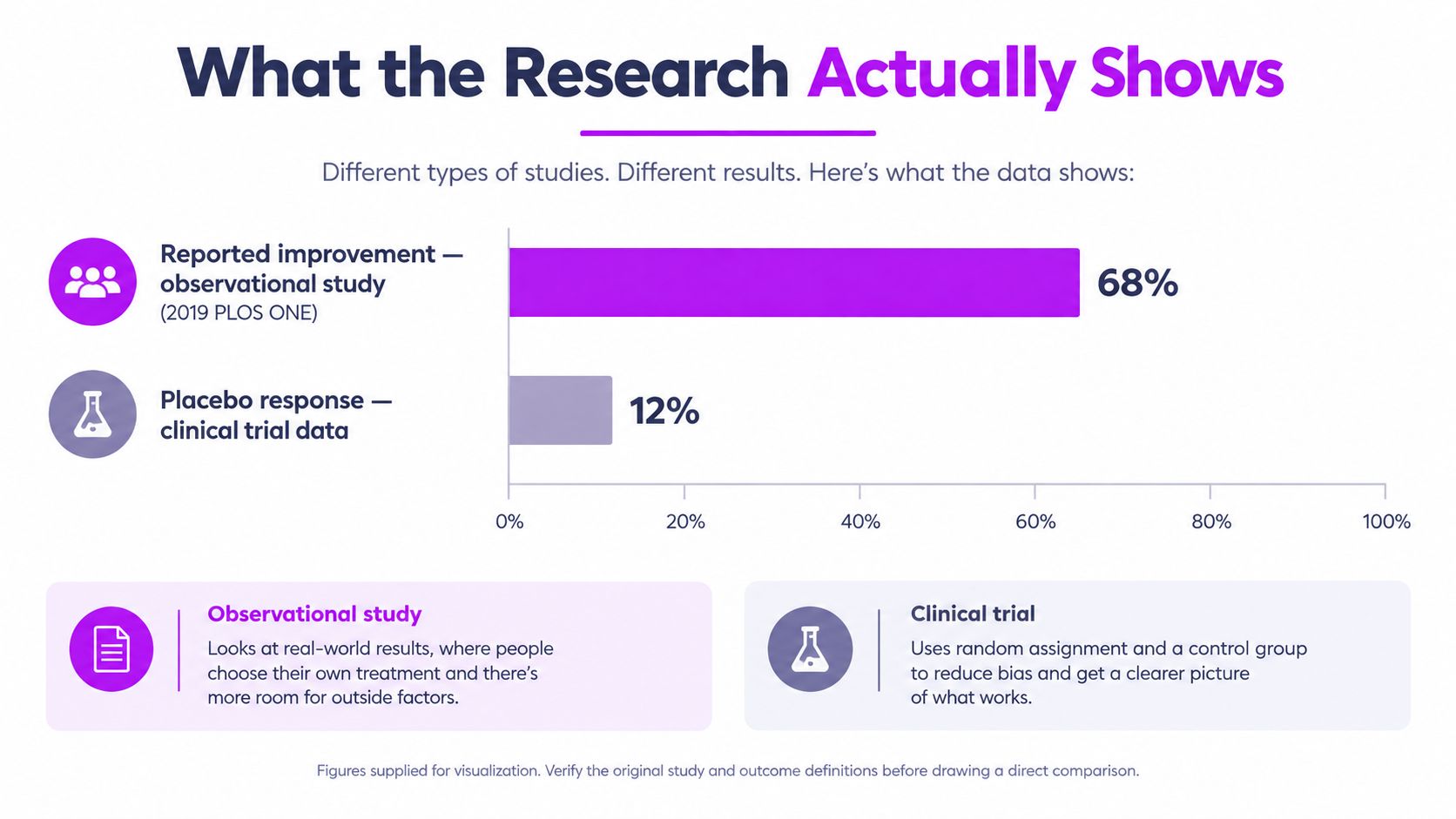
The graphic above shouldn't be used to turn mixed evidence into a precise promise. The broader lesson is that observational findings can look more favorable than controlled comparisons when expectation, selection, and context remain active.
This is why more journaling doesn't automatically create more proof. It creates better personal records, which can improve decision-making, expose adverse effects, and reveal whether changes are consistent. The most defensible interpretation is modest: the off-days may be the protocol's most useful feature because they create comparison data, not because research has established that the exact rhythm is biologically optimal. For a broader discussion of reported outcomes and evidence limits, see the evidence around microdosing benefits.
Building a Log That Actually Compares Days
A useful journal starts before you think you feel anything. Record the date, dose or rest status, approximate time, mood, energy, focus, sleep from the previous night, and unwanted effects. Use the same measures on dose days and off-days, or your comparisons will reflect different questions.
A numerical mood scale can be easier to compare than a free-text entry alone. Add a short note for context, but keep the core rating consistent. “Mood was fine” can mean different things on different days, while a repeated scale gives you a stable reference for reviewing patterns.
The fields that protect interpretation
- Status: Mark dose, off-day, skipped day, illness, travel, or another interruption.
- Timing: Record when the dose was taken, especially if morning timing is part of your routine.
- Outcomes: Track mood, energy, focus, sleep quality, and any specific outcome you defined before starting.
- Confounders: Note caffeine, alcohol, exercise, workload, stress, menstrual-cycle context, and medication changes.
- Adverse effects: Log anxiety, insomnia, headache, gastrointestinal discomfort, impaired focus, blood-pressure concerns, or mood worsening rather than recording only positive experiences.
Sleep and caffeine deserve special attention because they can change how a day feels without any connection to dosing. A demanding deadline can make focus look worse, while an unusually restful night can make mood look better. Recording those factors doesn't eliminate bias, but it makes a later review more honest.
Two moments are better than one
Use a two-phase entry. At the dose moment, record the planned status, timing, baseline mood, expectation, and immediate context. At the close of the day, add what occurred, including unwanted effects and any event that may have shaped the result.
This approach fits the daily-reporting tradition associated with Fadiman, where repeated entries help identify patterns instead of relying on a single memorable day (discussion of Fadiman's daily reporting approach). It also separates expectation from hindsight. If you write the end-of-day story only after deciding whether the day felt successful, your memory may favor details that support that conclusion.

A journal such as MicroTrack's progress documentation approach can organize dose status, timing, mood, sleep, and later reflections in one place. The tool matters less than the discipline: record off-days, preserve missing entries, and review trends across complete cycles rather than selecting the most encouraging notes.
Safety, Contraindications, and When to Pause
The evidence doesn't currently establish reliable therapeutic benefits or long-term safety for the Fadiman schedule. A 2024 rapid review found that LSD and psilocybin microdosing can produce changes in neurobiology, physiology, subjective experience, affect, and cognition relative to placebo, but the available evidence can't determine how much is pharmacological versus placebo-driven. The review also identified a lack of long-term safety data and raised questions about chronic low-dose exposure to 5-HT2B agonists and possible cardiac effects (2024 rapid review).
That uncertainty makes adverse-event tracking as important as mood tracking. Potential problems discussed in the evidence and clinical guidance include:
- Sleep disruption: Insomnia can undermine mood and concentration even if the dose day feels productive.
- Anxiety or agitation: Increased anxiety is a reason to stop interpreting the practice as helpful.
- Headache or gastrointestinal symptoms: Physical discomfort belongs in the same record as subjective benefits.
- Raised blood pressure: New or concerning cardiovascular symptoms warrant medical attention.
- Impaired focus: A day that feels stimulating may still reduce the ability to complete careful work.
- Mood worsening: Persistent sadness, irritability, panic, paranoia, or detachment shouldn't be normalized as part of adjustment.
NCCIH cautions that microdosing may cause insomnia, increased anxiety or depression, poor focus, and physical discomfort. Psilocybin is considered unsafe for people with psychotic conditions or severe bipolar disorder, so anyone with that history shouldn't self-administer without appropriate clinical guidance.
Medication interactions and psychiatric history also require a clinician's input. Online schedules can't assess your prescriptions, cardiovascular status, diagnosis, or personal risk. If symptoms worsen, new physical effects appear, or you're using microdosing to manage depression, anxiety, or PTSD, personal tracking shouldn't replace professional assessment.
Set stop criteria before starting. Pause if mood worsens, sleep disruption persists, anxiety escalates, physical symptoms appear, or the practice starts interfering with ordinary functioning. A predefined rule is more reliable than deciding in the middle of a difficult day that you should continue for one more cycle.
Putting It Together Into a One-Month Plan
Begin with a baseline period before the first dose. Record mood, sleep, energy, focus, caffeine, workload, and relevant symptoms without trying to change everything at once. The purpose is to learn your ordinary variation before comparing it with dose days.
Then use the one-day-on, two-days-off rhythm across roughly a month. Keep the calendar honest, log both dose and off-days, record expectations before the day unfolds, and mark interruptions such as illness or travel. Don't change several variables together if you want the review to remain interpretable.
At the end, compare dose days with the two adjacent off-days and with your baseline. Ask:
- Did any change exceed your usual variation?
- Did it persist on off-days?
- Did expectation predict the outcome?
- Were benefits accompanied by sleep, anxiety, focus, or physical problems?
- Did the pattern remain acceptable without worsening daily functioning?
A favorable trend isn't proof of treatment effect, and an unfavorable trend isn't a personal failure. If you experience sustained mood worsening, significant anxiety, new physical symptoms, impaired functioning, or concerns related to psychiatric medication or diagnosis, seek medical input instead of starting another cycle.
MicroTrack provides a structured journal for recording Fadiman-style dose and off-days, two-phase reflections, mood, sleep, energy, timing, and unwanted effects while preserving skipped entries and personal schedule changes. Visit MicroTrack to create a clearer first-month record and review your observations without relying on memory alone.