How Long Does 2CB Last: A Clear Guide to Duration
Oral 2C-B typically produces felt effects for about 4 to 6 hours, with onset around 20 to 75 minutes, a peak around 1.5 to 2.5 hours, and detectable presence in oral fluid up to 16 to 24 hours after dosing. The experience can end in an evening, while the compound's measurable biological trail may continue into the next day.
That difference explains why “how long does 2CB last” has two answers. One answer describes what you notice, including the rise, peak, and comedown. The other describes how long the substance may remain detectable, which isn't the same as feeling intoxicated.
The figures below apply to oral 2C-B and should be treated as ranges, not guarantees. Dose, route, food, metabolism, and the actual contents of an unverified product can all change the timeline.
Table of Contents
- What You Can Expect From 2CB Timing Overall
- Onset, Peak, and Offset in Plain Language
- How Dose Level Shapes the Duration Window
- Why Route of Administration Changes Everything
- After-Effects Versus Analytical Detection
- Why 2CB Is Shorter Than Many Other Psychedelics
- Planning a Safer Experience Around the Timeline
What You Can Expect From 2CB Timing Overall
4 to 6 hours is the usual felt window for oral 2C-B, but that figure describes the experience, not the substance's full biological timeline. Noticeable onset commonly begins after 20 to 75 minutes, with the strongest effects around 1.5 to 2.5 hours, according to a clinical review of 2C-B timing. These are planning ranges, not a fixed schedule.
A controlled human study reported an average self-reported effect duration of 4.9 hours after a 30 mg dose, with individual observations ranging from 1.2 to 8.0 hours. The same study found a plasma elimination half-life of about 1.3 hours (controlled human study of 2C-B pharmacokinetics). Half-life describes how quickly the measured amount declines. It does not mark the moment when subjective effects stop.
The measurable window can extend well beyond the evening experience. In an oral-fluid study, 2C-B remained detectable for up to 16 to 24 hours after dosing (human oral-fluid study). Detection does not mean a person is still feeling intoxicated. It means testing may identify residual substance or metabolites after the main effects have faded.
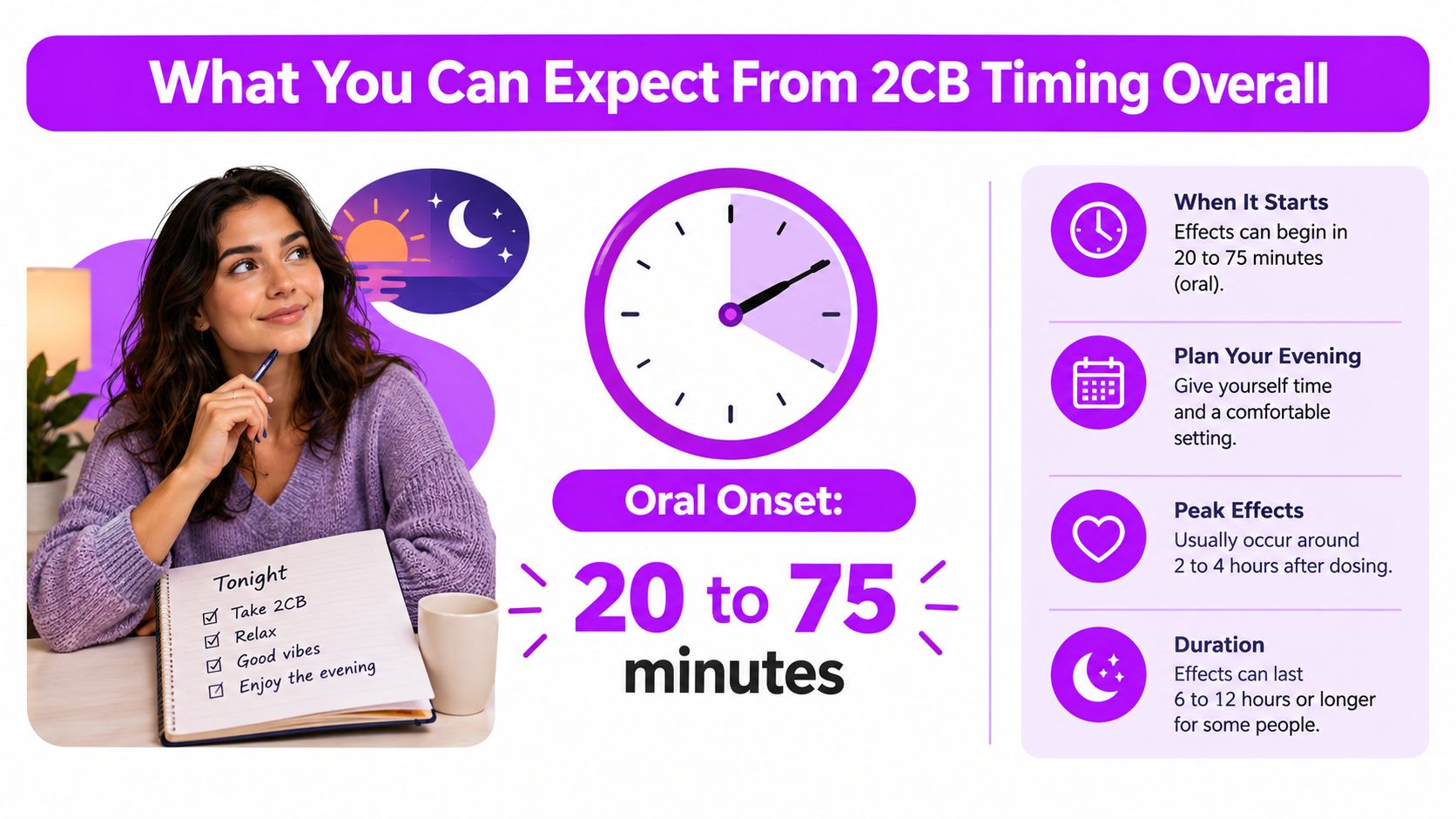
A range is not a promise
Food can delay or alter oral absorption, while individual metabolism can shift the rise and offset. Dose also matters, and a different route can change both absorption and intensity. An unverified product may contain a different substance or strength than expected, adding another source of uncertainty.
Practical rule: A slow onset does not prove that the dose has failed. Taking more before the first amount has fully appeared can produce a later, stronger peak that is harder to manage.
For background on what 2C-B is and how it affects people, remember the practical distinction: plan around the 4 to 6 hour felt window, while allowing for a biological detection window that may continue into the following day.
Onset, Peak, and Offset in Plain Language
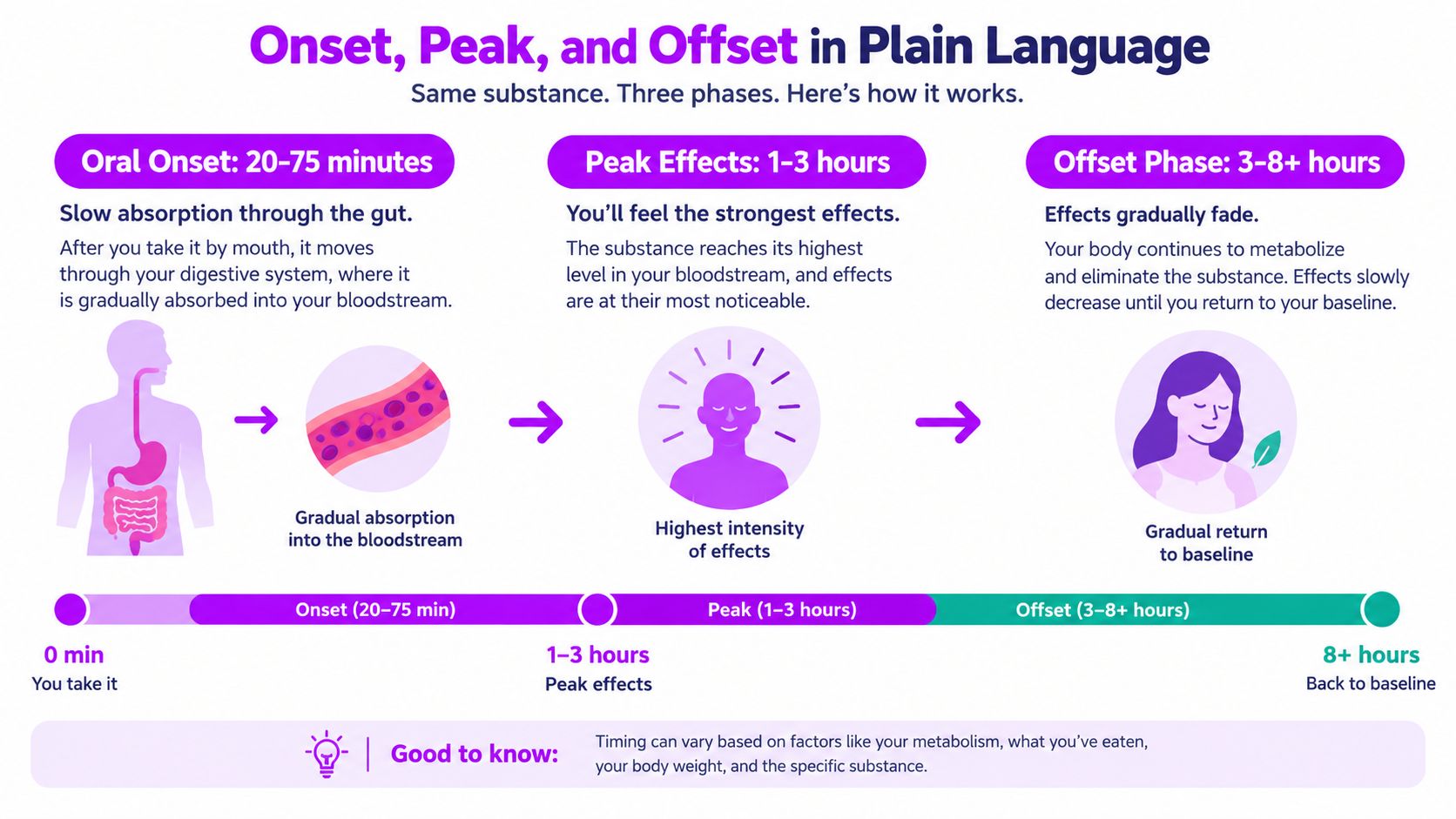
The oral timeline usually unfolds in stages rather than switching on at once. If someone takes a dose at 8:00 p.m., the first effects might appear between 8:20 and 9:15 p.m., with the strongest period often arriving around 9:30 to 10:30 p.m. (clinical review of onset and peak timing).
The rise
Oral 2C-B must pass through the digestive system before it reaches the bloodstream. Absorption through the gut, first-pass metabolism, and the contents of the stomach can all stretch or compress the 20 to 75 minute onset range. A person who feels little during the first part of that window may still be approaching the main effects.
During the rise, sensory changes may become more noticeable gradually. Colors, textures, music, touch, and emotional responses can feel intensified, while physical sensations such as nausea, tension, or stimulation may appear before the perceptual effects reach their strongest point.
The peak
The commonly reported peak falls around 1.5 to 2.5 hours after oral dosing. In the example above, that places the most intense period between approximately 9:30 and 10:30 p.m. The peak may include stronger visual changes, heightened tactile sensations, altered time perception, emotional intensity, and difficulty judging how much longer the experience will last.
The peak isn't necessarily a single sharp moment. Some people experience a broad high-intensity period, while others notice a clearer crest followed by a plateau. Your surroundings can affect how manageable this phase feels, even though they don't change the chemical timeline in a predictable way.
The offset
After the peak, effects generally ease rather than disappear instantly. A person who dosed at 8:00 p.m. may still notice meaningful effects later in the evening, followed by a softer tail as stimulation and perceptual changes recede.
Insufflated administration can shorten the rise dramatically and produce a faster, harder peak. The exact timing varies by route and preparation, but the key concern is practical: a rapid onset leaves less time to judge the first dose before intensity increases.
The timeline below illustrates the phases visually.
How Dose Level Shapes the Duration Window
Dose changes more than intensity. A larger oral amount can shift the peak later, extend the offset, and lengthen residual stimulation or fatigue. The available clinical data do not provide a reliable dose-by-dose timetable for everyone, so these categories describe patterns rather than fixed milligram thresholds.
2C-B oral dose vs. timing profile
| Dose Range (oral) | Onset | Peak | Total Felt Duration | Next-Day Impact |
|---|---|---|---|---|
| Lower amount | Usually within the oral onset range of 20 to 90 minutes | Peak typically arrives within the standard 1.5 to 2.5 hour window, with a shorter and less intense crest | May resolve toward the shorter end of commonly reported oral ranges | Some people may notice fatigue or lingering stimulation |
| Common amount | Often within the same oral onset range | Visual, emotional, and tactile effects become more pronounced | Commonly about 4 to 6 hours | Sleep and mood may still feel unsettled |
| Strong amount | Onset remains variable, and delayed effects can encourage premature redosing | The crest may be substantially more intense and harder to handle | May extend toward or beyond the broader 4 to 8 hour range | The comedown and recovery may feel heavier or last longer |
The 4 to 8 hour oral range is reported by drug-information sources. Clinical observations place the average for a 30 mg dose at 4.9 hours, with a broad observed range, according to Australian Alcohol and Drug Foundation duration information and controlled clinical data. These figures describe observed timing, not a dosing calculator.
Dose and duration are linked, but the relationship is not a precise formula. A stronger amount can keep effects active after the most enjoyable phase has passed, while increasing anxiety, confusion, physical stimulation, or difficulty sleeping. Individual metabolism also matters, so two people taking similar amounts may not follow the same schedule.
Redosing adds another layer of uncertainty. If the first dose is still rising, taking more can stack the timelines and produce a later, longer, or more intense experience than expected.
Dose changes the risk profile, not just the number of hours. A longer experience can mean more time handling intense effects, not simply more time feeling pleasant.
Why Route of Administration Changes Everything
Route affects how quickly 2C-B enters circulation, how sharply effects rise, and how much time someone has to respond to early warning signs. Oral use usually builds more gradually, while insufflation compresses the timeline and can make the peak feel more abrupt.
| Route | Onset | Peak | Total Duration | Notes |
|---|---|---|---|---|
| Oral | About 20 to 75 minutes in clinical summaries | Roughly 1.5 to 2.5 hours | Commonly about 4 to 8 hours | Slower rise and a more gradual offset |
| Insufflated | Faster than oral administration | Earlier and more abrupt | About 2 to 4 hours | More intense onset, with nasal discomfort and greater difficulty adjusting during the session |
| Rectal | Shorter onset than oral use | Earlier than the oral pattern | About 3 to 5 hours | Duration falls between some reported oral and insufflated ranges |
These ranges come from harm-reduction and drug-information summaries. A separate clinical source places oral onset between 20 and 90 minutes and reports peak plasma concentration at about one hour after self-administration (CAHMA's safer-use information). The figures describe broad patterns rather than a personal timetable.
Why faster isn't easier
With oral use, the delayed rise can make a dose seem weak at first. Insufflation can produce the opposite timing problem, with effects becoming intense before the person has time to reassess how much was taken. A faster route leaves less room to respond calmly to anxiety, physical discomfort, or other warning signs.
Rectal administration is sometimes described as smoother than insufflation, yet absorption still varies and the amount of active material may be uncertain. Accurate measurement before administration matters because adjusting after a rapid onset is difficult.
Route also changes the practical schedule. A shorter subjective window can still leave residual effects after the main peak, and it does not remove the risks linked to unknown strength, combinations, or cardiovascular strain. The felt timeline is only one part of the picture. Absorption speed, dose, and individual metabolism together determine how quickly effects appear and how long recovery may take.
After-Effects Versus Analytical Detection
“Still in my system” can describe two timelines. The subjective window covers effects a person notices, such as lingering stimulation, fatigue, anxiety, or a changed mood. The analytical window covers the period when a laboratory method may still identify 2C-B or related material.
A human pharmacokinetic study measured an oral-fluid elimination half-life of 2.48 ± 3.20 hours and reported detectable concentrations up to 16 to 24 hours after self-administration (oral-fluid pharmacokinetic study). The result provides a useful scale for the gap between the experience and biological detection, while dose, metabolism, sampling method, and test sensitivity can shift the timeline.
What the half-life does and doesn't tell you
A plasma or oral-fluid half-life describes how a measured concentration declines. It does not identify the point when effects stop, nor can it predict a workplace, clinical, or forensic result by itself. The main psychoactive phase may fade while smaller amounts remain measurable.
That gap matters in practical situations. Someone can feel sober while oral fluid still contains detectable material. Another person may feel tired or anxious because of poor sleep, stress, or the after-effects of the experience rather than ongoing psychedelic activity.
A normal-feeling morning and a negative test result are two separate milestones. Test type, sampling method, dose, metabolism, and laboratory sensitivity all influence detection.
Subjective sobriety cannot establish that no drug remains. Severe confusion, extreme agitation, chest pain, overheating, seizures, or difficulty waking require emergency help immediately, rather than an estimate of the remaining duration.
Why 2CB Is Shorter Than Many Other Psychedelics
2C-B is often compared with MDMA because both may involve stimulation, emotional intensity, and heightened touch. The timing differs, however. Oral 2C-B is usually a short-to-moderate evening experience, while MDMA and LSD tend to occupy different time windows.
| Substance | Typical Total Duration | Approx. Plasma Half-Life | Notes |
|---|---|---|---|
| 2C-B | About 4 to 6 hours commonly reported | Around 1.3 hours in one controlled study | Earlier peak and shorter subjective window |
| MDMA | Commonly reported at 4 to 6 hours of primary effects, followed by a longer tail | Varies by person and dose | Its stimulation and after-effects can extend beyond the main experience |
| LSD | Typically 8 to 12 hours | Varies by person and dose | See this guide to how long an acid trip lasts |
A controlled study observed a 2C-B plasma half-life of about 1.3 hours, which helps explain why the strongest subjective effects may resolve within an evening. Half-life describes the decline of a measured concentration, not the exact moment effects end or all traces disappear. Oral-fluid findings discussed earlier show that biological detection can continue after the felt experience has faded.
The practical distinction is between the subjective window and the biological window. Dose, route, metabolism, and test sensitivity can shift both, although they do not shift them in the same way. A person may feel sober while residual material remains detectable.
2C-B can overlap with MDMA or LSD in certain effects, but its onset, peak, offset, and detection profile should be assessed independently. A shorter experience does not make it automatically safer, particularly when the product's identity or strength is uncertain.
Planning a Safer Experience Around the Timeline
Duration information works best as a planning boundary, not a recipe. If someone is considering taking 2C-B, they should avoid building plans around the earliest possible end of the range, because the actual offset can be later and sleep may be difficult even after the strongest effects have passed.
Before dosing
Build a generous buffer between dosing and sleep, ideally 8 to 10 hours, and don't schedule driving, work, childcare, or other responsibilities afterward. A sober, trusted person can provide practical support during the peak, especially if the setting is unfamiliar or the material hasn't been verified.
Check the environment before anything is taken. A calm room, comfortable temperature, easy access to water, and a way to reduce noise or social pressure can make the experience easier to manage. Food and hydration should be approached sensibly, without forcing large amounts during nausea or drinking excessive water.
During the rise and peak
Use the clock to interpret what is happening. A person may still be rising during the early part of the session, while the 1.5 to 2.5 hour period can bring the strongest changes. If effects are increasing, adding more or mixing substances can create a much more intense and unpredictable experience.
Keep physical exertion and heat under control. Take breaks from dancing or crowded spaces, cool down gradually, and pay attention to symptoms such as chest pain, severe confusion, rigid muscles, or dangerous overheating. Those signs need urgent medical attention.
The following harm-reduction practices can help people organize information about timing, surroundings, and after-effects without treating a tracker as a safety guarantee.
Combinations and the following day
Alcohol and serotonergic substances can distort the felt timeline and raise health risks. Combining drugs also makes it harder to identify which substance is causing a symptom, particularly when a product sold as 2C-B may contain something else.
Don't drive or make high-stakes decisions just because the peak has ended. Rest, eat when comfortable, and reassess how you feel the next day. If symptoms remain severe, worsen, or include chest pain, overheating, seizures, or unresponsiveness, contact emergency services and explain what was taken as accurately as possible.
MicroTrack gives you a private way to log dose timing, mood, and later reflections in a structured journal, which can help you identify patterns without relying on memory alone. Visit MicroTrack to explore its encrypted entries, flexible schedules, trend views, and exportable history.