Microdosing Mushrooms Benefits Risks and Safe Practice

You've read the threads, bookmarked the schedules, and you're still staring at a calendar wondering if a tiny amount could help you feel steadier, or if you'd just be noticing what's already there. That uncertainty is exactly where careful learning matters. Microdosing mushrooms isn't a promise you can test in one good afternoon. It's a practice that asks for patience, comparison, and honest notes.
Table of Contents
- Introduction to Microdosing Mushrooms
- What Microdosing Mushrooms Means
- Potential Benefits and Evidence Limits
- How to Choose a Microdosing Schedule
- Risks, Interactions, and When to Stop
- Examples of Microdose Journaling
- A Practical Decision Framework
- Final Guidance for Mindful Practice
Introduction to Microdosing Mushrooms
You're at your desk before your first meeting, coffee cooling beside an open notebook. You've written down why you're curious. Maybe it's focus on scattered days, mood during a heavy month, creativity for a stalled project, or quieter personal reflection. The plan on your screen looks tidy. Real life isn't.
That's the first thing to understand. A schedule can look precise while the material itself is variable, your sleep shifts, and your workday changes. One bright morning proves very little. One flat morning proves very little either.

Why Observation Comes Before Conclusions
Think of microdosing mushrooms less like flipping a switch and more like keeping a weather log for your own house. You note the conditions, not just the temperature. Did you sleep well? Was it a deadline day? Did anxiety show up, or a headache? Without that context, you'll credit or blame the dose for almost anything.
This isn't a niche curiosity, either. A nationally representative U.S. survey of 4,263 adults found that 12.1% had used psilocybin at least once, and among past-year users, 46.9% said their latest use was a microdose. That tells you the behavior is measurable, not that it's proven to work.
A useful mindset: You're not hunting for a dramatic result. You're learning whether any change is repeatable, worthwhile, and safe enough to keep observing.
What follows pairs evidence-based caution with structured self-reflection. You'll get plain definitions, what controlled research can and can't say, how schedules differ, what risks deserve a pause, and how to compare dosing and non-dosing days. Tracking both perceived benefits and unwanted effects matters more than chasing a single standout day, because a pattern you can trust takes time to appear, if it appears at all.
What Microdosing Mushrooms Means
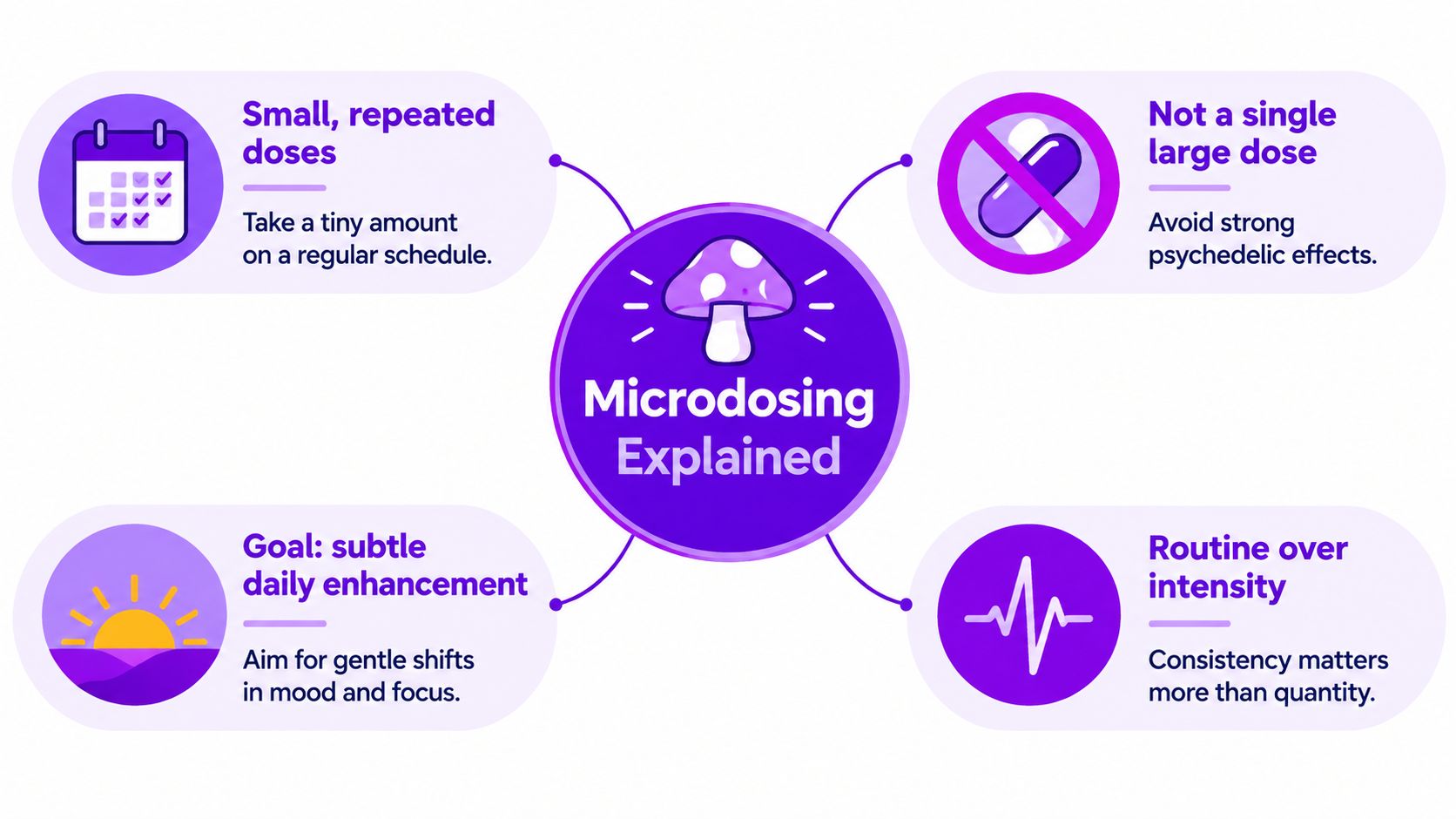
Start with what it isn't. Microdosing mushrooms isn't a single large dose taken for an intense psychedelic experience. It's closer to a small, repeated course spread across days or weeks, where the stated aim is to stay functional and notice subtle shifts in routine. People usually describe the goal as avoiding obvious alteration, not seeking it.
That mental model helps. A large dose is one event. A microdosing routine is a rhythm, with on days, off days, and breaks built in. The routine itself, including rest, reflection, and regular check-ins, is part of what you're experiencing.
The Moving Parts Behind a Simple Word
The National Institute on Drug Abuse describes microdosing as regularly taking a very small amount, commonly about 5–10% of a typical recreational dose, with the intention of avoiding noticeable hallucinations. That definition covers intention and rough size. It doesn't give you a standardized product.
Here's where readers often get confused. Psilocybin content isn't standardized in naturally occurring mushrooms or truffles. Species, batch, storage, and preparation can all shift potency, so dried weight alone can't reliably predict a compound dose. Two equal weights can represent different exposures, and comparing your gram amount to someone else's online post can mislead you.
Schedules add another layer. You'll see patterns described like this:
- One day on, two days off: A spaced rhythm with built-in reflection days between doses.
- Four days on, three days off: A denser weekly block followed by a longer pause.
- Custom patterns: Flexible calendars shaped around work, rest, or personal observation goals.
These are community conventions, not a single established standard. None of them turns an unstandardized material into a predictable treatment.
So hold the definition loosely but precisely. Microdosing means low-dose repetition with variability built in, usually aimed at subtle, functional changes rather than hallucinations. That variability is the reason dose notes, timing, sleep, and off-day comparisons matter so much. If you can't describe what varied, you can't interpret what changed.
Potential Benefits and Evidence Limits
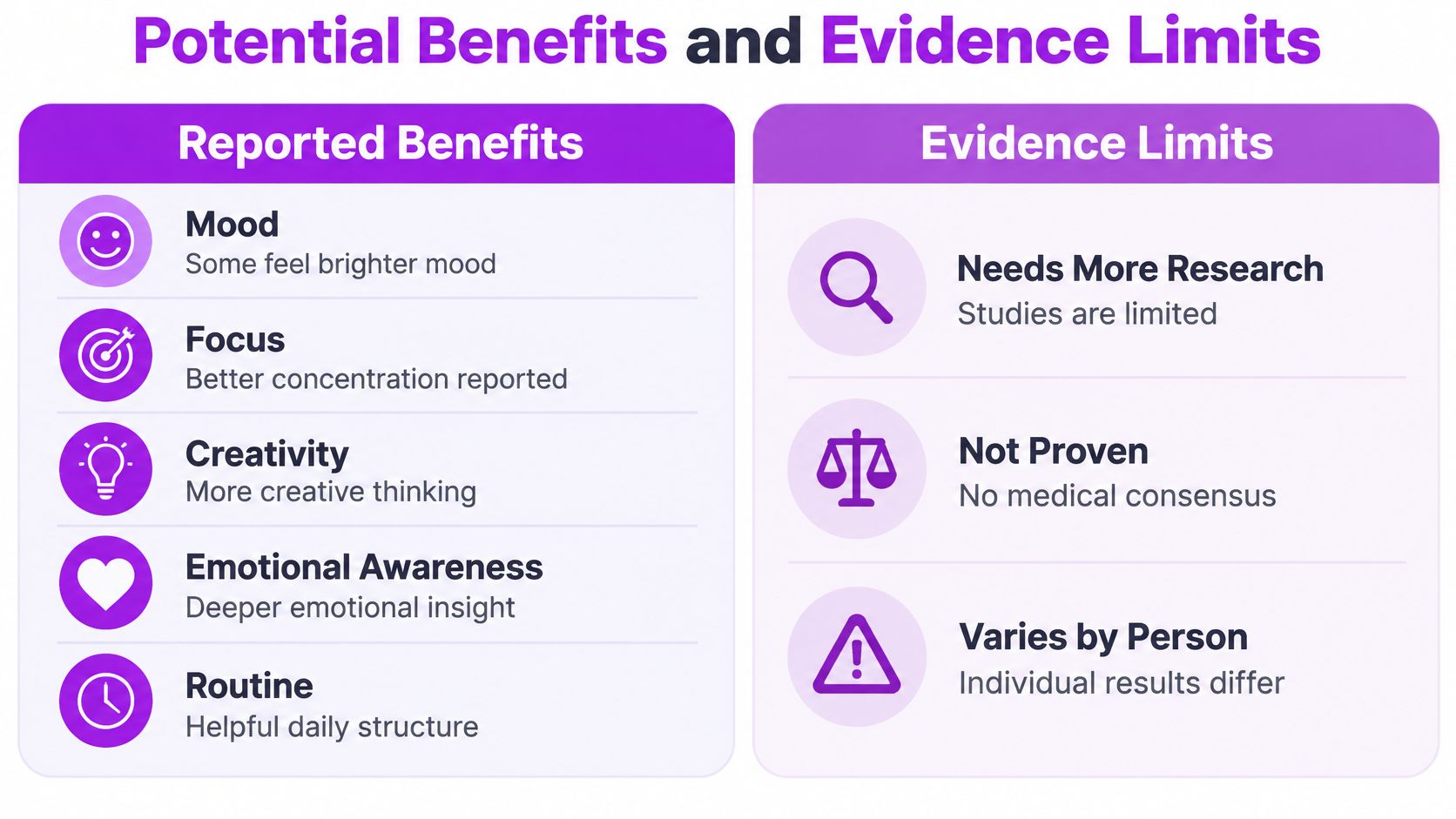
People commonly say they're looking for a brighter mood, easier task starting, steadier focus, more flexible creative thinking, or greater emotional awareness. Some describe a helpful daily structure, where the routine prompts walks, planning, or reflection. Those reports are real as personal observations. They aren't the same as established effects.
Use a simple analogy. A weather report describes patterns across a region using shared instruments. A personal journal describes what the day felt like in your kitchen. Both can be useful, but only one is built to support general claims. Your journal can guide your next decision. It can't prove the practice works for people in general.
What Can Shape How a Day Feels
Expectancy sits at the center of this problem. If you expect a dose day to feel clearer, you may notice every clear moment and discount the foggy ones. Sleep, stress, caffeine, cannabis, a difficult conversation, and ordinary mood variation can all produce the same effect. That's why learning about correlation versus causation in personal tracking helps before you draw conclusions from a handful of entries.
Controlled research gives you a reason for that caution. A review synthesizing 57 human studies found reported benefits alongside anxiety, physical discomfort, and cognitive disruption, while noting that observational studies tend to report more positive outcomes than controlled experiments. In double-blind, placebo-controlled work described in the verified research summary, psilocybin microdosing hasn't reliably improved mood, creativity, cognition, or emotion processing beyond expectancy effects. In some comparisons, both active and placebo groups improved from baseline.
Feeling better after starting a routine is information. It isn't, by itself, evidence that the substance caused the improvement.
That distinction changes how you track. You collect ratings on dosing and non-dosing days, you choose outcomes in advance, and you allow enough time for ordinary ups and downs to show themselves. You're separating signal from expectation as accurately as a personal log allows.
For a visual walkthrough of how benefit claims are commonly discussed, watch the video below with those limits in mind.
Treat reported benefits as hypotheses about your own days, not conclusions. A good journal tests them gently, repeatedly, and against your non-dosing baseline.
How to Choose a Microdosing Schedule
Two calendars can produce the same number of doses and very different evidence. One person doses every third day and writes a short rating each evening. Another follows a dense four-day block, changes two supplements midweek, then tries to remember later whether Thursday felt clearer than Monday. The first person has a comparison. The second has a story.
A schedule is a measurement frame. Like choosing which days you weigh yourself, the value comes from spacing observations so ordinary noise stays visible. Three dials matter: how often a dose happens, how often you pause to compare days, and when a longer break forces reconsideration.
| Common rhythm | Typical pattern | Tracking question it raises |
|---|---|---|
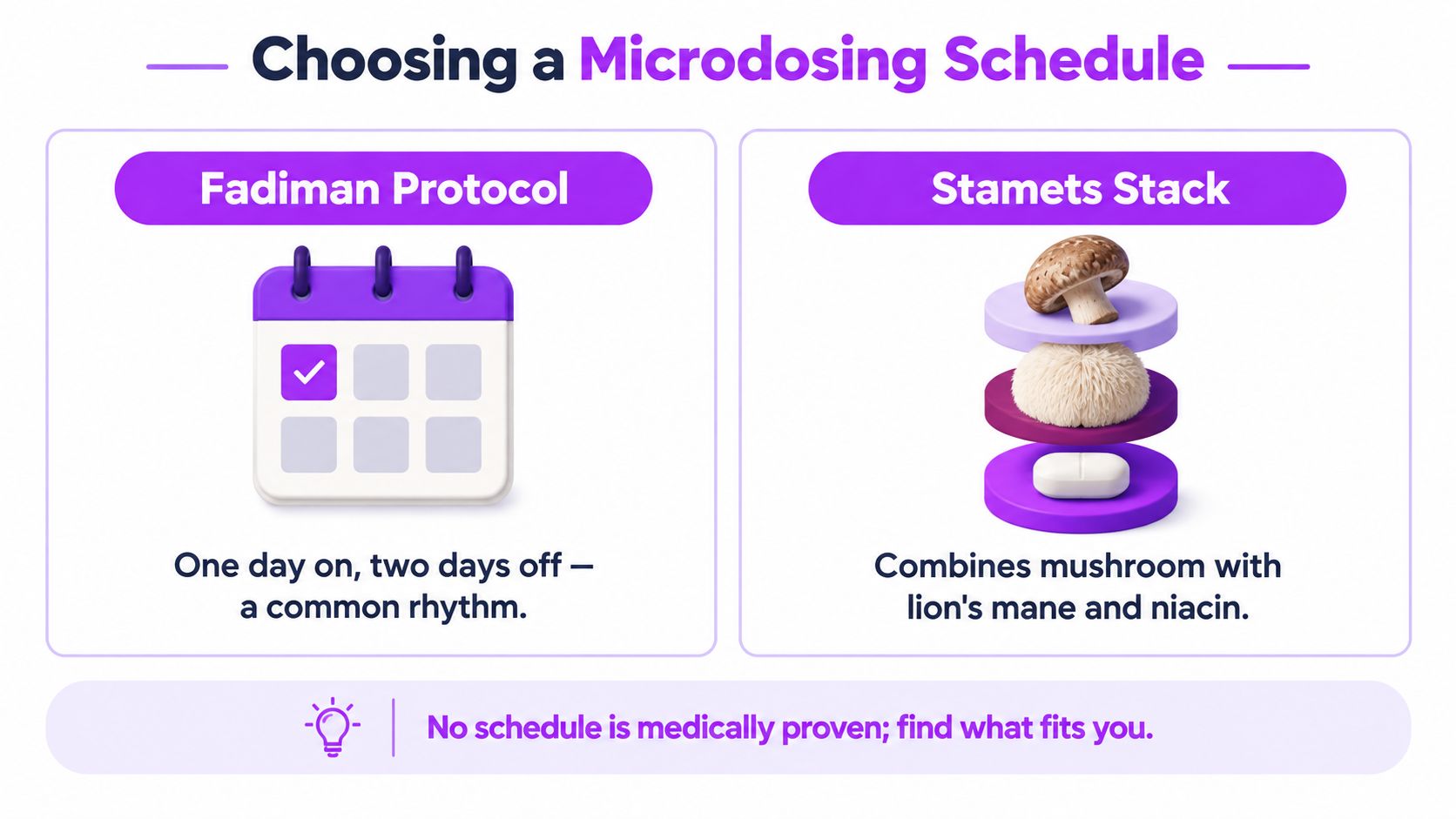
| Fadiman-style spacing | One dosing day followed by two lower-use days | Can today be compared with the next two days before memory blurs them? |
| Stamets-style block | Several consecutive dosing days, then days off | Can day one be separated from day four, and added lion's mane or niacin from the mushroom? |
| Custom spacing | Doses placed around work, sleep, or stress | Do the extra variables still leave clean non-dosing days? |
Research has not crowned a winner. A systematic review found different dose ranges and schedules across low-dose psilocybin work and no peer-reviewed clinical studies testing regular chronic low-dose practices in naturalistic settings. Controlled work also tends to use defined preparations, timing rules, and washout periods, so a result tied to one capsule or truffle does not transfer cleanly to a different product at home.
Set the observation frame before day one. Name one outcome narrow enough to rate, such as afternoon focus or evening irritability. Log several ordinary days first, including sleep, caffeine, alcohol, cannabis, and medication changes. Decide in advance who you would contact and which activities you would stop if agitation, anxiety, or impaired functioning appeared. Pick a review date and a pause point while motivation is calm.
Then judge each calendar by one standard: does it make dosing days and non-dosing days easy to compare? If the answer is muddy, simplify the rhythm before chasing a more famous name. Expectation can fill gaps quickly, so the better schedule is the one that leaves fewer gaps for expectation to fill.
Risks, Interactions, and When to Stop
A low dose is still a dose, and repeating small amounts does not make the cumulative exposure risk-free. Short studies generally describe effects that are mild and transient, yet long-term safety for repeated real-world use remains under-characterized. The evidence supports a middle reading: documented harms exist, while their frequency and severity at microdose levels stay poorly mapped.
Reported short-lived effects include anxiety, headache, sleep disturbance, increased blood pressure, sensory changes, gastrointestinal discomfort, impaired focus, and unusual agitation. The National Center for Complementary and Integrative Health lists insomnia, increased anxiety or depression, poor mood, low energy, gastrointestinal symptoms, headache, disrupted sensory experiences, impaired focus, reduced cognitive functioning, and impaired social skills as possible microdosing-related problems. A symptom that reads as minor on a list can still matter once it touches driving, work, caregiving, or several nights of sleep.
Your comparison habit proves useful here. One edgy evening could trace to the dose, the espresso, or a hard week. The same restlessness logged across three dose days and absent on non-dosing days is a pattern worth acting on. Symptom entries turn into safety data when you compare like with like.
Situations That Need a Clinician, Not a Schedule
Medication and health questions call for direct professional input. Research summaries flag possible concerns with serotonergic medicines and stimulants, while noting that clinical significance remains incompletely validated. If you are weighing questions like those covered in this guide to mushrooms and antidepressants, use it to prepare sharper questions for a qualified clinician.
The same caution applies to bipolar-spectrum conditions, psychotic disorders, cardiovascular concerns, and pregnancy. Do not start, stop, or adjust prescription medication based on a microdosing plan. That decision belongs with the professional who knows your history.
Stop-rule principle: Write your exit criteria on an ordinary day and treat them as instructions to your future self. Escalating symptoms are harder to judge from the inside.
Use a written checklist and stop to seek appropriate help if you notice any of these:
- Escalating anxiety or agitation: Distress is intensifying, repeating, or hard to settle.
- Impaired functioning: You can't work, think clearly, socialize, or complete ordinary responsibilities.
- Concerning physical symptoms: Cardiovascular symptoms, severe headache, or bodily sensations that feel unsafe.
- Worsening mental health: Mood, sleep, or stability is moving in the wrong direction across entries.
- Any reaction that feels unsafe: Your logged pattern and your own judgment both say pause.
Repeated low-dose use calls for repeated risk assessment. A quiet first week says little about month three, so keep comparing dose days with clean days for as long as the practice continues.
Examples of Microdose Journaling
Consider a fictional beginner, Maya, who wants to know whether dose days feel different for afternoon focus. She doesn't begin by chasing a verdict. She logs ordinary days first, rating mood, sleep quality, anxiety, headache, and social functioning. That baseline becomes the plain background against which later entries can be read.
On a dosing day, her first entry is brief and factual. She records the time, source material and estimated amount as she understands it, breakfast, caffeine, work demands, and how she felt before anything could plausibly be noticed. Later, she adds concurrent substances, bodily sensations, and whether she finished the task she'd chosen in advance.
The Second Entry Is Where Learning Happens
That evening, Maya adds a delayed reflection instead of rewriting the morning note. Maybe she writes that focus felt easier, but she'd also slept well and had no meetings. Maybe she felt edgy after extra coffee. Tools such as MicroTrack support this two-phase habit with a 10-point mood scale, flexible entries you can complete later, calendar schedules, and searchable history, while a paper notebook can do the same job if you use it consistently. Browsing journal prompt examples for structured reflection can help you keep prompts specific instead of writing only general impressions.
| Observation point | Examples | Purpose |
|---|---|---|
| Dosing day, in the moment | Time, material, estimated amount, baseline mood, food, caffeine | Preserves facts before interpretation takes over |
| Dosing day, later | Focus, anxiety, headache, social ease, sleep that night | Captures delayed effects and costs |
| Non-dosing day | Same mood, sleep, work, and symptom ratings | Provides a fair comparison day |
| Weekly review | Repeat patterns, exceptions, other explanations, null results | Separates repeatable change from isolated impressions |
After four weeks, Maya doesn't ask which single day felt best. She asks whether any change repeated on comparable days. If nothing stands out, that's valid data, not failure. It may mean the practice, schedule, or goal doesn't help her in an observable way.
Potency uncertainty is another reason for restraint. A 2024 rapid review identified two placebo-controlled experiments using truffle exposures equivalent to approximately 0.8 mg and 1.5 mg of synthetic psilocybin, and concluded that long-term safety was not established. Your journal can organize observations for discussion. It can't replace controlled evidence, chemical testing, or medical advice.
A Practical Decision Framework
Maya finishes her fourth week with a stack of entries and a familiar pull toward a verdict: a few bright days, several flat ones, one rough afternoon. Before she rates anything, the framework asks three questions, in order, answered from the page rather than from memory. Memory keeps the vivid Tuesday. The page keeps the ordinary ones.
- Does the change repeat on comparable days? A productive Tuesday after deep sleep says little if every well-rested Tuesday looks that way. She pairs each dosing day with off days sharing similar sleep, workload, and caffeine, then checks whether the pattern survives the pairing.
- Is it large enough to matter? A half-point mood shift can be real and still leave her work, patience, and evenings unchanged. Effects she can point to in her life carry more weight than effects visible only in the log.
- Could something else explain it? She began during a rough stretch, and rough stretches often drift back toward average on their own. Statisticians call that regression to the mean. Expectation works like background hum: a deadline ending, better sleep, or hoping the practice helps can all sit underneath a good week.
The answers usually sort the reading on their own. A possible signal repeats, matters outside the log, and still shows against matched off days; continuing observation for a set window teaches more than swapping variables midstream. A null result, nothing repeating or nothing worth caring about, makes pausing a fair reading of her data. An adverse pattern, anxiety or headaches or fractured sleep clustering on dosing days, points toward stopping and, where relevant, speaking with a qualified clinician.
Trial design explains why the comparisons are built this way. A randomized, double-blind, placebo-controlled study ran seven doses of psilocybin or placebo across three weeks, then inserted a two-week break before an alternate three-week condition. The pause created contrast, and contrast made the comparison readable. Her version is simpler, but the logic holds: spacing and honest off days turn a journal from a collection of impressions into evidence about her own response, which is still different from proof that the practice works for anyone else.
Final Guidance for Mindful Practice
Keep the big picture plain. Microdosing isn't synonymous with all mushroom use, benefits remain uncertain, and neither product strength nor schedules are standardized. Personal tracking can clarify your own patterns, but it cannot establish medical efficacy or turn an impression into a treatment claim.
That may sound deflating if you arrived hoping for certainty. It can also be freeing. You don't have to perform optimism for your journal, defend a protocol, or treat a quiet result as a personal failure. A null result tells you something useful about fit, timing, expectations, or the limits of the practice for your stated goal.
A Short Checklist to Keep Beside Your Journal
- Make an informed decision: Know the legal constraints where you live and don't treat educational material as legal advice.
- Seek qualified medical input when relevant: Especially with prescription medicines, cardiovascular concerns, pregnancy, bipolar-spectrum conditions, or psychotic disorders.
- Predefine your outcomes: Choose a small set of mood, sleep, focus, and symptom measures before you begin observing.
- Log baseline and comparison days: Rate non-dosing days with the same care as dosing days.
- Reflect twice: Record facts in the moment, then add delayed reflection after sleep and hindsight.
- Write stop rules down: Escalating distress, impaired functioning, or any unsafe reaction overrides the calendar.
- Review on a schedule: Look for repeatable, meaningful patterns, and name alternative explanations out loud in your notes.
The purpose of a structured routine is clarity and self-knowledge, not performance pressure.
Observe carefully, change one variable at a time, and let disappointing entries count as information. If a pattern doesn't hold up against your own comparison days, believing your notes is the mindful outcome. That's not giving up on learning. That is learning.
If you're comparing dosing and non-dosing days, MicroTrack gives you a calm place to log dose details in the moment, add reflections later, follow a chosen schedule, and view mood and timing trends across weeks. Visit MicroTrack to start a private, structured journal that helps you separate repeatable patterns from expectation, without streaks or performance pressure.