Microdosing Protocol Guide and Comparison

Most microdosing advice starts with the wrong question: Which schedule is the perfect protocol? The more useful question is whether your chosen schedule can help you distinguish a genuine, repeatable signal from expectation, ordinary mood variation, poor sleep, stress, caffeine, workload, or selective memory.
The best-known modern approach is the Fadiman protocol, one sub-perceptual dose followed by two days without dosing. James Fadiman popularized it in The Psychedelic Explorer's Guide, published in 2011, and described a repeating three-day cycle that can be observed for approximately one month, or about 10 cycles. That history matters, but popularity doesn't make the schedule clinically validated. A protocol is most useful when it creates consistent comparison points, protects non-dose days, and gives you enough structured information to decide whether continuing makes sense.
This guide treats a microdosing protocol as a bias-control framework, not a prescription. Laws differ by jurisdiction, and psychedelic substances can carry psychological and physical risks. If you're considering use where lawful, discuss your health history and medications with a qualified clinician.
Table of Contents
- Rethinking the Microdosing Protocol
- Comparing Popular Scheduling Frameworks
- Implementing Your First Observation Cycle
- Navigating Safety and Contraindications
- Tracking Outcomes and Filtering Bias
- Adapting Schedules to Real Life
- Evaluating Long Term Efficacy
Rethinking the Microdosing Protocol
Online guides often present Fadiman-style and Stamets-style routines as if they were established treatments. They aren't. Fadiman's schedule is a convention built largely from correspondence and self-reports, not a controlled trial comparing it with other schedules. Reports associated with the approach drew on more than 1,000 people across dozens of countries, but self-reports can't separate pharmacological effects from expectation, lifestyle changes, or selective reporting. The protocol overview from iMicrodosing describes the schedule and its observational origins.
That distinction changes how I'd advise a first-time participant to think. The calendar isn't evidence that a substance works. It's a way to place dose days beside non-dose days, preserve dates and context, and notice whether a pattern survives ordinary life.
Practical rule: A favorable day is an observation, not a conclusion.
The strongest foundational controlled evidence comes from Szigeti and colleagues' 2021 self-blinding citizen-science study of LSD microdosing. Of 1,630 people who signed up, 240 began the study and 191 completed the four-week protocol. Psychological outcomes improved during the study period, but the placebo group improved as well, and the active microdosing group didn't differ statistically from the placebo group. The published study doesn't prove that every reported effect is imaginary. It shows that expectation and participation can explain a substantial share of perceived benefit under that protocol.
A review of 14 controlled studies found that repeated low-dose LSD didn't reliably change mood or cognition. Perceptible effects generally appeared at 10–20 micrograms, rather than at 5 micrograms, which also challenges the assumption that “sub-perceptual” has a universal meaning. A review of controlled evidence00015-6/fulltext) also highlights the role of expectations, setting, baseline state, and measurement method.
The calendar is a measurement design
A useful protocol should answer practical questions:
- Did dose days differ from non-dose days after accounting for sleep?
- Did the effect appear before you expected it, or only after reflection?
- Did anxiety, sleep disruption, or cognitive interference rise alongside perceived benefits?
- Did the pattern persist across changing workloads and ordinary stress?
The schedule helps create the comparison. The journal creates the evidence. Neither one establishes causality on its own.
Approach the experiment with a predefined observation window, a small set of outcomes, and clear stop rules. Avoid changing the substance, preparation, timing, supplements, caffeine intake, and workload all at once. If everything changes together, your trend line may look precise while telling you very little.
Comparing Popular Scheduling Frameworks
Popular schedules differ mainly in cadence, not in clinical status. The Fadiman protocol repeats one dose day followed by two non-dose days. An every-other-day pattern places a non-dose day between each dose day. A continuous micro schedule reduces or removes regular comparison days, which may feel simpler but makes it harder to compare ordinary functioning with exposure-free periods.
The research literature shows substantial variation in preparations, amounts, and frequency. Examples include approximately 0.1–0.2 grams of dried mushroom on days 1, 4, and 7, 0.7 grams of dried truffles taken 5–7 times over three weeks with at least one day between doses, and 0.1–0.3 grams of dried mushroom under schedules ranging from weekly dosing to six days per week. A systematic review of microdosing research found major heterogeneity and no established long-term safety profile. These examples should be treated as descriptions of research and community variation, not dosing instructions.
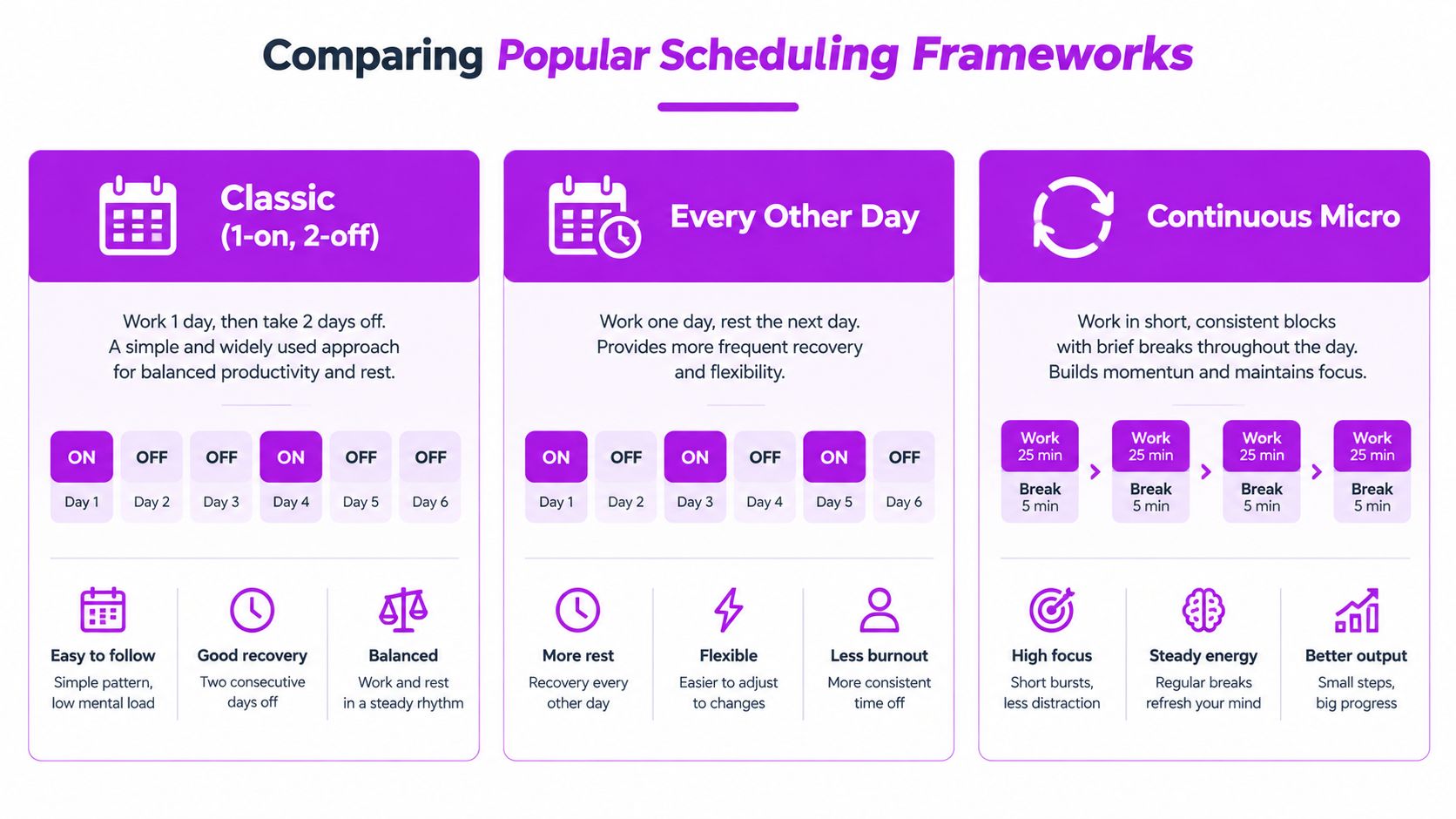
| Protocol Name | Cadence | Best For |
|---|---|---|
| Classic, Fadiman-style | One dose day, followed by two non-dose days | People who want clear comparison days and a memorable repeating rhythm |
| Every Other Day | Dose day alternating with a non-dose day | People who want more frequent observations while retaining regular controls |
| Continuous Micro | Repeated dosing with fewer planned comparison days | People testing a flexible routine, although interpretation becomes more difficult |
The classic schedule has a major practical advantage: it creates a clean rhythm that separates exposure from ordinary days. Its trade-off is that a person may feel the schedule is too sparse for a routine requiring frequent feedback. The every-other-day pattern offers more dose observations, but it can make expectation stronger because the next dose is always close. Continuous dosing may fit a demanding calendar, yet it weakens the comparison structure and can make tolerance, sleep changes, or gradual anxiety harder to interpret.
Community discussions also include the Paul Stamets stack, often described as a multi-day-on, multi-day-off approach involving additional ingredients. The concept remains lightly studied as a combined practice, so adding several variables makes self-experimentation harder, not more rigorous. If mood or focus changes, you won't know which component, expectation, routine shift, or ordinary life event contributed.
The controlled literature illustrates why popular schedules shouldn't be treated as interchangeable evidence. One LSD trial protocol specifies 10 micrograms every third day for six weeks, with 14 administration opportunities, while a planned psilocybin depression trial specifies 2 milligrams once weekly for four weeks, followed by another four weeks of weekly dosing. Those are research designs, not proof that either community schedule is superior. The LSD trial protocol and psilocybin trial protocol show that controlled investigators define formulation, timing, comparison periods, and outcomes precisely.
For practical self-observation, choose the least disruptive framework that gives you meaningful non-dose comparisons. Don't choose a schedule because its label sounds more advanced.
Implementing Your First Observation Cycle
A first cycle should be deliberately boring. The aim isn't to create an impressive experience. It's to reduce noise so you can tell whether the routine affects the outcomes you care about.
Start with a baseline
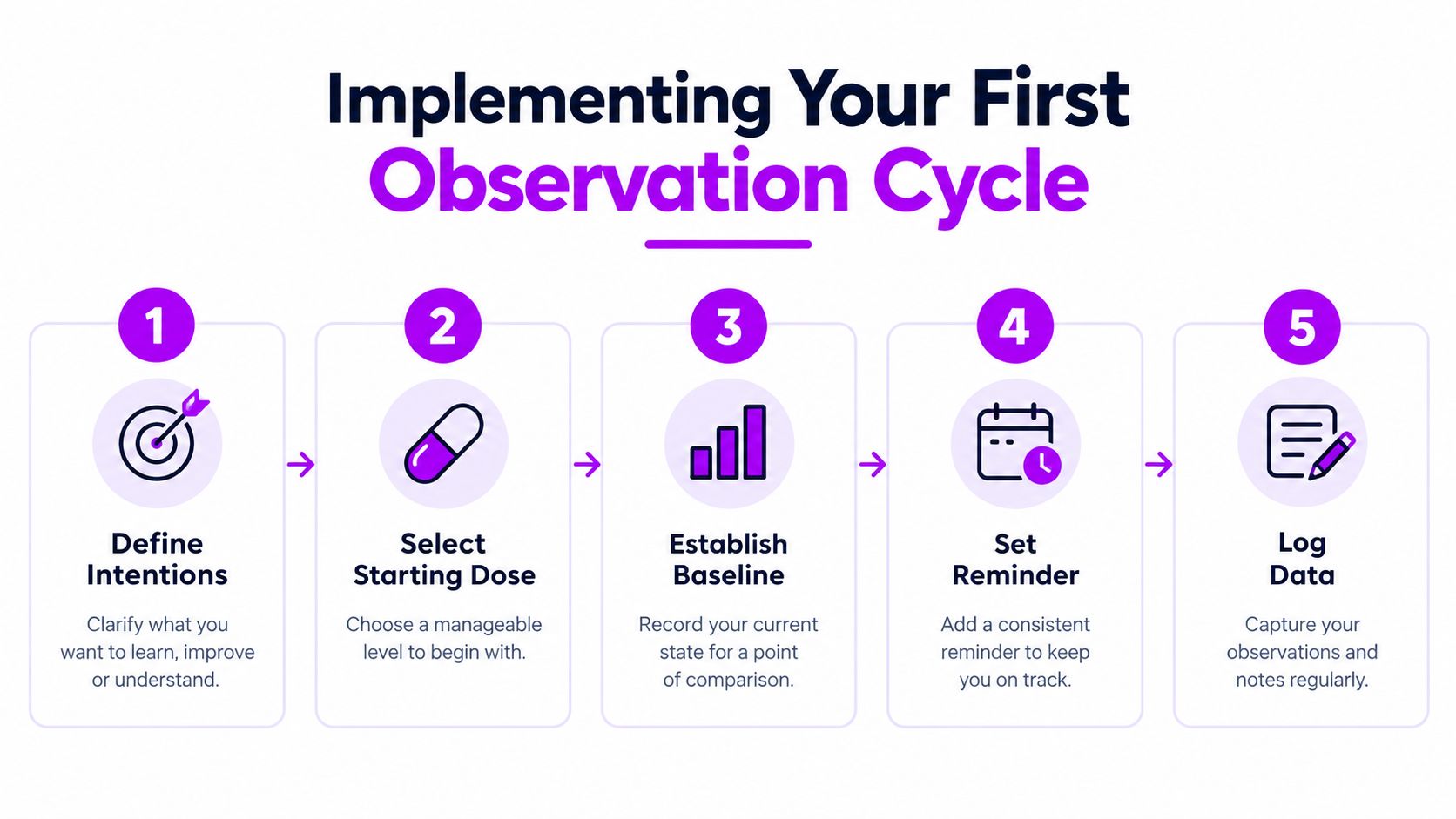
Before changing anything, record how you normally function. Use the same short measures each day, such as mood, focus, sleep quality, anxiety, energy, and a specific task relevant to your goal. A baseline measurement guide can help you define what “normal” means before the protocol influences your expectations.
Keep the baseline simple enough to complete consistently. If your goal is focus, choose one repeatable work measure. If your goal is mood, use the same rating scale and record the major context around it. Don't add a long questionnaire that you'll abandon after a few entries.
Define the experiment before the first dose
Write down what you expect to change and what would count as failure. Include outcomes you hope to improve and outcomes you need to protect, such as sleep, calmness, appetite, or cognitive clarity. Record the substance and preparation, the mass or estimated active dose, the time, and the interval since any prior dose.
A conservative starting point should be selected with attention to potency, formulation, local law, health history, and professional advice. I wouldn't treat a gram amount copied from a general guide as transferable between species, batches, or preparations. If a dose produces obvious perceptual or cognitive effects, don't drive, operate machinery, or treat the experience as successfully “micro.”
Reduce variables around the dose
Choose a predictable period rather than a day with travel, illness, an important presentation, or unusual sleep loss. Keep caffeine, exercise, work intensity, and bedtime as stable as reasonably possible. The point isn't to control your life perfectly. It's to record enough context that a difficult day doesn't become false evidence for or against the protocol.
Use a reminder for the entry rather than relying on memory. Log the dose details close to the event, then add a later reflection after you've completed meaningful work or reached the end of the day. Separating immediate recording from delayed interpretation reduces the temptation to rewrite the day around a hoped-for result.
Navigating Safety and Contraindications
“Usually mild” is not the same as safe for every person or safe over an unlimited period. A 2025 systematic review of LSD and psilocybin microdosing studies found that adverse effects were generally mild and short-lived, but included increased blood pressure, anxiety, and cognitive impairment. The same evidence base is dominated by short trials, so it doesn't establish long-term cardiac or psychiatric safety. The systematic review indexed by PubMed supports caution rather than reassurance.
A sub-perceptual label also doesn't guarantee an identical response. Controlled studies have reported detectable subjective effects at 10–20 micrograms of LSD, while short studies commonly describe transient anxiety, headache, increased blood pressure, sleep disturbance, or cognitive interference. If you notice impairment, the label on the schedule doesn't override what your body is telling you.
Screen before you track
A non-diagnostic screening layer should come before the first observation entry. It should prompt you to consider:
- Mental-health history: Extra caution is needed with PTSD, anxiety, depression, bipolar-spectrum symptoms, psychosis risk, or any history of mania or perceptual disturbances.
- Physical conditions: Cardiovascular conditions and blood-pressure concerns require professional review rather than generic protocol advice.
- Medication questions: Psychiatric medications and other substances may affect risk or experience. A qualified clinician or pharmacist should review the full list.
- Life circumstances: Pregnancy, nursing, acute illness, severe sleep disruption, and unsafe environments are reasons to pause the experiment and seek appropriate advice.
Don't use a journal to self-clear a contraindication. A clean log can document what happened, but it can't diagnose an interaction or establish that repeated exposure is medically appropriate.
Use explicit stop rules
Decide in advance what ends a cycle. Escalating anxiety, agitation, perceptual disturbances, insomnia, cognitive impairment, or concerning physical symptoms should take priority over completing the calendar. Record the event, stop dosing, and contact a qualified clinician. Seek urgent medical help for severe or rapidly worsening symptoms.
Blood pressure, sleep, and adverse effects deserve their own fields rather than being buried in a general mood note. A person who records only improved focus may miss a pattern of shorter sleep and rising agitation. Safety data isn't a footnote to efficacy. It determines whether efficacy is worth pursuing at all.
Tracking Outcomes and Filtering Bias
Memory compresses a complicated week into a story. If the story is “dose days made me productive,” you may remember the successful work session and forget the poor sleep, unusually light workload, or expectation that preceded it. A structured journal keeps those variables visible.
The most important design choice is to log both dose and non-dose days. The Fadiman approach is commonly paired with a daily journal for mood, productivity, creativity, sleep, and physical effects, but journaling doesn't turn self-report into clinical evidence. It gives you a more disciplined personal record.
Measurement principle: Record what happened before deciding what it means.
Capture context before interpretation
Use a two-stage entry. First, record the factual details close to the event:
- Exposure: Substance, preparation, amount or estimated active dose, time, and interval since the previous dose.
- State: Mood, focus, energy, anxiety, and physical sensations.
- Context: Sleep, stress, caffeine, exercise, menstrual cycle when relevant, workload, social setting, and illness.
- Safety: Blood pressure when available, sleep that night, and any adverse effects.
Later, add a reflection that asks what changed. Did you finish a defined task? Did you work more smoothly, or did the day merely feel more interesting? Did the result remain visible after accounting for sleep and workload?
A delayed reflection is useful because it separates immediate expectation from later assessment. Pre-dose predictions are useful for the same reason. Before dosing, write what you expect your mood and focus to be. At day's end, compare the prediction with the recorded outcome rather than judging the day against a vague hope.
Look for patterns, not dramatic points
Szigeti's self-blinding study found improvement in both active and placebo groups, with no statistically significant difference between them. That makes a single excellent dose day weak evidence. A pattern becomes more informative when it repeats across different contexts, includes non-dose comparisons, and doesn't require ignoring adverse effects.
The distinction between association and causation is explained practically in MicroTrack's guide to correlation versus causation. A trend line can show that higher mood often appeared after dosing. It can't prove that dosing caused the mood change.

Review the data by comparing distributions and conditions, not just averages. Look at dose days against non-dose days, morning entries against evening entries, and high-sleep days against low-sleep days. If the apparent benefit disappears when you account for sleep or workload, that's valuable information. It may mean the protocol isn't the main lever, or that your current routine creates too much noise to judge it.
A structured journal may therefore be more valuable as a bias-control tool than as a confirmation tool. The best outcome of an observation cycle isn't always “it works.” It can be “the effect is too inconsistent to justify the risk,” or “sleep and workload explain more of the variation than the protocol does.”
Adapting Schedules to Real Life
A rigid calendar can create bad observations. Travel changes sleep and setting. Illness changes mood and energy. A high-stakes work period can make focus ratings unusually important and anxiety harder to interpret. Continuing just to preserve a streak turns the schedule into a test of obedience rather than a useful self-experiment.
Pause when the context changes enough to compromise safety or interpretation. Skip a planned day during acute illness, severe sleep disruption, rising anxiety, or a demanding situation where any perceptual change would create risk. A missed day isn't a failed experiment. It's a clearly labeled observation that protects the quality of the rest of the record.
Treat overrides as data
If you adapt the cadence, record why. “Skipped because of poor sleep” tells you far more than an unexplained blank calendar. “Paused during travel” distinguishes a deliberate safety decision from forgetfulness.
A flexible system should allow you to:
- Skip a planned dose without rewriting the schedule.
- Add a non-dose day after an unpleasant effect or unusually stressful event.
- Change timing when morning dosing interferes with sleep or work.
- Resume cautiously only after the original safety concern has resolved.
- Mark a protocol change so later comparisons don't combine incompatible phases.
The goal isn't to make every week look identical. It's to make each change legible. A custom schedule can be more useful than a popular framework when it preserves safety, records comparison days, and matches the person's actual life.
The protocol should fit around responsible functioning, not force responsible functioning around the protocol.
If the data shows no meaningful benefit, repeated adverse effects, or increasing preoccupation with dosing, abandon the schedule. A protocol that demands constant explanation is already giving you important feedback.
Evaluating Long Term Efficacy
After an observation period, review the whole record rather than relying on your strongest memories. The question isn't whether you ever felt better. It's whether the practice produced a sustainable, worthwhile pattern without unacceptable costs.
Long-term safety remains unresolved. The systematic review described earlier found inadequate long-term adverse-event reporting and no established long-term safety profile. That means a short period of tolerability can't justify indefinite repetition.
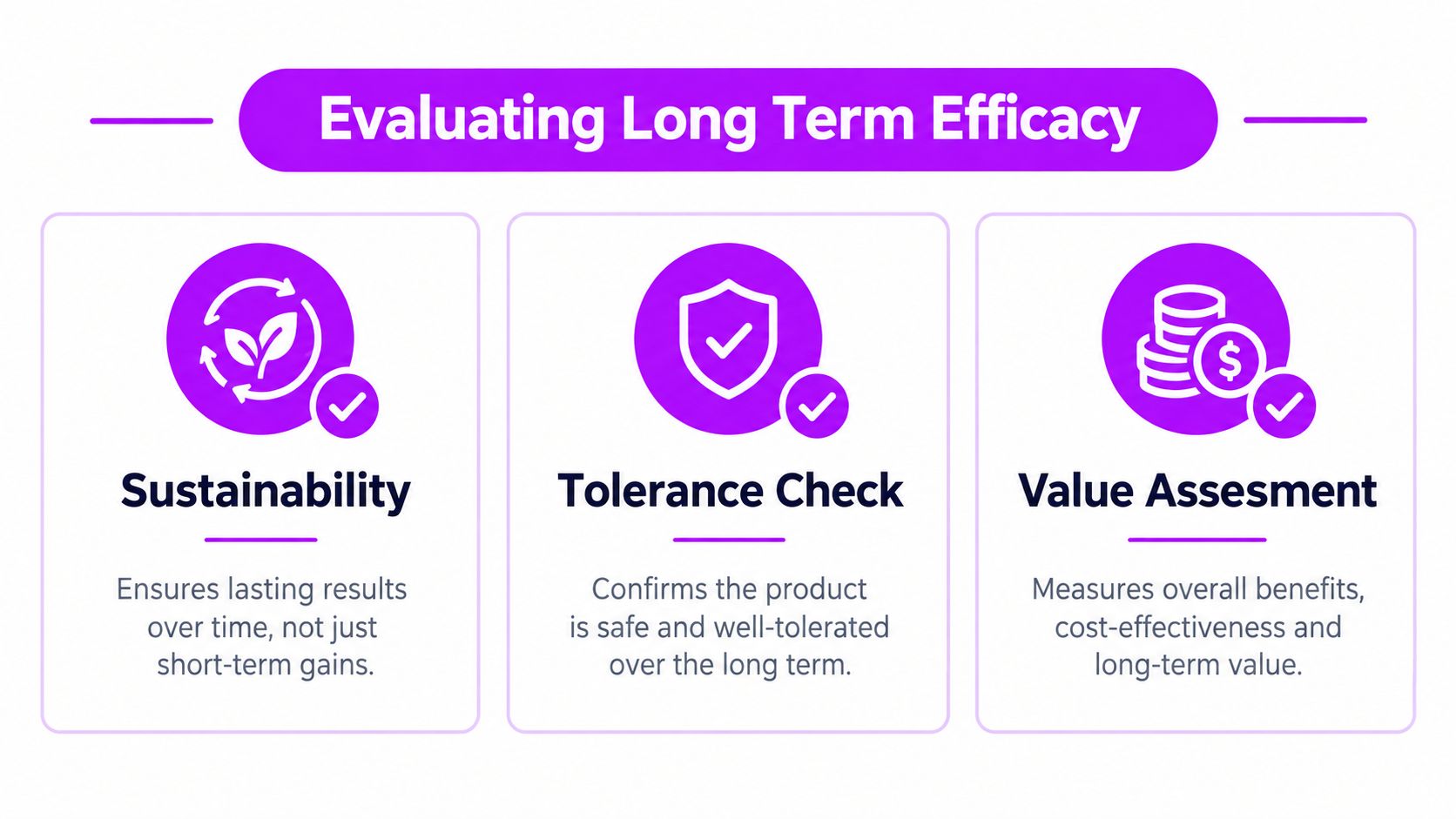
Use a three-part review
Sustainability: Did the routine fit your sleep, work, relationships, finances, legal obligations, and ordinary responsibilities? A benefit that requires constant schedule management may not be practical.
Tolerance check: Did the perceived effect remain stable, fade, or require increasing attention? Rising anxiety, poorer sleep, cognitive interference, or a stronger urge to dose are reasons to pause and seek professional guidance.
Value assessment: Did the protocol improve a defined outcome compared with your non-dose days and baseline? Weigh that result against adverse effects and uncertainty. Don't count a vague sense of novelty as a durable gain.
Export the historical record before changing the routine. Review dose timing, context, mood, focus, sleep, physical effects, adverse events, skipped days, and protocol changes. The planned phase II psilocybin study for major depressive disorder uses repeated measurements at baseline, week four, and week eight, which illustrates the value of comparing an initial state with later phases rather than judging change from memory. Its design specifies 2 milligrams once weekly for four weeks, followed by another four weeks of weekly dosing, and shouldn't be confused with evidence that self-directed microdosing treats depression. The study protocol is a research design, not a personal treatment plan.
Finish with a decision, not an indefinite habit:
- Continue cautiously only if the value is consistent, the risks remain acceptable, and a clinician has no unresolved concerns.
- Pause and reassess if effects are unclear, context has been unstable, or sleep and anxiety have changed.
- Conclude the experiment if benefits don't withstand comparison with non-dose days or if stop-rule symptoms appear.
- Integrate useful insights elsewhere, such as better sleep timing, workload design, therapy, exercise, or another evidence-based wellness practice.
MicroTrack provides a structured journal for recording dose details, mood, focus, sleep, sensations, side effects, reflections, skipped doses, and schedule changes across Fadiman, Stamets-style, or custom calendars. Use MicroTrack to preserve dose and non-dose comparisons, review trends over time, and export your history before deciding whether to continue, pause, or stop.