Mood Tracking Journal: What It Is and How to Build One
A mood tracking journal is a structured record of your emotional states over time, and digital diary research has shown that 130 participants can sustain 8,824 entries across an average of about 69 days. That makes it more than a place to vent: it's a practical way to detect patterns and improve self-awareness when you're unsure why your mood keeps shifting.
You might notice the same cycle repeating. You sleep poorly, feel tense by afternoon, lose focus, and assume the whole day was “bad.” Or you have a productive week but can't explain what made it easier. Memory gives you the general story, but a consistent record shows the smaller details that memory tends to flatten.
A useful journal doesn't require pages of writing. It needs a repeatable check-in, a clear mood rating, a little context, and a regular review. The right structure helps you learn from ordinary days, not only the days when your emotions become impossible to ignore.
Table of Contents
- What Is a Mood Tracking Journal
- Why Mood Tracking Works
- How to Design a Mood Tracking Journal
- Mood Tracking Use Cases
- From Paper to App - How MicroTrack Enhances Mood Tracking
- Getting Started with Your Mood Tracking Practice
What Is a Mood Tracking Journal
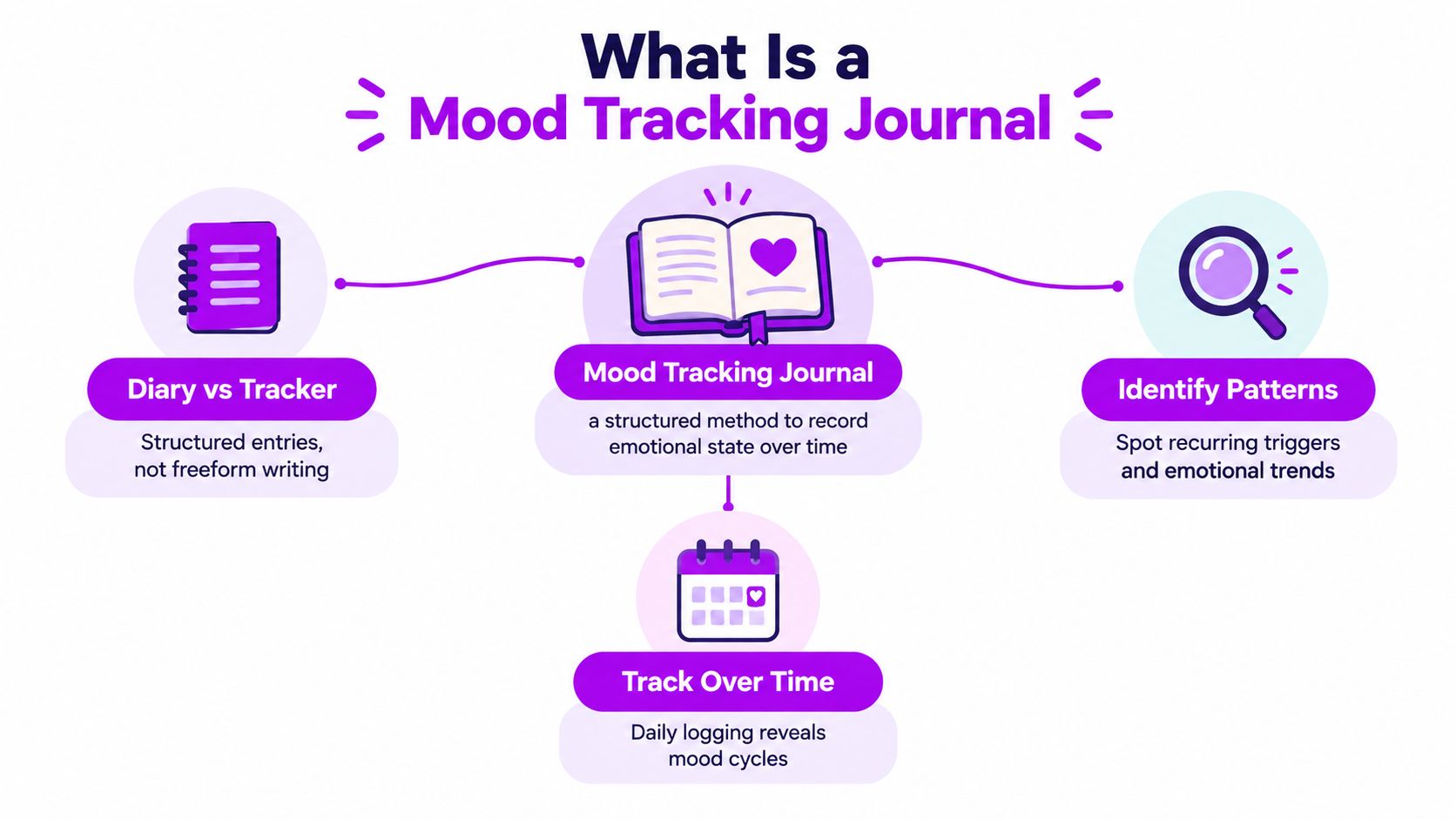
A mood tracking journal is a structured method for recording how you feel, how strongly you feel it, and what may be influencing that state. A traditional diary might describe an argument after it happened. A tracker asks you to capture your mood close to the moment, using the same basic questions often enough to make comparison possible.
That difference matters. Freeform writing is valuable for reflection, but it can focus heavily on memorable events. A tracker gives quieter experiences a place in the record too, such as steady contentment, mild irritability, low energy, or a gradual improvement that you might otherwise overlook.
The basic structure
A practical entry can include four parts:
- Mood rating: Choose a consistent scale that lets you compare one entry with another.
- Emotion label: Add words such as calm, anxious, frustrated, hopeful, numb, or energetic.
- Context: Note relevant conditions, including sleep quality, stress, social contact, work demands, or physical sensations.
- Short reflection: Record what happened or what you noticed, without trying to explain your entire life in one entry.
The journal isn't trying to prove that one event caused one emotion. It's helping you collect observations that can support better questions. If low mood appears repeatedly after poor sleep, that pattern deserves attention. It still isn't proof of a simple cause, because several factors may occur together.
A mood journal also differs from gratitude journaling and therapy notes. Gratitude journaling deliberately directs attention toward appreciation. Therapy notes capture material for a clinical conversation. Mood tracking is broader and more neutral. It records positive, negative, and mixed states so you can see movement rather than collect only one kind of experience.
Why timing changes the record
People reconstruct feelings imperfectly after the fact. A difficult conversation can make the whole day seem worse, while a successful outcome can make earlier distress seem less important. Timely entries reduce that distortion and create a record that reflects the day as it unfolded.
Digital diary research supports the feasibility of sustained self-monitoring. The early study involving 130 participants and 8,824 diary entries showed that people could continue logging health and mood information across weeks, not merely for a short burst, as documented in the digital diary research record.
The point isn't to monitor yourself with clinical precision every minute. It's to create enough consistent information to notice what your mind may miss.
Why Mood Tracking Works
Mood tracking works because it turns a vague internal experience into a sequence of observations. “I've felt awful lately” may be emotionally accurate, but it doesn't tell you whether your mood is steadily declining, changing at particular times, or reacting to a specific routine. Repeated entries make those possibilities visible.
A structured record can also create a pause between feeling and reaction. You name the emotion, rate its intensity, and identify context before deciding what it means. That pause doesn't eliminate distress, but it can make your response less automatic.
Evidence for repeated monitoring
Research has found that structured monitoring can do more than describe mood. In a 2021 Frontiers in Psychiatry study, 47 young people used a mood-monitoring app twice a day for three weeks after a three-week baseline period. The intervention significantly reduced momentary negative mood and retrospectively assessed impulsivity, with results reported at P<0.001 for negative mood and P=0.001 for impulsivity in the study of app-based mood monitoring.
That finding doesn't mean every user will experience the same result. It does suggest that a check-in can become part of an active behavioral process. When you repeatedly observe your emotional state, you may notice an earlier warning sign, question an unhelpful assumption, or recognize that a coping strategy isn't helping.
The same research record describes the Mood 24/7 study, where patients completed 324 of 333 expected reports across 36 weeks. Their app-based mood scores correlated strongly with blinded psychiatrist assessments at r=0.86, P<.001, supporting the usefulness of structured digital ratings for clinically meaningful observation. The result is evidence for the measurement approach, not a promise that an app can diagnose you.
From observation to action
A journal becomes useful when review leads to a small, testable adjustment. You might compare mornings with evenings, notice whether social contact changes your energy, or bring a clear pattern to a therapy appointment. The record gives you something more specific than a general impression.
An American Diabetes Association summary also describes a study of 70 adults with medical symptoms and anxiety who journaled for 15 minutes a day, three days a week, for 12 weeks and reported less stress and better moods. That evidence concerns structured journaling rather than every form of mood tracking, so it supports a measured conclusion: regular writing may help some people process experience and manage stress, especially when the practice remains manageable.
A useful explanation of the behavioral value appears in the benefits of consistent logging. Consistency creates comparable observations, and comparable observations make review more informative.
Practical rule: Track to learn what changes your experience, not to produce a perfect record of yourself.
The habit can also reduce all-or-nothing thinking. Missing one entry doesn't invalidate the journal. A tracker should help you return to observation, not turn self-awareness into another performance test.
How to Design a Mood Tracking Journal
Good design balances low effort with useful context. If every entry demands a long explanation, you'll tend to log only when you have plenty of time or when something feels wrong. If the journal contains only one vague rating, you may struggle to understand what changed.
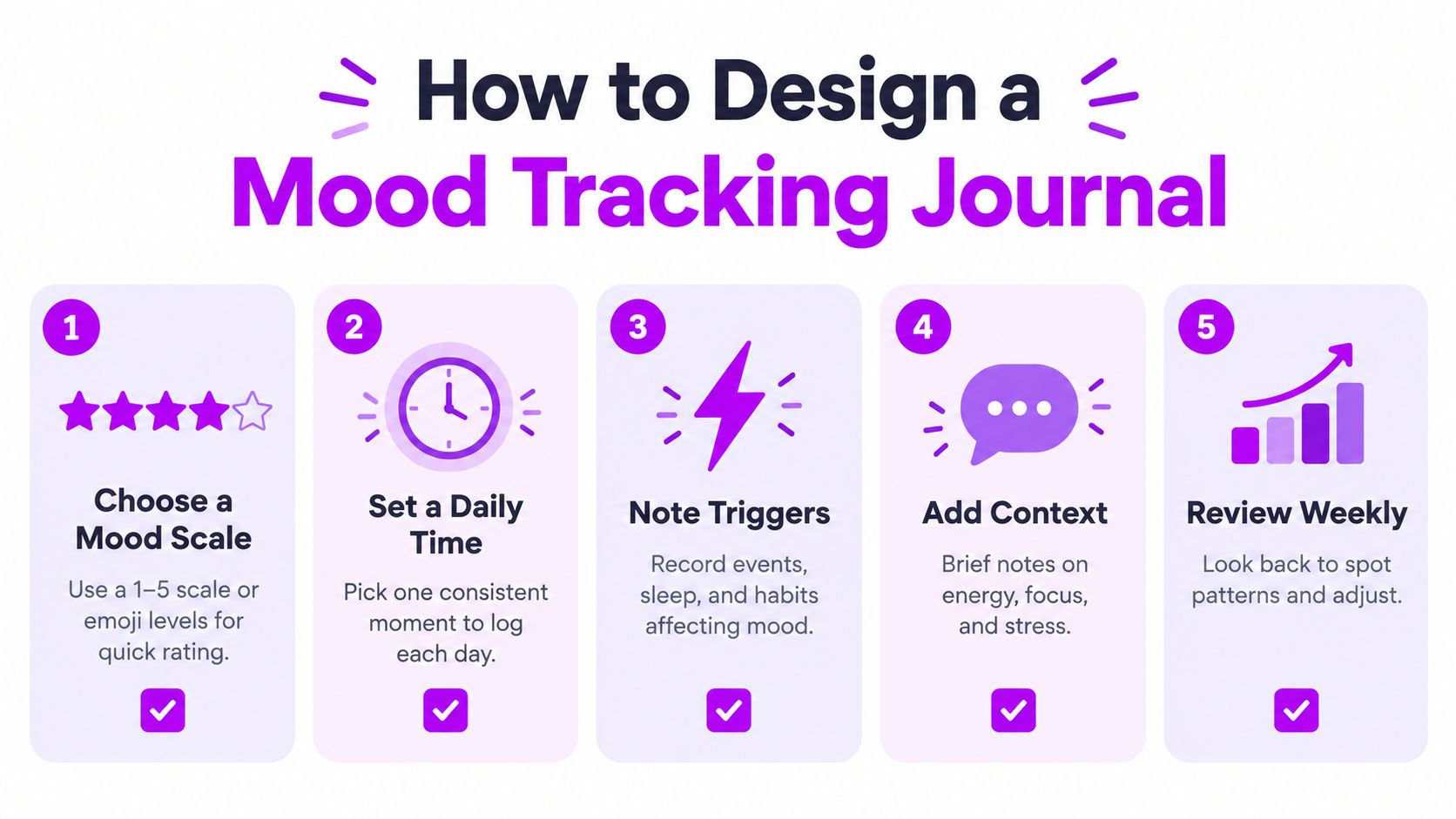
Start by choosing a mood scale and using it consistently. The exact labels matter less than keeping the meaning stable. A middle rating should represent roughly the same experience each time, and the ends of the scale should have plain-language descriptions such as “very low” and “very good.”
Build a small entry system
Use prompts that answer different questions rather than asking you to repeat the same feeling in several ways:
- What is my mood right now? Record the rating before you explain it.
- Which emotion is most noticeable? Choose a word that feels close enough, even if it isn't perfect.
- What context might matter? Note sleep, food, work pressure, exercise, conflict, social time, or another factor relevant to your life.
- What do I need? Identify rest, distance, connection, movement, information, or professional support when appropriate.
Short repeated entries can be more useful than occasional essays. One validation study found that three-item measures of anxious mood, depressed mood, anger, fatigue, and vigor had appropriate reliability across 35 daily reports from 68 people under stress and 28-day reports from 164 people in normal conditions, as reported in the validation study of compact mood measures. The lesson is practical: a concise journal can still capture meaningful change when the questions remain stable.
Choose a daily moment you already have, such as after breakfast, after work, or before bed. If your mood changes quickly, a second check-in may help, but don't add frequency because more data sounds better. The best schedule is one you can sustain without resentment.
Keep context focused
Context should explain the entry, not bury it. Pick the factors most connected to your purpose. Someone exploring sleep may record bedtime, wake time, and perceived rest. Someone preparing for therapy may add a trigger and coping response. Someone studying work stress may note meetings, deadlines, and breaks.
Avoid tracking every possible variable at once. Too many fields create noise and increase the chance that you'll stop. Start with mood, one or two context tags, and a brief note. Add another variable only when you have a clear reason to review it.
For a more detailed approach to choosing ratings, use this guide to daily mood rating scales. The central principle is simple: make the entry quick enough for an ordinary day and specific enough to support a later comparison.
Protect the quality of your data
Don't log only hard days. A record made entirely during crises will make distress look more constant than it is. At the same time, don't fill missing days with confident guesses. A blank is more honest than a precise reconstruction based on a mood you have today.
Review your entries at a regular interval. Look for repeated combinations rather than isolated events. Ask, “What tends to appear before this mood?” and “What happens afterward?” Keep your conclusions provisional until the same pattern appears more than once.
Mood Tracking Use Cases
The right journal depends on the question you're trying to answer. A beginner may need a fast emotional check-in. Someone working with a therapist may need dates, triggers, and coping responses. A data-focused user may want sleep, time of day, habits, and searchable history. These are different jobs, even though they all use mood ratings.

Match the journal to the user
| Use case | Useful emphasis | What to avoid |
|---|---|---|
| Self-awareness | A simple rating, emotion word, and one context tag | Building a complex system before the habit exists |
| Sleep and performance | Sleep quality, energy, focus, timing, and relevant routines | Treating correlation as proof of causation |
| Therapy preparation | Triggers, symptoms, coping responses, and questions for the next session | Using the journal as a substitute for professional care |
| Long-term pattern review | Consistent entries, searchable history, and trend comparisons | Making decisions from one unusually good or difficult day |
A person exploring sleep might notice that low energy follows restless nights, while a therapy client might discover that anxiety rises before particular interactions. Neither user needs the same prompts. The first needs practical context around rest and alertness. The second may need language that supports a careful conversation with a clinician.
The journal can also support people managing anxiety, depression, PTSD, or other concerns, but it should remain a self-observation tool rather than a diagnostic instrument. If entries show worsening distress, thoughts of self-harm, inability to function, or a need for urgent help, contact a qualified professional or emergency service instead of relying on trend charts.
Missing days are part of the interpretation
A missed entry creates uncertainty. It doesn't automatically mean your mood was stable, and it doesn't prove that the days around it were unusually difficult. One consumer discussion of mood tracking warns that logging only hard days skews the record toward low points, while another points out that reconstructing a blank period from memory can bend the record toward the story you already believe. These concerns are summarized in the discussion of incomplete mood-tracking data.
Mark missing entries clearly. You can write “not logged” or leave the date blank, then review whether missed days cluster around travel, stress, low energy, or loss of routine. That pattern may tell you something about the conditions required to keep the practice sustainable.
A missing day is information about the record, not evidence about your emotional state.
Before each review, separate three things: what you directly recorded, what you remember later, and what you infer from the pattern. This habit prevents a sparse journal from creating false certainty.
When a visual explanation would help, the following video offers another perspective on the role of mood tracking and reflection:
A weekly review should end with one modest question, such as “What variable deserves closer attention next week?” That keeps the journal exploratory instead of judgmental.
From Paper to App - How MicroTrack Enhances Mood Tracking
You record a difficult morning on paper, then spend several minutes searching for similar entries weeks later. The page may contain useful details, but the pattern remains hidden among handwriting, scattered dates, and changing labels. Paper remains a valid choice because it is immediate, physically private, and easy to customize. You can draw a calendar, use colors for emotional levels, or write a longer reflection when something important happens.
Retrieval is its main limitation. Comparing several weeks may require scanning every page, while inconsistent labels make similar experiences harder to recognize. A paper journal stores observations well, but it does not organize them for quick comparison.
A digital journal reduces that friction. It can place entries in chronological order, display trends, filter observations, and retain the context attached to each record. These functions improve inspection, not accuracy. The app can show what you recorded more clearly, but it cannot prove that a particular factor caused a mood change.
A digital tool is especially useful when a journal contains repeated observations that would be difficult to compare by hand. Our guide to the best mood tracking app compares features that support this kind of review.
MicroTrack is a microdosing journal and tracker designed for that specific use case. It provides a 10-point mood scale, records session details, and lets users add reflections later through two-phase entries. It also displays mood trends across weeks and months. The delayed reflection option separates the act of recording an event from deciding what the event might mean, which can make the record more orderly.

Connect schedules with observations
Microdosing users may need to compare a planned schedule with what happened in practice. The Fadiman protocol follows a one-day-on, two-days-off cycle for at least four weeks. A dosing day is followed by a transition day and then a baseline day. The summary of Fadiman's protocol also recommends keeping a daily journal during the schedule.
A 2024 survey-style paper reported that 38% of respondents, n = 75, used the Fadiman schedule. The figure, described in the survey of microdosing schedules, describes that sample rather than proving the schedule is broadly preferred. A calendar that records skipped or added sessions can show how closely real routines follow the intended plan.
A useful record can include dose amount and time, food and drinks, side effects, mood, focus, energy, sleep, and the apparent duration of effects. Educational guidance on microdosing logs recommends these kinds of fields. Recording them adds context for reflection, but it does not establish that microdosing caused a later change.
Review trends without overclaiming
Digital review tools can group mood levels by frequency, show whether changes cluster at particular times of day, and make a focused history easier to share with a professional. These views work like a map: they highlight routes worth examining, while the underlying entries provide the detail.
Longer observation also matters. Fadiman-style use is described as continuing for four to ten weeks before a break of two to four weeks in this guide to reviewing microdosing patterns. Comparing periods can therefore provide more context than reacting to one entry.
Privacy deserves the same attention as convenience. Before choosing a digital journal, check its approach to encryption, sharing, export, and deletion. The most useful workflow may be quiet and repeatable: record an observation, review the organized history, test a question, and adjust the journal carefully.
Getting Started with Your Mood Tracking Practice
Start with a purpose you can state in one sentence. You might want to understand afternoon anxiety, prepare clearer notes for therapy, observe the relationship between sleep and energy, or document a structured microdosing routine. That purpose tells you which context fields belong in the journal and which ones are distractions.
Choose a scale, add one emotion label, and record one relevant factor. Keep the first entry short. A complete check-in can be as simple as: “Mood: low. Emotion: tense. Context: poor sleep. Note: felt better after a walk.”
Set a regular review time, but don't turn missed entries into a failure. During review, separate direct observations from assumptions, look for repeated combinations, and choose one question to investigate next. Don't interpret a single high or low day as a trend.
Common questions
Does a mood tracking journal replace therapy? No. It can help you remember experiences and identify topics to discuss, but it isn't a replacement for assessment or treatment from a qualified professional.
What should I do if tracking makes me more distressed? Stop or reduce the practice, return to grounding activities, and seek support if difficult emotions feel unmanageable. A journal should create useful awareness, not force you to examine feelings without support.
Can I use paper instead of an app? Yes. Paper works well when it helps you log consistently. An app becomes useful when you need easier trend review, searchable history, flexible scheduling, or exportable records.
A sustainable practice is not the one with the most fields. It's the one that gives you enough reliable context to make a wiser next decision.
MicroTrack offers a structured mood journal with a 10-point scale, two-phase entries, flexible schedules, trend visualizations, searchable history, and CSV export for reviewing your practice over time. If you want a calm way to connect mood observations with a microdosing routine, visit MicroTrack and start logging without a credit card.