Personal Data Protection for Health Apps
You finish a private wellness entry late at night: your mood is low, your thoughts are unusually honest, and you record details about a microdosing day that you'd never share on social media. The next morning, your phone is left in a rideshare, your account stays signed in on a shared tablet, or an app sends data to a service you've never heard of.
That vulnerability changes the meaning of personal data protection. A wellness journal isn't just a collection of harmless notes. It can reveal your mental state, routines, symptoms, substance use, sleep patterns, relationships, locations, and the conclusions you draw about your own health. The right app should help you reflect without turning that private record into a product.
Table of Contents
- Understanding Personal Data Protection in Wellness Tracking
- The Legal Framework Governing Your Health Data
- Technical Safeguards That Actually Secure Your Information
- Unique Threat Models for Microdosing Journals
- Evaluating Privacy Claims with a Practical Checklist
- Mastering Data Portability and the Right to Erasure
- Building a Mindful and Secure Tracking Practice
Understanding Personal Data Protection in Wellness Tracking
Personal data protection means keeping control over information that identifies you or can reasonably be connected to you. For a wellness tracker, that may include your name and email address, but the most revealing details often look less obvious. A timestamp, mood score, journal phrase, location, and recurring schedule can form a recognizable profile even when an app removes your name.
Consider a typical entry. You record that your anxiety felt intense after poor sleep, that you took a substance earlier in the day, and that your mood improved later. On its own, each detail may seem limited. Combined across a searchable history, those notes can expose a pattern about your psychological state and personal decisions.
That's why wellness data deserves a stricter privacy standard than ordinary app activity. A shopping preference may influence an advertisement. A mental health reflection can affect how another person, employer, insurer, platform, or automated system interprets you. The practical question isn't only, “Can someone read my journal?” It's also, “What could someone infer from it?”
The principles that protect your autonomy
Three principles should guide every private tracking practice:
- Data minimization: The app should collect what it needs for the function you choose, not every available detail about your life.
- Specific consent: You should understand what you're agreeing to, why the data is processed, and whether optional sharing can be refused.
- User sovereignty: You should be able to access, export, correct, and delete your records without negotiating with the provider.
A privacy notice can mention these ideas while the product behaves differently. Look for evidence in the interface and settings. Can you use the core journal without advertising trackers? Can you choose whether location is recorded? Can you delete an individual entry, or does the service force you to delete the whole account?
Wellness tracking needs a personal threat model
Start with the people and systems you're protecting against. Your concerns may include a curious partner, a lost phone, a compromised email account, a data broker, a hostile third party, or a provider that changes its business model. Each threat calls for a different control.
A screen lock can help with a lost device. Two-factor authentication can reduce account takeover. Encryption can reduce exposure if storage is accessed. Minimal collection can limit the damage before any breach occurs. Privacy isn't one feature. It's a chain of decisions that limits who can learn what about you.
The Legal Framework Governing Your Health Data
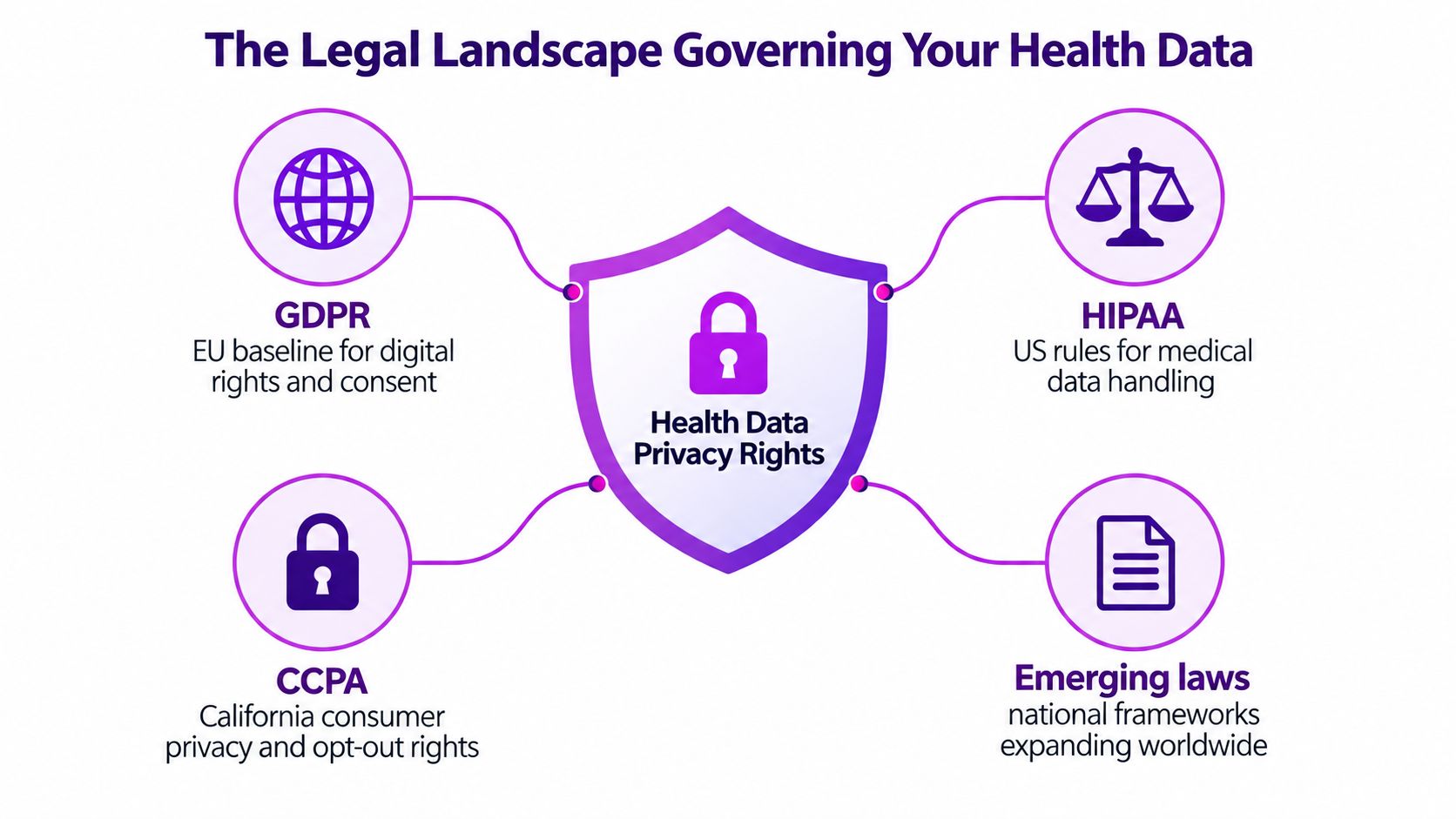
A wellness journal can reveal far more than a fitness goal. Entries about mood, sleep, medication, symptoms, or microdosing may expose sensitive patterns about your health and daily life. The rules protecting that information depend on your location, the provider's location, the service's business model, and the legal category assigned to the data.
By early 2026, data protection laws or regulations had been adopted in 167 countries and jurisdictions, covering about 83% of the global population and roughly 145 of the 193 UN member states, according to the global survey cited in the worldwide personal data protection overview. Around 30 countries had pending bills, so legal coverage continues to expand.
What the GDPR changes for users
The GDPR remains the most influential personal data protection regime globally. It took effect in May 2018, and cumulative fines were estimated at about €7.1 billion by January 2026. One enforcement tracker recorded €6.11 billion across 2,685 cases and 443 reported breach notifications per day across Europe, a 22% year-over-year increase, as reported in these 2026 GDPR enforcement statistics.
These figures do not prove that every wellness app is unsafe. They show that regulators treat poor data handling as a serious business risk and that breach response is a normal operational requirement.
For a person keeping a private or microdosing journal, GDPR-style rights can provide a strong basis for asking what an app stores, why it processes each field, whether it shares the information, and whether it can delete or export your records. The exact result depends on the legal basis and circumstances. A provider should still give you a clear request process instead of forcing you to interpret vague policy language.
HIPAA and state privacy laws
In the United States, HIPAA applies in specific healthcare contexts. Many consumer wellness apps are not automatically covered just because they collect health-related information. Treat “health app” as a product description, not proof of a particular legal safeguard.
California's CCPA and other state privacy laws add further consumer rights and provider obligations. Definitions of sensitive information, opt-out choices, exemptions, and access procedures vary. Check the app's privacy notice and rights request process directly, especially before recording details that could identify treatment, substance use, or mental health concerns.
Practical rule: Legal protection helps, but choose a product that makes private handling clear before you need to file a request.
Read the policy for four specifics: collection, purposes, sharing, and retention. “We may use information to improve services” tells you little. Look for a field-by-field explanation, the identity of outside analytics providers, and the point at which records disappear. For a user-centered explanation of control and ownership, review this guide to personal data ownership in wellness tracking.
Technical Safeguards That Actually Secure Your Information
A privacy promise is only credible when the product can explain what happens to your entry after you tap save. The core safeguards are understandable even if the underlying engineering is complex.
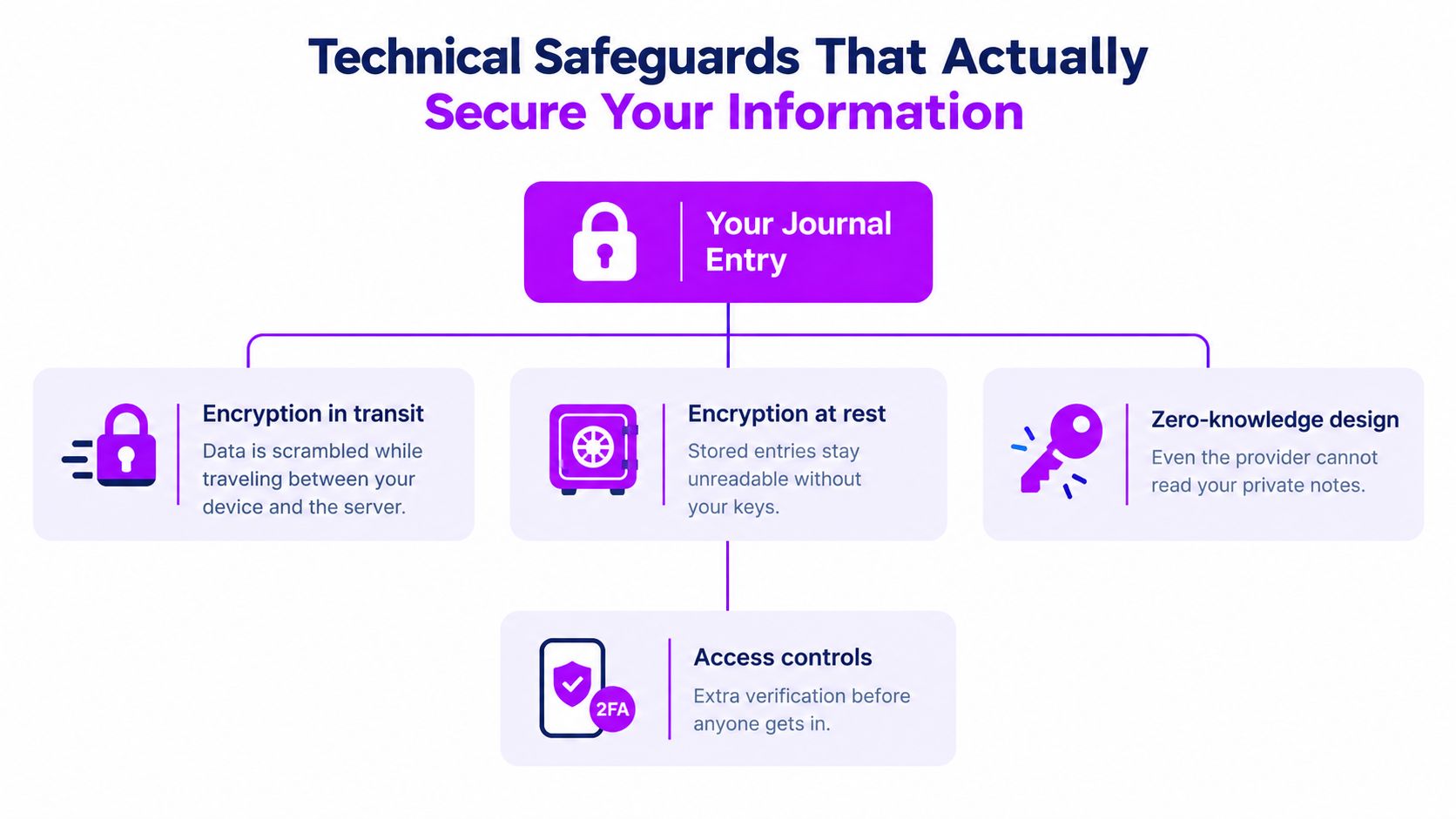
Encryption in transit protects data while it travels between your device and a server. Think of it as placing a message into a locked channel before it leaves your phone. Encryption at rest protects stored records on servers, devices, backups, and storage media. If an unauthorized person gains access to the storage, the data should remain unreadable without the relevant key.
The European Data Protection Board guidance on securing personal data makes an important distinction: encrypted information remains personal data when a key can reconnect the ciphertext to an identifiable person. Encryption therefore isn't a magic eraser. It works only when the provider also protects the keys.
Ask how access is controlled
A secure app should limit access for both users and internal operators. Start with your account:
- Use a unique password: Don't reuse the password attached to your email or banking account.
- Enable two-factor authentication: A second verification step makes a stolen password less useful.
- Lock the device: Use a passcode or biometric lock, especially if entries remain accessible while the phone is not locked.
- Review active sessions: Sign out devices you no longer recognize or use.
- Protect exports: A CSV file is readable data, so store it as carefully as the journal itself.
Pseudonymization can reduce direct exposure by separating identifying details from the journal. It doesn't create anonymity if another system can reconnect the pieces. A local-first design may keep more information on your device, while a cloud service may provide synchronization and recovery. A zero-knowledge design goes further by limiting the provider's ability to read private content, but you should ask how account recovery, search, analytics, and lost keys work.
The European Commission's obligations for organizations describes security as a risk-based, testable program. It includes measures such as pseudonymization, encryption, restoration of availability after incidents, regular testing, device patching, two-factor authentication for remote access, encrypted mobile endpoints, and TLS for web collection.
This short explainer can help you understand the difference between protected data in motion and stored information: encryption in transit for health apps.
Unique Threat Models for Microdosing Journals
A microdosing journal carries a different risk profile from a step counter. It may contain dose notes, mood changes, anxiety symptoms, trauma reflections, perceived effects, and private conclusions about substances that carry legal or social sensitivity in some places. The record can feel harmless because it sits inside a wellness routine. Its meaning becomes more sensitive when entries accumulate.
The assumption that “anonymous” data is safe is weak. A mood score without your name may still become identifying when combined with a timestamp, device identifier, location, writing style, or unusual routine. A data recipient may not need to read every sentence. Repeated patterns can support inferences about where you go, when you take something, whether you experience distress, or how your behavior changes.
Build the threat model around inference
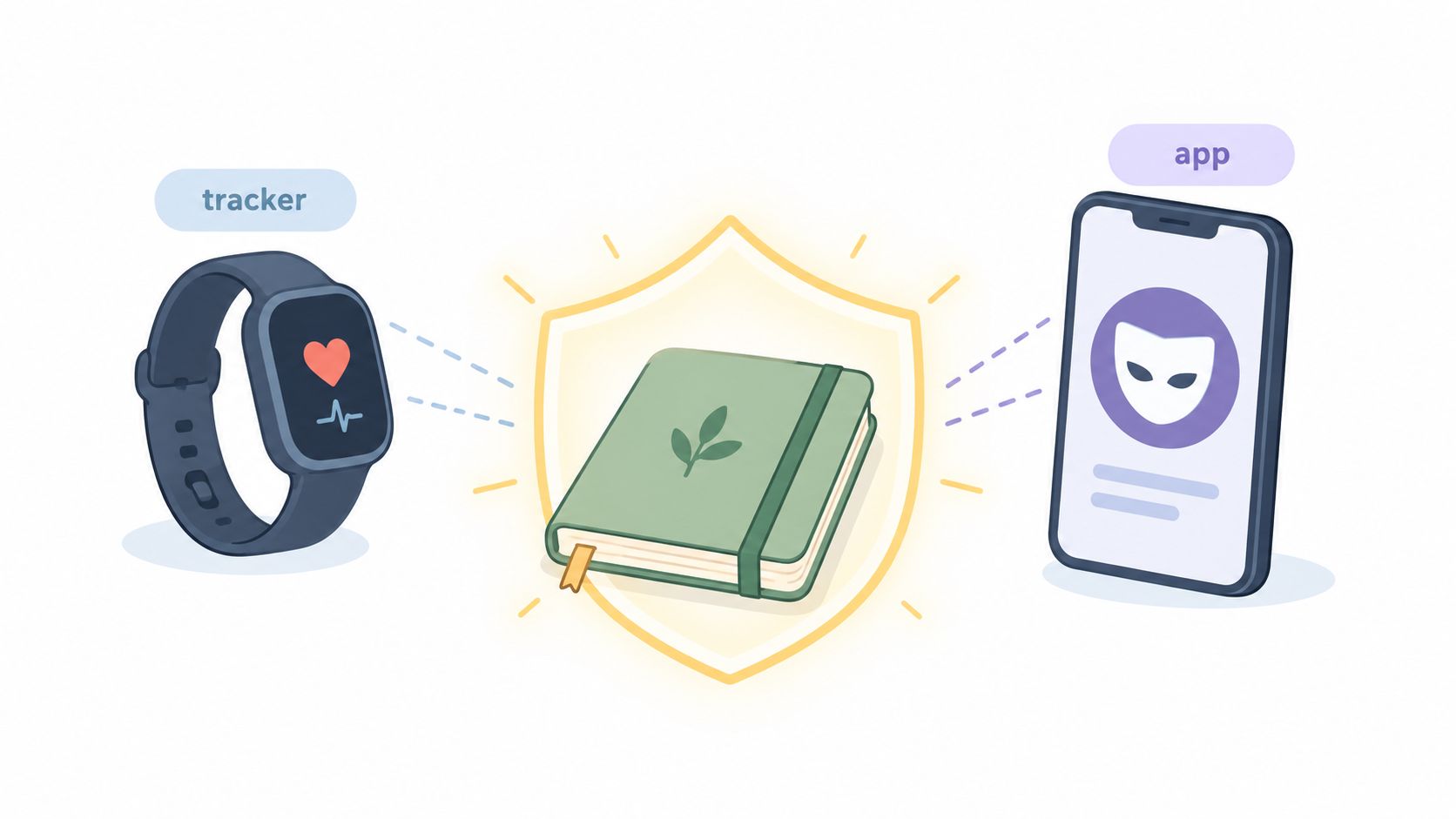
Ask what a third party could learn from combinations rather than isolated fields:
- Mood plus time: Regular low scores at particular times may expose work stress, sleep problems, or medication-related patterns.
- Journal plus location: A location history can connect a private practice to a clinic, residence, retreat, or social setting.
- Dose details plus language: Specific terminology and recurring descriptions can make supposedly de-identified entries easier to recognize.
- Mental health reflections plus account data: Email addresses and device identifiers can attach sensitive content to a real person.
- Trend analysis plus sharing: An innocuous chart can reveal changes that the original writer never intended to disclose.
In 2025, the U.S. Department of Justice finalized a Data Security Program addressing bulk transfers of sensitive personal data and government-related data to several countries of concern. The same review of major U.S. data privacy developments notes that nine U.S. states amended privacy laws, while no new state privacy law was enacted that year. It also describes growing scrutiny of AI governance, data reuse, pay-or-consent models, and inferences used for profiling and significant decisions.
That matters for microdosing journals because inferred data can be as revealing as the words you deliberately write. A privacy-conscious service should not sell or casually share your entries, should limit third-party tracking, and should explain whether automated analysis uses identifiable records.
Evaluating Privacy Claims with a Practical Checklist
“Bank-level security” and “complete privacy” aren't verification. They're marketing language unless the provider explains the controls behind them. Evaluate the app as if you were deciding where to keep a handwritten journal, then add the risks created by cloud storage, exports, analytics, and account recovery.
Use this comparison before committing years of personal notes:
| Marketing Claim | What to Verify | Red Flag |
|---|---|---|
| “Private by design” | Whether entries are sold, shared, or used for advertising and whether optional analytics can be disabled | Broad permission to share data with partners |
| “Encrypted” | Whether encryption covers transit and stored data, and who controls the keys | Encryption mentioned without any explanation of scope |
| “You own your data” | Whether you can access, correct, export, and delete records yourself | The provider reserves broad rights to reuse your content |
| “Secure account” | Support for strong passwords, two-factor authentication, session review, and account recovery | Shared accounts or weak recovery questions |
| “Easy export” | Whether the export is complete, machine-readable, and delivered through an authenticated process | An emailed file with no warning about its sensitivity |
| “No tracking” | Whether the app includes advertising SDKs, third-party analytics, or unnecessary device identifiers | A privacy statement that never names service providers |
| “Delete anytime” | What deletion removes, how processors and backups are handled, and whether exceptions are documented | A delete button with no retention explanation |
Read the policy like a systems document
Search for the words retention, sharing, sale, analytics, inference, biometric, location, processor, backup, and deletion. Don't stop at the first reassuring paragraph. Check whether another clause permits broad use of “aggregated,” “de-identified,” or “derived” information.
The service should also explain what happens when you export a journal. A downloaded CSV can be copied to cloud drives, email accounts, backup services, and shared computers. The app may protect its copy while your exported copy remains exposed.
Finally, test the account before you depend on it. Create a small sample entry, export it, inspect the fields, remove it, and check whether it disappears from the interface. Ask support a concrete question about retention or third-party processors. A clear, specific answer is stronger evidence than a polished badge.
Mastering Data Portability and the Right to Erasure
A private service must let you leave. Keeping your data secure while you use an app matters, but long-term control also requires a usable exit. You shouldn't have to choose between preserving your health history and remaining tied to a provider indefinitely.
Under EU rules, data portability applies only when three conditions are met at the same time: processing is based on consent or a contract, processing is automated, and you provided the data yourself. The European Data Protection Board explanation of individual rights identifies structured, commonly used, machine-readable formats such as CSV, XML, and JSON. Direct transfer to another controller is required only when technically possible.
That makes exports more than a convenience. A complete export gives you a durable copy of your personal health narrative that you can inspect, move, or analyze independently.
Test portability before your history grows
Use a small trial rather than waiting until you have years of entries:
- Create representative entries: Include a mood score, free-text reflection, date, schedule detail, and any optional field you might use.
- Export the record: Check whether the file includes the actual journal text, dates, metadata, and any attachments.
- Open the format: Confirm that the file works in a spreadsheet or another tool without proprietary software.
- Review the delivery method: Make sure the download requires your authenticated account and isn't exposed through a guessable public link.
- Delete the test data: Ask whether deletion removes the account record, backups, logs, and data held by processors.
Deletion is where many privacy programs fail operationally. A visible “delete account” button may remove the front-end profile while copies remain in backups, support systems, analytics platforms, or legal retention stores. A 2025 EU enforcement report found that 17 data protection authorities flagged weak or undocumented erasure procedures, around 20% of controllers provided no regular refresher training, and many organizations were unclear about retention periods and deletion exceptions, according to this analysis of the 2025 right to erasure report.
A deletion workflow is credible only when the provider can explain what disappears, what remains temporarily, why it remains, and when the remaining copy is removed.
Read the retention schedule before you start. If the answer is vague, keep fewer identifying details, avoid unnecessary location data, and maintain your own encrypted backup only when you understand the risks.
For a practical export walkthrough, use this guide to export wellness journal data.
Building a Mindful and Secure Tracking Practice
Privacy should make reflection calmer, not more complicated. You're tracking because you want to notice patterns in mood, sleep, routine, or dose timing. If every entry creates anxiety about surveillance, the tool undermines the practice it was meant to support.
Choose a journal that collects narrowly, protects entries in transit and at rest, avoids selling or sharing private records, and gives you direct control over exports and deletion. Prefer a clean interface over features that encourage constant engagement. Streaks, leaderboards, aggressive reminders, and gamification can turn self-observation into performance, while a quiet journal leaves room for honest reporting.
Keep your routine private by default
Use neutral device notifications if other people might see your screen. Don't include names, addresses, workplace details, or other identifying information unless the entry needs them. Review permissions periodically, and remove access to location, contacts, photos, or microphones when the journal doesn't require those functions.
Separate reflection from diagnosis. A mood trend can help you ask better questions, but it doesn't establish a medical conclusion. If you're dealing with PTSD, anxiety, depression, medication changes, or difficult reactions, share relevant information with a qualified healthcare professional rather than relying on an app's pattern detection alone.
Make control part of the habit
Every few months, check that your password remains unique, your account sessions are familiar, and your export still works. Delete entries you no longer need, but remember that an exported file needs its own protection. If you stop using a service, complete the deletion process and keep only the records you have deliberately chosen to retain.
A privacy-first practice isn't about hiding something shameful. It's about preserving the freedom to explore your own experience without allowing a platform to define, monetize, or expose it. Personal data protection is an act of self-care because it protects the space where honest self-reflection happens.
MicroTrack offers encrypted journal entries in transit and at rest, CSV export, and one-click account deletion in a distraction-free microdosing tracker without streaks or gamification. Visit MicroTrack to create a more controlled, private record of your wellness practice.