Psilocybin Microdosing Benefits: What Science Says in 2026

Controlled studies don't show a reliable immediate benefit from psilocybin microdosing for mood, anxiety, or cognition beyond placebo. What they do show is a noticeable subjective effect at low doses, which makes structured self-tracking more important than gut feeling.
People often report psilocybin microdosing benefits because the experience feels meaningful, but controlled research keeps separating sensation from sustained improvement. That gap matters, because if you can't tell the difference between a real effect and a convincing impression, you can't tell whether the practice is helping.
Table of Contents
- What Controlled Research Shows About Psilocybin Microdosing Benefits
- Why People Report Benefits Even When Studies Show None
- The Gap Between Self-Reported Outcomes and Clinical Evidence
- How to Track Your Microdosing Experience Like an N of 1 Study
- When Microdosing Is Not a Substitute for Clinical Care
- Building a Cautious, Data-Driven Microdosing Practice
What Controlled Research Shows About Psilocybin Microdosing Benefits
The cleanest starting point is controlled evidence, because it separates measured outcomes from personal impressions. In a 2022 double-blind, placebo-controlled study of 34 people beginning to microdose psilocybin mushrooms, participants received either 0.5 grams of dried Psilocybe cubensis or placebo. The active dose produced stronger subjective effects, but mainly among people who correctly guessed what they had taken (PubMed).
Subjective effects are not the same as broad improvement
That distinction matters. Across well-being, creativity, cognition, behavior, perception, and brain activity, researchers found no evidence of enhancement, aside from a few small changes that pointed more toward cognitive impairment than cognitive gain (PubMed). A separate preregistered, double-blind, placebo-controlled study also found no improvement in emotion processing or symptoms of anxiety and depression compared with placebo.
Practical rule: if a low dose is noticeable but does not outperform placebo in blinded testing, treat the feeling as data, not proof.
A systematic review of 11 eligible studies found that 8 studies, or 72.7%, reported at least one positive health outcome, 1 study, or 9.1%, reported both positive and negative effects, and 2 studies, or 18.2%, found no significant improvement across most health outcomes. In that review, the authors concluded that the evidence was heterogeneous and too biased to establish effectiveness or safety (Frontiers in Psychiatry). That mix of signals is why the topic remains contested. Open-label enthusiasm can coexist with controlled null results, and both can be true at the same time.
| Outcome Domain | Controlled Trial Finding | Anecdotal Report Claim |
|---|---|---|
| Mood | No reliable immediate benefit beyond placebo | Lighter mood, less rumination |
| Anxiety | No clear advantage over placebo | Calmer baseline, less social tension |
| Cognition | No enhancement, with some signs of impairment | Better focus, mental clarity |
| Creativity | No evidence of improvement | More ideas, easier brainstorming |
| Well-being | No sustained benefit detected | Feeling more balanced or resilient |
The table shows the core tension in this literature. People often describe psilocybin microdosing benefits in functional language, but blinded trials have not shown that those gains survive careful comparison. Self-report can still be useful, but only as one part of the evidence. It can tell you what changed for you, not whether the capsule caused the change.
Why People Report Benefits Even When Studies Show None
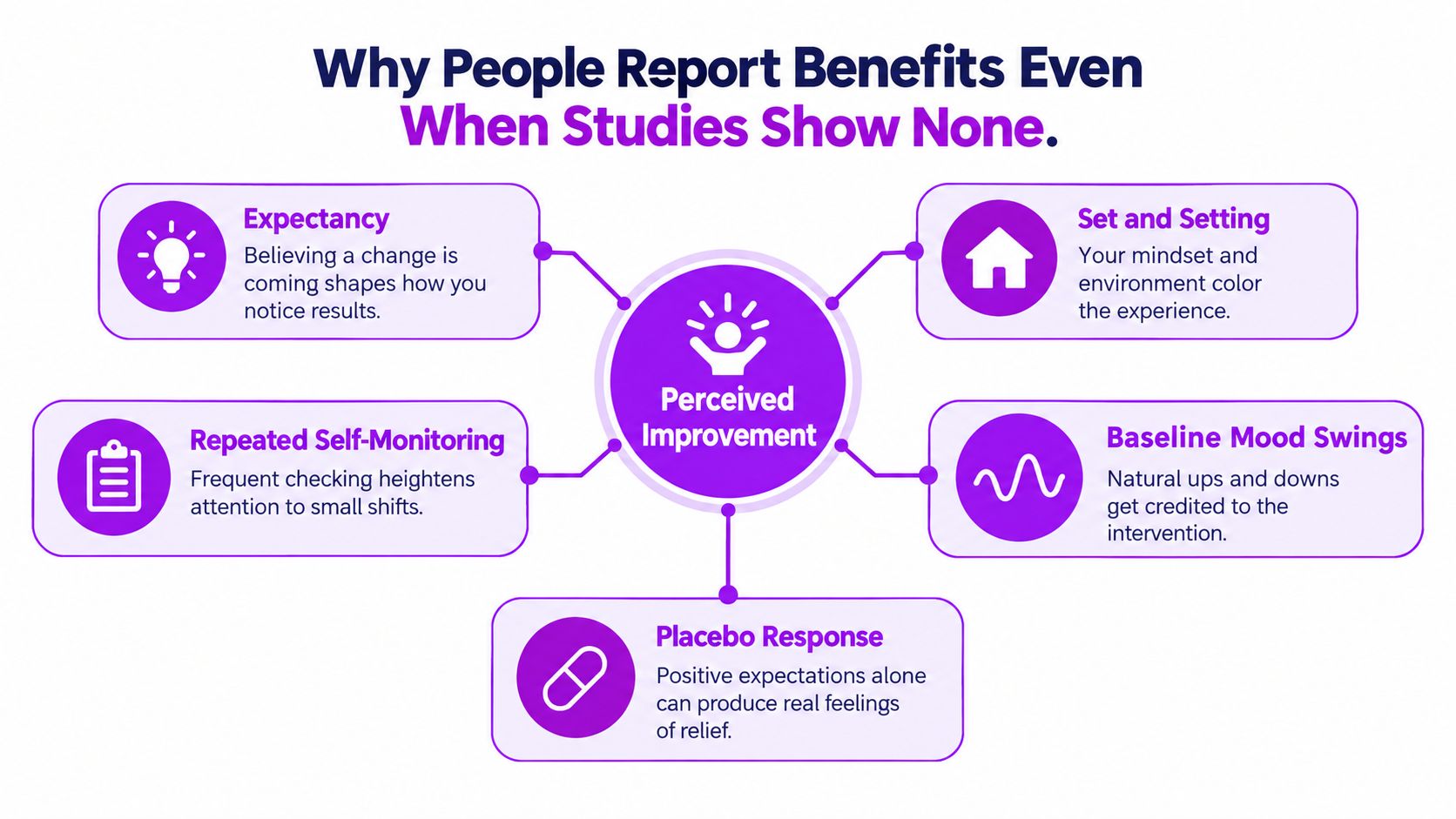
Perception changes quickly when attention, expectation, and routine all shift at once. A critical review covering 57 human studies found reported improvements in mood, cognition, social functioning, and mental health, but the findings were inconsistent and relied heavily on self-report, with observational studies looking better than placebo-controlled experiments (PubMed).
Expectancy, context, and attention can all move the needle
If someone starts microdosing while expecting a clearer mood or a more productive morning, they are more likely to notice days that fit that story. The review also notes that expectations, context, and baseline psychological state may strongly shape outcomes, while anxiety, physical discomfort, and cognitive disruption appear as recurring adverse effects (PubMed).
The experience is real but mixed, and not every part of it comes from the capsule. A person who pays closer attention after starting a new routine may detect genuine shifts, but they may also become more sensitive to small ups and downs that were already present.
Natural variation can look like a treatment effect
That is the part many consumer accounts miss. A week that starts badly and then improves can feel pharmacological even when it is only regression toward a personal baseline. Daily self-checks can also create a feedback loop, where attention itself becomes part of the effect.
A useful question is not “Did I feel better today?” It is “Did I feel better on dose days, and does that pattern hold when I compare it with non-dose days?”
The most defensible interpretation is n-of-1 logic, not certainty. Track the practice as a personal observation problem, where the task is separating expectancy, environment, and routine from anything the dose itself may be doing.
The Gap Between Self-Reported Outcomes and Clinical Evidence
Self-reported outcomes matter because they reflect lived experience, but they're not a substitute for controlled testing. A systematic review and meta-analysis of randomized controlled trials found no clear immediate symptom reduction from psychedelic microdosing in healthy adults, with pooled standardized mean differences of -0.19 for depressive symptoms, -0.20 for anxiety, and 0.02 for stress, and the confidence intervals all included no effect (Systematic review and meta-analysis).
What observational data tends to overstate
Observational reports often capture people who already believe the practice suits them. That selection effect matters, because people who feel nothing, feel worse, or stop early are less likely to keep posting detailed updates. By contrast, randomized trials put the claims under pressure, and that pressure has so far produced null or near-null results for immediate mood-related outcomes.
A second layer of caution comes from the structure of the data itself. Self-reports usually mix dose effects with sleep, work stress, caffeine, social events, and the day's emotional weather. Without a comparison condition, you don't know which part changed first.
For a deeper look at that problem, see correlation vs causation.
Comparison only works if the comparison is honest
The practical standard is simple. Compare dose days with matched non-dose days, and compare both against your own baseline instead of against a hoped-for outcome. If the same mood lift appears on dose days, off days, and stressful days alike, the dose probably isn't the main driver.
Good tracking separates memory from measurement. If you rely on retrospective impressions, your mind will smooth over the messy parts.
That's why the evidence gap isn't just academic. It affects how you interpret your own notes. A journal that records only highlights will exaggerate the apparent benefit, while a journal that records outcomes consistently can show whether anything repeatable is happening.
How to Track Your Microdosing Experience Like an N of 1 Study

A useful tracking system doesn't need to be complicated. It needs to be consistent, timestamped, and honest about off-days, side effects, and routine changes. The point is not to prove microdosing works in the abstract, it's to see whether it works for you under stable conditions.
Start with fixed inputs and fixed outcomes
The strongest tracking designs borrow from structured research. In a double-blind, placebo-controlled study of 191 healthy volunteers, both the psilocybin and placebo groups improved from baseline, but between-group differences weren't statistically meaningful, which is exactly why repeated self-monitoring needs a comparison condition and pre-registered outcomes rather than loose impressions (ScienceDirect).
A workable journal should include:
- Dose timing. Record the time, the dose day, and whether it was planned or shifted.
- Mood and focus. Use the same scale every time so you can compare like with like.
- Sleep and recovery. Note sleep length, sleep quality, and whether the next day felt fragmented.
- Context. Capture workload, social stress, exercise, caffeine, and major events.
- Off-days. Log the non-dose days too, because that's where comparison lives.
That list sounds basic because it should be. The more you complicate the method, the more likely you are to stop using it.
Make the comparison window long enough
A single good day tells you very little. Several weeks of matched observations tell you more, because they smooth out noise from mood swings and routine changes. If you want a cleaner read, compare dose days with adjacent non-dose days and review the pattern weekly rather than instantly.
MicroTrack is one option for that kind of logging, because it supports dose notes, mood entries, reflections, and structured schedules in one place. Its value here is practical, not magical. A tool like that can help you keep the same fields in view so you're less likely to rewrite your memory after the fact.
The best question to ask yourself is simple. Did the same pattern show up twice, under similar conditions, without a major confounder? If the answer is no, the result is still interesting, but it isn't evidence yet.
Use fixed review points, not constant checking
Frequent checking can distort the picture. If you check your mood every twenty minutes, you'll create more noise than insight. A better method is one review in the morning, one in the evening, and a weekly summary that looks for repeatable patterns rather than memorable moments.
Track the pattern, not the story. Stories are easy to remember. Patterns are what matter.
That approach lines up with the logic of the trial literature, which measures outcomes at fixed intervals rather than by feel alone. If your notes only capture the most vivid day, they'll overstate both the highs and the lows.
For a cleaner workflow, use progress documentation as a habit rather than a one-off event. The question isn't whether you felt something today. The question is whether your notes show a stable difference across dose and non-dose windows.
When Microdosing Is Not a Substitute for Clinical Care

Microdosing should not be treated as a treatment for depression, anxiety, PTSD, or existential distress. A 2026 synthesis of randomized trials found no clear immediate reduction in depressive, anxiety, or stress symptoms, and the observed improvements did not significantly exceed placebo effects (PubMed).
The boundary between curiosity and care matters
A separate randomized, double-blind study reported no reliable cognitive or emotional enhancement beyond placebo. Initial signals in social cognition, mood, and cognitive flexibility did not survive correction for multiple comparisons, while negative bodily sensations were stronger in the active-dose condition (PubMed). That pattern calls for caution, especially when someone is already managing a mental health condition.
Microdosing may still be something people explore. That is different from calling it treatment. Experimental self-use and clinical care serve different purposes, use different safeguards, and answer different questions.
Warning signs deserve more weight than wishful thinking
If anxiety rises, sleep worsens, concentration drops, or bodily discomfort shows up repeatedly, those are not minor footnotes. They are signals that deserve attention. If someone is already dealing with severe depression, panic, trauma symptoms, or suicidal thinking, self-experimentation is the wrong place to start.
A cautious frame does not require rejecting the practice. It requires admitting that the current evidence does not justify using it as a replacement for therapy, medication, or proper assessment. That is a stricter standard, but it is the right one when the controlled data stay mixed.
If you are trying to solve a clinical problem, use clinical care. If you are exploring a personal pattern, track it carefully and keep the two tasks separate.
That distinction protects people from overreading their own experiences. It also keeps the conversation honest, which is the only way the research can eventually become useful.
Building a Cautious, Data-Driven Microdosing Practice
The best way to approach psilocybin microdosing benefits is with a narrow claim and a disciplined method. Don't assume the practice will improve mood, creativity, or cognition. Treat it as a personal experiment whose value depends on whether your own data show a repeatable change, not whether the idea sounds compelling.
Set the bar before you start
If you want clarity, define what counts as improvement in advance. That might be steadier mood, fewer off-days, easier task initiation, or better recovery after stress. Define it once, write it down, and review it on a schedule rather than in the heat of a good morning.
The same logic applies to stopping. If you notice stronger anxiety, disrupted sleep, or reduced concentration, don't keep trying to reinterpret the signal. Stop, compare your notes, and decide whether the pattern is worth continuing.
Use the evidence as a filter, not a slogan
The research doesn't support broad claims of reliable benefit, and it doesn't support using microdosing as a stand-in for treatment. The most honest way forward is to combine that skepticism with structured observation, so you can see whether your own experience survives comparison with placebo-like variation. A framework like evidence-based protocols can help you keep the method conservative and the conclusions modest.
If you do keep going, stay consistent with timing, record off-days, and watch for patterns over weeks instead of days. The point isn't to force a verdict. It's to avoid fooling yourself.
MicroTrack gives people a structured way to log dose timing, mood, sleep, side effects, and reflections, then review the pattern over time. If you want to explore microdosing with more rigor and less guesswork, visit MicroTrack and use it to turn your own experience into something you can evaluate.