Psychedelic Harm Reduction: A Practical Safety Guide
You've checked the room, told a friend what you're planning, and put your phone within reach. Then the experience starts going differently than expected. In that moment, the difference between a frightening stretch and a crisis may be a sober person who knows what you took, a medication list that's already written down, and an agreement about when to call for help.
Psychedelic harm reduction is for people who've decided to use, people still considering it, and people supporting someone else. It doesn't promise safety or tell anyone what to take. It helps people make clearer decisions before, during, and after an experience, especially when uncertainty or distress appears.
Table of Contents
- Why Psychedelic Harm Reduction Matters Now
- What Psychedelic Harm Reduction Actually Means
- Set, Setting, and the Pre-Session Checklist
- Medication Interactions You Should Not Guess About
- Substance Verification, Support Lines, and Real-Time Help
- Warning Signs That Mean Stop, Call, or Seek Care
- Two Sessions, Two Outcomes, What the Difference Looked Like
- Tracking, Reflection, and Knowing When to Stop
Why Psychedelic Harm Reduction Matters Now
At 2 a.m., a friend messages: "My heart will not slow down, and I cannot tell if this is panic or too much." The person who gets that text does better with a written dose, a medication list, and an agreed call-now threshold than with encouragement alone.
That gap exists because prohibition interrupted research and pushed use into settings without the screening and monitoring used in clinical studies. In the United States, the Controlled Substances Act of 1970 placed psychedelics in Schedule I, classifying them as having no accepted medical use; clinical research then contracted internationally. A review of psychedelic-related emergency care and population data describes serious harms as less common than with alcohol and opioids, while still real enough to plan for; in a Canadian cohort it summarizes, 5,217 of 9,244,292 people had an emergency-department visit involving hallucinogen use.
Low population risk can still hide personal risk. The same review also supports a broader point: vulnerable people can carry more of the danger, so a calm average is a poor substitute for your own history, medications, and supports.
I treat harm reduction as documentation plus decisions. Before anyone takes anything, write what is planned, what health flags change the plan, who observes, what counts as a warning sign, and who gets called at each step. Under distress, memory narrows and confidence gets loud; paper stays boring.
The person considering use screens risk. The person using knows the next step. The friend knows when reassurance ends and escalation starts. Harm reduction makes those choices while there is still room to choose.
What Psychedelic Harm Reduction Actually Means
A friend messages at midnight: they plan to take a psychedelic on Saturday, they changed a medication this week, and they want a quick yes or no. Harm reduction is the discipline that slows that moment down. It turns a vague plan into named risks, written limits, chosen support, and agreed escalation before judgment narrows.
Psychedelic harm reduction is a continuum of practical measures that reduce potential harm without making abstinence a condition for receiving support. It can include choosing not to use, postponing because of a medication or mental-health concern, seeking qualified clinical care, or arranging support and an escalation plan. It is a safety framework for people who have independently decided what they will do; it stays outside sourcing, dose instructions, and pressure to proceed.
The approach grew from the wider harm-reduction movement, shaped by the limits of abstinence-only drug policy, the U.S. war on drugs, and the AIDS epidemic. A 2025 scoping review of psychedelic harm-reduction practices describes that history and separates practical support from encouragement of use.
Seatbelts and airbags make the point cleanly. A seatbelt does not expect a crash; it responds to the fact that conditions can change faster than confidence. One safeguard can fail, so the useful question is which layers cover which failure.
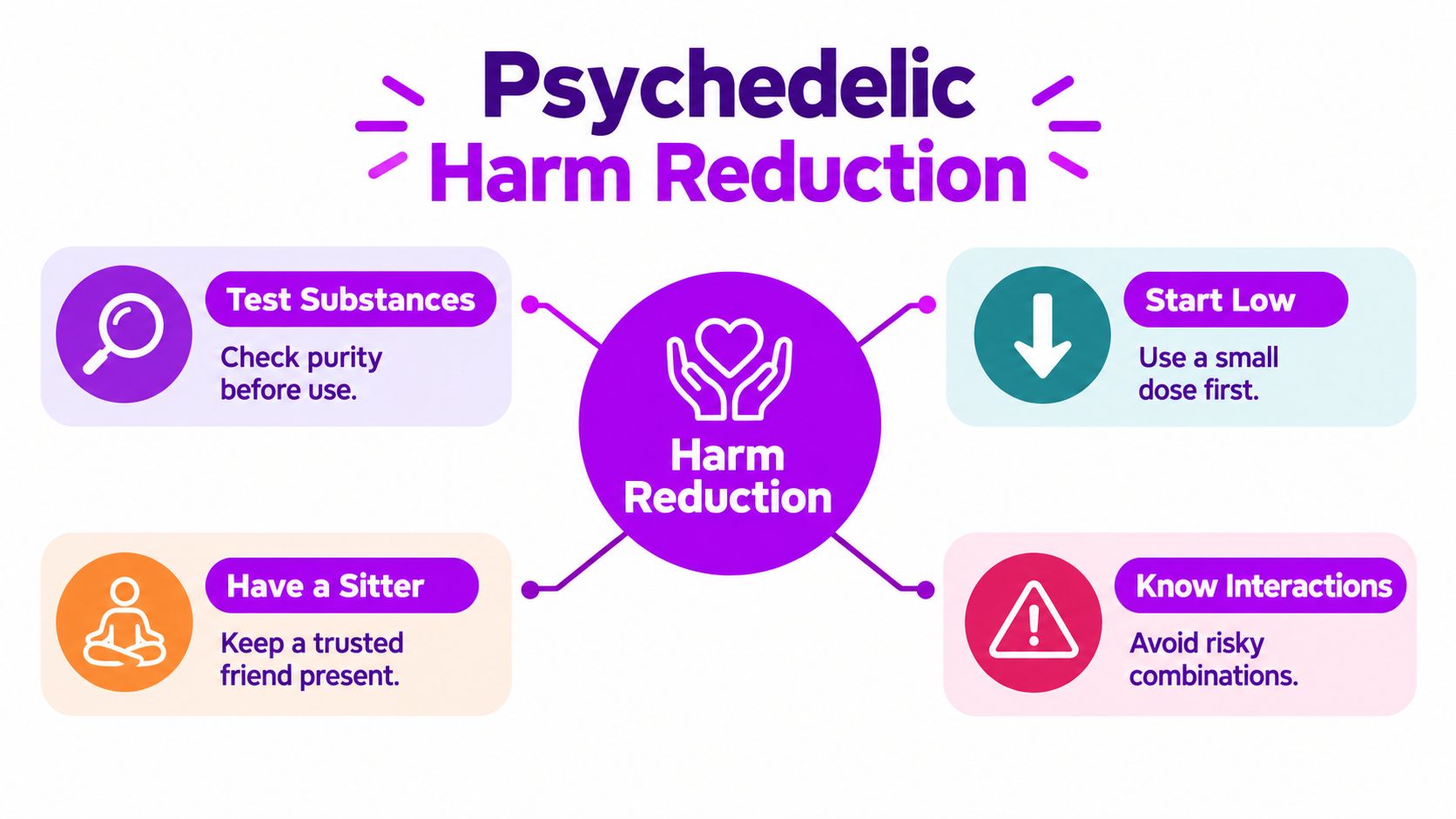
Three connected safeguards
Preparation records health flags, medication changes, mindset, setting, and who can help. Real-time support puts a sober, trusted person or nonjudgmental support line within reach, with reassurance and escalation treated as different jobs. Reflection writes down what happened, including difficult effects, so memory does not get promoted to evidence.
Each layer covers a gap the others leave open. A sitter cannot identify an unknown substance. A test cannot predict a psychological response. A journal cannot provide medical supervision. Written thresholds matter because fear, euphoria, and group loyalty can all sound reasonable in the moment.
That review found 27 relevant papers, but only four evaluated actual interventions. The practical lesson is disciplined modesty: use checklists, support, and care when risk factors or serious symptoms appear, and treat any protocol that promises certainty as marketing.
Set, Setting, and the Pre-Session Checklist
Treat preparation as a pre-flight check, not a mood board. "Set" covers mindset and recent circumstances: how you've been sleeping, whether anxiety or irritability is already heightened, and whether you're emotionally steady enough to pause. "Setting" means the physical and social environment: somewhere familiar, a calm space, and a sober, trusted person who understands the plan.
Check the personal-health side too. Cardiovascular symptoms, significant psychiatric history, and recent medication or supplement changes all matter. Schizophrenia, prior psychosis, bipolar disorder, borderline personality disorder, pregnancy, breastfeeding, and uncontrolled cardiovascular disease are generally excluded from supervised psilocybin trials or raise substantial safety concerns. That means the safety findings from controlled studies can't be applied to people with those histories. Seek qualified medical advice rather than treating unsupervised use as equivalent to clinical care. A clinical review of psilocybin safety and exclusions discusses these concerns.
A screening card you can save
Clinical protocols commonly screen for cardiovascular and psychiatric exclusions, establish baseline vital signs, and monitor participants during sessions. In one protocol, readings above 140/90 mmHg led to repeat measurements and possible physician review. That's an example of clinical monitoring, not a do-it-yourself rule for deciding whether you're safe to proceed. The protocol describes its measurement and review process.
| Personal or medical factor | Why it matters | Recommended next step |
|---|---|---|
| Psychiatric history or emerging symptoms | Some histories raise concern about severe distress or psychosis | Pause and consult a qualified clinician |
| Cardiovascular disease or concerning symptoms | The experience may involve temporary cardiovascular effects | Get professional advice before considering exposure |
| Pregnancy or breastfeeding | Safety evidence is insufficient | Avoid unsupervised use and consult a clinician |
| Medication or supplement changes | Interactions may alter effects or acute risk | Ask a clinician or pharmacist to review the full list |
| Poor sleep, heightened anxiety, or an unstable setting | Distress may be harder to manage | Postpone rather than trying to push through |
Before any session, write down four confirmations: you know what substance you believe you have and what you don't know about its potency; a sober support person has agreed to be present; you have a contact or escalation plan; and a clinician or pharmacist has reviewed medication concerns. If you're weighing the emotional and environmental parts of preparation, this practical guide to set and setting can help structure that reflection.
Medication Interactions You Should Not Guess About
Medication screening isn't a footnote. A person can misread a muted effect as evidence they should take more, or a stronger-than-expected response as a personal quirk, when medication exposure may be relevant. Don't change a dose to compensate for an effect you can't explain. Ask a clinician or pharmacist to review the medication list first.
U.S. FDA guidance reports that sustained use of SSRIs, SNRIs, or MAOIs may reduce psychedelic effects. Tricyclic antidepressants or lithium may potentiate effects and raise psychiatric-safety concerns. Combining MAOIs with MDMA or other amphetamine-like psychedelics can produce life-threatening hypertension. FDA guidance on drug-interaction considerations also makes clear why individual medication decisions belong with a qualified professional.
Think of medication combinations like household chemicals: products that are safe when used separately can become dangerous when combined. The analogy has limits, but the practical rule holds. Don't test a combination casually, and don't stop prescribed medication abruptly to try to change an experience. Discontinuation can cause serious harm in its own right.
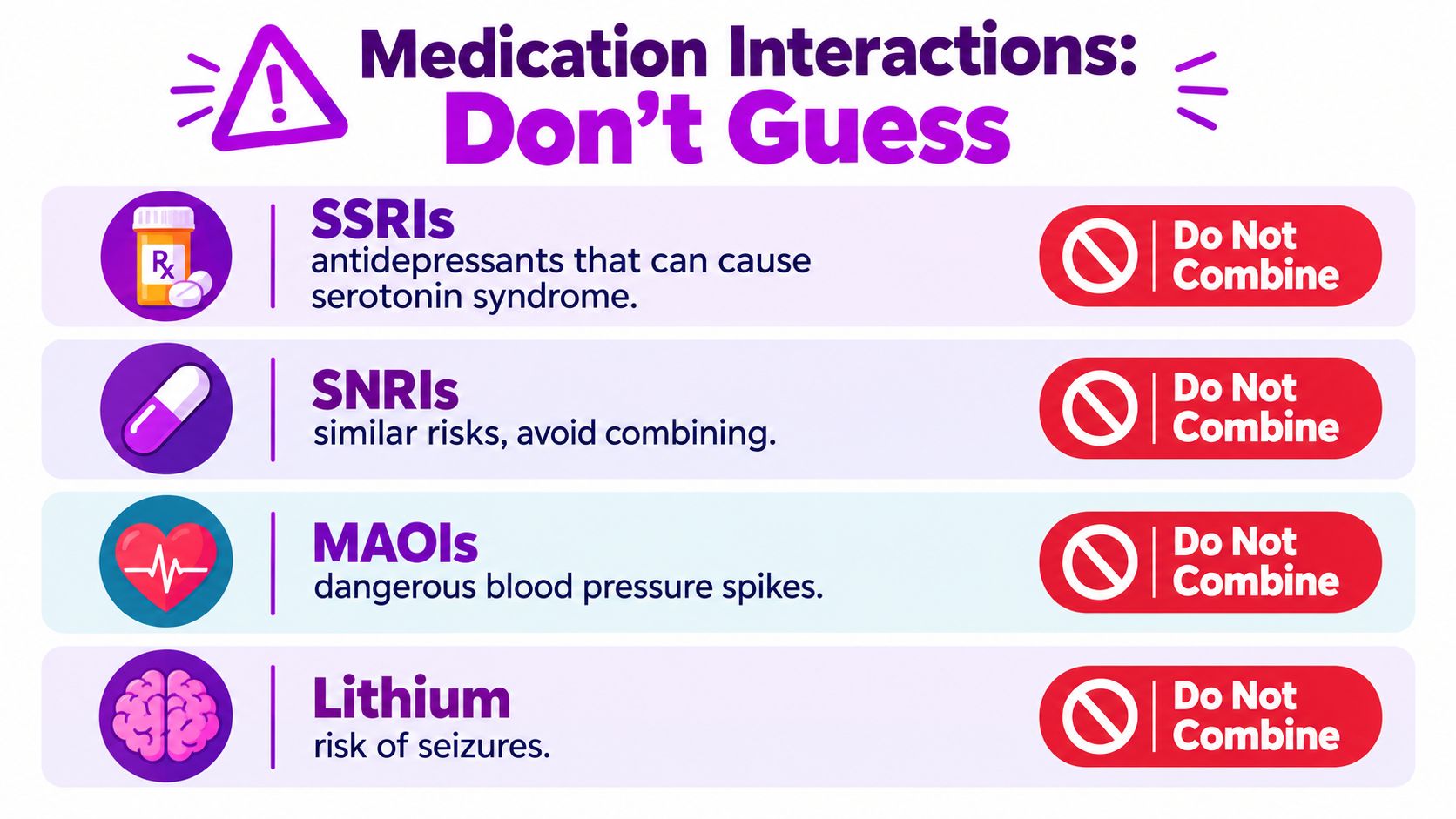
Record exposure, not just the outcome
A useful log records the medication or supplement name, prescribed or usual dose, timing of the last dose, and any recent changes. Include caffeine and other stimulants in the conversation with a clinician, since they can add to cardiovascular strain. Timing matters because effects and interaction risks may depend on how long a medication has been taken, not just whether it appears on today's list.
A weak effect isn't a signal to increase a dose. A strong effect isn't proof that a medication is safe to combine next time. The cautious step is to get the list reviewed and follow medical advice. For a focused discussion of mushrooms and antidepressants, use information as a prompt for that conversation, not as a substitute for it.
Substance Verification, Support Lines, and Real-Time Help
Substance checking and emotional support do different jobs. A checking service or reagent test can help reveal that a sample may not be what someone expected. It can't guarantee purity, establish a safe dose, or tell you how your body will respond. A support line can help someone stay oriented and less alone during distress, but it can't identify a substance or replace emergency medical care.
Unexpected contents are a real uncertainty, so appearance and a supplier's confidence are weak evidence. A review of psychedelic harm reduction found that psychedelics made up only a small share of samples submitted to drug-checking services, and it documented unexpected psychedelic substances and adulteration, including amphetamine in some LSD samples in the Netherlands. Checking works as one layer of a decision, with a result written down before the session rather than trusted to memory.
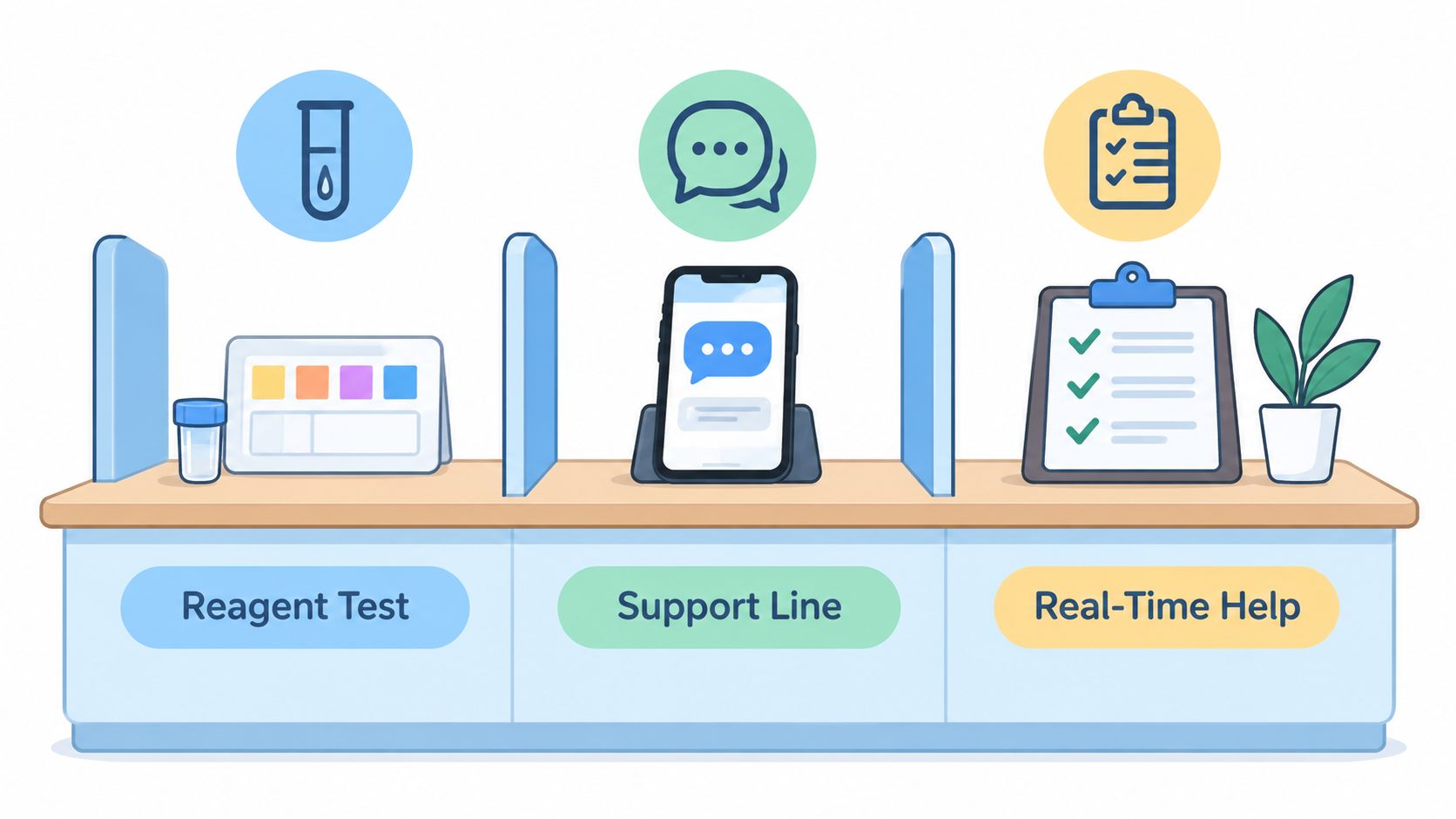
Make the support plan before distress starts
As noted earlier, the same review reports helpline findings worth knowing about. In a study of a psychedelic-support helpline, most callers said the service helped de-escalate psychological, mental, or physical distress, and a substantial share said they might otherwise have been harmed without it. That supports nonjudgmental, real-time help as a practical layer of care. It does not replace abstinence or medical treatment.
Before an experience, find out what checking services exist locally and save the number for a nonjudgmental support line. Write both down somewhere your sober support person can find without asking you. If services aren't available, don't treat that absence as a reason to proceed alone. Postponing is a valid safety decision.
Make the call easy before you need it. Agree on who calls, what information they'll share, and what symptoms mean they won't wait for a support-line conversation.
Warning Signs That Mean Stop, Call, or Seek Care
The hardest call during a supported session is rarely spotting distress. It is knowing when calm reassurance stops being enough. Decide that line before the session, while everyone is sober and thinking clearly.
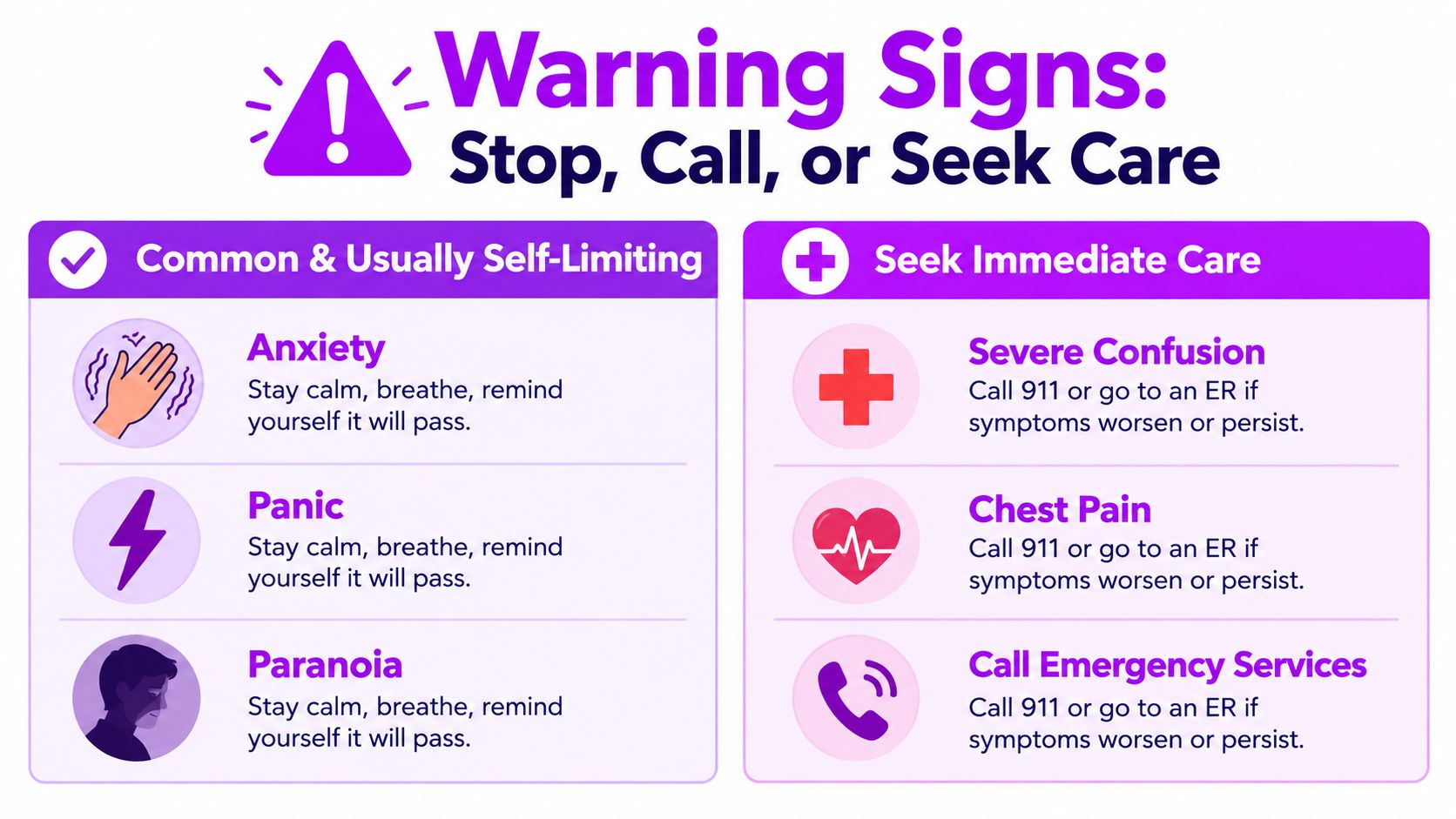
Anxiety, panic, and paranoia are frightening. In a global survey of past-year magic-mushroom users, they were the most commonly reported symptoms among people who sought emergency medical treatment. A sober sitter lowers stimulation, speaks in short calm sentences, helps the person reorient to the room, and calls a support line if distress keeps climbing.
Reassurance ends where safety questions begin.
| What you notice | What to do |
|---|---|
| Anxiety, panic, or paranoia, with the person still responsive and physically safe | Reduce noise and stimulation; stay with them; use calm, simple reassurance |
| Persistent confusion, severe agitation, or inability to remain safe | Call emergency services or seek urgent medical care |
| Chest pain, fainting, breathing difficulty, severe headache, or concerning sustained blood pressure | Seek urgent medical evaluation |
| Seizures, dangerous overheating, loss of consciousness, or worsening symptoms | Call emergency services immediately |
Cardiovascular symptoms deserve particular caution. In a systematic review of cardiovascular effects in supervised psilocybin research, systolic blood pressure above 160 mmHg occurred in 34% of participants during high-dose sessions and 17% during low-dose sessions, with diastolic pressure above 100 mmHg in 13% and 2% respectively. Those readings came from monitored trials. Outside that setting, a concerning reading calls for urgent evaluation.
Experience with a substance does not soften severe symptoms. Persistent confusion, dangerous overheating, seizures, or an inability to stay safe warrant emergency care at any level of familiarity. A guide on recognizing a possible overdose on shrooms can sharpen your judgment, yet nothing online assesses the person in front of you. When in doubt, treat it as one.
If medics get involved, give them facts instead of guesses. A written note covering what was taken, when, what you observed, and what you did beats a panicked summary.
One longer-term signal belongs in your records as well. The Canadian cohort discussed earlier followed people after a hallucinogen-related emergency visit and found schizophrenia-spectrum diagnoses at rates well above the general population within three years. The association does not prove causation. It still justifies screening for personal or emerging psychosis risk with a clinician before any future use.
Two Sessions, Two Outcomes, What the Difference Looked Like
Consider two anonymized scenarios. In the first, someone has recently changed an SSRI prescription but hasn't discussed psychedelic use with a clinician. They interpret a weaker-than-expected effect as a reason to take more. Anxiety builds, the person gets stuck in a frightening loop, and concerning blood-pressure symptoms lead their friend to seek emergency care.
In the second, a person with a similar medication question pauses for a clinician or pharmacist to review the list rather than making a dosing decision alone. They agree in advance on a sober support person and know how to reach a support line. When anxiety rises, their friend reduces stimulation and stays present while they seek support. The distress settles over the next few hours without medical intervention.
These are illustrative scenarios, not clinical case reports, and preparation can't guarantee either outcome. A global survey found that 19 of 9,233 past-year magic-mushroom users reported emergency medical treatment, an estimated 0.06% risk per use event. The study relied on self-report and may underrepresent rare severe outcomes, so a low observed rate isn't a promise of safety. The survey findings also linked reported emergencies with poor mindset, poor setting, and mixing substances.
The practical difference between the scenarios begins before the experience. Prepare, log, observe, escalate. Preparation identifies questions worth resolving; a log captures medication timing and baseline context; observation notices changes; escalation means getting help when the situation crosses a pre-agreed threshold. Tracking can support clearer decisions. It can't verify a substance, diagnose illness, or provide medical supervision.
Tracking, Reflection, and Knowing When to Stop
A useful record captures more than dose details. Note sleep, mood, anxiety, irritability, perceptual changes, physical symptoms, medication changes, and what happens on non-dose days. That context can help distinguish a short-lived effect from a pattern that calls for a pause or professional review.
Don't use a mood improvement as proof that dosing caused it. Expectancy, a change in routine, or regression to the mean can all shape what someone notices. Tracking is for safer self-observation, not proof of benefit or a substitute for care. A 2025 scoping review found 27 relevant papers on psychedelic harm reduction and only four intervention-based studies, while microdosing safety evidence remained heterogeneous with insufficient evidence about sustained effects. The review of current harm-reduction evidence is a reminder to keep conclusions modest.
Stop self-experimenting and involve a qualified clinician if you have an existing psychiatric diagnosis, cardiovascular disease, are pregnant or breastfeeding, take psychiatric or cardiovascular medication, or notice that the experience is no longer manageable. Severe symptoms, suicidal thoughts, mania, psychosis risk, or medication-interaction concerns need professional care, not another entry in a tracker.
The commitments are straightforward: screen carefully, avoid guessing about combinations, arrange sober support, record what happens, and seek help when warning signs appear. A journal can organize information, but it can't tell you that you're medically safe.
MicroTrack gives you a structured space to record dose details, mood, sleep, sensations, side effects, and later reflections, then review patterns over time. Use a journal to support more careful self-observation, not to replace medical advice or emergency care; visit MicroTrack to learn more.