Rhodiola Rosea Benefits and Side Effects Guide
The popular advice to take rhodiola whenever you feel stressed skips the most important question: what's causing the stress and fatigue? A supplement experiment for a tiring workweek is a different decision from self-treating depression, panic, or trauma symptoms. Calling a product natural doesn't make those decisions interchangeable.
A useful guide to Rhodiola rosea benefits and side effects should help you decide whether to leave the bottle alone, ask a pharmacist, or try a short, carefully tracked experiment. The aim isn't to feel stimulated. It's to find out whether one clearly identified product makes one mild symptom meaningfully better without disrupting sleep or creating a medication problem.
Table of Contents
- Rhodiola Rosea Benefits the Evidence Actually Supports
- How Rhodiola Acts More Like a Thermostat Than a Stimulant
- Doses Used in Studies and on Labels
- Side Effects and Drug Interactions Worth Screening
- What Side Effects Looked Like in Real Trials
- Who Gets a Green Light and How to Trial It
Rhodiola Rosea Benefits the Evidence Actually Supports
Rhodiola's most defensible potential benefit is modest relief of stress-related fatigue, and even that result is inconsistent. It isn't a proven treatment for mood disorders or a dependable way to improve performance.
What rhodiola trials support by outcome
| Outcome | Doses in the evidence | What trials found | How to read it |
|---|---|---|---|
| Stress-related fatigue | About 100–576 mg/day in mental-fatigue studies; 200 or 680 mg/day in some physical studies | Possible benefits, but the systematic review of fatigue trials included 11 studies and 446 participants and couldn't establish firm effectiveness | A personal response to one extract, not a guaranteed effect |
| Mental performance | Roughly the mental-fatigue range above | Four of 11 placebo-controlled trials examined mental performance in a review of clinical evidence; findings remained preliminary | Score one real task, not a vague sense of focus |
| Mild-to-moderate depression symptoms | 340 or 680 mg/day SHR-5 for six weeks; a separate 12-week comparison with sertraline | The same clinical review describes improvements in insomnia, emotional instability, and somatization in 89 adults aged 18–70; in 57 people, reported improvement odds were 1.4 for rhodiola versus 1.9 for sertraline | Investigational adjunct, not a replacement for treatment |
| Physical performance | 200 mg/day and 680 mg/day where positive findings occurred | Six of the placebo-controlled trials examined physical performance; study quality and extracts differed | Don't add stimulants to force a performance effect |
| Severe depression, PTSD, or anxiety disorders | Not established | Only two trials in the clinical review enrolled diagnosed mental-health conditions; broader results conflict | Get clinical care rather than self-treating |
Why a positive trial doesn't predict your bottle
The fatigue review found substantial differences in extract preparations, doses, study quality, and outcome measures. Those differences matter because a change in a laboratory attention test isn't necessarily a noticeable improvement in an ordinary workday.
There's also a useful negative example. A controlled-study evidence summary describes a shift-working nursing-student trial using 364 mg of extract standardized to 2.8% rosavins that didn't establish a reliable fatigue benefit. A promising result with another preparation doesn't cancel that result, and neither result applies automatically to every supplement labeled rhodiola.
The practical distinction is between possible benefit and predictable benefit. You can reasonably investigate a possibility without treating it as a promise.
Practical rule: Choose an observable outcome before choosing a supplement. Less end-of-workday fatigue is testable; feeling optimized isn't.
Keep mood-treatment claims in their proper place
The depression findings justify further investigation, not a switch away from established treatment. Improvement within an active-treatment group doesn't demonstrate superiority over placebo, and the numerical comparison with sertraline doesn't establish equivalent effectiveness.
A review discussing rhodiola's mental-health evidence describes conflicting clinical results and emphasizes that findings in mild-to-moderate depression don't establish efficacy for severe depression, PTSD, suicidality, or generalized anxiety. Symptom severity is therefore part of the decision, not an afterthought.
If you're also considering lion's mane fungus, evaluate that separately rather than starting both together. Otherwise, a better or worse week won't tell you which product mattered.
For mild stress fatigue, the useful experiment pairs one standardized product with one symptom for a limited period. For depression, trauma symptoms, or anxiety that interferes with daily life, the useful next step is professional assessment.
How Rhodiola Acts More Like a Thermostat Than a Stimulant
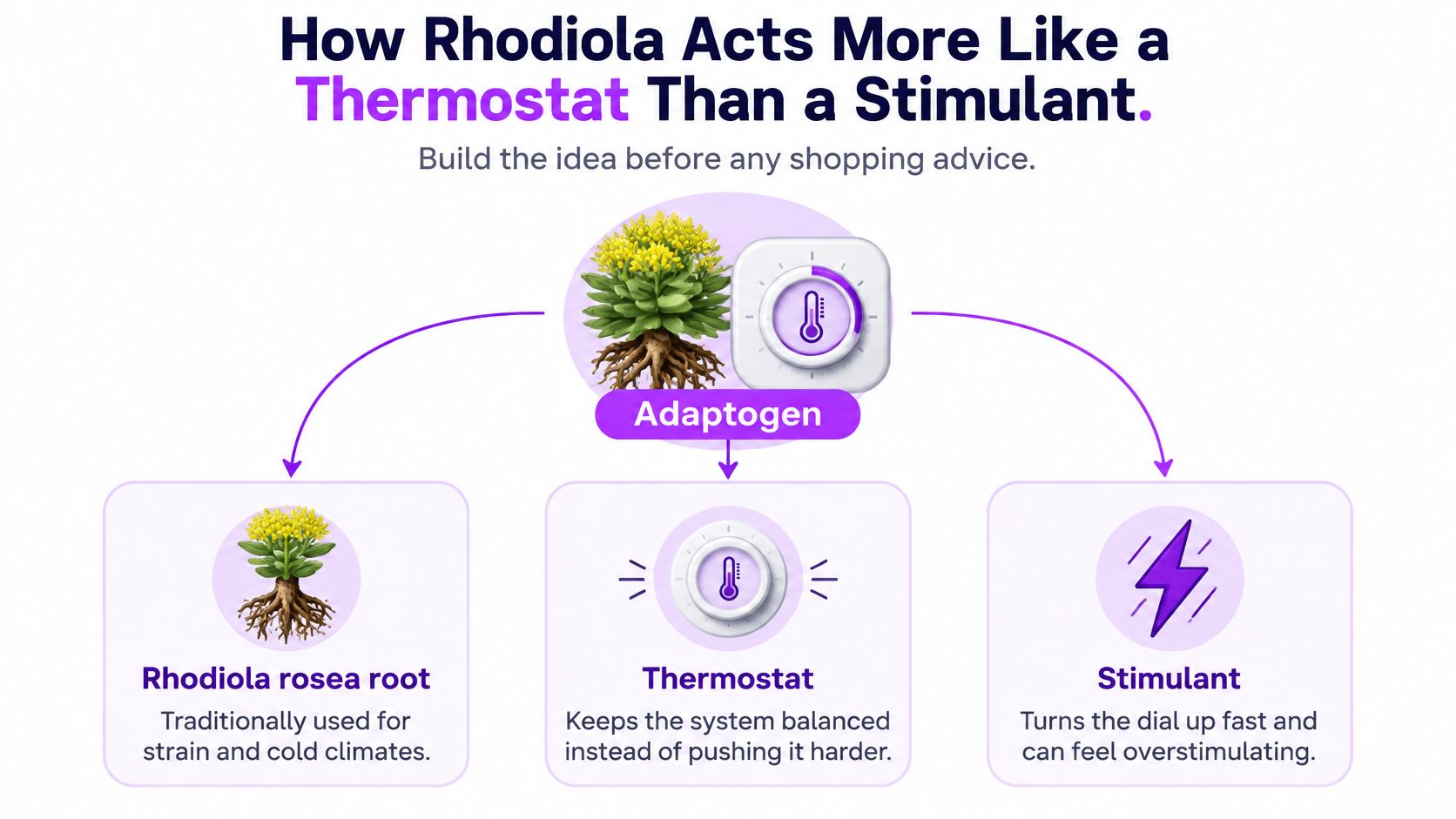
Think of a stimulant as turning the heating dial upward. The thermostat analogy for an adaptogen is different: the proposed aim is to help a stressed system settle rather than push it harder.
Rhodiola rosea is a root traditionally associated with coping with strain in cold climates and is now sold as an adaptogen. That term describes a proposed role, not a guarantee that the product restores balance or is safe for everyone.
The diagram makes the analogy concrete, but it shouldn't be read as proof of a physiological reset.
What the analogy explains, and what it doesn't
Proposed actions include changes in stress-response signaling, cellular energy use, and mood-related chemical messengers called monoamines. These are possible explanations for an effect, not confirmation that a capsule will improve your energy or mood.
The thermostat picture also has a limit. Rhodiola can still feel activating, so the adaptogen label shouldn't persuade you to dismiss restlessness or poor sleep as signs that it's working.
Say a nurse on rotating shifts tries a morning capsule. The useful observation is whether fatigue at the end of comparable shifts changes, alongside sleep and workload. A tingle after swallowing, or an unusually energetic morning, isn't the outcome she set out to measure.
A plausible mechanism can explain a finding. It can't substitute for a finding.
Why the extract matters
Rosavins and salidroside are the marker groups readers will encounter on labels. Standardized extracts, including studied preparations such as SHR-5, use declared specifications to make the preparation more identifiable.
A root powder, a tea, and a standardized capsule aren't interchangeable just because they share a plant name. For a hypothetical label comparison, a capsule declaring 3% rosavins and 1% salidroside gives more specific information than a package that says only root powder. Those example percentages aren't a universal target or proof of superior quality.
Before taking anything, record:
- Extract name: Include the named preparation, not just the brand.
- Marker specifications: Copy the rosavin and salidroside percentages exactly.
- Extract amount: Record milligrams per capsule and the intended daily amount.
A higher marker percentage isn't automatically better. These details matter because any later observation belongs to that particular preparation, not to rhodiola as an entire category.
Doses Used in Studies and on Labels
A dose used in a trial is a description, not a personalized prescription. The table is useful for checking what a label means, not for choosing the largest amount researchers have tried.
Rhodiola doses in references and trials
| Source | Amount | Schedule | Note |
|---|---|---|---|
| Egyptian herbal monograph | 144–200 mg single dose; 144–400 mg daily | Keep the total within that daily range | A reference range, not a promise of effect |
| Four-week clinical study described in the monograph | 400 mg/day | 200 mg twice daily | Mostly mild events; no serious events reported |
| SHR-5 depression trial | 340 or 680 mg/day | Daily for six weeks | Both active doses improved depression-related measures versus placebo |
| Nursing-student fatigue trial | 364 mg initially, optional additional capsule producing up to 546 mg/day | At waking, extra dose within four hours, for 42 days; most used 364 mg | Standardized to 2.8% rosavins |
| Commercial products in study reviews summarized by the monograph | 50–660 mg per capsule; up to 1,500 mg/day | Product-specific capsule counts and schedules | A studied high dose isn't a reason to take more |
| NCCIH duration guidance | No single approved dose | Possibly safe for up to 12 weeks | Not evidence for indefinite daily use |
Check the bottle before calculating the dose
Start with the serving size. A front label may advertise the amount in a serving rather than the amount in each capsule, so read the supplement panel before doing the arithmetic.
Then check these details:
- Total daily extract: Multiply the amount per capsule by the number you intend to take.
- Standardization: Look for declared rosavin and salidroside specifications, not just a prominent milligram figure.
- Timing: Establish whether the intended amount is taken in the morning or divided across the waking day.
- Duration: Write down when you'll evaluate the result and stop, rather than letting a bottle become an automatic refill.
The trial doses for depression aren't an invitation to reproduce psychiatric treatment at home. Likewise, a high dose from a commercial-product review doesn't establish that the dose was helpful or appropriate for everyday fatigue.
A capsule-count example
Suppose a hypothetical bottle contains 200 mg per capsule. Taking one capsule in the morning and another at midday gives 400 mg/day; taking a capsule on three occasions gives 600 mg/day, which exceeds the monograph's daily reference range.
That example is arithmetic, not a recommendation to take the product twice daily. The timing and amount still need to fit the individual, the extract, and any professional advice.
Don't raise the dose because the first week feels unremarkable. More milligrams don't reliably mean more benefit, and escalating the amount makes it harder to interpret emerging side effects.
A proprietary blend containing caffeine creates another problem: even if you feel more alert, you can't confidently attribute that change to rhodiola. If the bottle hides the extract identity, marker specifications, or individual ingredient amounts, it can't be meaningfully matched to the study preparations.
Side Effects and Drug Interactions Worth Screening
The most important safety question isn't whether rhodiola can cause a headache. It's whether your medicines or health conditions make an otherwise mild effect consequential.
The short-term fatigue evidence summarized in Merck's rhodiola safety guidance included 446 participants, with only five adverse events reported across three studies, including headache. Sparse reporting doesn't establish that combinations with prescription medicines are safe.
Use this checklist before treating rhodiola as a low-risk wellness purchase.
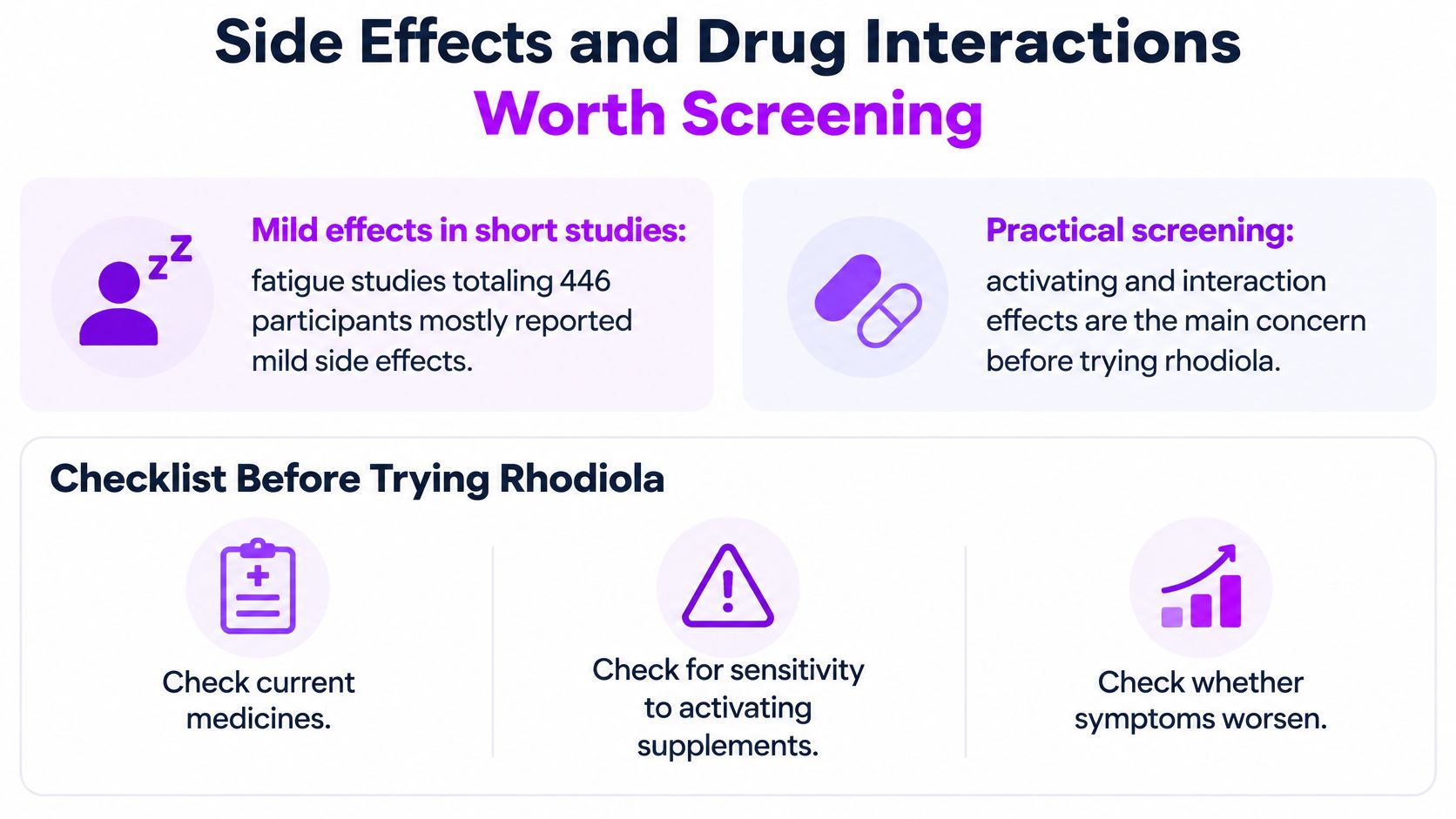
Medicines and conditions that change the decision
Merck describes possible dry mouth or excessive salivation, blood-pressure and blood-glucose lowering, and increased heart rate or serotonin-related toxicity with serotonergic antidepressants. The European Medicines Agency assessment identifies reported headache, nervousness, insomnia, dizziness, nausea, and vomiting, alongside concerns about insufficient safety evidence in vulnerable groups.
Who should get a clinician review first
| Situation | Why it matters | Action |
|---|---|---|
| SSRI or other serotonergic antidepressant | Possible fast heart rate or serotonin-related toxicity | Ask a pharmacist or prescriber; don't stop the prescription to try rhodiola |
| MAOI | Concern about activating effects and serotonergic overlap | Don't combine unless a prescriber explicitly clears it |
| Stimulants or a high-caffeine stack | Potential added nervousness, insomnia, or palpitations | Get the combination reviewed; morning dosing doesn't make a risky stack safe |
| Losartan or other blood-pressure medicine | A losartan interaction has been reported; possible additional pressure lowering | Ask a pharmacist first and agree on appropriate pressure checks |
| Insulin or other glucose-lowering drug | Possible blood-glucose lowering | Use only with the prescriber's monitoring plan |
| Warfarin, phenytoin, or another narrow-therapeutic-index drug | Possible CYP2C9 or CYP3A4 effects; clinical importance remains uncertain | Don't start without clinician review |
| Pregnancy, breastfeeding, or under 18 | Insufficient evidence; use isn't recommended | Don't use |
| Autoimmune disease or immunosuppressant | Theoretical immune stimulation could worsen disease or oppose treatment | Discuss with the treating clinician |
The enzyme names in the table refer to pathways the body uses to process medicines. A possible laboratory effect doesn't prove a clinically important interaction, but uncertainty is especially relevant when small changes in a medicine's exposure could matter.
Bring the actual bottle and a complete medication list to the pharmacist. Include nonprescription anti-inflammatory medicines, other supplements, caffeine products, and the times you take them.
Don't mistake activation for recovery
Feeling wired isn't the same as recovering from fatigue. If you need progressively more caffeine to manage sleep disrupted by a supplement, the experiment has moved away from its original purpose.
Readers exploring natural alternatives to anxiety medication should keep the same boundary: natural products don't bypass medication screening or replace an assessment.
Introduce only one new product at a time and avoid late-day dosing. Stop if insomnia, agitation, palpitations, dizziness, or gastrointestinal symptoms appear; seek medical advice rather than trying to counteract the reaction with another supplement.
What Side Effects Looked Like in Real Trials
Nursing students on clinical shifts make a useful test case, because sleep loss and heavy workload already produce headaches, nausea, and poor concentration on their own. A controlled trial in that setting works like a thermostat with a reference sensor: it separates a complaint that happened during supplementation from a complaint caused by it.
This illustration reflects the practical setting: morning dosing followed by observations during a demanding day.
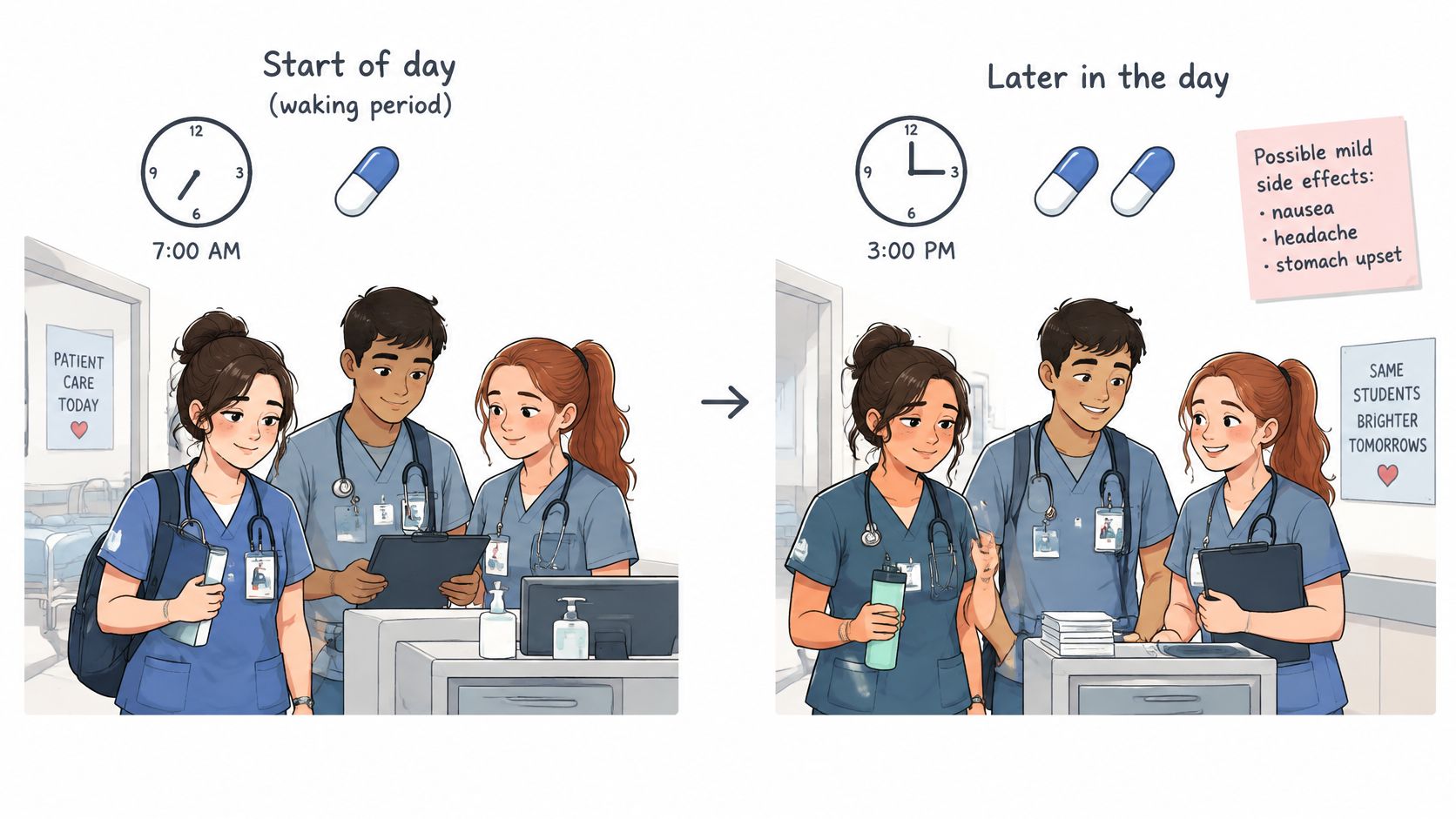
Matching event counts don't establish universal safety
In the randomized nursing-student trial, participants took 364 mg at waking, with an optional additional capsule within four hours, allowing 364–546 mg/day over 42 days; most stayed at the initial dose. The rhodiola and placebo groups each reported 10 adverse events among six participants.
Reported complaints included headache, nausea or diarrhea, dark stool, blurred vision, and light-headedness. The safety-monitoring board found no safety concerns. That conclusion covers the monitored trial population, not every future user or medication combination.
For an individual student, a headache after a night shift could reflect the shift, the capsule, or something unrelated. Equal event counts across groups are exactly what you would expect if most complaints came from the setting rather than the supplement.
Open-label reports answer a different question
Remove the placebo group and the measurement changes meaning. Open-label studies collect every complaint participants mention, so what they produce is a reporting rate: how often people describe symptoms while taking a product. Without a comparison group, that figure can't show how many of the same complaints would have appeared anyway, so a high reporting rate doesn't prove rhodiola caused the reactions.
Context also limits how far findings travel. A 2025 meta-analysis of standardized rhodiola injections in heart failure with reduced ejection fraction found no statistically significant increase in adverse reactions versus standard treatment, with a risk ratio of 0.86. Reassuring for that hospital population, it says little about a wellness capsule taken at home.
For an additional perspective, the following video can accompany the written evidence, not replace medication review.
Record what happened before deciding why it happened.
A useful journal entry captures the symptom, its timing, your dose, sleep, workload, and what else you took that day. Patterns across several entries carry more weight than a single rough day, and a rising pattern of complaints is a reason to end the experiment rather than keep gathering data.
Who Gets a Green Light and How to Trial It
A green light means an experiment may be reasonable, not that benefit or safety is guaranteed. Start by identifying reasons not to begin.
Skip a self-directed trial during pregnancy or breastfeeding, for children or adolescents, or while using a potentially interacting medicine. Antidepressants, MAOIs, stimulant stacks, blood-pressure or glucose-lowering medicines, warfarin, phenytoin, and autoimmune treatments all warrant professional review rather than personal experimentation.
The National Center for Complementary and Integrative Health describes rhodiola as possibly safe for up to 12 weeks, lists dizziness, headache, insomnia, dry mouth, and excessive saliva as possible effects, and notes a reported interaction with losartan. Possibly safe is a qualified short-term statement, not permission for indefinite daily use.
Sort the symptom before selecting the product
Green means mild daytime fatigue clearly associated with ordinary stress, no medicine or condition that needs clearance, and no troubling change in mental or physical health. You're functioning, but you want to test whether the end of the day feels less draining.
Red means symptoms that need assessment. Daily panic, intrusive trauma symptoms, persistent low mood with major disruption to sleep or appetite, or an inability to manage ordinary responsibilities shouldn't become a supplement dose-finding exercise.
Thoughts of self-harm require immediate support through local emergency services or a crisis service. Don't wait to see whether an herb changes how you feel.
Unexplained, worsening, or persistent fatigue also deserves clinical attention. A supplement trial can't tell you whether tiredness has an underlying medical cause.
Decision boundary: When symptoms interfere with safety or basic functioning, arrange care instead of raising the dose.
Run a defined experiment only after the screen is clear
Choose one identifiable extract and write a stop date. Look for the extract name, milligrams, and both marker specifications. If a clinician or pharmacist agrees that a trial is appropriate, use a low morning amount within the monograph reference range rather than trying to reproduce a high-dose study.
Keep caffeine, other supplements, and your ordinary routine as stable as practical. Don't add another energy product because you're impatient for a result. If your workload or sleep changes substantially, record that change rather than pretending the comparison is clean.
Choose a brief observation window and one outcome. For a practical trial, you might plan two to four weeks of observation, with any longer use requiring review rather than an automatic extension. Score fatigue before the dose and at a consistent later point, or record a repeatable task such as completing a routine proofreading assignment with fewer interruptions.
Stop for insomnia, agitation, palpitations, dizziness, or stomach symptoms. Don't deliberately repeat a concerning reaction to test whether it happens again. A suspected interaction belongs with a pharmacist or clinician.
End an unhelpful trial instead of escalating. Decide beforehand what would count as worthwhile, such as a noticeable improvement in the chosen task without worse sleep. If the result is ambiguous or trivial, stopping is a useful conclusion.
Make the record useful without treating it as a diagnosis
A simple entry can include the product, dose time, fatigue before and later in the day, sleep, workload, and any new symptom. Keep descriptions concrete: difficulty falling asleep is more useful than bad reaction, and finished the usual task without an extra break is more useful than better focus.
In MicroTrack, our journal entries can include mood, dosage, sensations, and side effects, allowing those observations to sit beside a dated note. The record supports reflection; it doesn't diagnose a condition or establish that rhodiola caused a change.
Understanding correlation versus causation helps prevent overconfidence when a better week follows a new capsule. A quieter workload, improved sleep, or expectation may also explain the difference.
Finish with a dated decision: stop, seek professional review, or complete the already-defined observation window. Don't let uncertainty turn a short experiment into an open-ended habit.
MicroTrack offers a place to record mood, dosage, sensations, and side effects while you evaluate a carefully screened rhodiola trial. Visit MicroTrack to keep your observations together and write down your review date, chosen symptom, and reasons to stop before you begin.