Standardized Assessment Tool: A Practitioner's Guide
PHQ-9 and GAD-7 are the two most widely validated standardized assessment tools for depression and anxiety screening, and tools in this class often show Cronbach's alpha around 0.80, which is commonly interpreted as about 80 percent reliability and 20 percent measurement error in classical test theory. Standardized scoring beats intuitive self-reporting because it can reveal patterns your day-to-day feeling state won't catch.
The most popular advice in microdosing circles is still some version of “just listen to your body.” That sounds wise, but it breaks down fast when you're trying to separate a dosing effect from poor sleep, conflict, hormonal shifts, workload, or plain expectancy.
I've seen the same pattern in clinical assessment and in wellness tracking. People trust memory far more than memory deserves. They remember the good dosing days, smooth over the flat ones, and build a story that feels coherent but doesn't survive repeated measurement. A standardized assessment tool doesn't replace self-awareness. It gives self-awareness a fixed frame, so you can compare one week to the next without rewriting the past every time your mood changes.
Table of Contents
- Why Intuition Fails You as a Microdosers Tracker
- What Standardization Actually Means in Practice
- Psychometric Basics You Need Before You Score
- Validated Instruments for Mood and Anxiety Tracking
- How to Choose and Run a Standardized Assessment Protocol
- Integrating Scores into Daily Tracking Workflows
- Limitations, Bias, and Ethical Privacy Considerations
- Practical Templates and Sample Protocols
Why Intuition Fails You as a Microdosers Tracker
Starting with unstructured notes is common. “Felt lighter today.” “Bit anxious.” “Dose worked.” That's useful for reflection, but it's weak for comparison.
The problem isn't that you're careless. The problem is that your internal reference point keeps moving. A hard workday can make a normal mood feel low. A hopeful morning can make mild anxiety feel manageable. By the end of the week, you don't have a stable record. You have a narrative.

The failure mode most trackers miss
In microdosing practice, the most common mistake is misattribution. Someone starts a protocol, has a better week, and credits the dose. Then you look closer and see they also slept better, exercised, or finished a stressful project. The reverse happens too. A person blames the dose for feeling flat when they were already sliding before the dosing day.
A structured scale helps because it forces the same question to be asked the same way each time. That creates an external anchor.
Practical rule: If you can't compare today's score with last week's score under roughly the same conditions, you're not tracking a pattern. You're documenting impressions.
Why standardized tools became central
This isn't a fringe idea imported into self-tracking. Standardized assessment became a major institutional practice during World War I, when psychologists developed the Army Alpha Examination to screen recruits, helping move standardized testing from a niche psychological method into a large-scale selection system and later influencing civilian testing in schools and colleges, as outlined in this history of the Army Alpha Examination and the SAT's early mass testing role.
That history matters because the core benefit hasn't changed. Standardization lets different people, times, and settings become comparable.
What actually helps
For personal mood tracking, intuition works best as context, not as the main measurement system. Use free-text notes for events and interpretation. Use a standardized tool for the score itself.
A better stack looks like this:
- Fixed questions: Use the same validated mood or anxiety instrument each check-in.
- Stable timing: Complete it at the same point in your day or dosing cycle.
- Short context note: Record anything obvious that could affect the score, such as illness, conflict, travel, or poor sleep.
That combination catches subtle weekly drift far better than gut feel alone.
What Standardization Actually Means in Practice
People often use “standardized” to mean “formal” or “scientific-looking.” That's too vague. In practice, standardization means every respondent receives the same items, instructions, response options, and scoring rules, which reduces construct-irrelevant variance and improves comparability across sites and populations. Many validated tools also interpret scores against representative norms or criterion thresholds rather than relying on subjective judgment alone, as explained in this practical guide to psychometric concepts.
The plain-English version
If you change the wording, the response scale, the timeframe, or the scoring method, you may no longer be measuring the same thing.
That's why a diary entry and a standardized assessment tool are not interchangeable. A diary captures experience. A standardized instrument produces a score that can be compared across time.
Think about a bathroom scale. It works because you step on the same device under roughly the same conditions and get a number from a fixed system. If each weigh-in used a different scale, different unit, and different instructions, the trend would be meaningless. Mood tracking works the same way.
What you should keep fixed
Here's the practical distinction that matters most for self-trackers.
| Element | What Stays Fixed | What You Can Adapt |
|---|---|---|
| Items | The exact questions | Whether you complete them on paper, in a notes app, or digitally |
| Instructions | The official prompt and timeframe | A brief reminder for yourself about when to complete it |
| Response options | The original answer choices | The format of entry, such as tap, checkbox, or manual log |
| Scoring rules | The same scoring method every time | Whether you graph the raw total or review it in a journal |
| Interpretation | The same threshold logic | Whether you pair the score with notes about dosing or life events |
Standardized doesn't mean automatically fair
Many guides stop too early. A tool can be tightly standardized and still fit your life poorly.
If the instrument was normed on people unlike you, the score may still be limited. If the language feels culturally off, overly clinical, or hard to map onto your lived experience, that's not just annoyance. It can distort your answers.
So the working rule is simple. Keep administration stable, but stay critical about whether the instrument fits the population and purpose.
Psychometric Basics You Need Before You Score
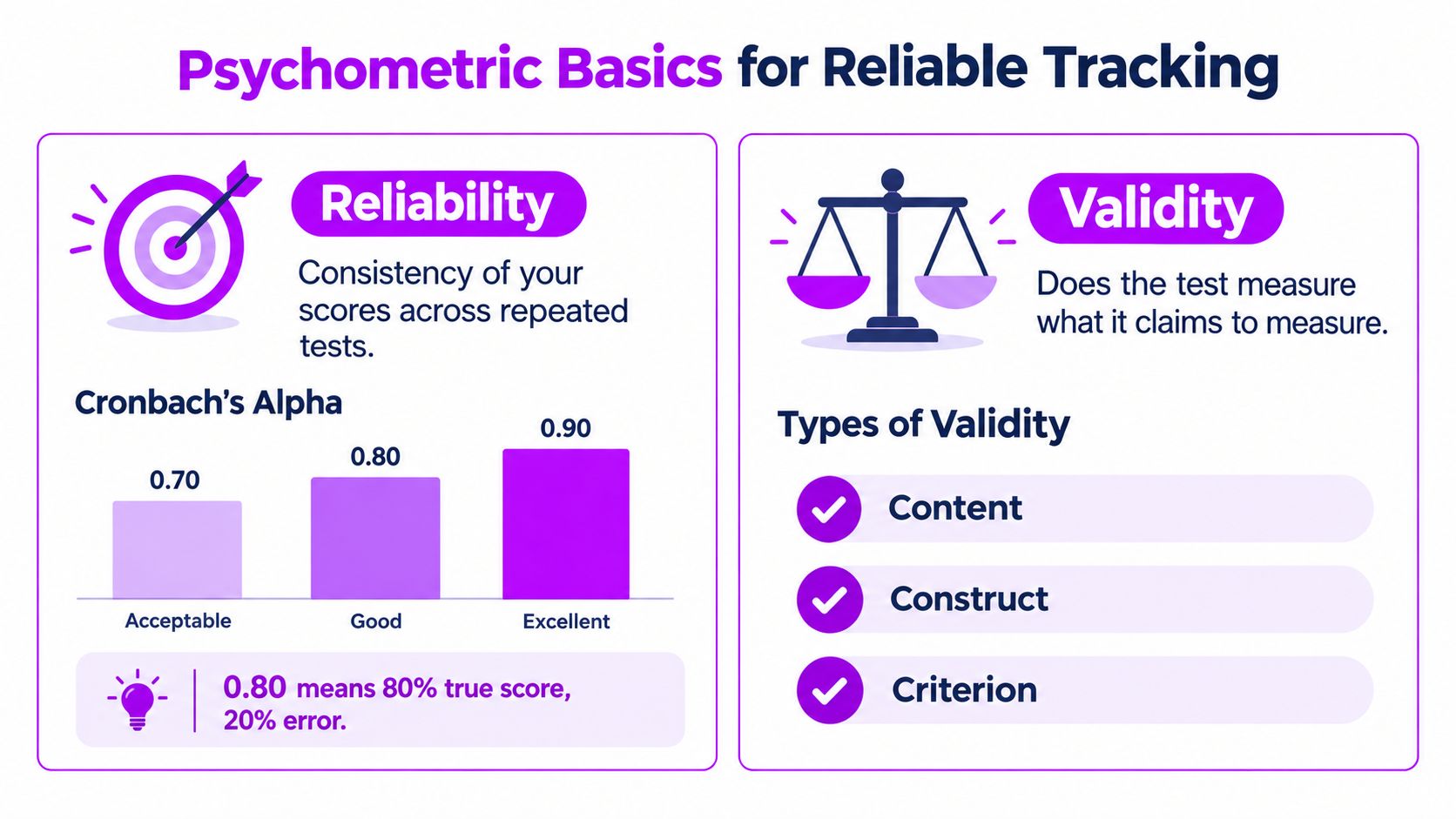
Before you trust a score, you need to know what kind of confidence the instrument earns. In standardized assessment, reliability and validity are the core statistical foundations. Reliability is about consistency. Validity is about whether the tool measures what it claims to measure, as summarized in this overview of reliability, validity, Cronbach's alpha, kappa, and related coefficients.
Reliability in terms that matter
A commonly used reliability statistic is Cronbach's alpha, which ranges from 0 to 1. A value of 0.80 is often interpreted as about 80 percent reliability and 20 percent measurement error in classical test theory. That doesn't mean the tool is perfect. It means the score is stable enough to be useful for many real-world decisions.
For personal tracking, that matters because you don't need flawless measurement. You need enough consistency to detect signal over noise.
Published guidance also gives a practical floor. One psychometric standard says internal consistency at 0.6 can count as adequately reliable, with 0.6 to under 0.7 considered marginally reliable and 0.7 or higher relatively reliable. For test-retest reliability, one standard uses ICC > 0.4, Pearson r > 0.3, or Cohen's kappa > 0.4 as adequate, according to this NCBI Bookshelf review on psychometric reliability thresholds.
When “adequate” isn't enough
Not all use cases deserve the same bar. If you're doing low-stakes weekly self-checks, adequate reliability may be fine. If you're using a tool to support a high-stakes decision, the bar should rise.
A stricter benchmark from an assessment-selection review states that test-retest reliability should exceed .90 to satisfy that criterion, which you can see in this assessment selection review discussing stricter score stability standards.
A tool can be acceptable for self-monitoring and still be too weak for diagnosis, gatekeeping, or major treatment decisions.
Sensitivity and discrimination
If a tool is used for screening, another question matters. Does it separate likely cases from non-cases?
A screening-tool accuracy review notes that AUC of 0.5 means no better than chance, 70 percent to 89 percent indicates moderate discrimination, and 90 percent to 100 percent indicates perfect discrimination. The same review says a committee found 70 percent sensitivity with lower specificity to be an acceptable middle ground for recommendations, as described in this review of ROC, AUC, sensitivity, and specificity standards.
For a microdoser's weekly check-in, that means this: a screening tool doesn't need to function like a crystal ball. It needs to be good enough to flag change worth paying attention to.
| Metric | Marginal | Acceptable | Strong |
|---|---|---|---|
| Cronbach's alpha | 0.6 to under 0.7 | 0.7 or higher | Around 0.80 is often treated as good; above 0.90 is a high bar in some contexts |
| Test-retest | Below common adequacy thresholds | ICC > 0.4, Pearson r > 0.3, or Cohen's kappa > 0.4 | Above .90 for stricter score-stability expectations |
| AUC discrimination | 0.5 | 70% to 89% | 90% to 100% |
Validated Instruments for Mood and Anxiety Tracking
If your goal is mood and anxiety tracking, don't build a Frankenstein stack of five overlapping scales. Pick one main depression screener, one main anxiety screener if needed, and use them consistently.
For most personal monitoring, PHQ-9 and GAD-7 are the practical starting point. They're widely used, easy to repeat, and structured enough to create clean comparisons over time. They also fit the kind of weekly pattern detection most people want from a microdosing journal.
Which tools fit which job
Some instruments are better for routine self-tracking. Others are heavier and more clinician-facing.
| Instrument | Construct | Typical Use Case | Administration Time |
|---|---|---|---|
| PHQ-9 | Depressive symptoms | Repeated mood screening and weekly trend review | Brief |
| GAD-7 | Anxiety symptoms | Repeated anxiety screening and weekly trend review | Brief |
| Beck Depression Inventory | Depressive symptoms | Deeper symptom review when someone wants more detail | Longer than a quick screener |
| HAMD | Depressive symptoms | Clinician-administered assessment | Less practical for solo tracking |
| Hamilton Anxiety Rating Scale | Anxiety symptoms | Clinician-administered anxiety assessment | Less practical for solo tracking |
| Visual analogue mood scales | Momentary mood | Fast before-and-after snapshots | Very brief |
If you want a lighter daily complement to a validated screener, a simple daily mood rating scale for structured journaling works well alongside a weekly PHQ-9 or GAD-7 rhythm.
What works for microdosing and what doesn't
Good fit: PHQ-9 and GAD-7 for weekly monitoring. They're short enough that people complete them and structured enough to catch shifts you'd otherwise rationalize away.
Decent fit: Visual analogue mood scales for same-day snapshots before and after a dose. They're not a replacement for a validated screener, but they're useful for immediate state tracking.
Poor fit for most individuals: HAMD and Hamilton Anxiety Rating Scale. These have value, but they're cumbersome for personal use and can push you into over-measuring.
One useful lesson from the broader assessment literature is that thresholds matter when they're validated. An independent validation study found an optimal cut-off score of 77 out of 116, with sensitivity of 0.964 and specificity of 0.960, showing how a well-defined threshold can cleanly separate stronger from weaker assessment quality in that context, according to this independent validation study of an assessment quality measure. The broader takeaway is practical: choose instruments with clear scoring rules and known cut points instead of inventing your own interpretation system.
How to Choose and Run a Standardized Assessment Protocol
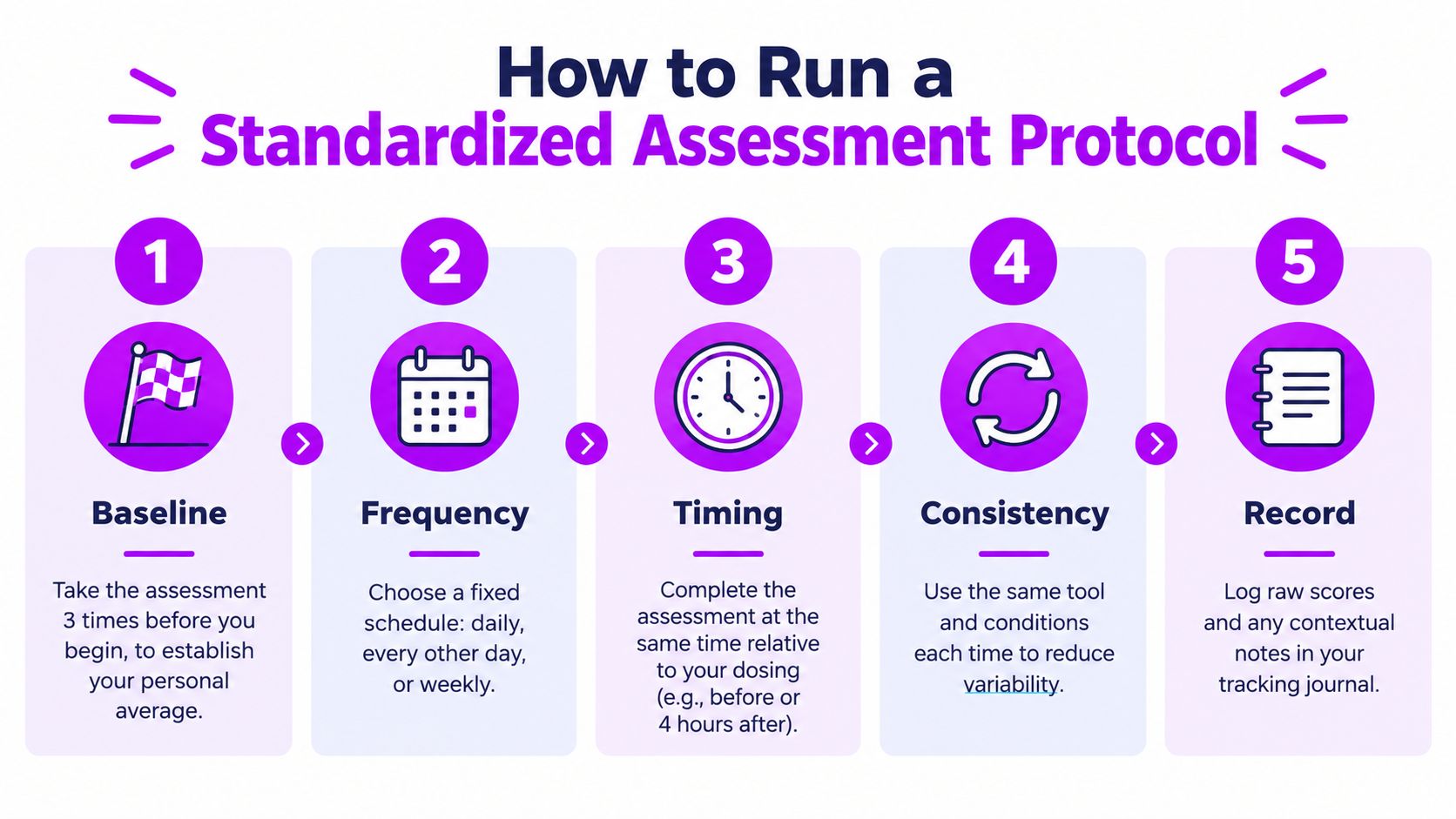
A useful protocol is boring on purpose. Same tool, same timing, same scoring. That's what makes changes interpretable.
A simple setup that people actually follow
Use one instrument for mood and one for anxiety only if both are genuine concerns. Otherwise, start with one.
A practical implementation looks like this:
- Set a baseline. Complete the scale on multiple pre-start days before changing your protocol.
- Pick a cadence you can sustain. Weekly works well for broad symptom shifts. A brief daily rating can sit alongside it if you want state-level context.
- Fix the timing. Complete the scale at the same time of day and at the same point relative to dosing.
- Keep raw scores. Don't just write “better” or “worse.”
- Add context sparingly. Note major confounders, not every passing thought.
The cleanest protocols feel almost repetitive. That's a strength.
Screening isn't the same as diagnosis
Many self-trackers drift into pseudo-clinical behavior without noticing. They start treating a score as a verdict instead of a signal.
That's risky because standardized interviews and more formal assessment methods have real practical downsides. Clinician research reports that standardized diagnostic interviews can interfere with rapport, take too long to administer and score, and may be hard for families to understand. Educational critiques also note that these tools often produce only a single score with limited diagnostic value unless paired with richer feedback or other data sources, as discussed in this review of limitations in standardized diagnostic and assessment tools.
Use scores to trigger questions, not to end them.
For implementation ideas, I like the logic behind these evidence-based protocols for consistent tracking routines because the emphasis is on repeatability rather than perfectionism.
A short explainer can help if you're trying to make your routine more concrete:
A workable microdosing assessment rhythm
- Before starting: Establish baseline scores.
- On dosing days: If you use a same-day mood measure, take it at a fixed time before dosing and again at a consistent interval after.
- On non-dosing days: Use the same daily check-in time if you're collecting daily mood state data.
- Weekly: Complete your main standardized screener on the same day each week.
- Escalate: If scores worsen persistently, or if distress feels bigger than the tool can capture, stop trying to self-interpret and involve a clinician.
Integrating Scores into Daily Tracking Workflows
A standardized score only becomes useful when it fits into daily life without turning you into a lab technician. The best workflows make room for both structure and context.
One pattern works especially well. Keep a light daily rhythm for state tracking, then layer a validated screener on top at a slower interval. Daily entries catch texture. Weekly standardized scores catch drift.
A concrete workflow example
Say someone is following a Fadiman-style 1-on-2-off rhythm or a Stamets-style 4-on-3-off rhythm. Their daily workflow might include a quick mood number, dose details, and one sentence about sleep or stress. Once a week, they add a PHQ-9 or GAD-7 score.
After a few weeks, the pattern often becomes clearer than the day-to-day feeling narrative. Maybe dosing days feel subjectively “good,” but weekly anxiety scores don't budge. Maybe the opposite happens. Maybe mood improves most on the day after dosing, not the day itself. That's the kind of insight intuitive journaling usually muddies.
What to log and what to ignore
You don't need maximal data. You need consistent data.
- Log full standardized scores when you complete the actual instrument.
- Log a simple daily summary number when you want low-friction continuity.
- Track timing variables such as before dose, after dose, morning, or evening.
- Record major confounders like illness, travel, or acute stress.
- Ignore vanity detail that you'll never review consistently.
The best tracking system isn't the one with the most fields. It's the one you'll still use when life gets messy.
Where patterns become actionable
Trend review matters more than isolated scores. Weekly and monthly views make it easier to spot whether symptom scores improve, flatten, or worsen across a protocol.
That shift from event-based interpretation to trend-based interpretation is what usually moves the needle. Instead of asking, “Did today's dose work?” you start asking, “Across this protocol, what reliably changes and what doesn't?”
Limitations, Bias, and Ethical Privacy Considerations
More testing doesn't automatically mean better insight. Sometimes it just means more noise wrapped in more confidence.
The biggest blind spot in many conversations about standardized assessment is cultural and linguistic bias. Many explanations stop at broad pros and cons, but the harder question is whether the instrument is valid for the person taking it. Recent guidance notes that standardized assessments may carry content bias and technical limitations because of their norming samples, and cross-country use can raise translation, cultural adaptation, and item-equivalence problems, as outlined in this discussion of cultural and linguistic bias in standardized assessments.
What bias looks like in real use
A question can be standardized and still land badly. A symptom item may assume a cultural norm about emotion, work, family roles, or language that doesn't fit the person answering it.
That matters in personal tracking because repeated mismatch creates false precision. You may think you're capturing change, but you're partly capturing poor fit between the tool and your lived context.
Privacy isn't optional
Mood and anxiety logs are sensitive records. If you're tracking them digitally, minimum standards should include:
- Encrypted storage: Data should be protected in transit and at rest.
- Searchable history: You should be able to review your own records without friction.
- Export control: CSV export matters if you want to review or share your data on your terms.
- Easy deletion: If you want your data gone, the process should be simple.
For a grounded checklist, this guide to data privacy best practices for personal tracking tools is worth reviewing.
A final caution matters here. A single PHQ-9 or GAD-7 score can be useful. It should never replace clinical judgment, crisis assessment, or common sense about your safety and functioning.
Practical Templates and Sample Protocols
If you want a protocol you can copy today, keep it small enough to survive real life.
Minimal mood tracking protocol
- Baseline phase: Take your chosen standardized assessment tool on several pre-start check-ins under similar conditions.
- Weekly anchor: Complete PHQ-9 for mood or GAD-7 for anxiety on the same day each week.
- Daily layer: Add a brief mood rating and one short context note.
- Dosing note: Record whether it was a dosing day, non-dosing day, or skipped day.
- Review habit: Look at trends weekly. Don't reinterpret the plan every day.
Decision rules that keep you honest
Use these rules to avoid overreacting to noise:
- If one score is off but the week was unusual, log the context and wait for the next scheduled check-in.
- If scores drift in the wrong direction across repeated check-ins, don't explain it away as “part of the process.”
- If your functioning drops, your distress spikes, or you feel unsafe, stop relying on self-tracking and seek clinical support.
A simple template you can reuse
Tool: PHQ-9 or GAD-7
Cadence: Weekly
Daily add-on: Brief mood rating plus one-line note
Timing: Same day, same time, same relation to dosing
Review question: Are scores changing, or am I just telling a different story about the same week?
Escalation point: Persistent worsening, confusion about what the data means, or symptoms that exceed what a tracker can safely hold
Used this way, a standardized assessment tool stays in its proper role. It supports reflection, sharpens pattern detection, and reduces self-deception. It doesn't become a ritual of over-measurement.
MicroTrack gives you a clean way to run this kind of structured practice without turning your day into a spreadsheet. You can log dose details, daily mood, and later reflections in one place, then review trends over time with privacy controls that matter for sensitive self-tracking. If you want a calmer system for applying the ideas in this guide, visit MicroTrack.