Structured Data Entry for Mindful Tracking

You've just finished a microdosing session, opened your journal, and found yourself staring at a blank page. You remember feeling more focused in the morning, slightly restless later, and unsure whether the change came from the dose, poor sleep, caffeine, or the demands of the day. By tomorrow, those details will be harder to separate.
That's the practical problem with wellness journaling. Free text preserves nuance, but it makes comparison slow. Structured data entry creates a small set of repeatable signals, so you can review your experience without turning every entry into an essay. The most useful system combines both: quick fields for consistent capture, followed by reflection when you have enough distance to interpret what happened.
Table of Contents
- The Hidden Friction in Wellness Journaling
- Core Mechanics of Structured Tracking
- Designing the Two-Phase Entry Method
- When Manual Logging Beats Automation
- Turning Raw Inputs into Protocol Trends
- Privacy and Data Stewardship in the AI Era
- Implementing Your Practice with MicroTrack
The Hidden Friction in Wellness Journaling
The blank page creates more work than expected. After a session, you have to decide what matters, how much to write, which feelings deserve attention, and whether today should be compared with yesterday. That decision-making can drain the habit before the journal has collected enough information to become useful.
A typical note might say, “Good energy today, but a little tense in the afternoon. Slept badly. Not sure if the dose helped.” It's honest, yet difficult to analyze. You'd need to reread every entry to determine whether tension appears more often on dose days, whether poor sleep changes the experience, or whether your mood follows a weekly rhythm instead.
Practical rule: Capture the variables you want to compare before you need the comparison.
Structured data entry turns that vague task into a short routine. Instead of asking yourself what to write, you answer the same carefully chosen prompts: dose or no dose, time, mood, energy, sleep quality, notable sensations, and a brief context note. The fields act like rails. They reduce the mental effort required to begin while leaving room for observations that don't fit a scale.
Structure should serve attention
A useful journal doesn't try to record every sensation, thought, meal, conversation, and environmental detail. Over-structuring creates its own friction. If logging feels like completing an administrative form, people start postponing entries, guessing values, or skipping them entirely.
The better target is minimum viable structure. Choose fields that answer real questions about your practice. If you want to understand mood, record mood consistently. If timing matters, capture the time. If sleep changes your response, give sleep its own field rather than burying it in prose.
This distinction matters for mindfulness. A structured log can help you notice patterns without requiring you to explain yourself in the moment. The practice becomes less about producing polished writing and more about leaving your future self a dependable trail. Guidance on why consistent logging improves reflection is also available in MicroTrack's guide to the benefits of logging.
A diary becomes an instrument
The shift from blank page to defined fields changes the role of the journal. It no longer serves only as a memory archive. It becomes a personal measurement instrument, with enough consistency to support comparison and enough flexibility to preserve context.
You'll still have days that don't fit the pattern. That's useful information, not a failure of the schema. A short context field can record unusual stress, travel, a late night, or a change in routine. The structured values tell you what happened; the note helps explain why.
Core Mechanics of Structured Tracking
A personal dataset fails in two distinct ways. Structural integrity means every value sits in the correct field and follows the expected format. Content quality means the value accurately represents your experience. Entering sleep as mood creates a structural error. Giving nearly every day the same mood score because your internal scale has drifted creates a content problem. Both errors can distort the patterns you later use to adjust a protocol.
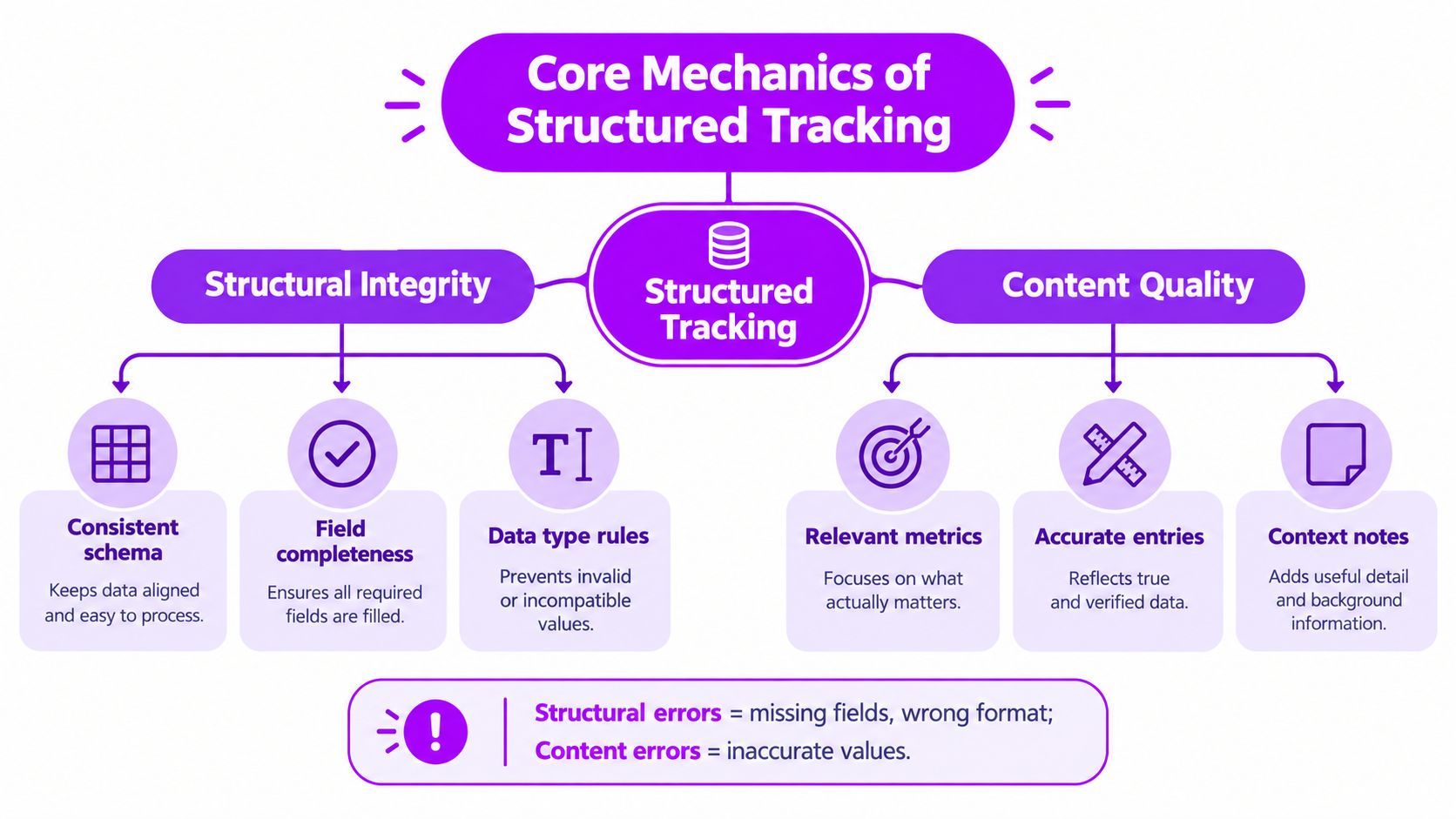
Research on data quality identifies schema violations, misfielded values, inconsistent formats, and incorrect categories as common sources of error. It also describes controls such as required fields, dropdowns, regular-expression constraints, and cross-field validation in suitable workflows, as summarized in this research on structured data quality. A personal log does not need enterprise software to apply the same reasoning. It needs definitions you can follow when you are tired, busy, or experiencing an unexpected response.
Build a small personal schema
Choose fields with one clear meaning:
- Date and time: Use a consistent timestamp instead of phrases such as “early morning.”
- Dose status: Separate dosed, rested, skipped, and added entries when your routine includes those states.
- Mood and energy: Use fixed numeric scales so each score keeps the same interpretation.
- Sleep: Record a simple rating or category rather than rewriting the description each day.
- Context: Keep a short note field for stress, illness, travel, caffeine, social intensity, or another variable that could affect interpretation.
Make only realistic fields required. A mandatory reflection box can cause delayed or missing entries, while a required dose status and mood rating preserve the core record. This is the practical trade-off between schema precision and daily adherence. If the structure demands more attention than the event itself, the resulting dataset may look detailed while containing more gaps and guesses.
Constrain what needs consistency
Use dropdowns for categories that should not be endlessly rephrased. “Calm,” “anxious,” and “restless” can be valid options. Unlimited labels can fragment one pattern into “tense,” “tension,” “wired,” and “on edge.” Numeric scales help only when their endpoints are defined and applied consistently.
Double-key entry shows the value of repeatable validation in high-stakes workflows. A controlled study reported 0.046 errors per 1,000 fields for manual double-key entry, compared with 0.370 errors per 1,000 fields for single-key entry, with the difference statistically significant at p=0.020 (clinical review). Personal tracking rarely requires a second person to enter a mood score. The transferable practice is simpler: review ambiguous entries, define fields clearly, and check values before they shape your conclusions.
Automation helps when source and destination fields already mean the same thing. One EHR-to-EDC system reduced errors across 477 structured fields from 13.6% with manual entry to 0.0% with automated transfer, a 100% reduction for those fields. Personal logs rarely provide that controlled transfer, so automate stable facts and reserve manual entry for context that needs judgment. Capture the event first, then refine its meaning during review.
Designing the Two-Phase Entry Method
The most sustainable log separates capture from interpretation. Trying to enter dose details, mood, sensations, environmental factors, and a thoughtful reflection in one sitting makes the habit feel larger than it needs to be.
The two-phase entry method solves that by giving each task its own moment.
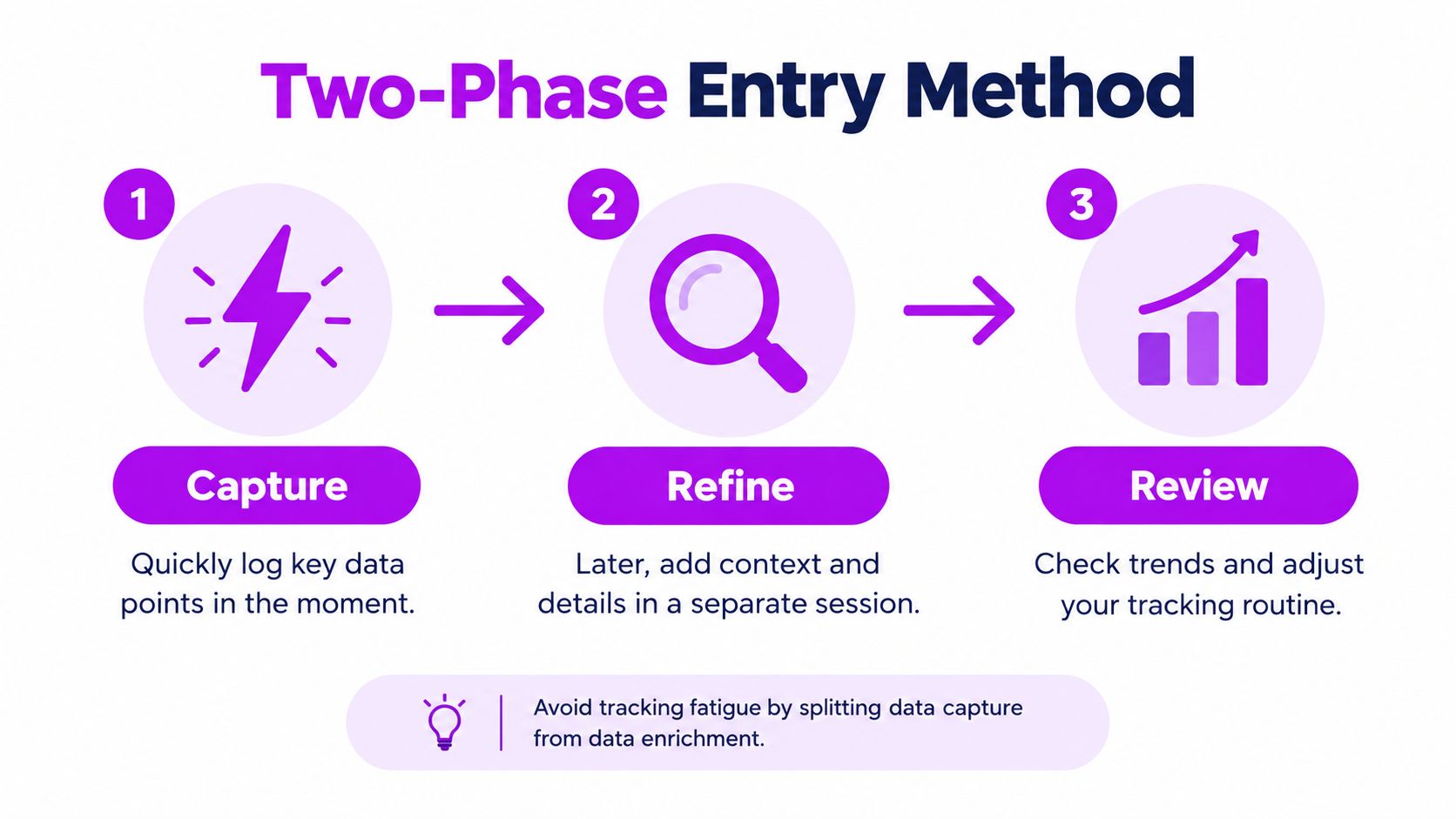
Phase one captures the event
Log the facts closest to the event while they're still easy to recall:
- Dose status: Record whether you dosed, rested, skipped, or added a planned entry.
- Time: Use the actual time or a consistent time category.
- Immediate rating: Enter mood and energy on your chosen scale.
- Short signal: Add one quick sensation or side-effect label if something stands out.
This phase should feel almost mechanical. Don't try to explain your entire day. You're preserving the timestamped skeleton that later reflection can attach to.
Phase two adds meaning
Hours later, or the next morning, add context with more distance. Note sleep, stress, social demands, work intensity, unusual physical sensations, and whether the day felt different from your baseline. If your initial rating was optimistic or pessimistic, you can refine it when the immediate emotional charge has passed.
This separation protects both speed and nuance. The first phase reduces memory loss. The second phase reduces impulsive interpretation. A short capture can happen during a busy day, while a deeper note can wait for a calm review session. For a practical approach to preserving context and turning notes into usable insight, see MicroTrack's documentation guide.
Review the system, not just the scores
Once you have a consistent routine, review whether each field earns its place. A field that you routinely skip may be poorly timed, too ambiguous, or irrelevant to the decisions you want to make. Remove it, make it optional, or move it to phase two.
The method works because it respects attention. Real-time logging should be light. Reflection should be deliberate. Combining them into one demanding form usually sacrifices both.
When Manual Logging Beats Automation
You finish a session with an unusual sense of calm, but the form asks you to choose between “relaxed” and “energized.” Selecting one keeps the record complete while losing the detail that could explain the day. Automation cannot resolve that mismatch for you.
Wearables can provide biometric signals, and AI can extract fields from natural-language notes. Those tools work well when inputs follow a regular format, labels are clear, and the desired output is defined. Personal wellness logs often fail those conditions. “Calm but emotionally porous” may carry more meaning than a fixed category, while the same sensation can reflect relaxation one day and overstimulation another, depending on sleep, stress, setting, and expectations.
An analysis of AI data entry describes situations where manual entry can outperform extraction, including dynamic forms, specialized terminology, missing labels, inconsistent layouts, and multiple values in one field. Personal tracking has the same problem: the irregular context may be the signal you need. For a closer look at how automated pattern recognition handles extracted information, see MicroTrack's guide to automated pattern recognition.
Compare the trade-offs
| Approach | What works | Where it breaks |
|---|---|---|
| Rigid template | Fast comparison, consistent categories, clear trend charts | Can flatten nuance and make the routine burdensome |
| Free-text journal | Preserves context, ambiguity, and unexpected observations | Makes filtering and comparison slow |
| AI extraction | Handles regular formats and repeated language efficiently | May misread context, labels, or personal terminology |
| Manual structured entry | Keeps the user in control of meaning and timing | Requires deliberate participation and stable definitions |
Choose the method field by field. Automate timestamps or recurring schedule logic when those values are unambiguous. Keep subjective ratings and context notes with the person who experienced them.
Use automation for repetition, not interpretation.
Know when structure becomes interference
A schema has gone too far when it changes your behavior. You might postpone a session until you can complete every field, skip an unusual experience because no category fits, or choose an inaccurate option to submit the form.
Keep the structure, then add an escape hatch. Include a short note field, make context optional, and review categories periodically. Remove fields that repeatedly go unused, or move them into the reflection phase. A useful system makes the behavior easier to observe. It should not become another variable that distorts the observation.
Turning Raw Inputs into Protocol Trends
A log becomes valuable when it changes a decision. Structured fields let you compare days across a protocol without relying entirely on memory, but the comparison still needs discipline. Look for repeated relationships between schedule status, timing, sleep, mood, energy, and context. Don't treat one unusual day as proof of a causal effect.
The Fadiman schedule is commonly described as a repeating three-day cycle, dose on day one, rest on days two and three, then dose again on day four. Independent protocol guidance also describes running this pattern for 4–8 weeks before taking a longer break (Fadiman protocol guide). A structured history can show whether your own mood, energy, sleep, and side effects differ across dose and rest days, without assuming that the protocol will affect everyone identically.
Mapping structured fields to protocol insights
| Structured Field | Data Type | Resulting Insight |
|---|---|---|
| Dose status | Category | Compare dose days, rest days, skips, and additions |
| Dose time | Time | Examine whether morning or later entries align with different experiences |
| Mood | Numeric scale | Review mood trajectories across schedule states |
| Energy | Numeric scale | Identify recurring energy patterns after dosing or resting |
| Sleep | Numeric scale or category | Check whether sleep quality changes how the following day feels |
| Sensations and side effects | Category plus note | Separate repeated signals from isolated events |
| Reflection | Free text | Preserve context that numeric fields cannot express |
The same structure can support a custom schedule or a different framework, including the Stamets 4-on/3-off stack named in MicroTrack's product description. The important point is not to force your data into a protocol label. Record the actual schedule you followed, including deviations, then compare outcomes against what happened rather than what was planned.
Read trends without overclaiming
Use distributions and trajectories as prompts for investigation. If energy appears higher after particular timing choices, check whether those days also had better sleep or fewer demands. If negative sensations cluster near a schedule change, examine the surrounding context before deciding that the schedule caused them.
Questions worth asking include:
- Do dose and rest days show different mood patterns?
- Does time of day coincide with changes in sleep or energy?
- Do side effects recur under similar conditions?
- Does your experience shift as a cycle continues?
- Are skipped or added days associated with different reflections?
Tolerance breaks should follow a considered review of your own observations and, where relevant, professional guidance. A spreadsheet can reveal patterns, but it can't establish medical safety or diagnose anxiety, depression, PTSD, or any other condition.
Privacy and Data Stewardship in the AI Era
A wellness log can expose routines, emotional states, sleep, medication context, relationships, and private reflections. If a tracker leaves you unsure who can access that history, better charts will not solve the problem. Privacy belongs in the tracking design from the first entry.
Enterprise data work increasingly focuses on making information usable for AI. IBM reports that up to 90% of enterprise data may remain in unstructured silos, where weak structure, metadata, and governance reduce its usefulness (IBM's discussion of data trends). For a personal journal, the practical lesson is simpler. Keep records understandable, controllable, and portable, even if you never run them through an AI system.
Ownership requires an exit
A tracker should let you retrieve your complete history in a usable format. CSV export keeps fields in rows and columns that you can review, analyze, or move to another tool. Deletion matters equally. Leaving a service should not require a support ticket or an unclear process to remove sensitive entries.
Check for:
- Encryption in transit and at rest, protecting entries during transfer and storage.
- Clear data isolation, with a direct policy explaining whether data is sold, shared, or used for other purposes.
- Full-history export, preferably in a structured format such as CSV.
- Account deletion, available through a direct, understandable control.
- Search and filtering, so you can examine structured records without exporting them immediately.
Encryption does not establish ownership by itself. Portability without deletion leaves a lasting footprint. Privacy appears in product behavior, not only in policy language.
MicroTrack states that its journaling app encrypts entries in transit and at rest, does not sell or share journal data, supports full-history CSV export, and offers one-click account deletion, as described on its protocols and privacy-focused product page. Those controls support personal stewardship: the user can keep, inspect, move, or remove the record.
Implementing Your Practice with MicroTrack
A workable setup starts with fewer fields than you think you need. Configure the routine around the questions you want answered, then add detail only when a repeated observation shows that the detail matters.
Set the baseline first
Use a 10-point mood scale as your primary subjective baseline. Define what low, middle, and high scores mean for you before you begin, and use the same interpretation throughout the tracking period. Add energy separately if it answers a different question. Mood and energy can move in different directions, so combining them into one score loses useful information.
Record dose details and time during the first phase. Add sensations, side effects, sleep, and reflection later when you can evaluate the day with more context. MicroTrack's app flow supports these structured fields alongside later reflection, which fits the two-phase method without requiring every observation at the same moment.

Configure the calendar around real life
Choose a protocol that matches the routine you intend to test. MicroTrack supports Fadiman's 1-on/2-off schedule, the Stamets 4-on/3-off stack, and custom schedules. The calendar view lets you manage skip and add overrides, so travel, illness, social commitments, or a missed entry don't force you to pretend the planned schedule was followed.
Use overrides as data, not as evidence of failure. A skipped day can reveal whether adherence depends on a particular time or setting. An added day may show that the protocol design doesn't match your actual week. Record the deviation and preserve the reason in the reflection field.
Review on a fixed rhythm
Don't wait until you feel confused to inspect the history. Review trend visualizations, frequency distributions, time-of-day patterns, and searchable entries on a regular schedule that feels sustainable. Ask one question at a time, such as whether mood differs between dose and rest days or whether later dosing appears alongside sleep changes.
Avoid turning charts into verdicts. Pattern detection can help you decide what to examine next, but it can't replace medical advice or establish that microdosing treats a health condition. If you're managing anxiety, depression, PTSD, medication changes, or troubling side effects, discuss your observations with a qualified clinician.
A calm tracking environment also matters. Remove streak pressure and gamification if they encourage you to optimize the record instead of observing yourself. The purpose of structured data entry is not to produce a perfect dataset. It's to create a trustworthy, private record that helps you notice what deserves a closer look.
MicroTrack gives you structured dose logging, a 10-point mood scale, flexible two-phase entries, calendar overrides, searchable history, trend views, and CSV export in one private journaling space. Visit MicroTrack to start a distraction-free tracking practice that captures the moment without losing the reflection that gives it meaning.