8 Tips for Anxiety Relief That You Can Use Today
Anxiety can show up before you've had time to name it. Your heart may race, your shoulders may tighten, and your breathing may turn shallow. Or your attention may lock onto a frightening possibility, replay the same thought, or keep returning to a problem you can't solve right now.
The best tips for anxiety relief depend on the problem in front of you. The eight tools below are small experiments, not promises of instant or universal relief. Each one explains when to try it, gives you a practical script, and uses a simple 0–10 rating before and after, where 0 means no anxiety and 10 means the most intense anxiety you can imagine.
Your tracking can stay private and minimal. Record only what helps you learn, such as the tool, the starting score, the ending score, and one sentence about what changed. Microdosing needs extra caution, lawful awareness, and qualified professional support. Observation can help you notice patterns, but it isn't a recommendation, proof of benefit, or substitute for medical care.
Table of Contents
- 1. Box Breathing for Immediate Physiological Calm
- 2. Progressive Muscle Relaxation for Somatic Release
- 3. Grounding Techniques for Sensory Spirals
- 4. Structured Journaling and Cognitive Reframing
- 5. Mindfulness Meditation and Present-Moment Awareness
- 6. Movement-Based Practices for Restless Energy
- 7. Cognitive Defusion for Thought Fusion
- 8. Scheduled Worry Time for Recurring Worry
- 8-Method Anxiety Relief Comparison
- Build a Personal Anxiety-Relief Feedback Loop
1. Box Breathing for Immediate Physiological Calm
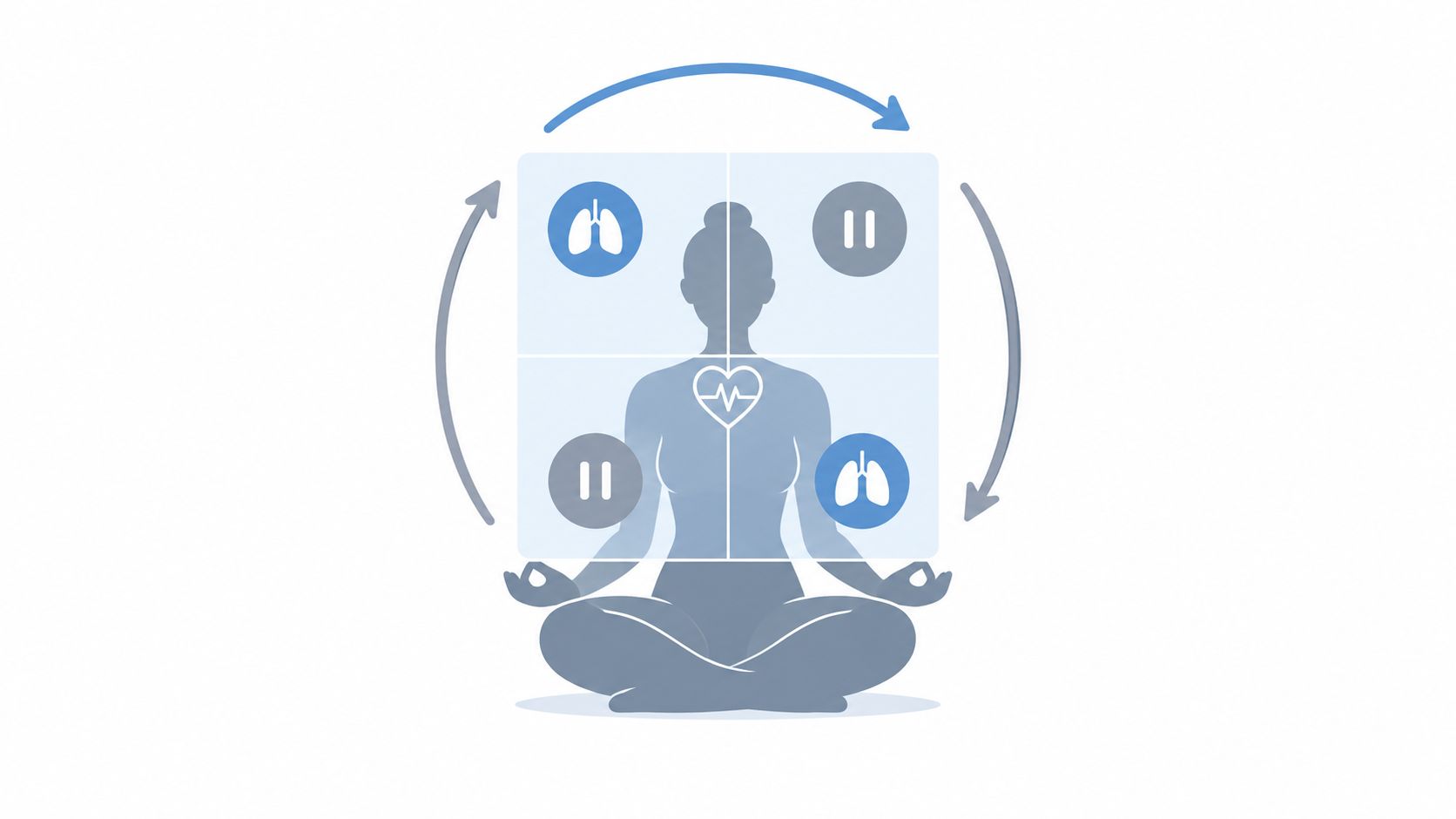
When anxiety feels physical first, a predictable breathing rhythm can give your body a simple task. Box breathing uses four equal phases: inhale, hold, exhale, and hold again. Start with four counts for each phase, but shorten or lengthen the rhythm if holding your breath feels uncomfortable.
Sit or stand with your feet supported. Breathe in gently for four counts, hold for four, breathe out for four, then hold for four. Repeat for several rounds without forcing a deep breath. The NHS controlled-breathing guidance recommends slow breathing for a few minutes and describes an example using two or three counts for the inhale and exhale.
Try it as a small experiment
Before starting, rate your anxiety from 0 to 10. Then use this script:
“I'm safe enough to slow this down. In for four, hold, out for four, hold.”
After several rounds, rate your anxiety again. A lower score is useful information, but no change is also information. You may need a gentler rhythm, or breathing may not be the right first tool for that moment.
Practice once when you're calm so the sequence feels familiar during stress. You can use a quiet timer, pair it with a familiar chair or doorway, and note only the date, before score, after score, and a short observation. If counting increases tension, let the exhale become slower without insisting on a perfect square.
2. Progressive Muscle Relaxation for Somatic Release
Sometimes anxious thinking continues because your body hasn't stopped bracing. Progressive muscle relaxation addresses that physical layer by creating a clear contrast between tension and release. You briefly tense one muscle group, notice the sensation, and then let it soften before moving through the body.
Choose a quiet position where you won't need to move suddenly. Start with your feet or legs, tense gently rather than painfully, hold for several seconds, and release slowly. Continue with the hands, arms, shoulders, jaw, and forehead. Skip any area affected by pain, injury, or a medical condition.
Notice the contrast
The useful question isn't “Did I relax perfectly?” It's “Can I detect a difference?” Rate your anxiety or physical tension from 0 to 10 before beginning. Then say:
“I'm noticing tension, not fighting it. I'll release this area and observe what changes.”
Rate yourself again when you finish. If the score stays high, try less effort next time. Some people tense too strongly and turn relaxation into another performance task. A recorded guide or a trusted PMR audio track can reduce the need to remember each step.
Practice at a consistent time, such as after work or before bed, so your body begins to associate that setting with release. Keep the log private and brief: body tension before, body tension after, and one note about the area that carried the most tension. This is self-observation, not a medical treatment, and it shouldn't replace care for persistent physical symptoms.
3. Grounding Techniques for Sensory Spirals
Anxiety can pull attention into predictions, memories, and imagined consequences. The 5-4-3-2-1 method redirects attention toward what your senses can detect right now. NHS inform recommends this technique as a simple way to shift focus from anxious thoughts to present-moment sensory cues in its anxiety self-help guide.
Look around and name five things you see. Then identify four things you can touch, three sounds you can hear, two smells, and one taste. Be specific. “A wall” becomes “a blue wall with a slightly uneven surface.” Detail makes the exercise more absorbing.
Use a direct grounding script
Rate your anxiety first, then say:
“I'm in this room, at this time. Five things I see are…”
Move through the senses at your own pace. If smell or taste isn't available, adapt the order or repeat another sense. You can carry a small grounding object, such as textured fabric or a mint, but ordinary surroundings work just as well.
Rate anxiety again after the sequence. Record the location and the before-and-after scores if you want to learn where grounding works best. A two-phase note can separate immediate experience from later reflection: first write “I felt trapped and noticed the floor texture,” then return later to record whether the spiral resumed or eased. Keep identifying details out of the note if privacy matters.
4. Structured Journaling and Cognitive Reframing
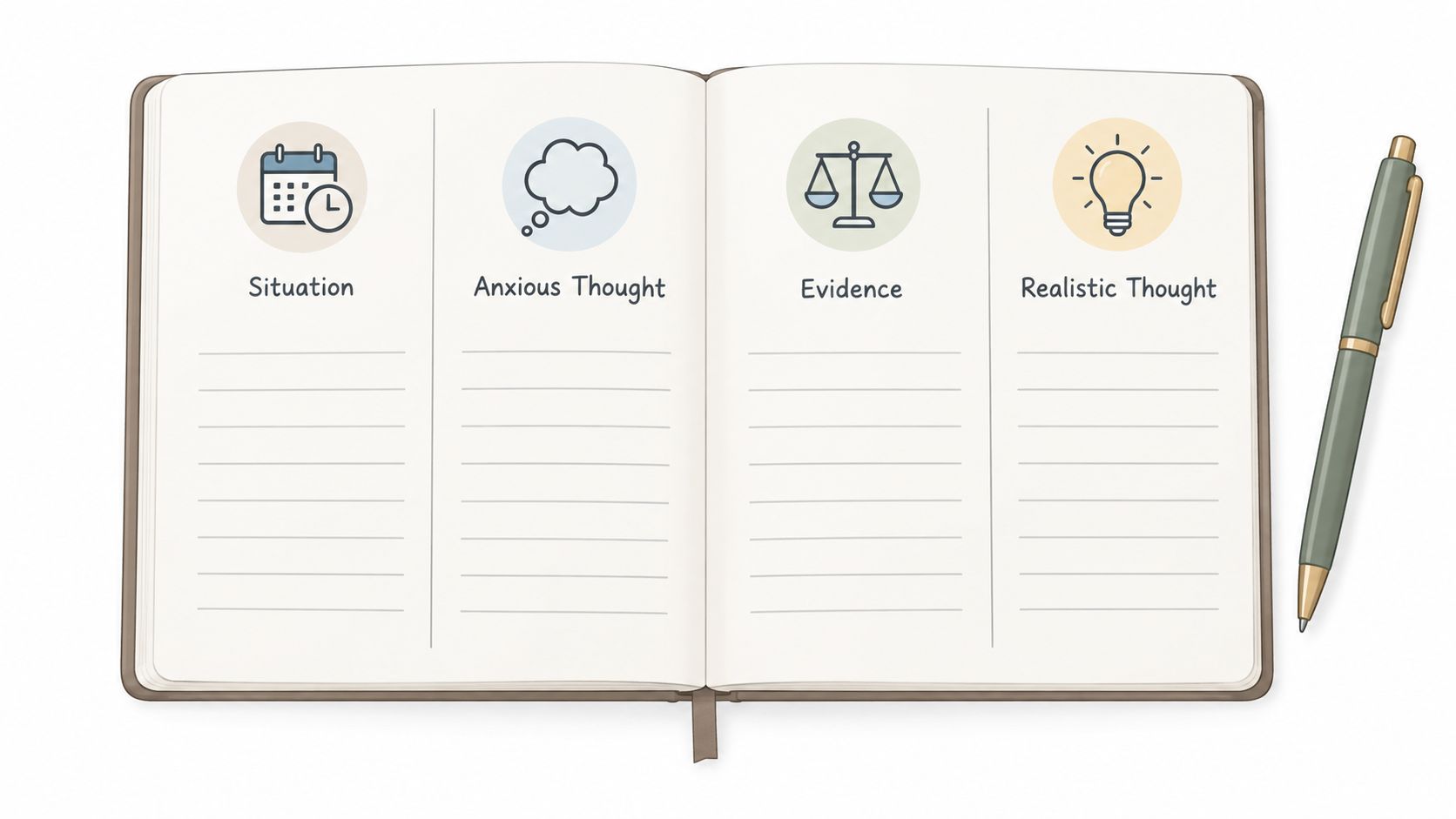
A vague worry often grows stronger when it stays unexamined. Structured journaling turns it into a sequence you can inspect: Situation, anxious thought, evidence for and against, and a realistic thought. The aim isn't forced optimism. It's a fairer appraisal that includes facts your anxious mind may be ignoring.
Write soon after an anxiety spike while the details are fresh. For example, “My manager hasn't replied” is the situation. “I'm about to lose my job” is the anxious thought. Evidence against it might include recent positive feedback or the possibility that the manager is busy. A realistic thought could be, “I don't know why there's no reply yet, and I can follow up tomorrow.”
For a practical guide to building this habit, see this self-awareness journal approach. You can tag entries privately by themes such as work, social situations, health, or family, then review them occasionally for repeated triggers rather than rereading every difficult moment.
Rate the thought, then revisit it
Before writing, rate anxiety from 0 to 10. Use this script:
“This is an anxious prediction. I'll test it against what I actually know.”
Rate anxiety after completing the record. The score may not fall immediately, especially if the situation remains unresolved. That doesn't mean the exercise failed. You may have gained clarity without feeling calm.
Use a two-phase prompt: In the moment: “What happened, and what did I think?” Later: “What became clearer after time passed?” Don't include names, addresses, or other sensitive details unless you need them. Journaling can support reflection, but it isn't a diagnosis and shouldn't be used to alter medication or other treatment.
5. Mindfulness Meditation and Present-Moment Awareness
Mindfulness is useful when the problem is not one specific thought, but the habit of being pulled into thought after thought. You practice noticing sensations, emotions, and ideas as they arise, without treating each one as an instruction or fact. Attention wanders. The practice is returning gently.
Start with a five-minute guided session focused on breathing or bodily sensations. Sit comfortably and notice where breathing is easiest to feel. When you realize you're planning, judging, or worrying, label it softly and return to the chosen anchor. You don't need an empty mind.
Make practice easier to repeat
Rate anxiety before and after the session, then use this phrase:
“Thinking is happening. I can notice it and return to this breath.”
Try different anchors if the breath feels uncomfortable. A body scan, sounds, or a compassion-focused practice may be more suitable. This body scan meditation guide can help you explore a body-based alternative.
A small daily practice may be easier to sustain than occasional long sessions. Track the type of meditation, starting score, ending score, and one sentence about attention. If you're exploring microdosing, don't assume that meditation feels “better” because a session feels more vivid. Compare observations cautiously, avoid changing treatment based on a mood entry, and discuss concerns with a qualified clinician.
The historical case for structured self-help is stronger than the idea that any wellness exercise works for everyone. A systematic review in the British Journal of Psychiatry found that self-help interventions performed better than waiting-list controls across 20 studies involving 1,121 participants, with an overall effect size of SMD = –0.86. That supports structured practice, not a promise that meditation alone will resolve severe anxiety.
6. Movement-Based Practices for Restless Energy
When anxiety leaves you restless, frozen, or disconnected from your body, gentle movement can offer a more suitable starting point than sitting still. Walking, yoga, tai chi, and simple mobility work combine physical activity with attention to breath and sensation. Choose the practice you're most likely to repeat, not the one that sounds most impressive.
Try a slow walk and notice the contact between each foot and the ground. In yoga, keep the focus on comfortable range of motion rather than pushing into a difficult pose. With tai chi, let the movements remain slow enough that you can follow your breathing. The NHS anxiety guidance identifies regular exercise such as walking, swimming, running, and yoga as potentially helpful, while warning against using alcohol, cigarettes, gambling, or drugs to manage anxiety.
Measure the effect without chasing a result
Rate anxiety or mood before moving. Then say:
“I'm not trying to outrun this feeling. I'm giving my body steady, manageable movement.”
Afterward, rate again. Note whether movement reduced agitation, increased it, or made no clear difference. A brisk walk may help one person and overstimulate another, especially during panic or physical illness.
Use a two-phase note: record the immediate body response after movement, then later record sleep, concentration, or emotional steadiness if those observations matter to you. The exercise and mood improvement resource offers a way to connect movement with reflective tracking. If microdosing is part of your personal practice, treat timing observations as uncertain and don't interpret them as evidence of safety or effectiveness.
7. Cognitive Defusion for Thought Fusion
A thought can feel like a fact when anxiety speaks with certainty. Cognitive defusion creates a little distance between you and the sentence your mind is producing. Instead of debating every prediction, you identify it as a mental event.
Start with the phrase, “I'm having the thought that I'll fail,” rather than “I'll fail.” You can also imagine the thought written on a leaf floating downstream, passing on a train you don't board, or spoken in an exaggerated cartoon voice. These exercises may feel strange, but the point is to change your relationship with the thought, not to prove it false.
Test distance, not positivity
Rate anxiety before the exercise. Then use this script:
“That's a worry thought my brain produces. It isn't automatically a fact.”
Repeat the thought slowly, quickly, or in a silly voice for a short period, then rate your anxiety again. If the technique feels invalidating, return to neutral labeling. You don't need to mock a thought to create distance from it.
Write down the thought, the defusion method, and the after-score. In the later phase, ask whether the thought still controlled your behavior. This distinction matters. Anxiety relief doesn't always mean the thought disappears. It may mean you can choose an action without obeying the thought.
A 2023 U.S. survey analysis found that about 25% of respondents reported using a mental health app, and anxiety was the only significant predictor of app adoption after controlling for sex, age, socioeconomic status, and race or ethnicity, according to the study published in JMIR Mental Health. That suggests digital tools may be relevant for people seeking structured support, but adoption alone doesn't establish that an app or a defusion exercise will work for you.
8. Scheduled Worry Time for Recurring Worry
Some worries return because your mind keeps trying to solve them at random times. Scheduled worry time gives them a defined place, rather than allowing them to occupy every quiet moment. The NHS recommends a planned 10 to 15 minute period every day or so for writing worries down and considering solutions in its CBT-based worry guidance.
Choose a consistent time, ideally not immediately before sleep if that makes you more alert. When a worry arrives earlier, acknowledge it, write a few words, and defer it: “There's that worry again. I'll look at it at 7 PM.” During the scheduled period, separate solvable problems from hypothetical fears. Write one practical next step for the first category, and practice letting the second category remain unanswered for now.
Keep the window contained
Rate anxiety before the session. Use this script:
“I'm not ignoring this concern. I'm giving it a specific time and boundary.”
Set a timer and stop when it ends, even if the thought feels unfinished. Rate anxiety afterward, then check in at an unrelated moment later in the day. This helps you learn whether containment changes the whole day or only the scheduled window.
Use the two-phase prompt: Now: “Which worries are present, and what action is possible?” Later: “Did postponing the worry make space for anything else?” Keep the log short and avoid turning it into a second rumination session.
Self-help has limits. Evidence syntheses describe self-help as potentially useful for mild-to-moderate anxiety, while face-to-face CBT is probably superior when anxiety is established or more severe, as discussed in this review of anxiety self-help evidence. A 2023 study of anxiety apps found moderate overall quality, with functionality rated highest, and participants commonly reported willingness to reuse or recommend the apps, increased motivation to manage anxiety, encouragement to seek further help, and reduced symptoms, according to the PLOS Digital Health study. These findings support using tools thoughtfully, not treating an app as a replacement for care.
8-Method Anxiety Relief Comparison
| Technique | 🔄 Implementation complexity | ⚡ Resources & time | ⭐ Expected effectiveness | 📊 Typical outcomes / impact | 💡 Ideal use cases & key advantage |
|---|---|---|---|---|---|
| Box Breathing (Immediate Physiological Calm) | Low, simple 4-count routine; needs practice consistency | None; 2–5 min; fully portable | ⭐⭐⭐⭐, rapid physiological calming for acute spikes | Immediate HRV increase; quick anxiety down-regulation | Acute anxiety spikes, pre-performance; immediate, no-equipment intervention |
| Progressive Muscle Relaxation (PMR) | Moderate, guided sequential tension/release; technique learning | Minimal; 15–20 min; lying/seated; audio helpful | ⭐⭐⭐⭐, strong somatic release with regular use | Reduced muscle tension, improved sleep/relaxation over weeks | Chronic tension, generalized anxiety; builds lasting body awareness |
| Grounding (5-4-3-2-1 Sensory Method) | Low, stepwise sensory prompts; requires focused attention | None; 5–10 min; highly portable | ⭐⭐⭐⭐, very effective for panic/dissociation | Rapid shift to present; stops rumination and dissociation episodes | Panic or dissociative moments; immediate attentional redirection |
| Structured Journaling & Cognitive Reframing | Moderate, uses templates and reflective practice | Low tools (journal/app); 10–30+ min; regular commitment | ⭐⭐⭐⭐, high for durable cognitive change with consistency | Documented cognitive shifts; trend detection across weeks/months | Integration, therapy adjunct, microdosing insight tracking; targets root thoughts |
| Mindfulness Meditation (Present Awareness) | Moderate, skill develops over time; varied formats | Minimal space; 5–60+ min; daily practice preferred | ⭐⭐⭐⭐½, cumulative neural and emotional regulation benefits | Reduced rumination, amygdala reactivity; improved attention over time | Long-term anxiety reduction, prep/integration for microdosing |
| Movement-Based Practices (Yoga, Tai Chi, Walking) | Moderate, learning movement patterns; adaptable intensity | Minimal–moderate; 20–60 min sessions; may use classes | ⭐⭐⭐⭐, multimodal benefits (movement + breath + mindfulness) | Lower cortisol, improved HRV/mood; somatic resilience | Somatic integration, physical tension release, group or solo practice |
| Cognitive Defusion (Distance from Thoughts) | Low–Moderate, simple but counterintuitive techniques | None; seconds–minutes; practice improves effect | ⭐⭐⭐, effective for reducing thought fusion with practice | Reduced compulsive reactions; increased psychological flexibility | When thoughts drive behavior; pairs well with journaling and microdosing |
| Scheduled Worry Time & Thought Containment | Moderate, discipline and boundary-setting required | Requires 15–30 min daily; consistent scheduling | ⭐⭐⭐, reduces intrusive worry over weeks with adherence | Decreased total worry time; symptom reduction in 2–4 weeks | Generalized worry, obsessive thinking; structured containment strategy |
Build a Personal Anxiety-Relief Feedback Loop
You don't need to practice all eight tools at once. Choose one immediate tool for moments of high activation, such as controlled breathing or grounding, and one longer-term practice, such as scheduled worry time, journaling, mindfulness, or regular movement. Keep the experiment low pressure. The purpose is to learn which tool fits which problem, not to achieve a perfect score.
Start with a 0–10 anxiety or mood rating. Use the selected tool, rate again, and add a two-phase note. The first phase captures what happened in the moment: “My anxiety was 8, my hands were tense, and grounding brought it to 6.” The second phase comes later: “I noticed the trigger was an unanswered message, and I chose to wait before sending another one.”
Keep tracking small: One score, one context note, and one later reflection are enough to begin.
A privacy-conscious record should avoid unnecessary names, locations, medical details, or information about other people. You can keep notes locally, use a private journal, or choose a service with controls that match your needs. Tracking shouldn't become another source of checking or reassurance seeking. If recording makes you more anxious, stop or simplify it.
MicroTrack supports structured mood entries, a 10-point mood scale, flexible scheduling, searchable reflections, trend views, and CSV export through MicroTrack. Its two-phase entry format can separate an immediate note from a later reflection, which fits the distinction between coping in the moment and understanding patterns afterward. Use those features only if they make reflection easier. Microdosing remains optional observation, not a treatment recommendation. Don't assume it's safe or effective, and don't change medication or other treatment without qualified medical guidance.
Seek professional help if anxiety persists, worsens, disrupts daily life, or feels unsafe. Self-help can be a useful supplement, but established or severe anxiety may need assessment and evidence-based treatment. If you're in urgent danger or thinking about self-harm, contact local emergency services or a crisis support service immediately.
Start today with one rating, one tool, and one honest note. Let the result guide your next small step rather than deciding in advance what it must mean.
MicroTrack gives you a private space for 10-point mood entries, flexible schedules, two-phase reflections, searchable notes, trend views, and CSV export. Visit MicroTrack to organize your anxiety-related self-reflection without turning it into a streak or performance goal.