Authentic Self Expression: A Practical Guide to Living It
You're in a team meeting, listening to a joke that doesn't land. Everyone else laughs, so you laugh too. The meeting moves on, but later, while driving home, you replay the moment and wonder why your response felt so automatic. You weren't trying to deceive anyone. You were trying to stay easy to work with, socially safe, and difficult to criticize.
That small mismatch between what you felt and what you expressed can become exhausting when it repeats. Authentic self expression doesn't require saying everything you think or rejecting every social expectation. It means learning to notice the gap, understand what created it, and choose responses that fit your values without ignoring safety, context, or other people.
Table of Contents
- The Moment You Catch Yourself Performing
- What Authentic Self Expression Actually Means
- The Barriers That Keep You Playing a Role
- Journaling Prompts and a Reflection Framework
- Using a Structured Tracker to Notice Your Patterns
- Integrating Practice With Therapy, Coaching, and Microdosing
- When Authenticity Backfires and Why Nuance Matters
- FAQs and a 30-Day Starter Plan
The Moment You Catch Yourself Performing
The professional in that meeting may appear relaxed from the outside. They smile at the right time, agree with a colleague's suggestion, and offer a polished update when their manager asks for one. Nothing dramatic happens. Yet the drive home carries a strange emotional residue, the sense that the person who spoke all day was technically them but didn't feel fully like them.
That feeling often arrives through small signals:
- Replayed conversations: You keep reviewing a sentence that seemed harmless but felt unlike you.
- Delayed irritation: You realize later that you agreed to something you didn't support.
- Unexplained fatigue: Social contact drains you more than the interaction itself seems to justify.
- Borrowed language: You use phrases, opinions, or enthusiasm because they belong to the group.
These signals don't prove that you've acted inauthentically. People adjust their tone constantly, and social flexibility is useful. A quiet person may speak energetically during a presentation. A considerate friend may soften criticism. Authenticity isn't the absence of adaptation.
Useful distinction: Adaptation changes your delivery. Performance asks you to abandon your experience.
The important moment is the one when you catch yourself monitoring the room more closely than you're noticing your own response. You may be asking, “What will keep everyone comfortable?” before asking, “What do I think?” That habit often began as protection. People-pleasing, conflict avoidance, or careful self-editing may once have helped you belong or stay safe.
Treat the discomfort as information, not a character verdict. The goal isn't to force a bold personality into every interaction. It's to create enough awareness that your choices become deliberate. The practical work ahead is simple but cumulative: observe the gap, record its context, and practice a smaller, safer expression of what's true for you.
What Authentic Self Expression Actually Means
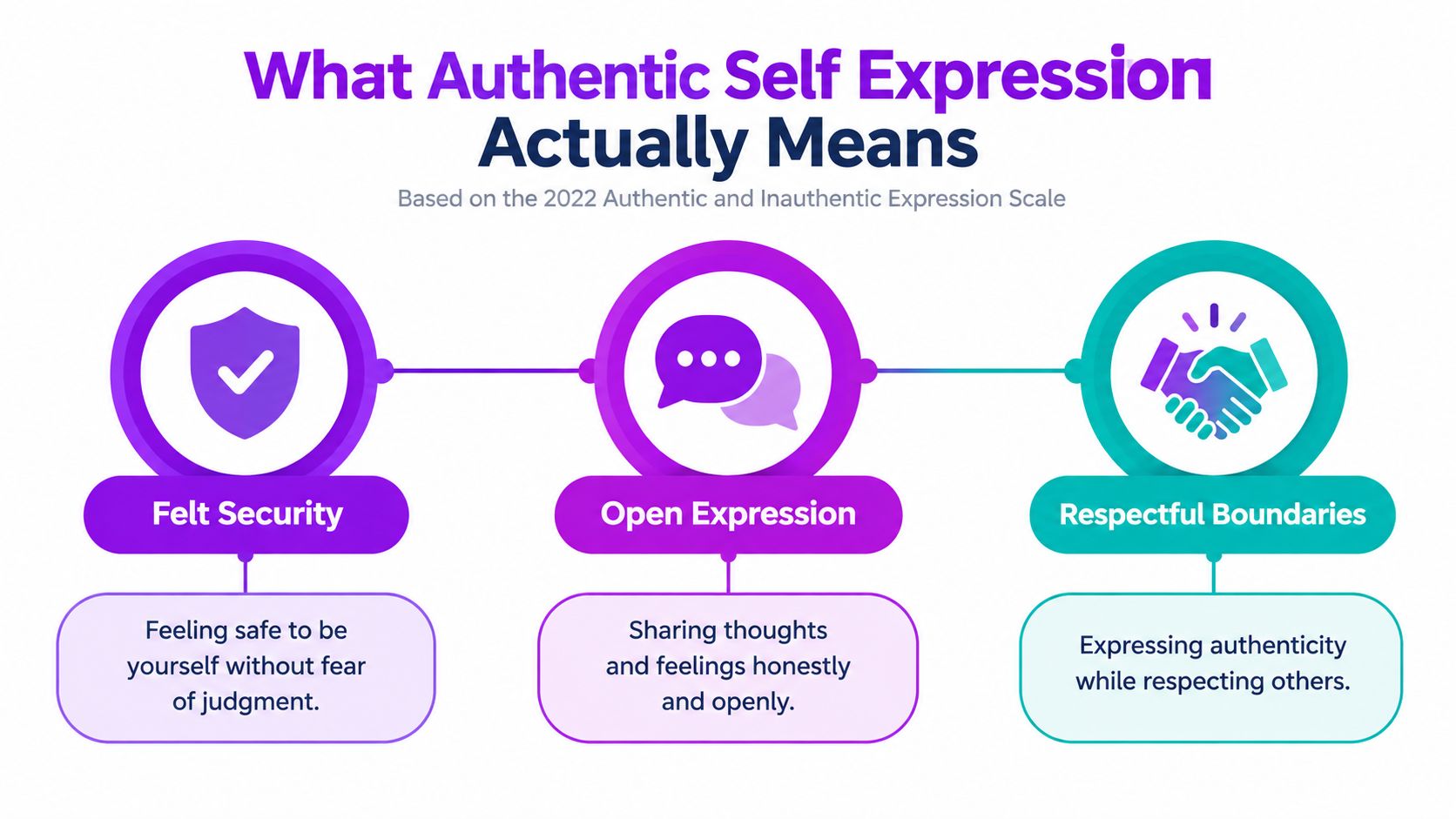
Authentic self expression is often reduced to “being yourself,” but that phrase leaves out the skills involved. The Authentic and Inauthentic Expression Scale, developed in a 2022 academic study, treats expression as something that can be examined through observable patterns rather than a vague inner feeling. Its validation found that authentic expression accounted for 44.54% of the variance in the scale's items, with an eigenvalue of 9.35, supporting a distinct underlying dimension of self-expression (the scale's validation research).
The framework is useful because it separates authenticity from impulsive disclosure. It points toward three connected capacities.
Felt security
Felt security is the internal sense that you can show some part of yourself without immediately bracing for rejection or punishment. It doesn't mean every environment is safe, or that you should disclose personal information to everyone.
A secure expression might sound like, “I need time to think before I answer,” rather than an automatic agreement. It might also mean wearing clothing you prefer, choosing a quieter social plan, or admitting that a popular idea doesn't appeal to you.
Open expression
Open expression is the willingness to communicate thoughts and feelings clearly enough that other people can respond to the message. It can be direct, cautious, creative, or brief.
Saying, “I'm interested in the project, but I can't take responsibility for the deadline,” is open expression. So is telling a friend, “I want company, but I'm not ready to discuss the whole story.” Openness includes accurate limits.
Respectful self-interest
Authenticity also requires regard for other people. Respectful self-interest means expressing your needs without treating your preferences as automatic commands. You can say no, ask for space, or disagree while leaving room for another person's dignity and perspective.
The older real-versus-fake framing misses this balance. It implies that an authentic person has a fixed “true self” waiting to be revealed, while an inauthentic person is merely pretending. In practice, you may be authentically reserved, authentically strategic, or authentically diplomatic. Authenticity is practiced through choices, not possessed as a permanent personality trait.
The Barriers That Keep You Playing a Role
The urge to perform usually has a history. It may come from inside you, from a particular relationship or group, or from conditions that make direct expression risky. Treating every barrier as a mindset problem creates shame and can push people toward reckless honesty.
Internal barriers
People-pleasing habits make approval feel like proof that you've behaved correctly. Conflict anxiety makes even a modest disagreement feel dangerous. An overdeveloped inner critic then reviews your words, facial expressions, and timing long after the conversation ends.
Reframe the urge to perform as data about a felt need. Perhaps you need safety, belonging, rest, control, or permission to disappoint someone. The need isn't evidence that your personality is weak.
Try one adjustment today: before answering a request, pause and say, “Let me check my schedule,” or “I want to think about that.” A pause interrupts automatic compliance without forcing immediate confrontation.
Social barriers
Families often assign roles, such as the dependable one, the peacemaker, or the difficult one. Workplaces reward certain communication styles, while friend groups may expect constant enthusiasm, availability, or agreement.
You don't have to contort yourself inside every context. Choose where a fuller expression is appropriate, and choose where a small, protected expression is enough. A colleague may receive your honest workload boundary, while a distant acquaintance may only need a polite decline.
| Barrier Type | Examples | Concrete Reframe |
|---|---|---|
| Internal | People-pleasing, conflict anxiety, harsh self-criticism | The performance urge points to a need. Pause before responding. |
| Social | Family roles, workplace norms, friend-group expectations | Choose contexts carefully instead of reshaping yourself for every audience. |
| Structural | Economic pressure, discrimination, caregiving responsibilities | Authenticity can include caution, support, and gradual change. |
Structural barriers
Economic pressure, discrimination, and caregiving responsibilities can limit the choices available to you. A person who depends on a job, supports relatives, or faces bias may need to manage visibility carefully. That isn't hypocrisy. It's context.
Authenticity isn't recklessness. Agency may look like finding an ally, documenting a concern, asking for accommodations, or expressing one preference at a time. Start with the adjustment that protects your stability while moving your behavior slightly closer to your values.
Journaling Prompts and a Reflection Framework
Journaling works best here as a short experiment, not a performance review. Set aside a consistent time and place, then write quickly enough that you capture your first response before your inner editor turns it into a polished explanation. You can complete the practice in 10 to 15 minutes.
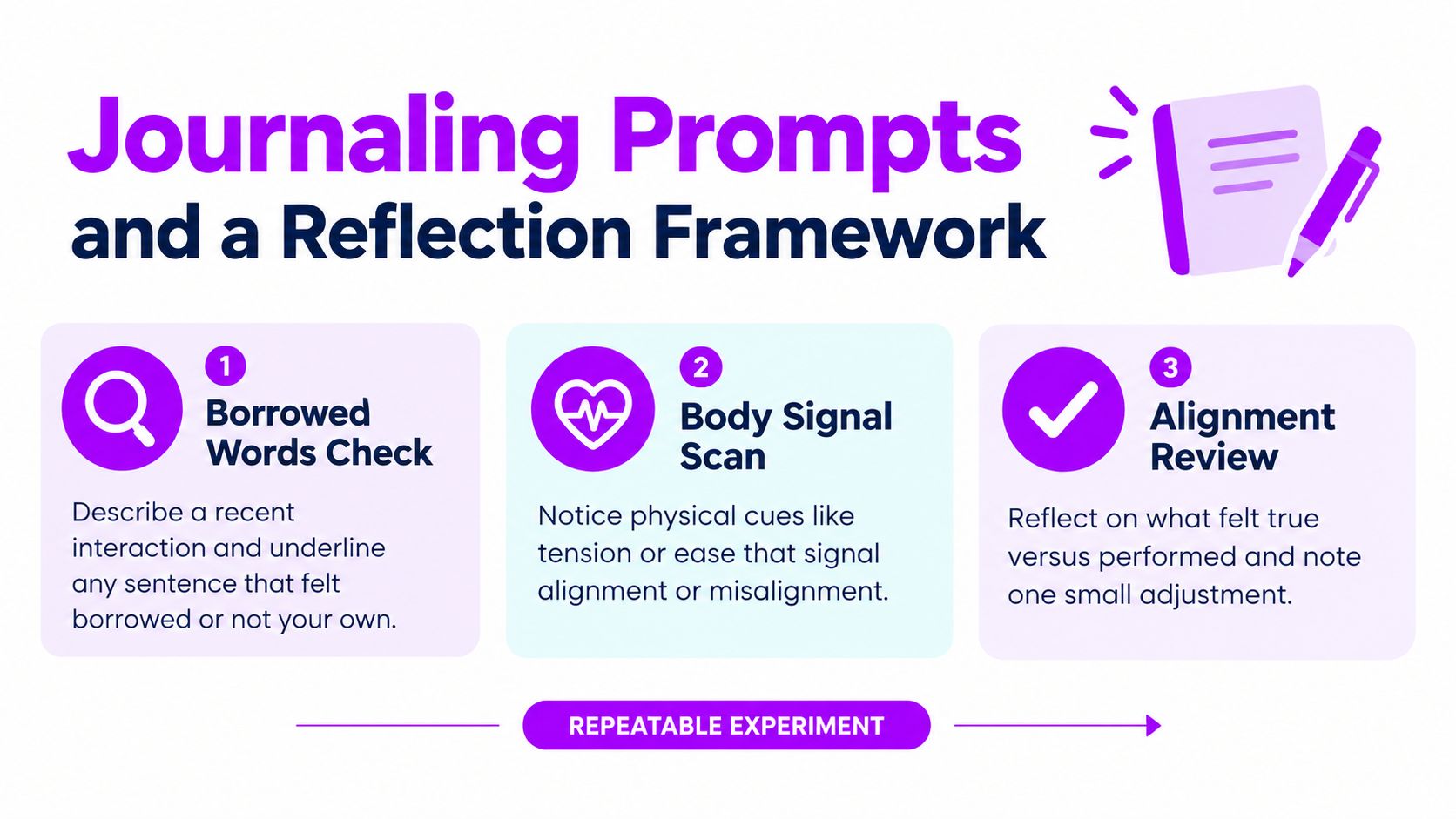
Prompt one, the borrowed words check
Describe a recent interaction in concrete detail. Write what happened, what you said, and what you wanted to say. Underline any sentence that felt borrowed, rehearsed, exaggerated, or disconnected from your actual experience.
Don't judge the sentence yet. Ask what it was protecting. Maybe it avoided conflict, preserved privacy, or helped you stay employed. The purpose is recognition.
Prompt two, the values inbox
List five behaviors you performed this week. They might include answering a message, accepting an invitation, postponing a task, helping someone, or expressing an opinion. Beside each behavior, rate how closely it matched your stated values, using your own simple scale.
A low-alignment entry isn't a failure. It's a candidate for experimentation. If you value honesty but repeatedly say “whatever works” when you have a preference, practice naming one preference in a low-risk situation.
Prompt three, the alternative sentence
Replay one moment of inauthentic expression. Write the sentence you wish you'd said instead, then make it safer and more usable. “I hate this plan” might become, “I'm concerned about the timeline, and I'd like to discuss another option.”
Use the reflection sequence notice, name, choose:
- Notice the body signal, such as tension, numbness, heat, ease, or relief.
- Name the protective story, such as “If I disagree, they'll reject me.”
- Choose one small behavior that reflects your values while respecting the situation.
For more variations, use these journal prompt examples for structured self-reflection. You can also watch the following guided resource before writing.
Keep the routine frictionless. Use the same notebook, phone note, or private document, and stop when the allotted time ends. Repetition matters more than eloquence.
Using a Structured Tracker to Notice Your Patterns
A journal preserves detail, but structured tracking helps you compare moments that otherwise blur together. Michael recommends logging three fields each day: a one-word mood label, an alignment rating from one to ten, and a two-phase note.
The first phase captures the trigger while it's fresh. Record the person, setting, topic, or event that preceded your response. The second phase records what you said, withheld, softened, or exaggerated. If you couldn't write in the moment, add the reflection later while the situation remains recognizable.
A small daily dataset
A useful entry might look like this:
- Mood: Drained
- Alignment rating: 4
- Phase one: Team meeting, disagreement about priorities
- Phase two: I agreed quickly, withheld my concern, and felt tense afterward
Another entry might show a different pattern:
- Mood: Calm
- Alignment rating: 8
- Phase one: Conversation with a trusted friend
- Phase two: I said I wanted help but didn't want advice
The point isn't to turn identity into a score. The rating gives your reflections a consistent reference point. Over time, you can review whether particular people, settings, or subjects appear repeatedly beside lower alignment.
MicroTrack provides one example of this workflow, with two-phase logs, a mood graph, and a pattern view for reviewing recurring triggers. Its structure can turn scattered observations into a small dataset you can examine weekly rather than relying on memory alone. Read about structured data entry for reflective tracking if you want to design a more consistent logging habit.

Review patterns, not isolated moments
Choose one review time each week. Look for repetition, not dramatic conclusions. You might notice that you perform most around senior colleagues, become more direct when tired, or feel more aligned when you have time to prepare.
Then select one experiment. Ask one clarifying question in the next meeting, state a preference before offering alternatives, or delay a personal disclosure until trust has developed. A tracker should support curiosity, not self-surveillance.
Integrating Practice With Therapy, Coaching, and Microdosing
Reflection can reveal a pattern without explaining its origin. That's where different forms of support serve different purposes.
Therapy is suited to processing the roots of inauthentic expression, including family roles, chronic shame, trauma, or experiences that made visibility feel unsafe. A therapist can help you work with emotional responses that aren't resolved through better scripts alone.
Coaching focuses more on translating insight into action. A coach may help you design a behavioral experiment, prepare a difficult conversation, and review what happened afterward. Coaching can be useful when you understand the pattern but struggle to change it consistently.
Microdosing is a separate, experimental lane. Some adults explore it alongside journaling and tracking, but the evidence doesn't support treating it as a reliable solution for authentic self expression or mood problems. A 2026 systematic review and meta-analysis pooled 24 studies with 3,681 participants, while randomized trials found no clear reduction in depressive symptoms, anxiety, or stress versus control; reported adverse-event rates were similar to controls (the 2026 synthesis).
Current protocols also vary. The same synthesis reported one day on and two days off as the most common regimen (the review's protocol summary). A phase II randomized, double-blind, placebo-controlled trial in major depressive disorder is using 40 participants and compares 2 mg psilocybin once weekly for 4 weeks, followed by another 4 weeks of psilocybin, with a control sequence that receives placebo first and psilocybin later (the registered trial description). Another 2026 clinical study is testing 2 or 3 mg daily, 4 days per week, for 2 consecutive weeks, demonstrating that research schedules differ substantially (the clinical trial record).
| Lane | Primary focus | Best for | Evidence status |
|---|---|---|---|
| Therapy | Origins, emotional processing, safety | Trauma, shame, entrenched relational patterns | Established clinical support varies by approach and person |
| Coaching | Goals, experiments, accountability | Practicing communication and behavior change | Useful as structured support, not a substitute for therapy |
| Microdosing | Personal experimentation and observation | Adults considering a carefully documented adjunct | Mixed and unresolved, with no clear randomized-trial mood benefit in the cited synthesis |
A tracker can serve as a shared measurement tool across these lanes. Discuss your entries with a qualified professional, especially if you have a mental health condition, take medication, or are considering a psychoactive substance. The integration practices guide can help you think about reflection as part of a broader support plan, not as a promise of a particular outcome.
When Authenticity Backfires and Why Nuance Matters
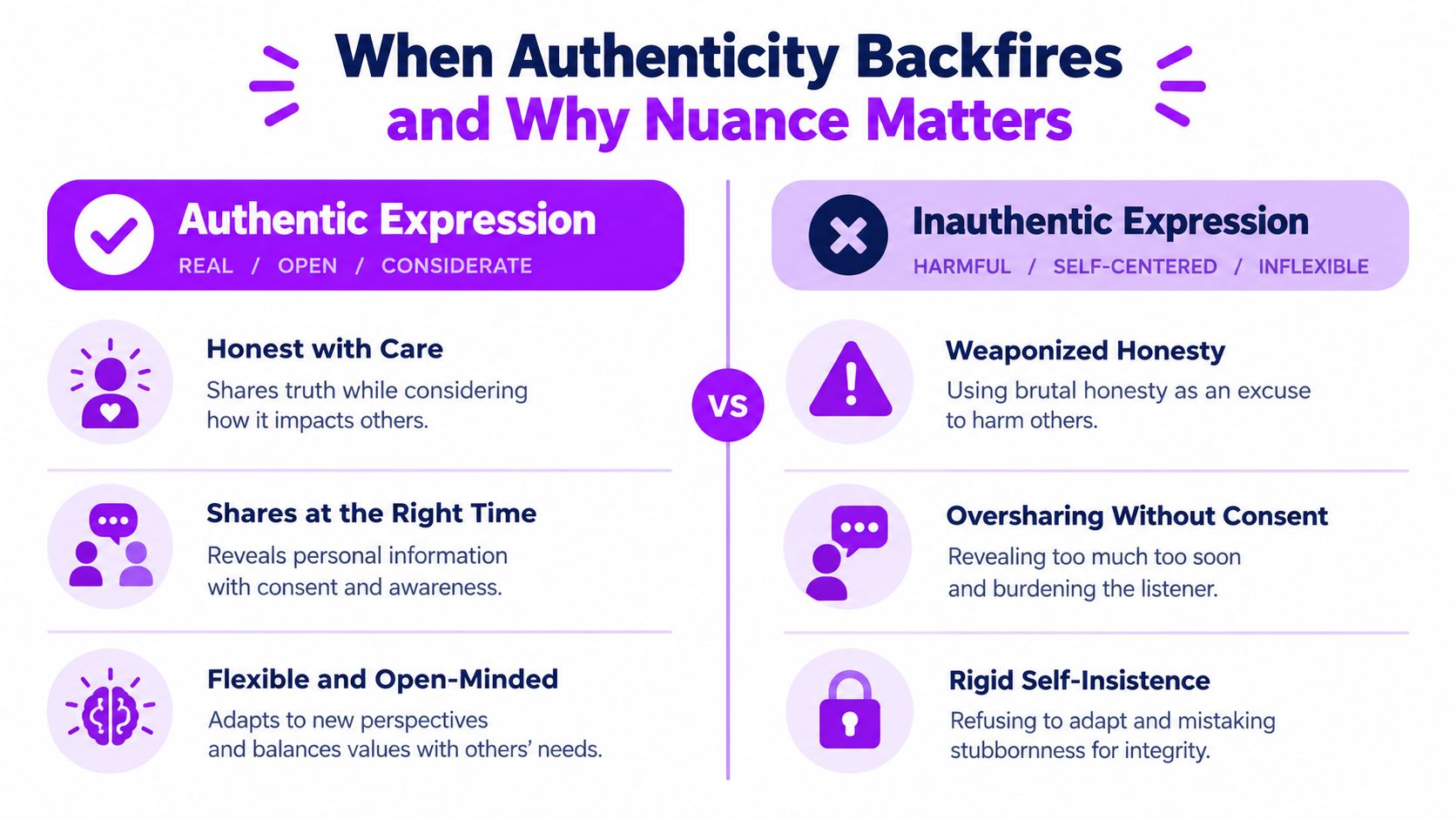
Authenticity can become another rigid rule. Someone may use “I'm just being honest” to justify cruelty, disclose intimate details without considering consent, or refuse every adjustment as though flexibility were betrayal.
Newer research distinguishes authentic expression from inauthentic expression rather than treating the latter as a simple opposite or automatic moral failure. The distinction matters because self-regulation can produce mixed effects, especially in relationships and workplaces (the academic discussion of authentic and inauthentic expression).
Three failure modes deserve attention:
- Weaponized honesty: You deliver an unnecessary insult and call it authenticity.
- Oversharing without consent: You reveal intense personal material before the listener has agreed to hold it.
- Rigid self-insistence: You refuse to adapt, negotiate, or learn because you've confused stubbornness with integrity.
Diplomacy, strategic silence, and adaptability can all serve authentic goals. You may believe something and still decide that the timing, audience, or wording needs care. The question isn't only, “Is this true for me?” It's also, “What am I trying to create by expressing it?”
Try this diagnostic after a difficult exchange: did you feel more grounded, or emptier? Did the listener receive a clear boundary, or feel attacked and trapped? A painful response doesn't automatically mean you were wrong, but a pattern of relief followed by regret may indicate that impulsive expression was protecting something else.
Skillful self-awareness beats unfiltered truth. Authenticity becomes healthier when it includes responsibility for impact, consent around vulnerability, and flexibility about delivery.
FAQs and a 30-Day Starter Plan
How long does it take to notice changes? There's no universal timetable. Many people first notice patterns when they review repeated entries, rather than after one powerful journal session.
Is journaling better than tracking? They serve different purposes. Journaling gives depth and language, while tracking makes recurring moods, triggers, and alignment easier to compare.
How can I start with a packed schedule? Use one prompt and a short timer. A small routine you repeat will teach you more than an elaborate system you abandon.
What if family or workplace expectations push back? Start with a low-risk boundary, protect your stability, and seek support before making a high-cost change.
Try this four-week sequence:
- Week one: Write for 10 minutes each day using the borrowed-words prompt.
- Week two: Add a mood label and energy or alignment rating to a simple log.
- Week three: Review the week's entries and identify one recurring trigger.
- Week four: Discuss one pattern with a therapist, coach, or trusted peer.
Start tomorrow with one interaction you can still remember clearly. Write what happened, name what you withheld, and choose one respectful sentence you'd like to try next.
MicroTrack gives you a structured place to record mood, alignment, triggers, and later reflections, so authentic self expression becomes something you can observe and practice. Visit MicroTrack to begin building a calmer, evidence-informed reflection habit.