Benefits of Mood Tracking: What It Shows and How to Start

The most popular advice on mood tracking is to log constantly, protect a streak, and treat a rising score as proof that a routine, a supplement, or a microdosing schedule is working. That advice gets the payoff backwards.
The useful benefits of mood tracking come from measurement quality. A consistent scale, a real timestamp, and a little context beat a pile of vague check-ins. A dated 0–10 score replaces the foggy sense that "the month was bad." It does not, on its own, prove that anything you changed caused the shift.
A careful log answers narrower questions. What does an ordinary day look like for you? When do low scores cluster? What should you hand a clinician? Those questions get clearer when you record close to the moment and wait for a pattern to repeat before you act.
Table of Contents
- What Mood Tracking Actually Gives You
- Why Timestamped Logs Beat Memory
- Where Mood Tracking Fits in Mental Health and Microdosing
- How to Start Your Mood Log and Keep It Going
- Telling Real Effects Apart From Wishful Thinking
- Reading Trends and Patterns in Your Own Data
- Warning Signs That Call for Professional Help
- Start Your First Week of Mood Tracking
What Mood Tracking Actually Gives You
Read the five gains below from top to bottom before you chase any of them. The most reliable gain is measurement itself: a dated written record replaces a hazy verdict on the month.
| Benefit | What you gain | Evidence strength | Example |
|---|---|---|---|
| Self-awareness | Clear view of your personal baseline and typical swings | Moderate; supported by measurement research | Low-energy mornings repeating every Tuesday |
| Symptom monitoring | Early dated record of depressive or anxious shifts | Moderate for tracking depressive change | Three low days in a row flagged before a missed appointment |
| Clinical conversation | Shareable trend data for a clinician | Supported as a communication aid | Bringing a four-week chart to a review visit |
| Routine feedback | Shows which habits coincide with better or worse days | Preliminary | Scores running lower on nights with under six hours of sleep |
| Treatment optimization | Helps you notice what changed after an adjustment | Not established; logs cannot prove cause | A mood rise after a dose change is an observation to discuss, not proof |
Self-awareness means you can see your own baseline. Say low-energy mornings show up every Tuesday. That repeat is more useful than a feeling that you are "always tired," because you can check the weekday, the sleep note, and the score together.
Symptom monitoring means a shift in depressive or anxious patterns has a date. Three low days in a row, written down before you miss an appointment, give you something to act on. The record is moderate support for noticing depressive change, not a diagnosis.
Clinical conversation means you arrive with four weeks of dated scores instead of a reconstructed guess. The chart is a communication aid. Your clinician still interprets it.
Routine feedback means habits line up next to worse or better days. Short sleep or skipped walks can sit beside lower scores. That lineup is preliminary. It shows coincidence, not a verdict.
Treatment optimization needs the most care. A log can show what happened after a change. It cannot prove the change caused it. A mood rise after a dose adjustment is a note for discussion, not evidence the adjustment worked.
Aim first at the benefit that makes your next decision clearer. Often that is routine feedback or the clinical conversation, not a hunt for proof.
Why Timestamped Logs Beat Memory
A weather station records temperature every hour. Ask someone about last month's weather and you get a rough guess shaped by the last few days. Mood memory works the same way. A timestamped log is the station, not the guess.
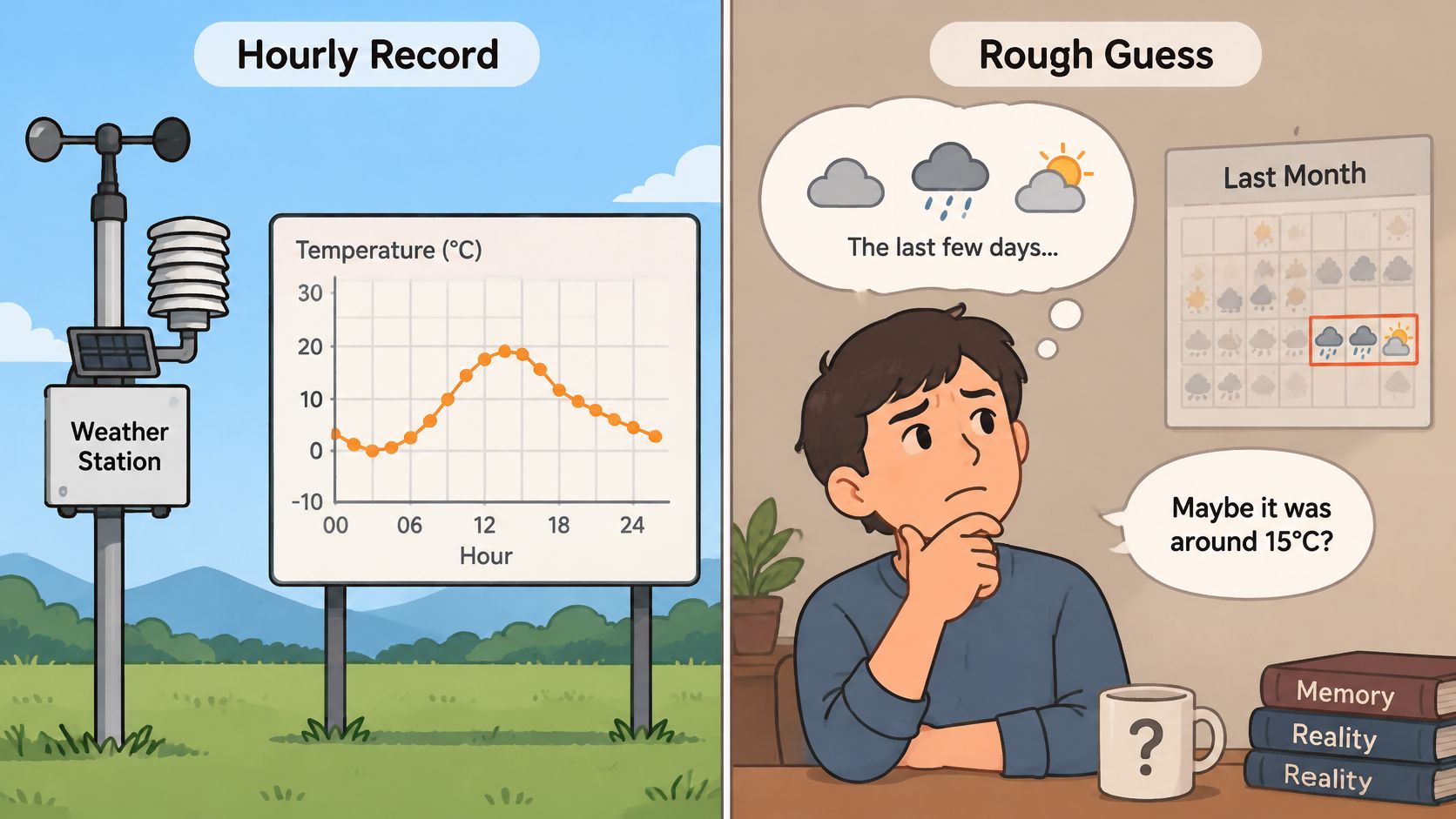
Ecological momentary assessment research describes three mechanisms that raise the technical quality of self-observation when you replace end-of-week recall with repeated, time-stamped ratings in ordinary life.
Real-time entries cut recall bias. You write the score while the hour is still the hour. A tense meeting at 2 p.m. gets a 3 with the time attached, instead of blending into "work was stressful" on Sunday night.
Repeated observations show movement. Mood, sleep, activity, and stress travel together. A short night, a flat afternoon score, and a skipped walk can sit on the same day so you can see the cluster, not three separate memories.
Context shows when a shift is likely. The useful extras are small and close to the event: a dose, a short night, a workout, or a tense conversation. You are marking the setting, not writing an essay.
Why a plain 0–10 score gets sharper
A bare number is thin. The same number with a clock time and one optional note lets you compare this week with your own earlier weeks. You are not grading yourself against a population average.
Ratings taken in kitchens, commutes, and offices also travel better into personal decisions than ratings taken only in a lab. Everyday measurement has more ecological validity for the life you live.
Practical rule: Log within minutes of the event you care about, then stop. A short true entry beats a polished memory written days later.
The limit stays in force. A repeated association is a hypothesis. Standardized questions and a steady sampling schedule help you spot a trend. They still do not turn that trend into a verified cause. A short walk-through of how momentary entries differ from recall is here:
Where Mood Tracking Fits in Mental Health and Microdosing
A mood log answers a narrower question than it first appears to. It records what changed, when it changed, and what else was happening at the time. It stays silent on why. Find your situation in the table and keep that boundary in mind, because it shifts with the condition you are tracking.
| Use case | What tracking can show | What it cannot show | Next step |
|---|---|---|---|
| Depressive episodes | Duration and frequency of low mood across weeks | Whether a treatment caused the change | Share the trend chart with your prescriber |
| Anxiety | Trigger clusters and time-of-day peaks | A diagnosis or severity grade | Discuss a sustained rise with a clinician |
| Bipolar disorder | Mood swings, sleep loss and energy changes side by side | Reliable detection of mania from self-ratings alone | Treat rising energy with reduced sleep as a clinical flag |
| PTSD | Trigger days, nightmares and avoidance logged next to mood | Whether a microdose reduces symptoms | Bring logs to a trauma-informed clinician |
| Microdosing practice | Dose days, mood ratings and side effects across cycles | Efficacy or safety guarantees | Review the log with a qualified clinician before changing anything |
Depression tracks more cleanly than mania
Structured self-ratings capture low mood more reliably than high mood. A falling score that persists across weeks, logged next to shrinking sleep and low energy, is a pattern a journal handles well. Rising energy, impulsivity, and racing thoughts are harder to grade from inside the experience, so self-ratings alone make a weak mania detector. A log can support a conversation about depressive change. Suspected hypomania or mania calls for clinical assessment.
The wider trial evidence is cautious too. Studies that add self-monitoring to care have produced modest and inconsistent changes in symptoms. Logging measures; it does not treat. Its value sits in the quality of the record it builds for you and your clinician.
The working rule
Use the log as feedback and as a discussion tool. Keep one scale so a 6 in March means the same thing as a 6 in June. Review rolling weekly or monthly trends instead of single days, and record confounders such as sleep and anything else you took that day. A mood dip after three short nights reads differently from the same dip on a stable week. Treat an abrupt or sustained change as a prompt to get clinical support.
A microdosing practice fits the same frame. Dose days, side effects, and mood across cycles give a clinician a timestamped record to examine. The record documents what happened; it cannot prove the dose caused it or guarantee safety. If you live with bipolar disorder, PTSD, or depression, involve a qualified clinician before you change anything.
Bring three things to that visit: a rolling chart, sleep notes, and dose timing. Leave the causal claim at the door.
How to Start Your Mood Log and Keep It Going
Set the clock before you invent a system. Four fixed check-ins, tied to habits you already have, outperform a heroic plan you abandon by Thursday.
| Time | What to record | Why it matters |
|---|---|---|
| Morning | Mood score, wake time, hours slept | Captures carry-over from the night |
| Afternoon | Mood score, energy, any dose or activity | Shows midday dips and effects |
| Evening | Mood score, main stressor, activity | Links the day's events to the score |
| Bedtime | Final mood score, short reflection, side effects | Closes the day and prepares the reflection phase |
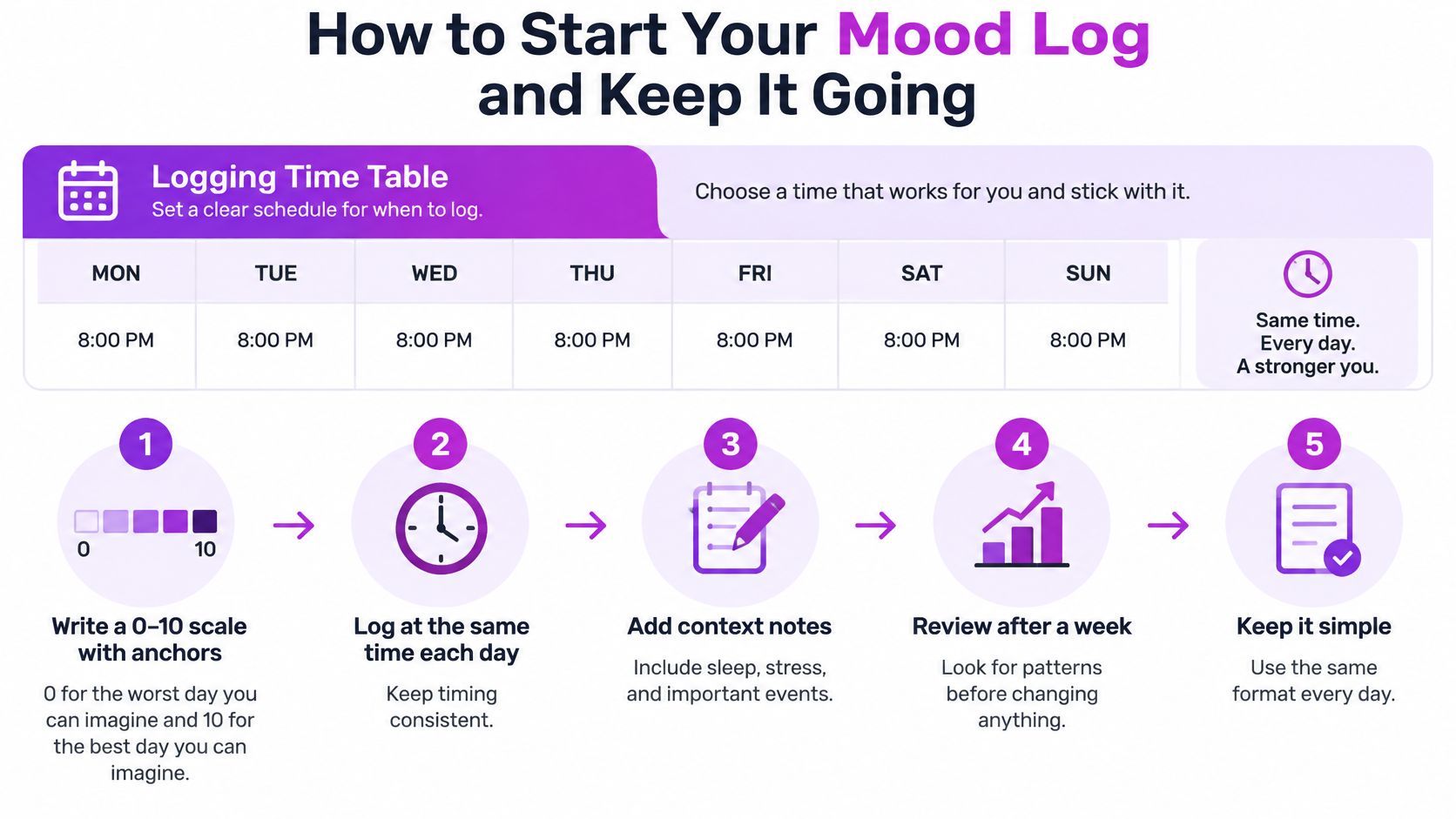
Six steps that survive an ordinary week
- Write the scale once. Use 0–10 with anchors you can reread: 0 for the worst day you can imagine, 5 for an ordinary day, 10 for your best. A written daily mood rating scale stops the meaning of "7" from drifting.
- Pick three or four times from the table. Attach them to coffee, lunch, dinner, or brushing your teeth so the prompt is a habit, not a reminder you negotiate with.
- Log within a few minutes. Mood first, context second. One line is enough: score, then sleep, stress, or the event that just happened.
- Split the entry into two phases. Record dose or session details in the moment. Come back later for a reflection when you have one. Do not stall the first save waiting for insight.
- Skip without a penalty. Leave the slot blank. Do not backfill it from memory tonight or next weekend.
- Review on a calendar, not on a feeling. Check a weekly average every Sunday. Check a monthly trend at month's end. One ugly afternoon is not a trend.
What adherence actually looks like
A 2016 Journal of Medical Internet Research study followed 27 Dutch university students for six weeks. 66% (18 participants) were still rating on study day 42. On days when someone logged at all, 91.9% of those days included four or more ratings. Short, repeated entries can capture within-day change for several weeks. That study measured participation and recording behavior, not clinical improvement, so it supports feasibility and data quality, not a claim that the log treats depression or anxiety.
Telling Real Effects Apart From Wishful Thinking
The common trap is one great day that feels like proof. You slept well, the score jumped, and the protocol suddenly looks effective. A single spike is an anecdote with a number on it.
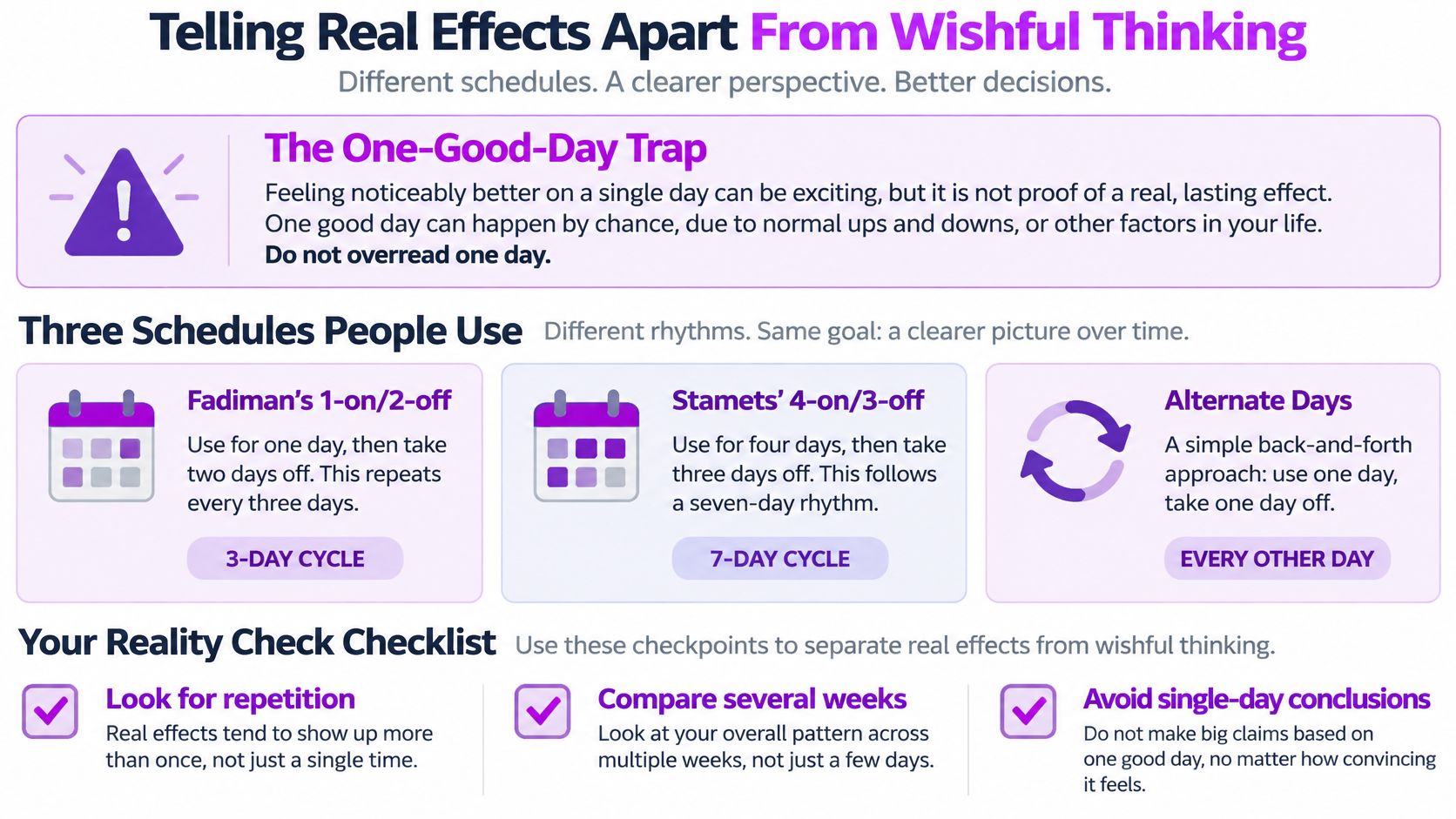
People comparing schedules usually meet three patterns. Fadiman's 1-on/2-off repeats every three days. Stamets' 4-on/3-off repeats every seven days. A custom schedule bends around work and travel. The useful question is not which rhythm feels best after one good day. It is whether the log shows the same shape across at least three full cycles. Legal status of psychedelic substances varies by location. This article gives no dosing advice.
Three ways a log lies to you
Self-ratings stay subjective. There is no widely accepted gold-standard momentary mood measure, and studies use different items and protocols, so charts are hard to compare across people. A review of those measurement problems is a reminder that a 10-point score is a personal signal, not a diagnosis and not proof that a microdose, supplement, or routine caused a change.
Hindsight rewrites last week as worse than the entries said, so this week looks like a breakthrough. The fix is to trust the timestamps you already saved, not the story you tell on Sunday.
Expectation nudges a dose day upward because you expect it to feel better. The fix is to score mood before you annotate the day as "on" or "off," and to keep the anchors for 0, 5, and 10 written down.
Confounders such as sleep, alcohol, stress, or weather move the score while the schedule gets the credit. The fix is to put the confounder in the same entry, leave missed slots blank, and compare several weeks side by side. Agree any on-day versus off-day comparison with a clinician before you treat it as a result. If you want a cleaner split between a pairing and a cause, read correlation versus causation before you change a protocol.
A personal chart does not replace professional assessment, especially if you are managing depression, anxiety, PTSD, bipolar symptoms, or a medication change.
Reading Trends and Patterns in Your Own Data
In a 2025 feasibility case series of eight outpatients, later rise times lined up with higher weekly PHQ-9 depression scores in two participants (ρ=0.74, P<.001, and ρ=0.78, P=.02). In one participant, later rise time also lined up with higher GAD-7 anxiety scores (ρ=0.59, P=.03). Across those preliminary looks, improvement generally sat with earlier rise times, longer sleep, and more light activity, while worsening sat with more sedentary time and delayed sleep onset.
That is a question generator, not a rule for your dose or your medication. Eight people cannot tell you that moving your alarm will change your symptoms.
A repeatable check on your own rows
Work in this order, and only on variables you logged.
- Weekly average. Add the week's scores and divide by the number of real entries. Skipped slots stay out.
- Split the month. Compare the first half with the second half. A one-point drift across two weeks is easier to see than day-to-day noise.
- Time of day. See whether evenings dip on most days or only after short sleep. A long-term trend analysis is about that repeat, not about a single dramatic afternoon.
- One variable, two weeks. If you test anything, test one thing, such as wake time, and keep the rest as steady as life allows.
Call it a pattern only when the shift repeats across at least three cycles. One dramatic day does not qualify.
A pattern that lines up with earlier rising or a bit more light activity is a reason to run a careful personal test and to raise it with a clinician. It is not a reason to change a medication or a dose because the chart looks suggestive.
Which single variable is most worth testing this month? Pick the one you can hold steady, usually wake time or a short daily walk, and leave everything else alone until the month's review.
Warning Signs That Call for Professional Help
Treat tracking as an experiment with an exit. Continue when the log answers a real question. Reduce how often you log when the habit turns compulsive or distressing. Get clinical support when symptoms worsen.
Low mood that settles in. Low mood on most days for two weeks or more, or a sustained drop from your own baseline, is a reason to contact a clinician rather than to wait for the average to recover.
Sleep down, energy up. Noticeably less sleep alongside rising energy, racing thoughts, or unusual impulsivity can point to mania. That combination needs prompt clinical review, not a private interpretation of a high score.
Trauma symptoms crowding the day. Flashbacks, nightmares, or panic that become more frequent, or harder to manage, belong with a trauma-informed clinician. The log can ride along. It should not be the only response.
The log itself feels unsafe. Checking, scoring, or logging that feels compulsive, or dread before you open the record, means the measurement is now part of the problem. Shorten the schedule or pause it.
Thoughts of self-harm or suicide. Tell a clinician, a trusted person, or a crisis service. If you are in immediate danger, contact local emergency services now. In the United States, call or text 988.
Bring the log to the next appointment so the dates are in the room. Do not start, stop, or adjust a medication or a dose because a chart seems to point that way. A spreadsheet is not a prescriber.
Start Your First Week of Mood Tracking
Decide on one tracker and log for seven days before you judge the practice. A tool earns its place when it protects the measurement, not when it nudges you to open it more often.
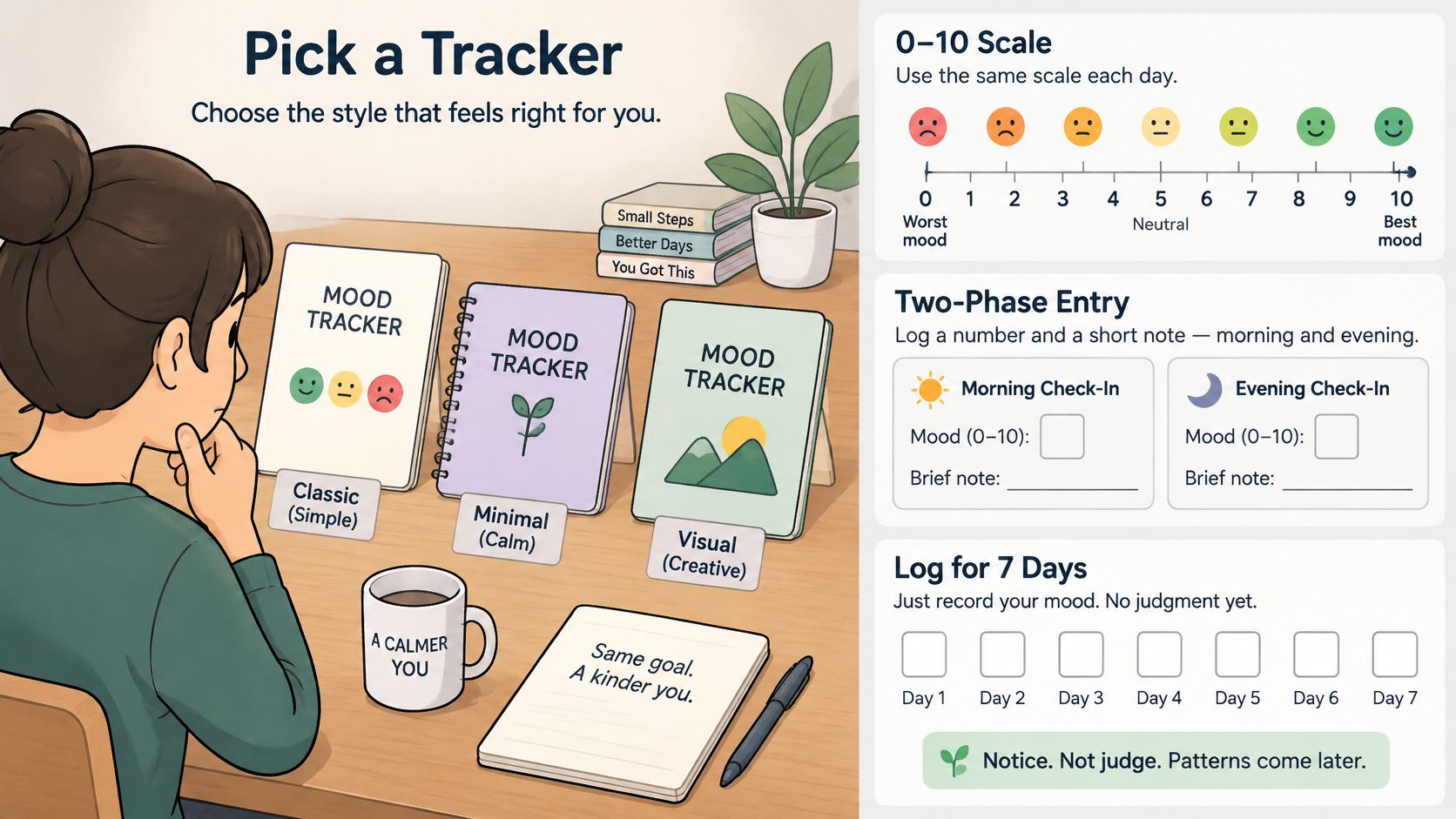
Look for this short list:
- Fixed 0–10 scale: The anchors stay put from day to day.
- Two-phase entries: Reflections can arrive later, after the score is saved.
- Skip and add without penalty: A missed slot stays blank, and a real event can still be added.
- Search and filtering: You can find dose days or bad-sleep days without rereading everything.
- CSV export: You can hand a file to a clinician or open it in a spreadsheet.
- One-click deletion: You can remove data when you want it gone.
- No streaks and no gamification: Nothing pushes compulsive logging.
MicroTrack, our microdosing journal and tracker, covers that list: a 10-point scale, two-phase entries, skip and add overrides, search, CSV export, and one-click deletion. You can start journaling in under a minute, and signing up does not require a credit card. We never sell, share, or train AI models on journals. MicroTrack is not a medical application and does not provide medical advice, diagnosis, or treatment.
Use the first week like this. Day one, write the scale and pick your check-in times. Days two through six, log only at those times. Day seven, read the weekly average and write one question to test. Put a review on the calendar 30 days out, and change nothing important before that date.
MicroTrack is a free mood and microdosing journal for timestamped 0–10 scores, dose notes, and week-by-week trends you can export and discuss with a clinician. It is built for cautious logs, not for streaks or medical advice. Visit MicroTrack and start a seven-day record before you judge what your scores mean.