Big Laughing Gym Mushroom: ID, Risks, and Lookalikes
'Big Laughing Gym' usually refers to Gymnopilus junonius, a wood-decaying orange-capped mushroom whose chemistry varies so much between populations that it cannot be treated as a standardized source of psilocybin.
The cheerful name is a poor guide to what a specimen contains. A useful encounter begins with observation, not an expectation of laughter: what's growing, what evidence supports its identity, and what remains unknown?
Table of Contents
- What the Big Laughing Gym Mushroom Actually Is
- Key Features for Field Identification
- Natural History and the Naming Story
- Where and When It Grows
- Dangerous and Confusing Lookalikes
- Chemistry, Psychoactivity, and Why Microdosing Is Unsafe
- Legal Status and Harm Reduction for Curious Foragers
- Field Checklist and What to Record Before Any Consumption
What the Big Laughing Gym Mushroom Actually Is
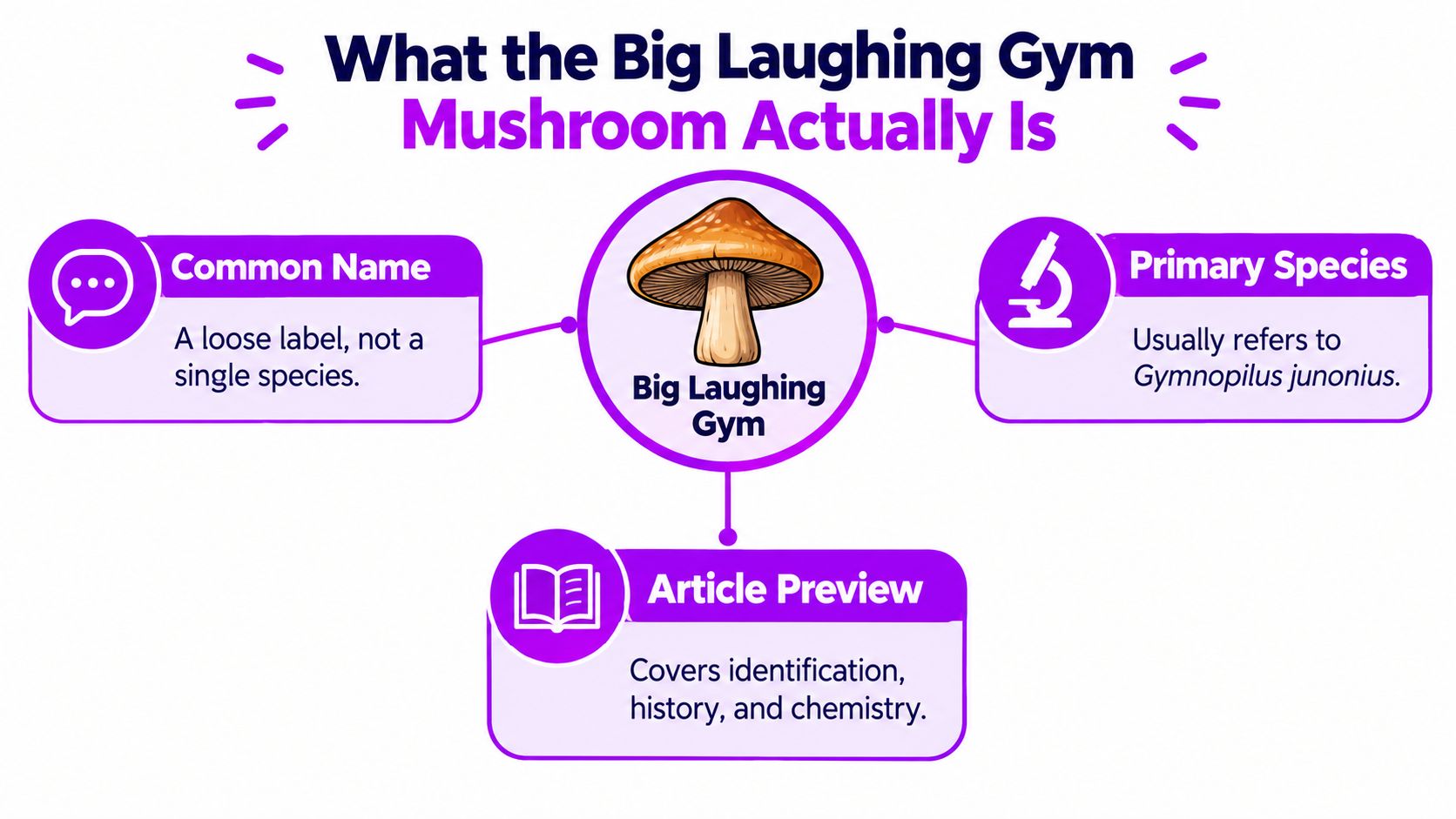
Big Laughing Gym is a common name, not a laboratory specification. It usually points to Gymnopilus junonius, also known as the spectacular rustgill, Laughing Gym, Laughing Jack, or Laughing Jim. Those overlapping names can make separate field observations sound more comparable than they really are.
For practical purposes, treat the label as referring to a species complex, rather than a single edible or psychoactive product. That doesn't mean every named specimen belongs to the same formally defined complex. It means a casual name can conceal unresolved identifications and closely related mushrooms, especially when people reuse older names without checking current taxonomy.
Separate the questions before seeking answers
A responsible identification distinguishes several kinds of evidence:
- Common name: What someone called the mushroom. This helps locate information but doesn't establish identity.
- Species confidence: How closely the specimen matches a current scientific description, including microscopic evidence.
- Chemical verification: What analytical testing established about that particular specimen or collection. A species name alone doesn't answer this.
- Safety assessment: Whether the available evidence supports any proposed use. Identification and chemical detection aren't equivalent to proof of safety.
The distinction becomes especially important with related species. The Burke Herbarium's account of Gymnopilus ventricosus provides a separate taxonomic reference for a mushroom that can enter discussions about large laughing gyms. Don't assume a related scientific name is interchangeable with G. junonius, or that a shared common name guarantees shared psychoactivity.
Consider a hypothetical field note: an observer labels a cluster “Laughing Jim” after comparing it with an online photograph. That note documents an impression, not a confirmed species or measured potency. Keeping those categories separate prevents a tentative observation from becoming an apparently authoritative record.
The educational value of this mushroom lies in that distinction. You can learn a great deal from its appearance and ecology without turning an uncertain identification into an ingestion experiment.
Key Features for Field Identification
A field identification is a description supported by several observations, not a match to one striking color. The large yellow-to-orange cap and rusty spore deposits can point toward a laughing gym, but neither confirms a species. The common name covers mushrooms whose identity may require closer taxonomic work.
The Missouri Department of Conservation's Big Laughing Gym field guide uses Gymnopilus junonius as the current name and lists G. spectabilis as a former name. It also warns that ingestion can cause serious illness. That warning belongs with any field description: a visual resemblance is not evidence that a specimen is safe to eat.
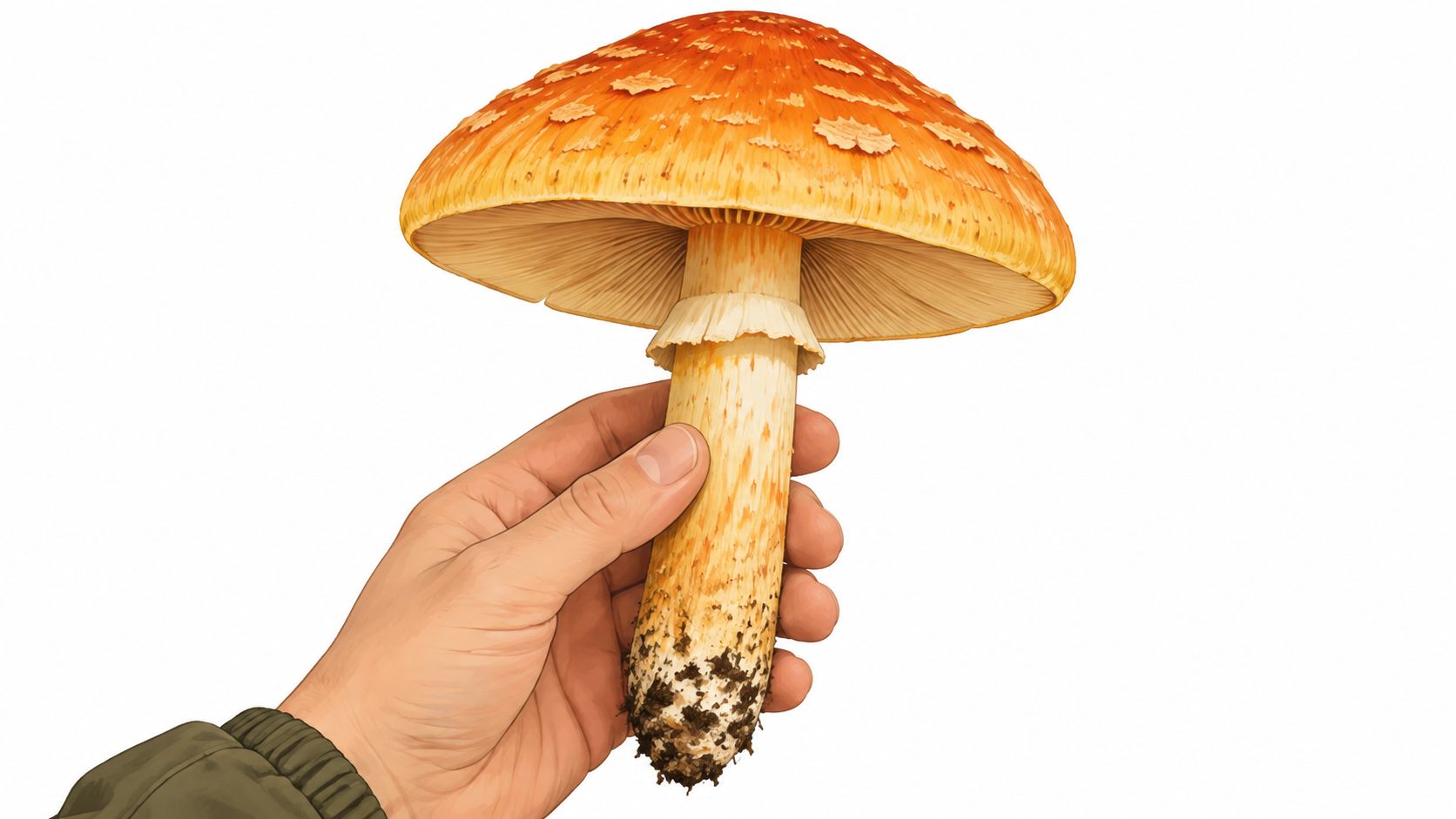
Build a record from what is visible. Photograph the cap's yellow or orange tones, fine threadlike markings, and any scales. The amount of scaling can vary, so its presence or absence is one observation, not a pass-or-fail test. For the gills, show their spacing, color, and attachment to the stem; rusty-orange tones are most useful when captured in natural context rather than an edited image.
Include the sturdy stem, or stipe, and any ring or ring-like zone. Keep the base in frame. If a rusty-brown spore deposit is visible, document it as supporting evidence. A photograph of exposed flesh may help when a specimen has already been collected for expert examination, but a description such as “solid-looking” cannot settle identification.
Bitterness is sometimes mentioned in descriptions. Do not taste an unidentified mushroom. A guide's sensory note is not an instruction, and tasting contributes little to a field record when dangerous lookalikes remain possible.
Field rule: Photograph what you can observe safely. Do not create an exposure just to complete an identification checklist.
Cap size, color, texture, and ring appearance can differ among specimens. If a feature is weak or absent, record that uncertainty instead of reshaping the identification to fit a preferred name. Microscopy and current taxonomic references may be needed for confident species-level identification. For a beginner, a carefully documented candidate is a better result than a confident-sounding name, and neither establishes potency or safety.
Natural History and the Naming Story
A mushroom's name can travel farther than the evidence supporting it. Swedish mycologist Elias Magnus Fries described the species in 1821 as Agaricus junonius. In 1960, British mycologist Peter Darbishire Orton transferred it to Gymnopilus, giving rise to the modern name Gymnopilus junonius. Betts Ecology's account of its taxonomy and natural history traces these changes.
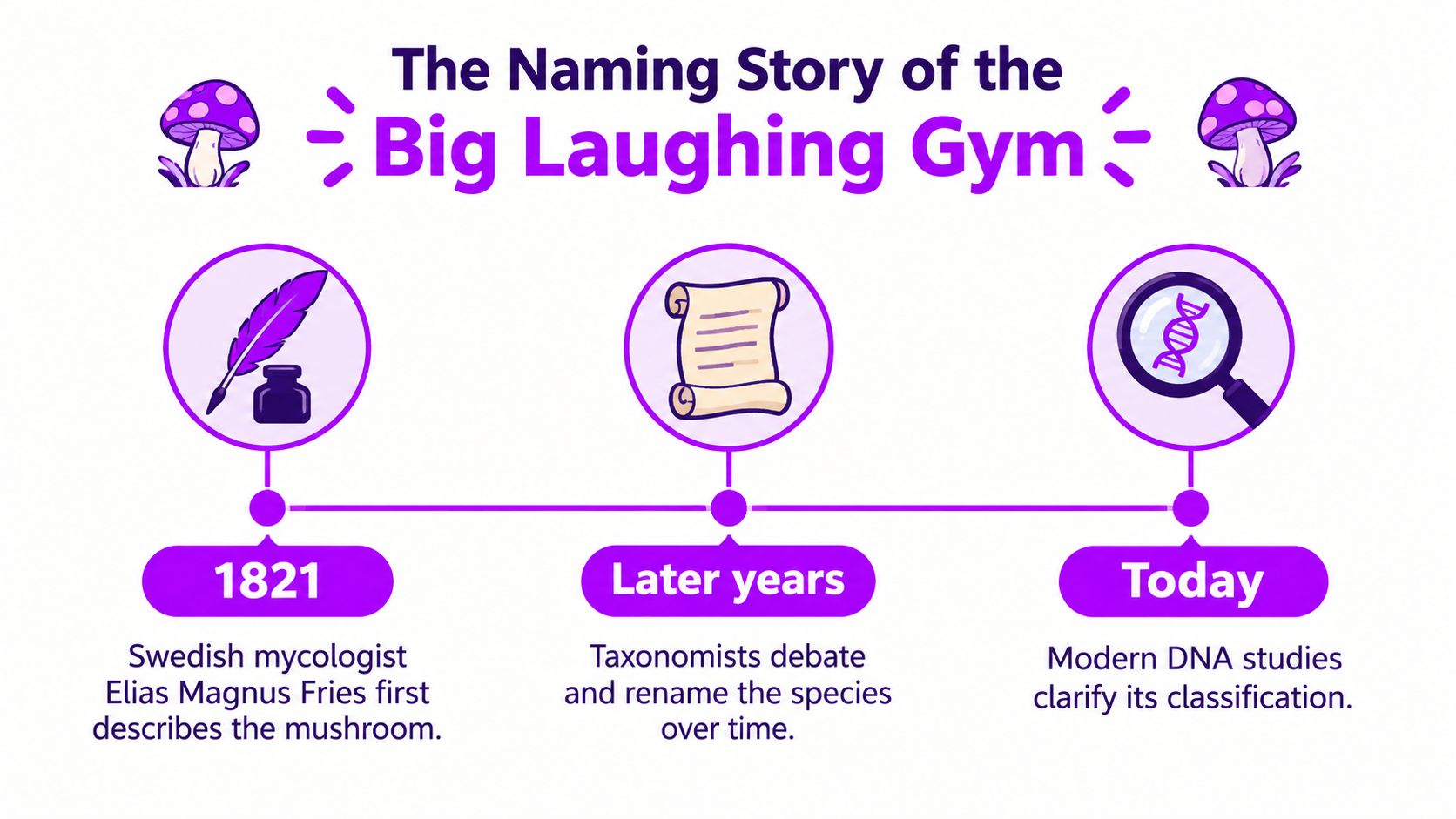
A scientific name records a classification, not a guarantee that every specimen carrying that name belongs to one clearly bounded species. Older reports can still preserve useful observations, but their identifications may need reassessment against current taxonomy.
One name, different geographic interpretations
The Betts Ecology account discusses a 2020 genetic study suggesting that “true” G. junonius may be concentrated in Europe, South America, and Australia, rather than occurring as one uniform species worldwide. North American records are harder to interpret: similar mushrooms have historically been called G. junonius or G. spectabilis.
That uncertainty changes how records should be compared. Keep the collector's or publication's original identification, and add a revised name separately only when a qualified examiner supports it. Retain the photographs, collection details, and any microscopic or analytical report alongside both names.
Consider two records labelled “Big Laughing Gym,” one from Europe and one from North America. The shared common name alone cannot show that the mushrooms belong to the same genetically consistent species. Treating reports of their effects as directly comparable would also assume that the specimens were the same kind of mushroom, an assumption the label cannot establish.
This distinction matters because the big laughing gym is better understood as a species complex in some records, not as one reliably uniform product. A species identification and a claim about potency answer different questions; one does not establish the other. Geography, the name used at the time, and the evidence behind an identification all help readers judge what a record supports.
Keep ambiguity visible. An unresolved identification recorded accurately is more informative than a confident name copied from an outdated source.
Where and When It Grows
A cluster of Gymnopilus junonius is commonly associated with dead wood: stumps, fallen logs, and the bases of dead broad-leaved trees. Conifer wood is also reported in the natural-history account cited above. The wood connection helps describe habitat, but it cannot by itself settle the mushroom's identity.
A mushroom growing beside a tree may be feeding on buried roots or wood rather than soil. Record the visible relationship as precisely as possible: stump, exposed log, or tree base. If the supporting wood cannot be seen, mark that connection as uncertain.
For field notes, a photograph showing the cluster and its substrate can be more useful than a close-up alone. Describe whether the wood looks intact or crumbling, and record whether it appears broad-leaved or coniferous only when you can support that distinction. Leave uncertain details unresolved.
Parks, woodland edges, and logged areas can offer accessible dead wood to observe. These are location notes, not evidence of a particular species. Urban settings do not make an identification more certain.
Late summer and autumn are useful seasonal cues in temperate climates. Still, record the actual date and local conditions rather than using the season as a test. A specimen outside the expected period still needs examination; one found during it is not automatically the expected species.
Buried wood can make a cluster appear to grow from bare ground. Photograph the visible connection without disturbing the site unnecessarily. If you return later, document that fruiting as a separate observation: a repeated cluster at one location does not prove that each flush is the same species.
The setting can also help frame, but not resolve, confusion. Another orange-brown mushroom may share the same wood-associated habitat, so a match in location should not be treated as confirmation.
A cut stump records that cutting occurred. A nearby mushroom does not establish when or why the tree was cut, or what prompted fruiting. Keep observations separate from explanations.
A habitat match helps explain where a mushroom is growing. It doesn't tell you whether the mushroom is edible or psychoactive.
Dangerous and Confusing Lookalikes
Several mushrooms can share the broad impression of an orange-brown, gilled fungus growing on wood. Other Gymnopilus species create taxonomic confusion; Galerina includes species that can contain deadly amatoxins; Pholiota can share the wood-associated appearance; and Omphalotus includes toxic mushrooms.
The important comparison isn't “Which one looks closest to my photograph?” It's “Which alternatives remain unresolved?” A close visual resemblance is a reason to investigate, not a reason to consume.
Big Laughing Gym vs common lookalikes
| Species | Spore print | Key distinguishing feature | Risk if mistaken |
|---|---|---|---|
| Gymnopilus junonius candidate | Rusty-brown | Evaluate the complete cap, gill, stem, ring-zone, and wood-substrate combination | Serious illness and unpredictable chemistry |
| Other Gymnopilus species | Verify against the particular species description | Microscopic characters and current regional taxonomy matter more than the common name | Incorrect species assignment and unsupported potency assumptions |
| Galerina species | Brown-toned prints require species-level comparison | Check stem and ring details, substrate, and microscopic characters together | Potentially deadly poisoning in amatoxin-containing species |
| Pholiota species | Check the species-specific description; a brown print alone is insufficient | Compare cap and stem surface, ring structures, and substrate | An unresolved identification, not permission to eat |
| Omphalotus species | Compare with a current species description | Examine gill arrangement, stem form, and the wood connection | Toxic mushroom ingestion |
The table is an exclusion checklist, not a complete identification key. Genus-level rows intentionally don't assign a universal print color or ring pattern to every species. A beginner can otherwise mistake a broad description for a definitive diagnostic rule.
Use independent observations
Compare multiple details that you've recorded. A ring zone, cap texture, substrate, and spore deposit can contribute to an examination, but no single observation should override conflicting evidence. Don't use taste as a shortcut for separating these groups.
Photographs also need context. A close-up of the cap can conceal the stem base, while an underside image can omit the wood connection. Keep both wider habitat photographs and close views of the specimen.
For comparison with a different identification problem, the blue-foot mushroom guide offers another topic to investigate. It isn't a substitute for a regional key covering orange-brown wood-inhabiting mushrooms.
Consumption boundary: An orange-brown gilled mushroom on wood that remains unresolved after expert examination should be treated as inedible.
Microscopy is part of resolving that uncertainty, not a guarantee that an identified mushroom is safe. Even a correct Gymnopilus identification leaves chemical and toxicological questions.
If an examiner cannot rule out dangerous alternatives, stop the consumption decision there. The useful next step is better documentation or specialist examination, not trying a small amount and watching for effects.
Chemistry, Psychoactivity, and Why Microdosing Is Unsafe
A small amount of an uncharacterized mushroom isn't a standardized microdose. Some collections identified as G. junonius have tested positive for psilocybin or related compounds, while apparently similar collections have tested negative. No reliable species-wide psilocybin concentration or defensible dose-equivalence has been established, according to the chemical overview of Gymnopilus, which also discusses bitter compounds such as hispidin and bis-noryangonin.
That uncertainty prevents a dried-weight measurement from answering how much psilocybin a specimen contains. A familiar schedule, including a Fadiman-style protocol or Stamets stack, can organize timing, but it can't supply missing chemical information.
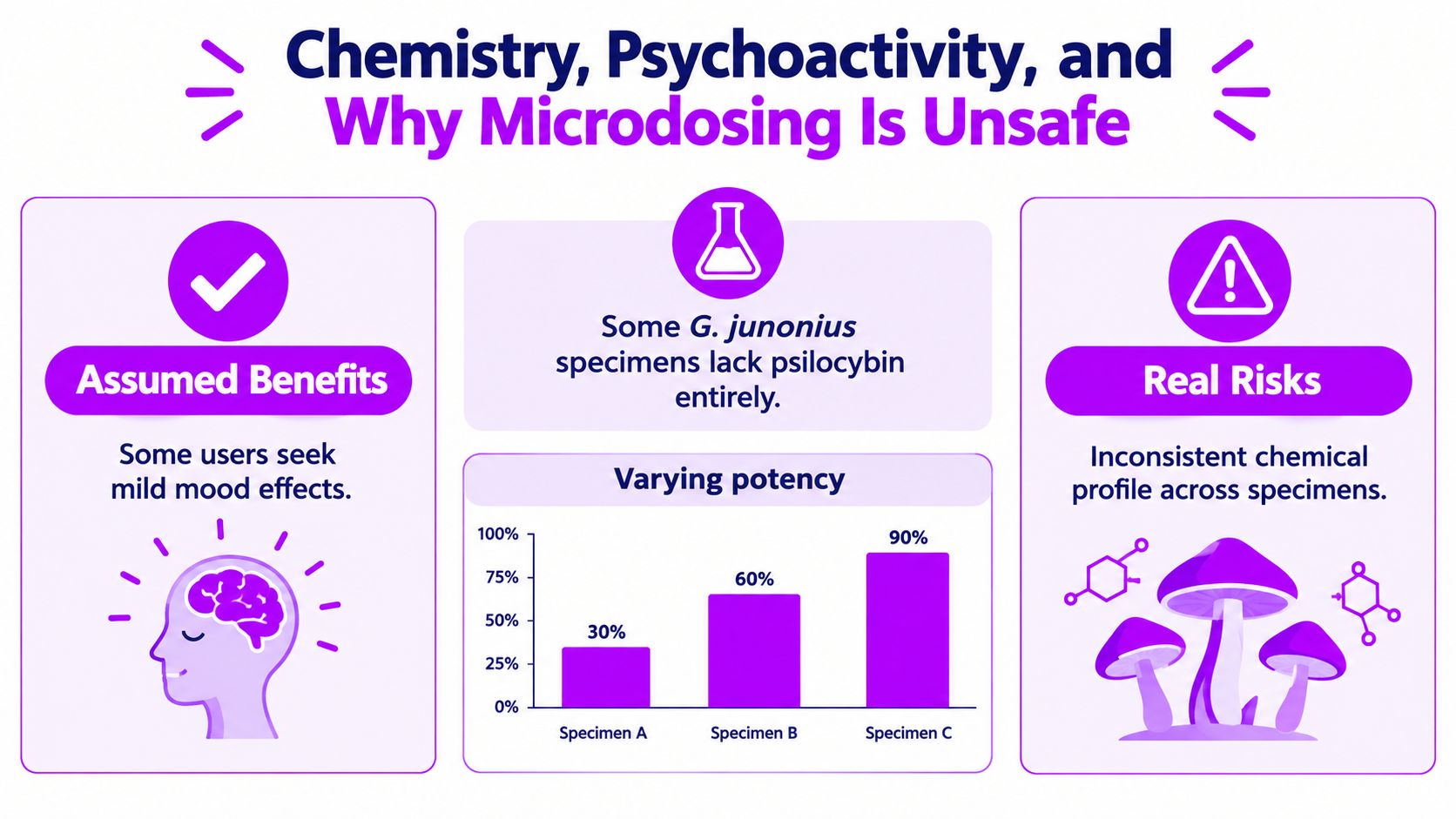
Any illustrative potency bars in the graphic should be read as a conceptual comparison, not measured concentrations or dosing guidance. They don't establish a usable potency range.
The chemistry extends beyond possible psilocybin
Researchers characterized three sesquiterpenes, including trichothecene and tremulane compounds, and reported marked cell-line cytotoxicity from two trichothecenes in a peer-reviewed isolation study of G. junonius. The chemical literature also describes gymnopilin-related oligoisoprenoids and depolarizing activity, a concern distinct from serotonin-mediated psychedelic effects.
These observations don't demonstrate medical benefit in humans. They also can't be converted into a safe oral dose. Cell-line results describe laboratory conditions, not what happens when someone consumes a chemically variable wild mushroom.
- Perceived effect: Laughter or altered perception describes an experience.
- Chemical result: Analytical testing describes detected compounds in tested material.
- Toxicological assessment: Safety requires evidence beyond either of those observations.
General microdosing research doesn't resolve this gap. A controlled psilocybin-mushroom microdosing study found noticeable subjective effects and altered EEG rhythms, but no evidence supporting improved well-being, creativity, or cognitive function; it also observed some small changes toward cognitive impairment.
Those findings concern psilocybin microdosing generally, not a validated treatment using wild Gymnopilus. Readers considering self-treatment for PTSD, anxiety, or depression shouldn't treat the word “microdose” as evidence of benefit or safety.
The microdosing side-effects guide provides related reading, but subjective mood tracking can't verify species identity, determine potency, or exclude toxicity. Intentional consumption should be avoided.
Legal Status and Harm Reduction for Curious Foragers
Don't infer legal status from the name “Big Laughing Gym,” from an identification app, or from a claim that a collection lacks psilocybin. Before collecting, transporting, or retaining material, check current official rules for your location and obtain qualified local advice where the application is unclear.
A useful legal inquiry separates the mushroom's identity from the action you intend to take. Ask specifically about collection permissions, possession, transport, and any proposed testing. Avoid treating an online statement about a different jurisdiction as an answer for yours.
Keep a record that preserves uncertainty
A journal should distinguish observation from interpretation. Use separate fields or clearly labeled notes:
- Identity and confidence: Record the proposed scientific name, who identified it, and whether microscopy supported the identification.
- Collection context: Keep the region, specimen source, substrate, and photographs together.
- Preparation or exposure: If exposure has already occurred, describe what happened without converting it into advice for repetition.
- Timing and co-ingestants: Record when exposure and symptoms occurred, alongside other substances taken.
- Adverse effects: Keep physical symptoms and medical escalation separate from mood ratings.
For example, a positive mood reflection and a report of physical discomfort shouldn't collapse into a single favorable score. Both observations matter. Missing information should remain visibly missing rather than becoming a blank that readers interpret as “no adverse effects.”
If ingestion has already happened
Stop further consumption and contact a poison service or medical professional promptly. Explain that the material was a wild mushroom with an uncertain identification. If symptoms are severe or worsening, seek emergency care rather than waiting to finish a journal entry.
Preserve available photographs, remaining material, and collection details for the professionals assessing the exposure. Don't delay medical contact while trying to obtain a perfect name, and don't assume an initially pleasant experience excludes poisoning.
Analytical verification and expert identification can clarify evidence, but neither replaces medical assessment after an exposure. The record should support care, not postpone it. Curiosity remains compatible with caution when the next action is documentation rather than another attempt at consumption.
Field Checklist and What to Record Before Any Consumption
Use this checklist to prepare an observation for expert review, not to qualify a mushroom for eating. A well-organized record makes unresolved questions visible and gives an examiner something more useful than a cropped cap photograph.
Capture the specimen and its context
- Photographs: Include the cap top, underside, complete stem, stem base, and substrate. Keep an uncropped habitat view.
- Identification evidence: Record the proposed scientific name, identification confidence, examiner, and any microscopic findings.
- Location details: Note region, date, visible wood connection, and specimen source.
- Chemical evidence: Attach an actual analytical report if one exists. Don't replace it with an anecdotal potency estimate.
An overview of free mushroom identification apps can help you explore documentation tools. Treat an app-generated name as a candidate for examination, not as authorization to consume.
Keep exposure information separate
If consumption has already occurred, record preparation, amount taken, timing, co-ingestants, delayed effects, adverse symptoms, and medical contact independently. Label the amount as an exposure record, not a verified psilocybin dose.
Treat Big Laughing Gym as inedible and don't build a microdosing schedule around it. Expert microscopy and analytical verification are necessary to clarify identity and chemistry, but even those findings don't automatically establish safe human use.
Your next field action is concrete: photograph the complete specimen, document its substrate, preserve uncertainty in the identification, and arrange qualified review without tasting it.
MicroTrack offers a journal for recording dose details and adding later reflections, with searchable history and exportable records. Visit MicroTrack to keep observations and adverse effects clearly documented, while remembering that tracking cannot identify a wild mushroom or make its consumption safe.