Microdosing Side Effects: What the Evidence Shows
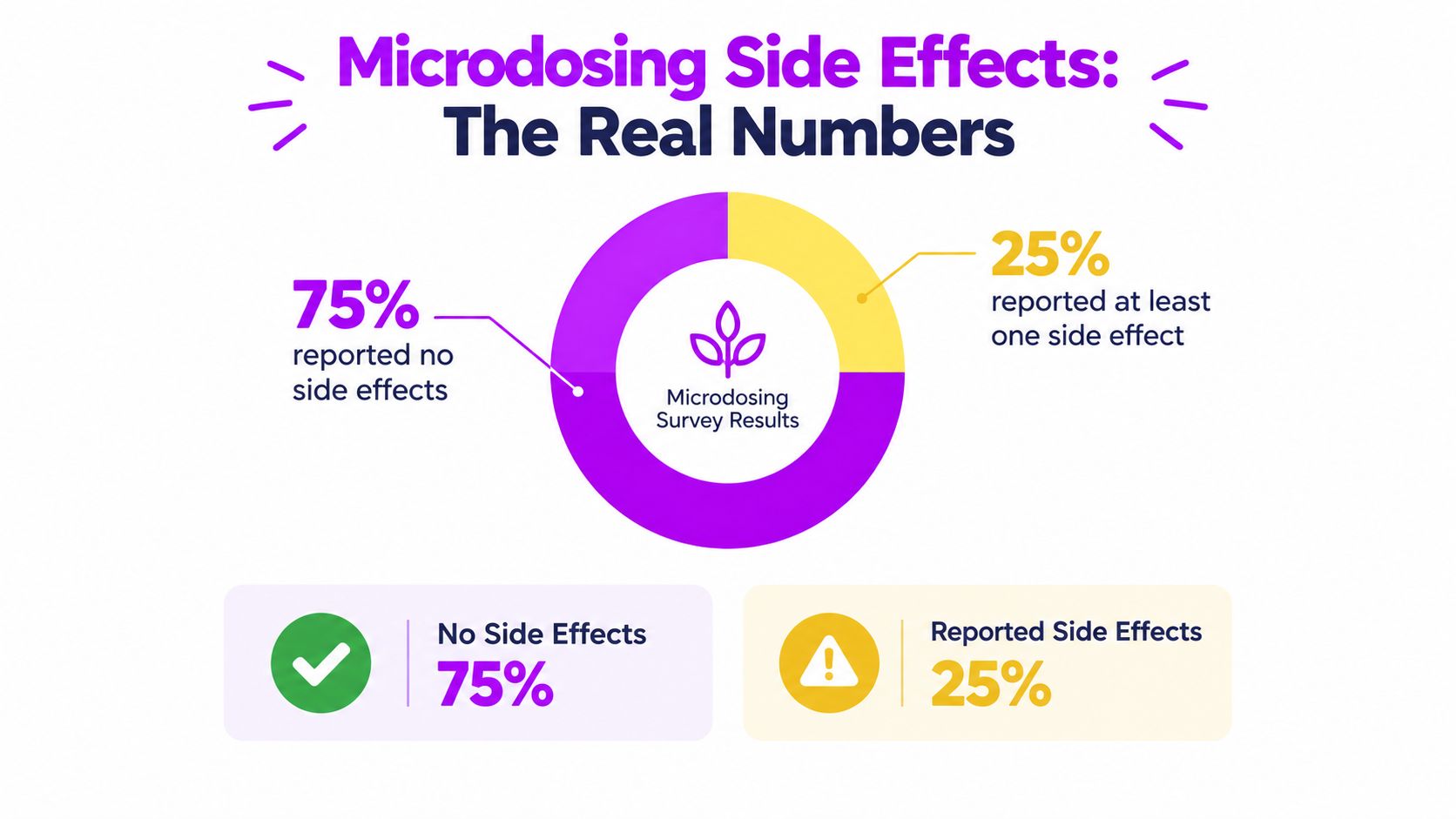
Around three-quarters of microdosers in the Global Drug Survey 2021 reported no side effects. That's a useful starting point, but it isn't proof that microdosing is safe: people also reported unwanted mental and physical effects, and the survey can't establish what caused them or predict risk for any individual. The survey's findings are best used as a prompt to track carefully, not as a personal safety guarantee.
The practical question isn't only whether a symptom appears. It's whether it repeats, worsens, affects daily life, or follows a change in dose, sleep, stress, or medication. A clear log helps you notice those patterns and decide when to pause rather than explain away a bad reaction.
Table of Contents
- How Common Microdosing Side Effects Really Are
- Physical and Psychological Effects You May Notice
- Why Short-Term Tolerability Is Not Long-Term Safety
- Interactions, Contraindications, and Medication Risks
- Expectation, Placebo, and Why Your Log Matters
- Reading the Warning Signs in Everyday Life
- Building a Monitoring System That Catches Problems Early
- Red Flags That Mean Pause, Adjust, or Seek Help
How Common Microdosing Side Effects Really Are
About three-quarters of microdosers reported no side effects in the Global Drug Survey 2021. Roughly 10% reported unwanted mental effects, 8% reported unwanted physical effects, and 10% of those who experienced problems stopped microdosing altogether, according to the survey report. These figures show why a single headline about tolerability is a poor guide to an individual decision.
The survey was self-reported and observational, so it cannot establish that microdosing caused each symptom or predict an individual's risk. The survey report also does not establish that its respondents represent everyone who microdoses. Health, substance, dose, expectations, and daily circumstances vary.
Prevalence isn't severity
A report of “no side effects” does not show whether someone noticed subtle changes, experienced benefits, or used the substance over time. A reported symptom, in turn, does not automatically mean a dangerous reaction. Frequency and severity are different questions: an uncommon symptom can still be urgent, while a mild one may recur enough to disrupt sleep or concentration.
Use the survey as context, not reassurance. Many respondents reported no problems, while others experienced unwanted effects and some stopped. A snapshot cannot establish safety.
For your own decision, record what happened, when it began, whether it returned, and how it affected daily functioning. Compare entries with dose, sleep, stress, and medication changes rather than relying on an overall mood rating. If a symptom repeats or worsens, pause and discuss it with a qualified health professional instead of explaining it away.
Physical and Psychological Effects You May Notice
Microdosing side effects can show up as physical sensations, emotional changes, or temporary difficulty thinking clearly. Commonly reported acute effects include anxiety, headache, nausea, disrupted sleep, increased heart rate or blood pressure, and impaired focus. They may be transient, but that doesn't make them irrelevant. If a symptom affects your ability to sleep, work, or feel safe, take it seriously instead of assuming it's part of the process.
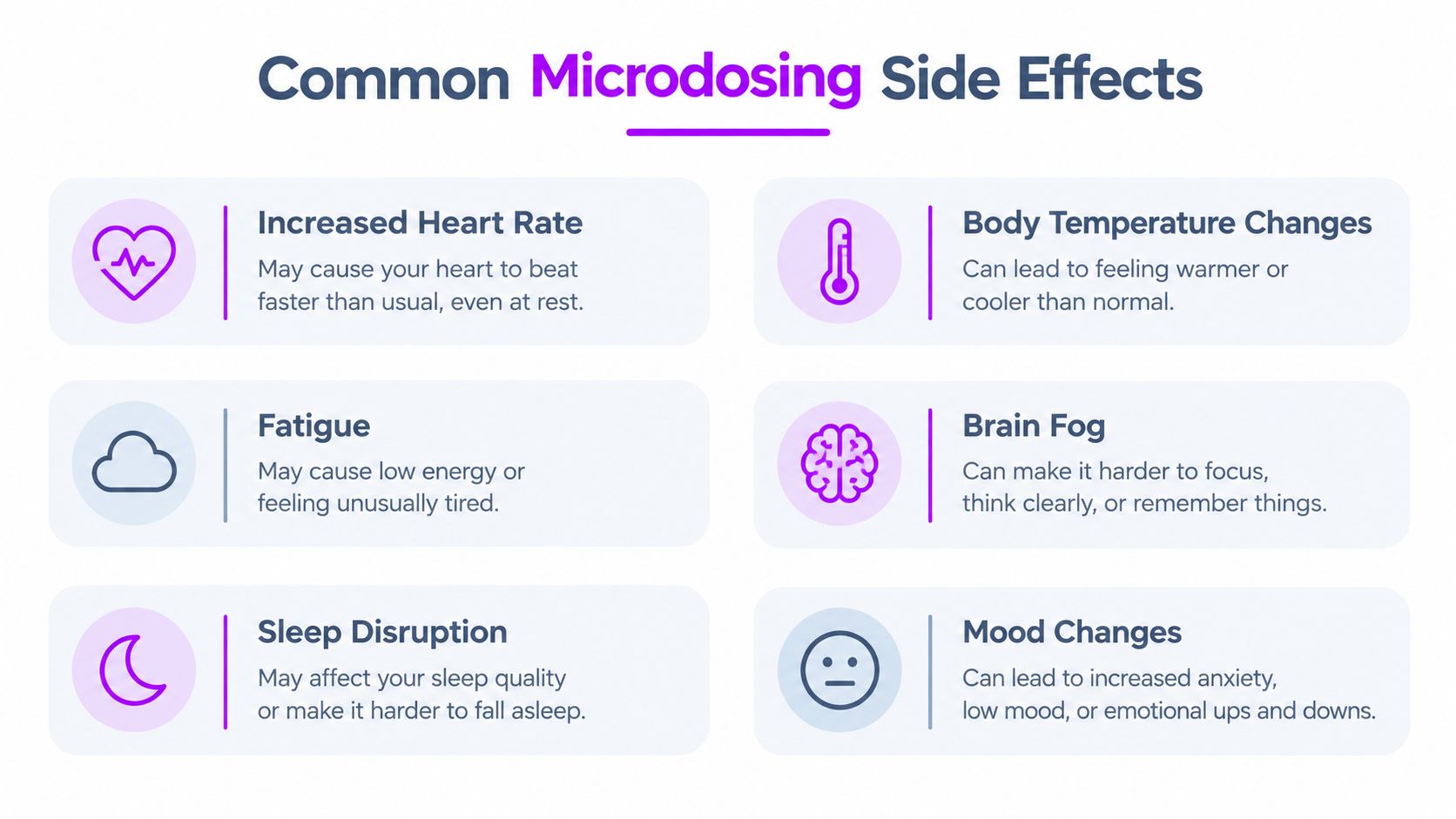
The pattern matters as much as the symptom. Anxiety that appears on a dosing day and settles may be different from anxiety that keeps intensifying. A headache or nausea should be logged with its timing and context. Sleep disturbance deserves its own entry, because a difficult night can affect mood and concentration the next day.
“Low” doesn't mean imperceptible
A placebo-controlled study of repeated low-dose LSD found that perceptible effects emerged at approximately 10–20 micrograms, but not at 5 micrograms. No serious adverse effects were reported among the healthy adults in that study. The study's findings show why it's a mistake to assume that a dose described as low can't be felt. They don't establish safety for people with psychiatric or cardiovascular conditions.
If you notice stimulation, anxiety, physical discomfort, or a change in focus, don't respond by increasing the dose. Record what happened and whether the effect interfered with your day. Pay attention to delayed changes too: poor sleep may show up later than the initial sensation, and next-day mood can be affected by how well you rested.
A practical record distinguishes the immediate experience from what follows. Note when the dose was taken, what symptoms appeared, how long they lasted, and whether they affected normal activity. That makes it easier to recognize a repeatable reaction without treating every unusual sensation as proof of a crisis or dismissing a pattern as coincidence.
Why Short-Term Tolerability Is Not Long-Term Safety
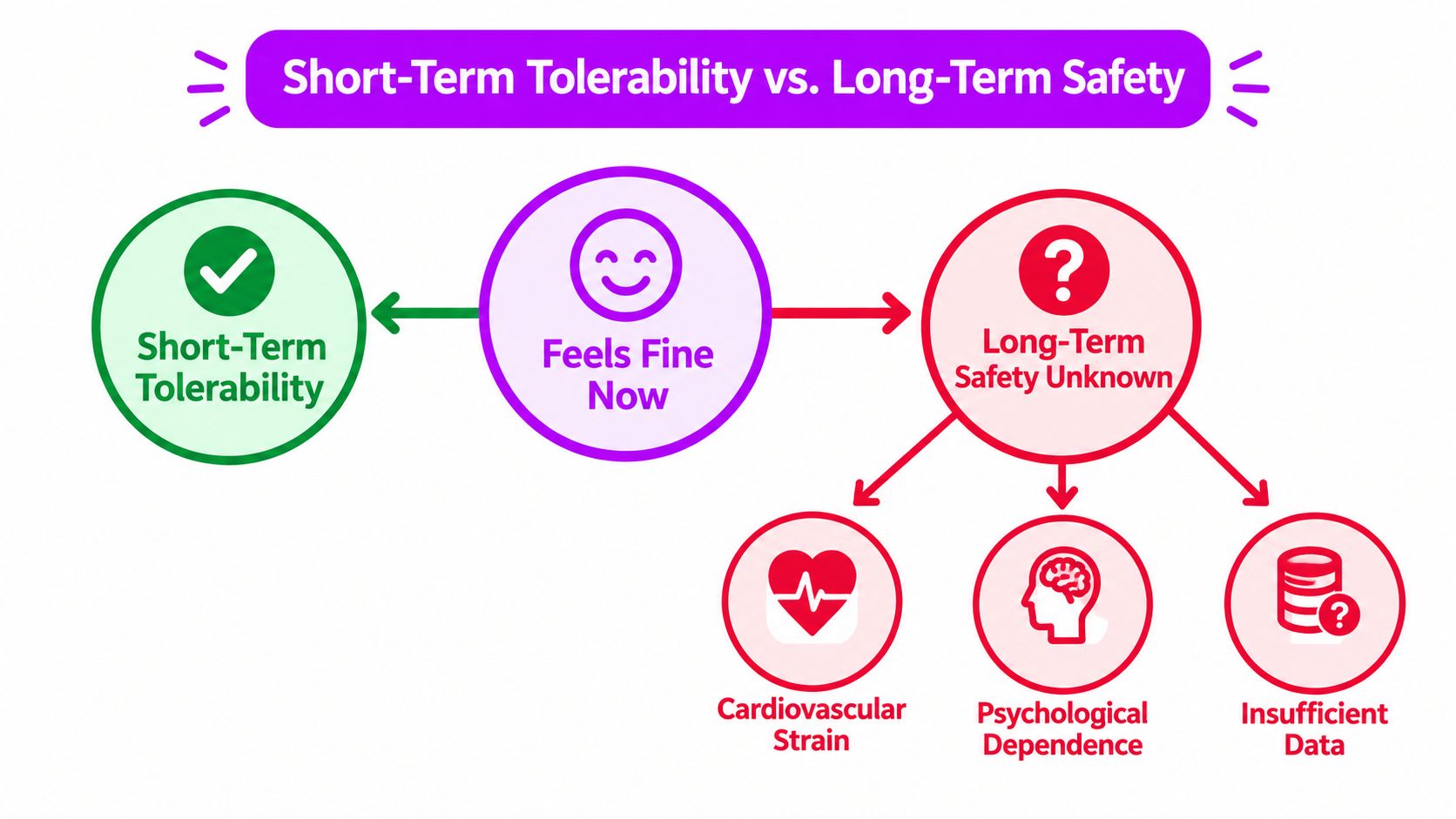
Feeling fine during a short period of use doesn't establish that repeated use is safe. The evidence base has not answered the long-term safety question. A 2024 rapid review identified 19 placebo-controlled microdosing studies and concluded that no studies had investigated long-term safety. It also found no blood-pressure or heart-rate data in psilocybin microdosing studies. The rapid review makes an important point: a lack of recorded problems can reflect missing measurement, not proof that problems don't occur.
What the gaps mean for you
The rapid review found mixed cardiovascular results in LSD studies: some reported no changes in blood pressure or heart rate, while others reported increases. In the psilocybin studies it reviewed, those measures weren't reported. Without consistent monitoring and longer follow-up, researchers can't confidently describe the risks of repeated use.
A separate 2026 systematic review of psilocybin-microdosing studies found that 4 of 11 studies (36.4%) reported one or more side effects, 1 study (9.1%) explicitly reported none, and 6 studies (54.5%) didn't report side effects at all. Most documented effects were mild, but inconsistent reporting limits reliable risk estimates. The review also describes a study reporting psychosis, sensory distortion, and suicidal ideation at higher doses.
Practical rule: Treat “no serious effect reported” as a description of what a study recorded, not as a guarantee that a repeated practice is safe for you.
Small samples, short follow-up, and incomplete adverse-event collection all limit what the evidence can show. That uncertainty doesn't mean every user will be harmed. It does mean that short-term tolerability shouldn't be used to justify ignoring symptoms, increasing a dose, or assuming long-term safety.
Interactions, Contraindications, and Medication Risks
Psilocybin can raise blood pressure and heart rate, creating added risk for people with cardiovascular disease. The National Institute on Drug Abuse says research has not established whether psilocybin microdosing is safe or effective. Its guidance on psilocybin supports a clear recommendation: people with cardiovascular disease should not use it unsupervised.
Psychiatric history also matters. People with a history of psychosis, mania, or significant mood instability should not treat microdosing as a self-directed experiment. Speak with a qualified clinician before considering use, especially if you have a psychotic disorder or severe bipolar disorder.
Don't change psychiatric medication on your own
The Global Drug Survey found that among microdosers taking mental-health medication, approximately one-quarter said they stopped their medication, and another one-quarter said they reduced its dose or frequency. The survey report does not show that microdosing caused those changes. It does show why a record of medicines and treatment changes belongs alongside a symptom log.
Do not start, stop, taper, or alter psychiatric medication without your prescriber's guidance. Changing treatment without medical advice can create risks and make symptoms harder to interpret. For a practical discussion of microdosing and antidepressants, review the possible medication issues with your clinician. Record medication names and any clinician-guided changes alongside dose timing and symptoms.
Pregnancy is another reason to avoid experimenting: available evidence does not establish psilocybin's safety during pregnancy. Ask a qualified clinician for guidance rather than assuming a low dose removes uncertainty. With cardiovascular disease, psychiatric history, pregnancy, or prescription medication, do not rely on tracking alone to make a safety decision.
Expectation, Placebo, and Why Your Log Matters
A symptom can be real without its cause being obvious. Anxiety, physical discomfort, and cognitive disruption recur in the literature, but context can shape what a person notices and how they interpret it. A 2025 critical review of 57 human studies reported these recurring adverse effects and found that observational studies of repeated use tend to report more benefits, while placebo-controlled experiments more often find null results. The review highlights why one good or bad day isn't enough to establish what caused the change.
Compare like with like
If you feel unusually focused after a dose, ask what else changed. Did you sleep well? Was your workload lighter? Did you have more caffeine than usual? Were you expecting a noticeable effect? The same questions apply when you feel more anxious or scattered. Expectation, dose variability, stress, and an unusually good or bad day can all complicate interpretation.
A useful log captures pre-dose expectations, sleep, caffeine, stress, dose timing, same-day effects, and delayed reflections. Compare dosing days with non-dose days when you can, and look for repeated patterns over time. This won't prove a cause, but it can help you avoid making a strong conclusion from an isolated experience.
Separate the event from the explanation. Write down what you felt first. Add your interpretation later, after you've had time to reflect.
That separation matters because a person may label a difficult day a side effect, or decide that discomfort is evidence of a benefit. Record observable changes in plain language: trouble concentrating, a tense feeling, nausea, or a restless night. Then note whether the same experience recurs under similar conditions.
Keep delayed effects separate from what happens immediately after dosing. Sleep disturbance and next-day mood changes can otherwise be misattributed to the wrong part of the day. A log is most useful when it encourages cautious pattern recognition, not when it tries to prove that every positive or negative change came from the substance.
Reading the Warning Signs in Everyday Life
Think of your journal as a way to spot a trend, not as a verdict on one entry. One anxious afternoon may have several explanations. Repeated anxiety that grows across dosing days, however, is a reason to stop and reassess.
Consider someone who notices their anxiety climbing over a period of use. They record the feeling, what was happening that day, and whether it settled. If the entries keep moving in the wrong direction, the sensible question isn't whether the person can push through. It's whether the trend is improving, stable, or worsening, and whether the practice is affecting daily life.
Three patterns worth taking seriously
Someone else sees their sleep steadily deteriorate on dosing days. They're tired and less focused the next day, but are tempted to treat that as unrelated. The journal can make the relationship easier to examine, especially if sleep quality and next-day mood are recorded separately.
A third person notices palpitations or a change in resting heart rate after dosing. That isn't a symptom to test by repeating or increasing a dose. Pause and seek medical advice if the symptoms are alarming, persistent, or accompanied by other concerning signs.
Use entries to compare conditions, not to set a universal threshold. In each example, ask whether the pattern is getting better, staying steady, or worsening across entries, and whether it impairs sleep, work, relationships, or basic functioning. A streak of worsening symptoms matters more than a single reassuring score.
Don't wait for a perfect data set before acting. If anxiety escalates, sleep keeps breaking down, perceptual changes persist, or ordinary functioning slips, pause. A log can help explain what happened to a clinician, but it can't diagnose the cause or replace medical care.
Building a Monitoring System That Catches Problems Early
A useful tracker shows what changed, when it changed, and whether the same pattern returned. Keep each entry simple and consistent. Record the substance and dose, timing, sleep, anxiety, mood, energy, physical symptoms, concentration, and social functioning. If you have cardiovascular concerns and can measure them, note blood pressure or heart rate as well.
The National Center for Complementary and Integrative Health lists possible problems such as insomnia, anxiety or depression, low energy, gastrointestinal discomfort, headache, altered sensory perception, temperature dysregulation, impaired focus, and reduced social skills. Its psilocybin guidance supports tracking distinct areas of functioning rather than relying on one overall mood score.
A practical entry
- Dose and timing: Record what you took and when, so you can compare symptoms with the timing of use.
- Sleep and energy: Log sleep quality separately from daytime energy. A disrupted night can affect how you feel the next day.
- Mood and anxiety: Track them separately. One mood score can conceal rising anxiety or worsening depression.
- Physical and cognitive effects: Note discomfort, headaches, changes in perception, and difficulty concentrating or focusing.
- Medication and context: Record concurrent medication, clinician-guided treatment changes, stress, and caffeine.
- Delayed reflection: Add a later note if sleep, mood, or another effect shifts after your first entry.
A flexible journal such as MicroTrack's microdosing journal can help organize dose details and later reflections with trend views and searchable records. A paper notebook or another tracker works too. Consistency matters more than the format.
A guide to microdosing schedules can explain what people track, but it cannot establish that a schedule is safe for you. Discuss schedule decisions with a clinician if they involve a health condition or medication. If your entries show a worsening pattern, or symptoms change alongside medication, pause use and bring the record to a healthcare professional. A log helps you describe events; it cannot diagnose their cause.
Red Flags That Mean Pause, Adjust, or Seek Help
A mild effect that resolves may call for careful observation, but don't normalize symptoms that are escalating or interfering with your life. The response should match the seriousness of the symptom, not your hope that it will pass.
Pause and reassess if anxiety increases, sleep keeps worsening, mood deteriorates, perceptual changes persist, or your work and relationships become harder to manage. Don't increase or repeat a dose to see whether the symptoms settle. If you have heart disease, a psychotic disorder, severe bipolar disorder, or are pregnant, avoid unsupervised use and seek qualified clinical guidance.
Stop and seek prompt professional help for severe confusion, persistent vomiting, alarming cardiovascular symptoms, suicidal thinking, manic symptoms, or psychotic-like perceptions. A placebo-controlled trial of home-administered LSD microdosing found treatment-related anxiety was its most notable adverse event and led four participants in the LSD group to withdraw. At least one adverse event was reported by 85.0% of LSD recipients and 80.0% of placebo recipients, while the difference wasn't statistically significant and the median severity was mild in both groups. The trial01164-2/fulltext) shows why anxiety deserves attention even when researchers don't find a statistically significant difference between groups.
Screenshot checklist
- Is anxiety, sleep, mood, or physical discomfort getting worse?
- Are symptoms persistent, alarming, or interfering with daily life?
- Did you change medication without your prescriber's guidance?
- Are you experiencing severe confusion, persistent vomiting, suicidal thinking, mania, or psychotic-like perceptions?
- If symptoms are severe, have you stopped and sought professional help?
For a broader practical overview, review harm-reduction practices for microdosing. If you're unsure whether a symptom is serious, don't use another dose to find out. Pause and contact a qualified professional.
MicroTrack gives you a structured place to record dose details, symptoms, and later reflections, then review patterns across your entries. If you want a clearer record of what's changing and when, visit MicroTrack.