Habit Tracking App Guide: Features and Benefits
A habit-forming behavior takes a median of 66 days, not 21, and a habit tracking app helps turn self-knowledge into measurable numbers you can review over time. Instead of relying on memory or motivation, you record what happened, notice patterns, and adjust your routine with evidence.
You may recognize the familiar cycle. On Monday, you decide to meditate, exercise, read, or change another part of your routine. You set reminders, make a neat checklist, and feel confident. A busy day arrives, one box stays empty, and the broken streak makes the whole effort feel wasted.
That reaction confuses a missed entry with a failed practice. Good tracking gives you a calmer way to learn from behavior. It records repetitions, context, mood, and exceptions so you can understand what supports consistency and what creates friction.
Table of Contents
- Why Habit Tracking Fails Without the Right Tool
- Understanding the Quantified Self Movement
- Core Features That Actually Drive Change
- Privacy and Security in Sensitive Tracking
- Measuring What Matters, Microdosing and Mindfulness
- How to Choose and Start Using Your Tracker
Why Habit Tracking Fails Without the Right Tool
Maya starts a reading habit with a note on her phone. Every evening, she checks a box after reading. The system works while her schedule is predictable, but a late meeting causes her to miss one night. The next morning, she sees a broken chain and decides she has “fallen off.” The note captures completion, but not the difference between a planned rest day, an unavoidable interruption, and a genuine loss of interest.
That is where a habit tracking app can change the question. Instead of asking, “Am I perfect?” you can ask, “What usually happens before I follow through?” A searchable history, flexible schedule, and visual trend can show whether the habit works better at a particular time, after a specific cue, or with a smaller target.

Replace all-or-nothing thinking with observation
The popular idea that a behavior becomes automatic after 21 days doesn't fit the strongest commonly cited habit-formation evidence. A 2009 study followed 96 participants for 84 days and found a median of 66 days for automaticity, with substantial variation by person and behavior. Missing one opportunity also didn't materially damage the formation process, as described in this summary of the habit-formation research.
That finding changes how you should use streaks. A streak can make progress visible, but it shouldn't become a verdict about your character. A useful app lets you mark a day as skipped, move a planned session, or add a note explaining why the routine changed.
Turn an intention into reviewable evidence
A task list tells you what you hoped to do. A tracker preserves what you did and adds context around it. For example, “walk” can become a record of whether you walked, how long you walked, how you felt afterward, and whether sleep or workload affected your choice.
This analytical approach also makes reflection easier. Logging benefits become clearer when entries answer a future question rather than merely filling a calendar square. Track enough to learn, but not so much that recording becomes another habit you abandon.
Practical rule: A missed day is an observation about your system, not a final judgment about your ability to change.
Understanding the Quantified Self Movement
Modern tracking apps belong to a much older tradition of diaries, personal measurement, and behavioral self-observation. Historical research identifies wearable-computing experiments for personal self-tracking as early as the 1970s. Digital self-tracking gained wider attention in 2001, when media practitioners began using newly available web technologies to record parts of daily life.
The phrase Quantified Self arrived later. Wired editors Gary Wolf and Kevin Kelly introduced the term in 2007 to describe the pursuit of self-knowledge through numbers, and the first official meeting took place in Pacifica, California, in October 2008, as documented in this history of quantified-self practices.
From isolated notes to longitudinal records
The important idea isn't the phone. It is the conversion of everyday experience into structured information that you can revisit. A paper diary might contain a sleep note, a mood description, or a record of exercise. A digital habit journal can preserve the same observations while adding timestamps, filters, trend lines, and exports.
That history explains why checkmarks alone are limited. A meaningful record often needs several layers:
- An event: What did you do, take, or avoid?
- A context: What else was happening around it?
- An outcome: How did you feel or function afterward?
- A review path: Can you find and compare the entry later?
The quantified-self tracking guide shows why a good app should support pattern discovery rather than only short-lived motivation. Longitudinal records help you compare ordinary days with unusual ones, while searchable history prevents important observations from disappearing into an endless stream of notifications.
Why numbers need interpretation
Numbers don't automatically become knowledge. A mood score without a timestamp may be difficult to interpret. A completed habit without context may tell you that something happened, but not why it worked that day. A chart can reveal a useful association, but it can't prove that one action caused an outcome.
The best design therefore combines structured fields with personal notes. Use a consistent scale for repeated measures, preserve the time of each entry, and leave room for details that don't fit a checkbox. The app becomes a memory aid and a reflection tool, not a machine that claims to explain every part of your life.
Core Features That Actually Drive Change
A tracker earns its place by making useful behavior easier to record and easier to understand. Before choosing one, test the complete path from reminder to review. If the process feels burdensome during setup, it will feel worse on a busy day.
Start with low-friction logging
Ecological momentary assessment research supports collecting information close to the event, but the design of the prompt matters. A systematic review found 80.63% mean compliance across 48 studies, while daily-diary designs averaged 91.03% compared with 77.16% for studies using multiple prompts per day. The findings are summarized in this review of ecological momentary assessment compliance.
That supports a simple two-phase workflow:
- Capture the essential fact immediately. Record the habit, dose, time, or basic outcome in seconds.
- Add reflection later. Write notes when you have enough attention to describe context and effects.
- Keep missingness visible. “Not logged” shouldn't become “no effect.”
- Review prompt timing. Evening reminders may be less reliable than morning ones, so place important prompts where your routine can support them.
A tracker that asks for a long narrative at the exact moment you need to act may produce detailed entries briefly, then lose the record altogether.
Choose visualizations that answer real questions
A colorful dashboard isn't automatically useful. Look for views that help you answer questions such as:
- Do I follow through more often on certain days?
- Does my mood change after a particular routine?
- Which entries are missing, and are the gaps concentrated at a certain time?
- What happened during the weeks when the habit felt easier?
A calendar can show continuity, while a trend chart can show direction. A distribution view can reveal timing patterns. Export matters when you want to inspect your own history elsewhere or share a selected summary.
Demand flexible schedules
Rigid daily streaks fit some routines, but they distort practices that include rest days, variable timing, or planned pauses. A skip override should preserve the difference between “not applicable,” “missed,” and “completed.” That distinction protects motivation and keeps the data honest.
Useful design test: If one unusual day forces you to restart the entire record, the app is measuring perfection more than behavior.
Privacy and Security in Sensitive Tracking
You log a skipped workout in one app and a change in mood, sleep, or medication-adjacent behavior in another. Those records do not carry the same risk. A record about laundry is inconvenient to expose. A record about mental health, substance use, or symptoms can reveal details you reasonably expect to keep private.
That difference matters because habit formation is slower and more revealing than many people expect. If a routine often takes about 66 days to become more automatic, not 21, a health-focused tracker can hold weeks of intimate context, not just a few checkmarks. The appeal is real, and so is the concern. A 2025 survey across eight European countries found that 42.71% of respondents were interested in health apps, while 72.34% worried about data misuse and 63.68% worried about hacking, according to this survey record on health-app adoption and privacy concerns.
Inspect the data path before you begin
Before logging anything sensitive, review what data security and privacy actually require and use it as a checklist. Then follow the record from entry to storage to export, the same way you would trace where a house key goes before handing it over.
Ask plain questions:
- Access: Who can view mood, dose, or reflection entries?
- Permissions: Does the app request location, contacts, or other data unrelated to tracking?
- Encryption: Is information protected during transfer and while stored?
- Exports: Can you generate a file through an authenticated, time-limited process?
- Deletion: Does deletion remove primary records and queued backups according to a clear policy?
- Sharing: Can you create a limited summary without exposing your complete history?
A peer-reviewed mHealth security framework organizes these checks around authentication, authorization, access management, storage, integrity, encryption, privacy, and privacy-policy practices. For a user, the takeaway is simpler. A sensitive tracker should protect the record technically and explain those protections in plain language.
Separate privacy from convenience
Cloud sync helps if you use more than one device, but it also adds another access point. Local storage can reduce exposure, but backup and recovery become your job. The better option is the one you understand well enough to use consistently.
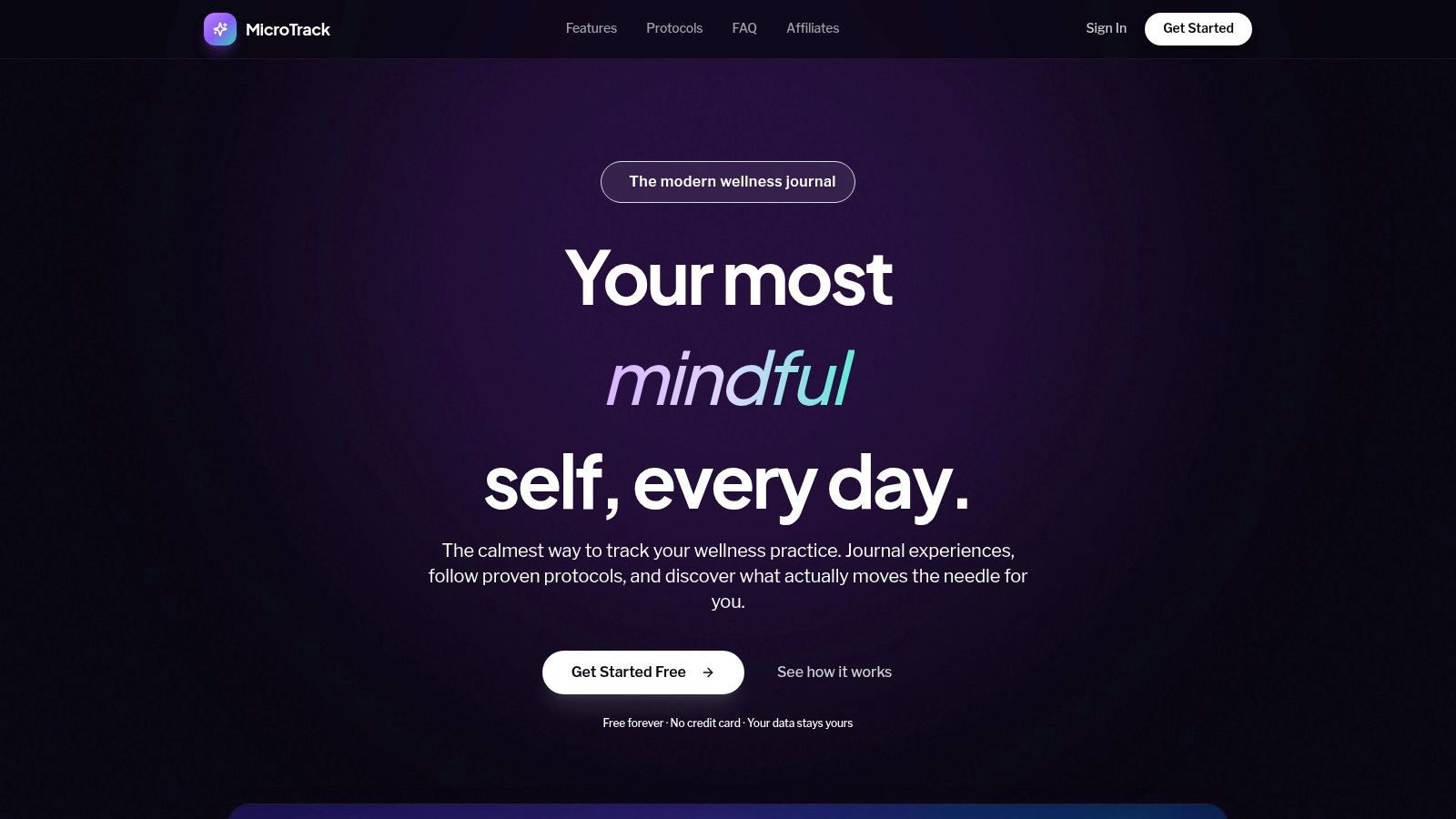
For sensitive tracking, MicroTrack includes structured journaling, encrypted transport and storage, CSV export, searchable history, and deletion controls. Its flexible schedule also matters here. Private tracking works better when the app supports honest pauses and changing routines, instead of pushing a public-looking streak.
Measuring What Matters, Microdosing and Mindfulness
A casual habit tracker asks, “Did I do it?” A more careful wellness journal asks, “What did I do, when did I do it, what else was happening, and what changed afterward?” That distinction matters for mindfulness practice, mood observation, and microdosing, where a simple yes or no can hide the information you want to understand.
Compare simple tracking with structured observation
For mindfulness, you might record the session, duration, mood before and after, and a short reflection about attention or stress. For microdosing, you might separate planned schedule, actual dose details, mood, sleep, anxiety, physical sensations, and later observations. The point isn't to create a diagnosis. It is to reduce reliance on memory and make your own observations easier to inspect.
A two-phase entry works well because the immediate record can stay brief while the reflection comes later. Ecological momentary assessment research supports collecting information close to events to reduce recall bias and examine within-person relationships among mood, stress, health behaviors, and time of day. This review of real-world momentary assessment also makes the limitation clear: temporal proximity can improve observation, but it doesn't prove causation.
Recent critical reviews report claimed improvements in mood and cognition from microdosing, but findings remain inconsistent and largely self-reported. Reported experiences also include anxiety, physical discomfort, and cognitive disruption, so the critical review of microdosing evidence supports disciplined personal tracking rather than broad medical promises.
Treat schedules as records, not prescriptions
The Fadiman schedule is commonly described as one dosing day followed by two non-dosing days, then another dosing day. Available evidence doesn't establish it as clinically validated, and no controlled trial has directly compared it with another microdosing schedule. Record it as a user-selected convention, separating planned days from actual days.
The Stamets Stack is generally organized as four consecutive dosing days followed by three non-dosing days, combining psilocybin with lion's mane mushroom and niacin, or vitamin B3. The available summary describes a mechanistic rationale and doesn't report a controlled trial showing that the added compounds improve outcomes. Details about these schedules are outlined in the overview of microdosing protocols and the Stamets Stack explanation.
Use a tracker to record what happened, not to imply that following a schedule proves effectiveness. Predefine what you want to observe, include relevant context such as sleep and stress, and treat visible correlations as hypotheses.
For a closer look at a calm, structured logging workflow, review the product demonstration below.
How to Choose and Start Using Your Tracker
Start with the smallest system that can answer your first question. If you want to build a reading routine, you may need only completion, time, and a note. If you're tracking mood or a sensitive wellness practice, you may need timestamps, context, flexible schedules, privacy controls, and export.
Use this selection checklist
- Check the first entry: Can you record the essential information in seconds?
- Check the schedule: Can you set rest days, custom cadences, skips, and changes?
- Check the review screen: Does it show trends you can interpret rather than only streaks?
- Check the privacy model: Do you understand storage, access, sharing, export, and deletion?
- Check the escape route: Can you export your history if your needs change?
Then choose one behavior and define what counts before you begin. “Exercise more” is difficult to evaluate. “Walk after lunch and record how I felt afterward” gives you a clear event and a useful outcome.
Review slowly and adjust deliberately
Don't interpret a chart after a handful of entries. Let the record develop across ordinary days, unusual days, and missed days. Compare your observations with context, and remember that a pattern can suggest a question without answering it.
A sustainable routine also needs an intentional response to lapses. Mark the exception, note the reason if it matters, and resume without trying to compensate through an extreme target. The best habit tracking app is the one that supports accurate, repeatable observation without turning your life into a performance score.
MicroTrack gives you flexible schedules, two-phase entries, mood tracking, searchable history, trend visualizations, CSV export, and privacy controls for structured wellness journaling. Visit MicroTrack to create a calmer record of your routines and review patterns without streaks or gamification.