How to Microdose Safely and Track What Actually Works

Most beginner advice on how to microdose starts with optimism and ends with wishful thinking. That's backwards. If you want useful results, treat it like a personal experiment with a journal, a baseline, and a stop rule, because the evidence keeps showing that expectation can distort what people think they're feeling.
Among 5,399 international respondents who reported microdosing at some point in their lives, 3,768 people, 69.8%, had done so within the previous year, and psilocybin was the most commonly reported substance at 81.1%, with LSD at 39.6%, noting that those percentages can overlap because people reported more than one substance. PubMed survey on microdosing patterns
Table of Contents
- Why Microdosing Is an Experiment, Not a Cure
- Choosing Between Fadiman, Stamets, and a Custom Schedule
- Measuring and Preparing Your First Dose
- Safety Checks Before You Begin
- Set, Setting, and Your First Two-Phase Journal Entry
- Reading Your Trends Without Fooling Yourself
- Troubleshooting the Most Common Practice Failures
Why Microdosing Is an Experiment, Not a Cure
Treating a subtle routine like a proven treatment is the central mistake in microdosing. A 2025 review of 48 eligible microdosing studies found that apparent benefits shrink in placebo-controlled research. A separate critical review of 57 human studies also found that observational and experimental results do not align cleanly, leaving the overall evidence inconclusive. 2025 review of microdosing evidence
Your experiment also starts with confounders. Hope, a new routine, improved sleep, a cleaner diet, or a change in season can all affect how you feel. Credit the capsule for every improvement, and you will mistake a good week for a repeatable effect. Keep the protocol separate from the rest of your life as far as you can.
What the evidence tells you
Placebo-controlled research exposes a problem that enthusiastic guides often ignore. In a study of 191 participants, apparent differences between microdose and placebo conditions were influenced by whether participants correctly guessed their condition. That expectancy-related unblinding can shape both the experience and the result you record. Scientific Reports trial on expectancy and unblinding
Practical rule: don't ask, “Do I feel something?” Ask, “Would I still think this was working if I didn't know which days were dosing days?”
A sound approach to how to microdose starts with a defined experiment window, usually eight to twelve weeks, and a baseline block before you change anything. Choose one or two outcomes in advance, such as mood stability, anxiety, or work focus. Set a clear standard for a win, a wash, and a stop.
Your journal becomes your personal evidence base. Record dose timing, substance, mood, sleep, caffeine, and stress. Add a later reflection in a separate field, after the immediate impression has passed. That separation helps reveal a recurring pattern instead of preserving the story your brain prefers.
A rule that keeps you honest
If you can't explain your protocol without talking about hope, you probably don't have a protocol yet.
The journal matters more than the hype around the substance. Its purpose is not to prove that microdosing works. It shows whether the practice helps you under your real conditions, alongside your normal habits, and despite the blind spots that expectancy creates.
Choosing Between Fadiman, Stamets, and a Custom Schedule
Pick the rhythm before you pick the substance. People drift when the schedule is vague, and once the schedule drifts, the whole experiment becomes hard to read.
The Fadiman protocol is the simplest starting point, one dosing day followed by two non-dosing days. A month on that schedule feels regular without becoming daily, which makes it easier to compare your notes across dosing and non-dosing days. The Stamets stack is the opposite in feel, more intensive, more structured, and usually discussed alongside psilocybin plus niacin. A custom schedule works when your week isn't stable enough for a fixed pattern and you need a cadence that fits real life rather than ideal life.
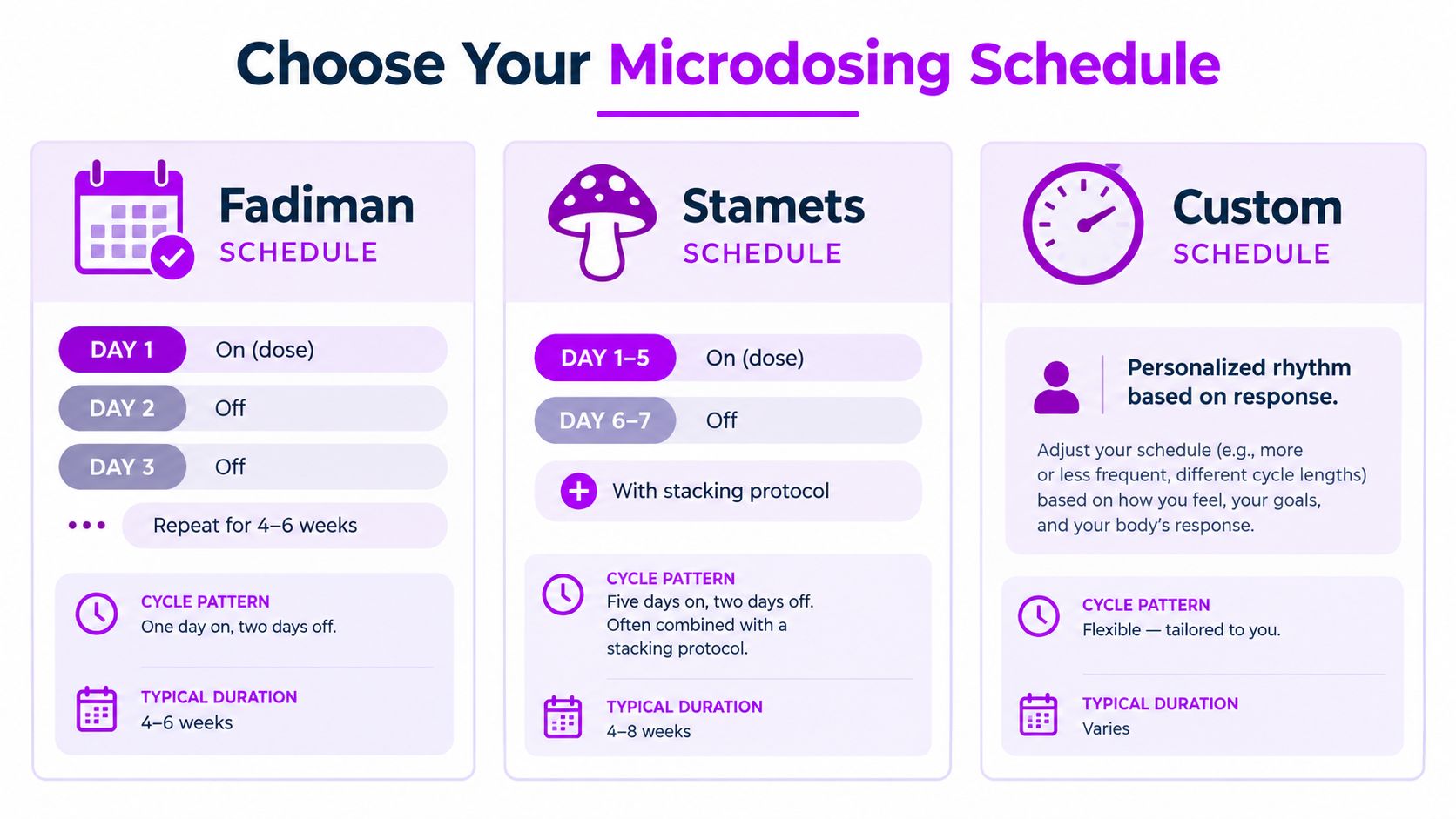
Comparing Fadiman, Stamets, and Custom Schedules
| Schedule | Cadence | Typical Substances | Best Fit |
|---|---|---|---|
| Fadiman | One day on, two days off | Psilocybin, sometimes LSD | Beginners who want a clean baseline and easy comparisons |
| Stamets | Five days on, two days off, with stacking | Psilocybin stack | Experienced users who already understand their response patterns |
| Custom | Personalized rhythm based on response | Depends on the user's choice | People with shifting work, travel, or family schedules |
If you want a simple decision rule, use this one. Choose Fadiman if you want the cleanest comparison log. Choose Stamets only if you already know you respond predictably and you're comfortable with a more demanding cadence. Choose custom if your life is irregular enough that a standard rhythm will collapse by week two.
A month-by-month sketch helps. On Fadiman, you'd dose Monday, rest Tuesday and Wednesday, then repeat. On a custom plan, you might dose only on days with low meeting load or a lighter evening, but you need to write that rule down before you start. Otherwise the schedule turns into a mood-based guessing game.
For a protocol reference you can compare against your own notes, see the MicroTrack microdosing protocol guide.
Measuring and Preparing Your First Dose
Don't improvise the mechanics. Most mistakes happen because people estimate instead of measure, then they blame the protocol for what was really a bad prep day.
Start with a reliable scale that reads to 0.001 g if you're working with dried plant material. Calibrate it with a known weight, then store the material in an airtight container away from light and heat. That sounds basic because it is basic, and basic discipline is what keeps the rest of the log trustworthy.
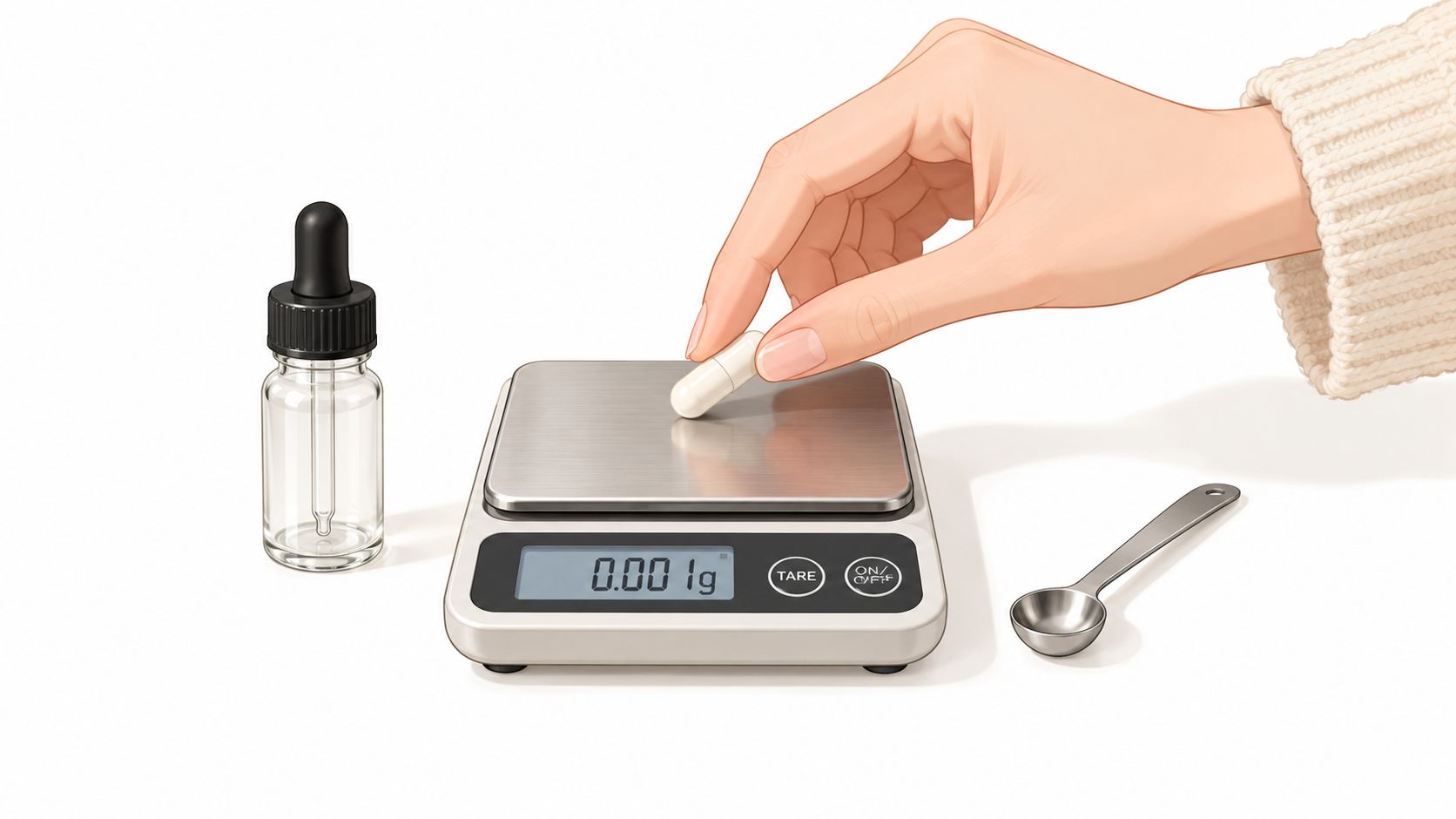
Measure once, then repeat the same way
For psilocybin material, weigh the dose rather than guessing by capsule size or mushroom fragment. For LSD, use a method that lets you control the amount consistently, not a rough cut based on appearance. The point is not to chase a perfect number on day one, it's to create a repeatable process you can trust.
If you need a measurement reference, use the MicroTrack milligram guide and write your own prep routine beside it. A starter routine should include calibration, weighing, packaging, and a final check that the dose stays sub-perceptual, meaning noticeable if you look for it, but not disruptive.
The evidence makes that caution necessary. In a double-blind study of 0.5 g of dried Psilocybe cubensis, participants experienced noticeable subjective effects, but the dose did not significantly improve creativity, cognition, physical activity, or self-reported mental health and well-being compared with placebo. That's a clear reminder that feeling something is not the same as getting a useful result. Study on 0.5 g dried Psilocybe cubensis
Before your first dose day, keep it boring. Eat light, hydrate, avoid alcohol the night before, and prepare the dose when you're calm enough to do it the same way next time. If you have to rush, don't dose.
Measurement rule: if the prep feels sloppy, the data will be sloppy.
That's the reason to care about the routine. A clean measurement process makes your later journal entries interpretable instead of theatrical.
Safety Checks Before You Begin
Safety comes first, not because microdosing is automatically dangerous, but because it's often discussed too casually around people who are already on medication or already dealing with mental-health symptoms. If you're taking antidepressants, mood stabilizers, stimulants, or heart medicines, you need a real preflight check, not a hopeful assumption.
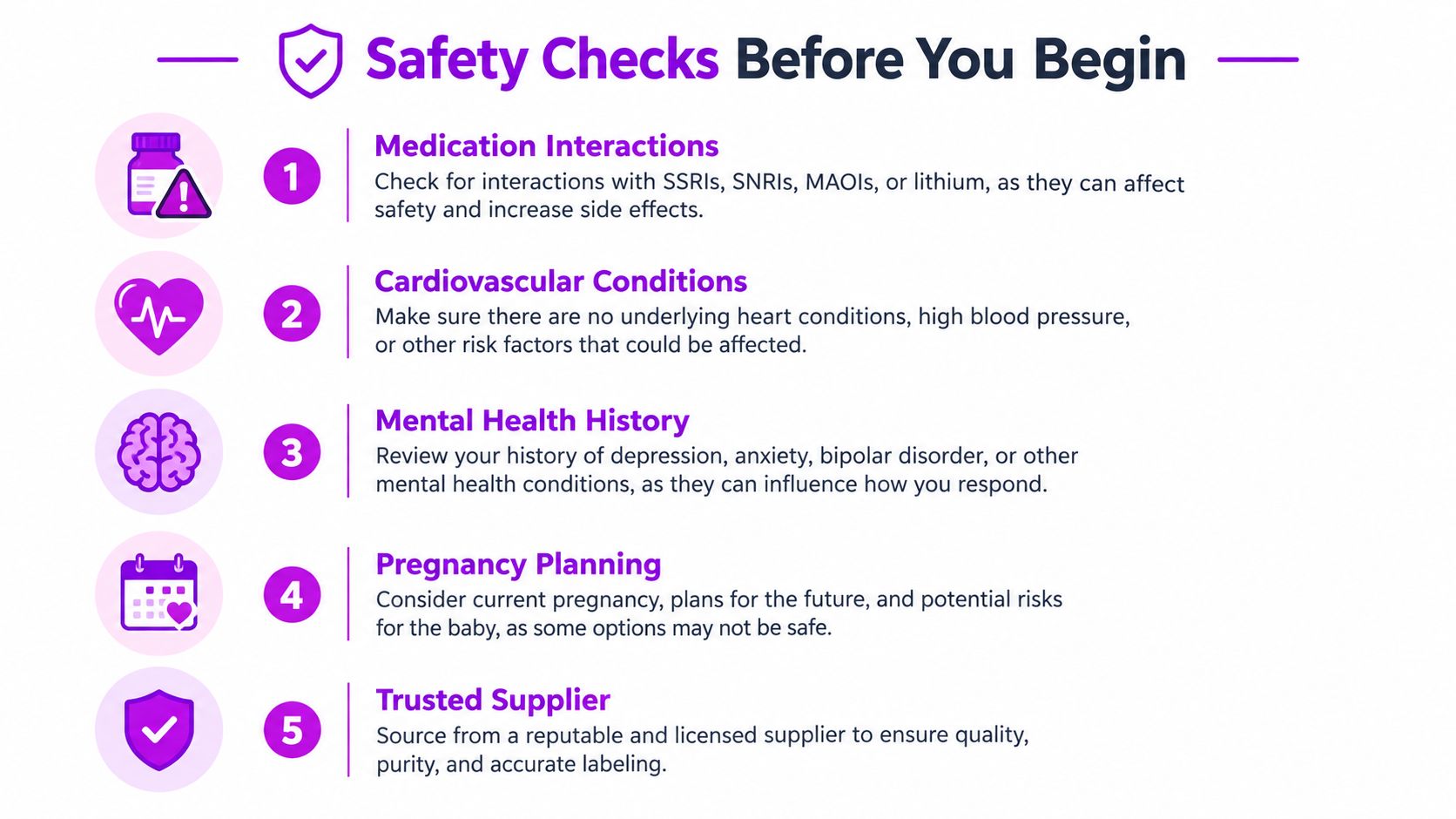
The safety screen that belongs on paper
FDA guidance notes that SSRIs, SNRIs, and MAOIs can alter psychedelic effects, while lithium and tricyclic antidepressants may potentiate them and create psychiatric safety concerns. It also warns that MAOIs combined with MDMA or amphetamine-like psychedelics can produce life-threatening hypertension. FDA guidance on psychedelic interactions
The practical version is simple:
- Medication name and timing: write down exactly what you take and when you take it.
- Cardiovascular history: note any blood-pressure, heart, or circulation issues.
- Sleep quality: track whether you're already underslept before dosing.
- Mental-health history: record past mania, psychosis, or severe mood instability.
- Escalation rule: if a red flag appears, talk to a clinician and stop treating the tracker as your guide.
The U.S. National Center for Complementary and Integrative Health lists insomnia, anxiety, depressed mood, impaired focus, and cognitive or social difficulties among reported microdosing effects, and it warns against psilocybin use in people with psychotic disorders or severe bipolar disorder. That's the part casual guides often skip. Sub-perceptual does not mean pharmacologically irrelevant.
What not to do
Don't use the tracker to self-diagnose compatibility. Don't use it to bless combinations. Don't use it to talk yourself through warning signs because you're excited to test the routine.
If you're on medication, the question isn't whether microdosing feels mild. The question is whether it's safe to experiment at all.
A good journal helps a safer conversation with a clinician by showing medication timing, adverse effects, sleep, and symptom changes clearly. It should never replace medical advice, and it should never be used to justify ignoring a red flag.
Set, Setting, and Your First Two-Phase Journal Entry
Microdosing is easier to read when the day around it is stable. That means the same breakfast pattern, the same work setup, the same people around you, and the same level of honesty about what else is going on.
The phrase set and setting gets thrown around so much that it loses force. Strip it down and make it practical. Wake up the same way, keep your first work block consistent, and don't schedule your first dose day on a day packed with stress, travel, or social noise.
What to record in the moment
A two-phase entry beats a single vague note because memory smooths everything over by evening. In the first entry, capture the substance, exact amount, time, and a quick mood rating on a 10-point scale. Later, add the reflection after the day settles.
That split matters because your first impression and your end-of-day interpretation are not the same thing. One shows what you thought in real time, the other shows what survived contact with the day.
The easiest way to structure it is this:
- Morning entry: dose, timing, mood, sleep quality, and any unusual stress.
- Evening entry: focus, anxiety, energy, social ease, side effects, and whether you'd guess it was a dose day.
A simple comparison day matters just as much. On a non-dose day, log the same fields at roughly the same times, then compare the entries without pretending the non-dose day is a control in the laboratory sense. It's your own practical baseline.

For people who want a structured place to do that, MicroTrack supports two-phase entries, a 10-point mood scale, scheduled protocols, custom rhythms, trend visualizations, searchable history, and CSV export. That doesn't make the conclusions for you, but it does make the notes easier to compare over time.
Record the day as lived, not as remembered.
If you keep that habit, your journal starts to become useful. If you don't, you'll end up with a collection of impressions that feel convincing and prove very little.
Reading Your Trends Without Fooling Yourself
A rising chart is not a verdict. It becomes useful only after you test whether sleep, workload, exercise, relationships, or seasonal changes could explain the same improvement.
Over-attribution is the common mistake. You begin a protocol, then your job changes or a relationship settles down, and your mood improves. The timing looks persuasive, but timing alone does not establish cause. Ask, “What changed besides the capsule?” Record the answer before interpreting the trend.
What your trends should answer
Compare like with like across weekly and monthly views. Check whether sleep is better on dose days or off days, whether anxiety differs from baseline later in the schedule, and whether good days follow exercise more often than dosing. These comparisons produce a more useful question than whether the line went up.
Frequency and time-of-day distributions show whether actual behavior matches the intended schedule. They also expose drift toward morning, afternoon, or irregular timing. If the calendar says one thing and your body did another, preserve that mismatch in the journal rather than smoothing it away.
The right label for most observations is correlation, not conclusion. The MicroTrack correlation versus causation guide offers a useful framework for testing that distinction against your own notes.
A trend is only convincing when it survives a boring explanation.
Use pattern detection as a prompt, never as a verdict. When it flags a possible pattern, inspect the surrounding entries and annotate workload, sleep, exercise, social events, illness, and unusual stress. Then mark the interpretation as a hypothesis. That keeps your journal useful without turning a suggestive cluster into proof.
Belief state belongs in the record too. As the expectancy trial covered earlier showed, people can often guess their condition, so any self-readout that ignores belief is incomplete. Add a quick guess about whether the day was a dose day before checking your schedule, then compare those guesses with your ratings. If confidence in being dosed rises alongside better scores, record that relationship as part of your N-of-1 evidence, not as a reason to dismiss the experience.
A structured journal gives you something stronger than memory: a record you can challenge.
Troubleshooting the Most Common Practice Failures
Microdosing experiments usually fail through poor controls, not dramatic events. Dose creep, skipped entries, and schedule changes can erase the comparison you needed to learn whether anything changed.
Dose creep begins when the starting amount feels ordinary, so you raise it without recording a clear reason. Stop changing the dose. Keep the original baseline, schedule a non-dose comparison week, and decide in advance what result would justify continuing. The placebo-control shrinkage covered earlier applies directly here. A 2025 review of microdosing evidence supports treating apparent benefits cautiously.
Missed logging needs a simple recovery rule. Complete the entry later the same day, mark it as delayed, and record uncertainty instead of reconstructing details from memory. At the end of each week, check for missing dose, sleep, mood, and side-effect fields. One incomplete entry is manageable. Repeated gaps make the experiment difficult to interpret.
Keep the protocol legible
Mood chasing means taking a dose outside the schedule because the day feels difficult. Record the decision and the reason. Do not treat that entry as clean evidence. If it happens repeatedly, stop calling the process an experiment and address the underlying problem separately.
Protocol drift appears when planned off-days disappear or dosing moves into another part of the day. Export or review the journal monthly, then count actual dosing days against intended dosing days. Keep the mismatch visible.
Run a reset week when the record becomes confusing:
- Return to the original baseline and planned schedule.
- Do not increase the dose or add new supplements.
- Mark dose days, non-dose days, sleep, stress, and side effects.
- Write your condition guess before checking the calendar.
- Review the entries only after the week ends.
Blinding often fails because people notice subtle sensations or expect a result. A better score on a day you believe was a dose day may reflect expectancy rather than the substance. Include belief in the journal, and compare confidence with outcomes.
My rule is direct: if two clean cycles show no meaningful improvement against baseline, stop. Stop sooner for recurring side effects, persistent uncertainty, or repeated schedule violations. MicroTrack provides two-phase logging, schedule tracking, and trend views for comparing dose and non-dose days. Use MicroTrack to keep the record structured.