Microdosing for Anxiety: A Realistic Guide
The most popular advice about microdosing for anxiety is often to “start low, go slowly, and see what happens.” That sounds sensible, but it skips the hardest question: how will you know whether anxiety improved because of the substance, rather than because you expected it to, changed your routine, slept better, or just had an easier day?
That distinction matters. People deserve relief, but they also deserve a way to interpret their experience without turning a hopeful pattern into a medical conclusion. Microdosing remains an emerging practice, and the clearest role for structured tracking is not to prove that it treats anxiety. It's to help you observe patterns carefully, recognize risks early, and decide when professional support is more appropriate.
Table of Contents
- The Anxiety Search for Alternatives
- Understanding What Microdosing Actually Is
- The Evidence for and Against Anxiety Relief
- Distinguishing Placebo from Genuine Improvement
- Safety Guidelines and Harm Reduction
- Identifying Warning Signs and Adverse Effects
- Building a Sustainable Personal Protocol
The Anxiety Search for Alternatives
Anxiety rarely arrives as one isolated symptom. It can begin with a physical sensation, such as tightness in the chest, then move into repetitive thoughts about work, health, relationships, or an uncertain future. A person may spend the day trying to calm down, only to become more anxious about the fact that calming down feels impossible.
Someone in that position might have already tried therapy, medication, breathing exercises, exercise, sleep changes, or several of these together. Those approaches can help, but they don't work equally well for everyone, and some people dislike side effects or feel frustrated by slow progress. Searching for an unconventional option isn't irrational. It often reflects a practical desire to regain control.

Consider a person who reads several positive accounts online and decides that a subtle intervention might offer relief without the intensity of a full psychedelic experience. On a promising morning, they feel calmer, make progress on a difficult task, and have a better conversation with a partner. The experience feels meaningful, but several explanations remain possible: the dose, improved sleep, lower caffeine intake, a supportive conversation, or the confidence created by trying something new.
Hope needs a method
Anecdotes can explain why people become interested, but they can't establish cause and effect. Anxiety naturally fluctuates, and people often begin a new practice when symptoms are especially difficult. If symptoms then return toward their usual level, the change can feel like a treatment response even when the intervention wasn't responsible.
A more careful approach starts with empathy and skepticism in equal measure:
- Take distress seriously: Anxiety can impair sleep, concentration, relationships, and daily functioning. It shouldn't be dismissed because evidence for a particular alternative approach is limited.
- Separate curiosity from treatment: Microdosing shouldn't replace an assessment or evidence-based care for an anxiety disorder.
- Record the whole context: A lower anxiety rating means more when you also know what happened with sleep, stress, caffeine, alcohol, therapy, and work demands.
Practical rule: A good day is an observation. A repeated pattern across comparable days is more informative, but it still isn't proof of treatment efficacy.
Understanding What Microdosing Actually Is
Microdosing generally refers to taking a very small, intended-to-be-sub-perceptual amount of a psychedelic substance, commonly psilocybin or LSD. The aim is to avoid the marked perceptual and psychological changes associated with a full psychedelic dose while remaining able to carry out ordinary activities.
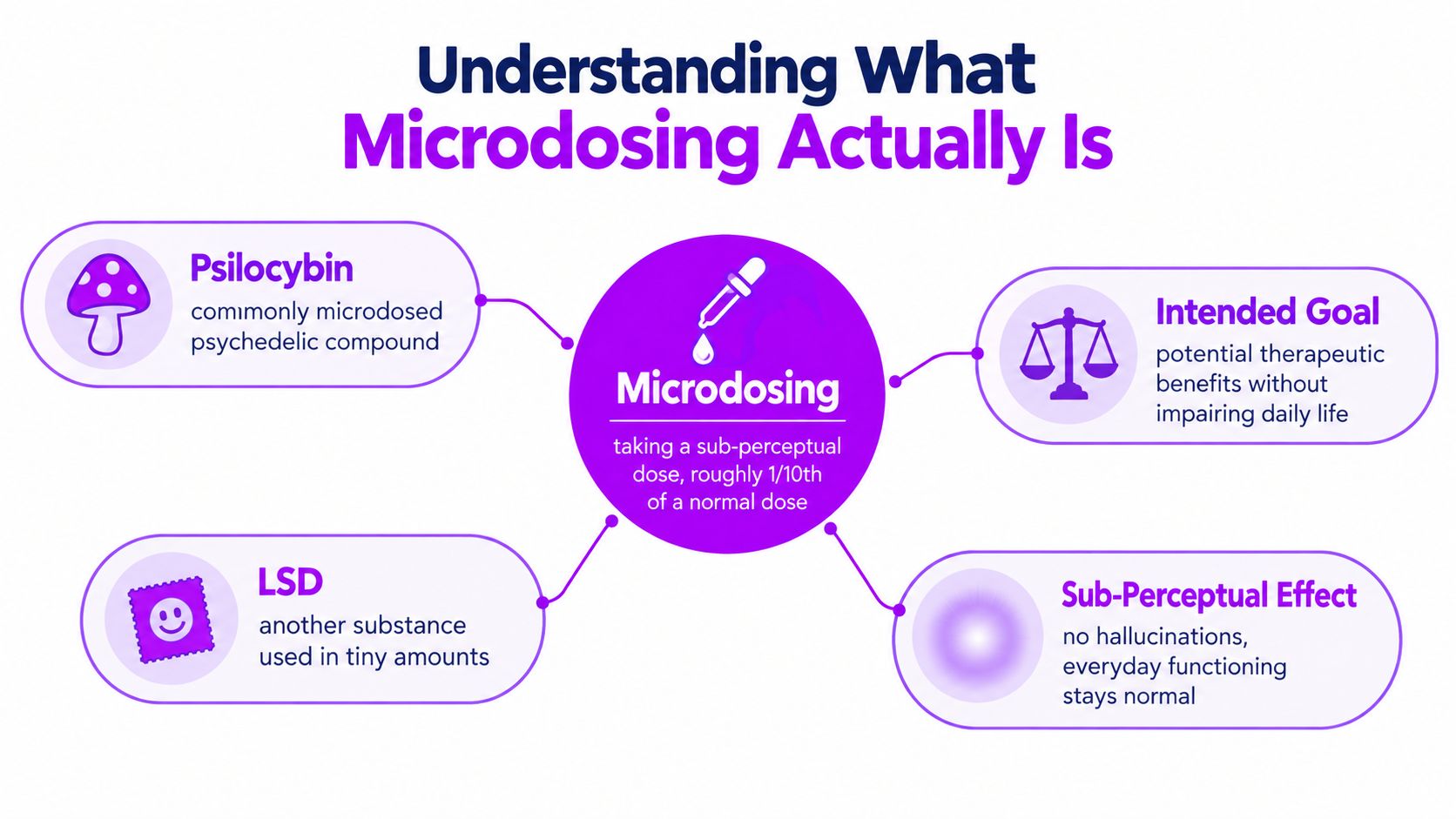
The term “sub-perceptual” can create confusion. It doesn't mean the substance has no biological or psychological effect. It means the intended experience shouldn't involve obvious hallucinations or substantial impairment. If someone feels altered, overstimulated, unusually distracted, or unable to function normally, the experience has moved away from the usual purpose of microdosing and deserves caution.
Substance and protocol are different variables
Psilocybin and LSD aren't interchangeable. They differ in pharmacology, duration, potency, legal status, and the way an individual may respond. Even within one substance, potency and preparation can vary, making a label such as “microdose” less precise than it sounds.
A protocol describes how someone organizes use over time. It may include dose days, non-dose days, timing, planned breaks, and conditions for stopping. A schedule can make observations easier to interpret, but it doesn't turn an uncontrolled personal experiment into a clinical trial.
The intended goal also needs careful wording. People may seek a calmer mood, less rumination, or easier task initiation, but those are reported goals, not established outcomes. Controlled evidence doesn't currently establish psychedelic microdosing as an effective anxiety treatment, and a smaller amount isn't automatically safe for every person.
Why the definition matters
Treating microdosing as “just recreational drug use” misses the deliberate self-monitoring that often surrounds it. Treating it as a gentle medicine misses the uncertainty, legal considerations, medication interactions, and potential adverse effects.
The useful middle position is more restrained: microdosing is a form of self-experimentation involving a psychoactive substance, with possible subjective effects and unresolved clinical value. That definition keeps the reader alert to both the appeal and the limits.
The Evidence for and Against Anxiety Relief
Positive personal reports are common, but they answer a different question from controlled research. A person can truthfully report feeling less anxious after microdosing without being able to show that microdosing caused the change.
A large 2020 survey offers an important early snapshot. Among approximately 2,200 respondents, 13% reported having microdosed at some point in their lives and 4% reported currently microdosing. Of 313 respondents who answered about anxiety changes, 56.55% reported improvement, 30.35% reported no effect, and 13.10% reported worsening, with a statistically significant distribution, χ² = 89.89 and p < 0.001. The broader sample included approximately 2,347 people, and 59% said they were familiar with psychedelic microdosing, according to the 2020 survey of microdosing experiences and anxiety.
Those findings show that anxiety management is a prominent perceived use case. They don't show that microdosing produced the improvement. Participants selected themselves, substances and amounts weren't necessarily standardized, and the outcomes were subjective.
Why controlled trials change the interpretation
Placebo-controlled studies ask a harder question: do people receiving the active substance improve more than people receiving a placebo under otherwise similar conditions? That comparison helps separate pharmacological effects from expectancy, attention, lifestyle changes, and regression toward the average level of symptoms.
A self-blinding citizen-science study involving 191 participants found improvement during a four-week microdosing period, but the placebo group improved as well, with no significant overall difference between groups. A small post-acute anxiety difference favored microdosing by approximately 1.4 points on the study scale, but participants' ability to guess their condition could explain that result, as reported in the self-blinding microdosing study.
The broader evidence remains limited. A systematic review and meta-analysis included 24 studies involving 3,681 participants, but only 6 studies contributed quantitative meta-analyses. Its randomized controlled trial component contained just 2 parallel trials, 3 comparisons, and 117 participants. For anxiety, the pooled standardized mean difference was −0.20, with a 95% confidence interval from −1.11 to 0.71 and substantial heterogeneity, I² = 82.3%. Because the interval crossed zero and results varied substantially, the analysis didn't establish a reliable immediate anxiety-reduction effect, according to the systematic review and meta-analysis.
The fairest conclusion is neither “it definitely works” nor “all reported benefits are imaginary.” People may notice real changes in their experience, but current controlled evidence doesn't establish microdosing as a proven treatment for anxiety disorders.
Distinguishing Placebo from Genuine Improvement
Expectancy isn't the same as deception or fabrication. If you believe a practice will help, that belief can change attention, interpretation, motivation, and behavior. Those changes may feel entirely genuine. The question is whether the substance adds an effect beyond the expectations and routines surrounding it.
A useful comparison looks like this:
| Observation | What it may suggest | What it can't establish |
|---|---|---|
| Anxiety is lower on a dose day | The day felt better in the presence of a dose | That the dose caused the change |
| Anxiety improves after a new ritual begins | The ritual or surrounding habits may help | That the psychedelic compound was responsible |
| Dose days look better than non-dose days | A possible within-person pattern | That the groups were comparable |
| Anxiety improves repeatedly across similar contexts | A stronger personal signal | A clinical treatment effect |
A single rating is especially vulnerable to noise. Someone may take a dose after a poor night of sleep, face an unusually stressful meeting, and then conclude the substance failed. Another person may dose before a quiet weekend and interpret calmness as proof. Both experiences contain information, but neither provides a fair comparison.
Build the comparison before reviewing the result
Structured self-observation works best when you define what you'll measure in advance. Record anxiety before the day unfolds, then record it again later. Keep the rating scale consistent, and note whether the entry was made before or after you knew how the day went.
A practical log can include:
- Anxiety: Use the same rating scale each day rather than changing the meaning of “mild” or “severe.”
- Context: Note sleep quality, caffeine, alcohol, therapy, exercise, conflict, workload, and major stressors.
- Timing: Record when the substance was taken and when anxiety changed.
- Expectation: Write what you expect before the day develops.
- Delayed reflection: Add a later entry so immediate impressions don't become the only record.
- Adverse effects: Track agitation, insomnia, physical discomfort, unusual sensory changes, or impaired focus.
A journal such as MicroTrack's guide to correlation and causation can help frame the central reasoning problem. Its value is not that a graph can prove efficacy. A searchable record with dose timing, mood, anxiety, sleep, side effects, and reflections can make selective memory less influential.
Compare dose days with non-dose days, but also compare similar days with similar days. Context is part of the experiment.
The preregistered, double-blind, placebo-controlled crossover study described in the controlled psilocybin microdosing research found no significant difference from placebo in anxiety symptoms, depression symptoms, emotion processing, or interoceptive awareness. Its within-subject design reduced some variability by allowing participants to serve as their own controls. For personal tracking, that supports a cautious method: look for repeated patterns against baseline, not a direct pharmacological explanation after one dose.
Safety Guidelines and Harm Reduction
Safety starts before any substance is taken. Psilocybin and LSD are regulated differently across jurisdictions, and legal access varies. Don't purchase, possess, prepare, or use a psychedelic where doing so violates local law, and don't assume that an online product has reliable identity, strength, or purity.
There isn't a universal safe starting dose that can be responsibly prescribed in a general article. Potency, formulation, body, mental-health history, medications, and sensitivity all differ. Anyone considering use should speak with a qualified clinician who can review their history, and shouldn't change prescribed medication without medical guidance.
Make the process conservative
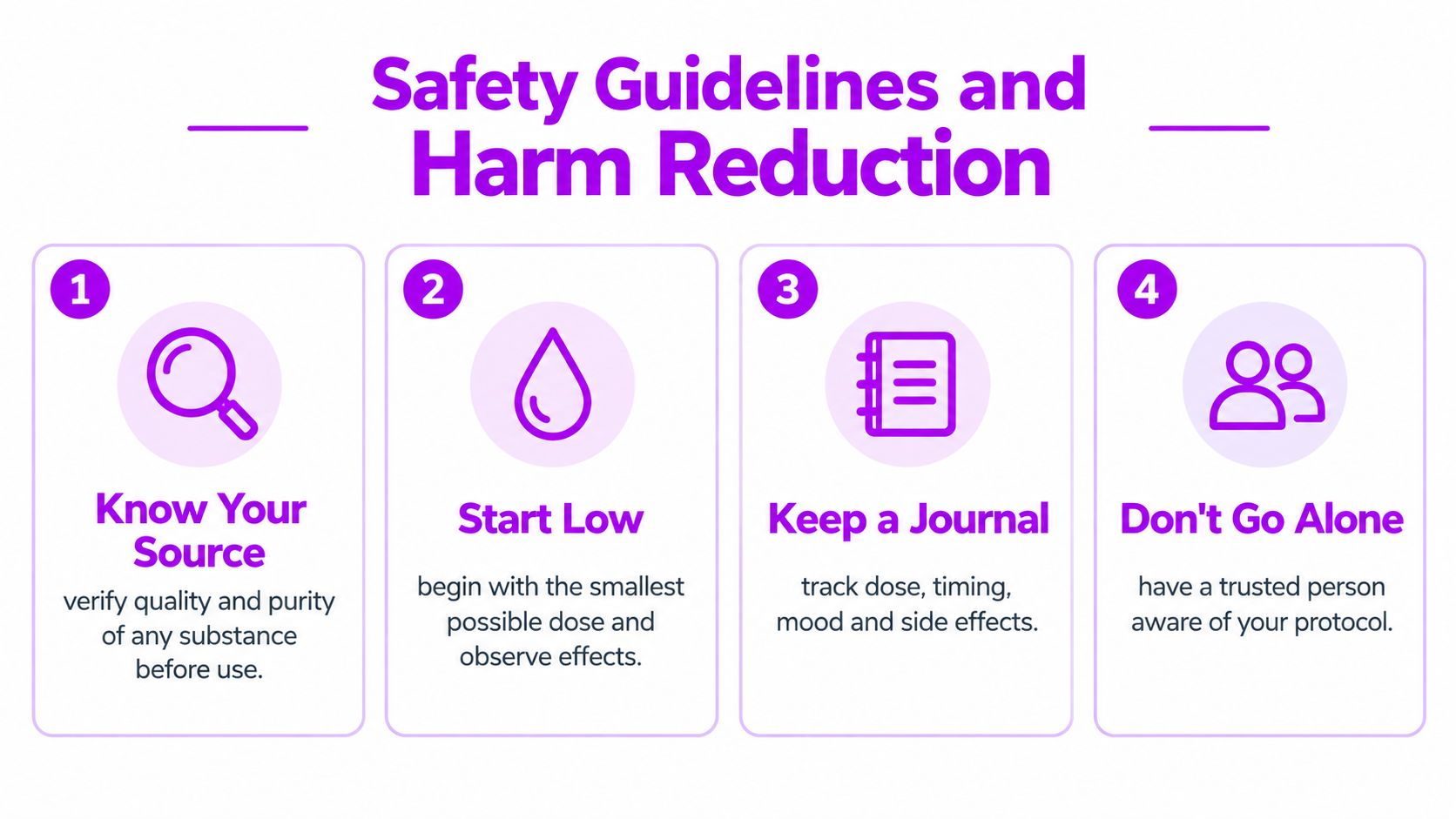
Use these principles to reduce avoidable risk:
- Verify legality and source information. Don't forage for wild mushrooms or rely on visual identification. Misidentification and contamination can cause serious harm.
- Avoid dose escalation. Feeling a noticeable effect, chasing a better mood, or responding to one disappointing day by taking more increases uncertainty rather than resolving it.
- Choose a low-risk setting. Don't drive, operate machinery, supervise vulnerable people, or make high-stakes decisions if you feel altered.
- Tell a trusted person. Someone who understands what you're doing can notice changes you might miss and can help if anxiety escalates.
- Track before interpreting. Record sleep, caffeine, stress, timing, anxiety, mood, cognition, and physical effects instead of tracking mood alone.
People with a history of psychosis, bipolar-spectrum symptoms, mania or hypomania, active suicidality, or serious psychiatric instability need particular caution and professional assessment. Pregnancy, nursing, cardiovascular disease, seizure disorders, glaucoma, and medication interactions also require clinical advice. The harm-reduction practices guide provides a broader framework for planning, monitoring, and knowing when to pause.
The evidence base itself supports restraint. In a controlled crossover study, psilocybin microdosing didn't outperform placebo on several anxiety-related and psychological measures. That doesn't prove that no individual can experience a subjective change, but it does mean that a personal protocol shouldn't be treated as established care.
Identifying Warning Signs and Adverse Effects
Microdosing isn't uniformly calming. Some people experience increased anxiety, agitation, sensory discomfort, impaired concentration, or sleep disruption. A person who feels worse shouldn't interpret that reaction as evidence that they need to persist until the substance “starts working.”
A review of reported adverse effects found mild anxiety in approximately 25% of respondents in large online samples, while one survey reported severe anxiety in about 4.6%. In a six-week trial, 4 of 80 participants discontinued because of anxiety, as described in the review of microdosing side effects.
Define stopping rules in advance
Write down the conditions that mean “pause,” “stop,” or “seek help” before beginning. Reasoning is harder during panic, insomnia, or overstimulation.
- Pause and reassess: Marked anxiety, persistent restlessness, unusual irritability, worsening sleep, or repeated physical discomfort.
- Stop the experiment: Panic symptoms, impaired functioning, escalating frequency, or a pattern of needing more to pursue the same mood.
- Seek urgent help: Suicidal thoughts, severe confusion, psychosis-like symptoms, dangerous behavior, or a medical emergency.
The National Center for Complementary and Integrative Health lists possible effects including insomnia, increased anxiety or depression, poor mood, low energy, gastrointestinal discomfort, headache, disrupted senses, temperature changes, poor focus, impaired cognitive functioning, and reduced social skills in its psilocybin safety information.
Don't reduce the record to “better” or “worse.” Note what changed, when it changed, and whether the effect interfered with sleep, work, relationships, or safety. If anxiety is already severe or functioning is deteriorating, contact a qualified mental-health professional rather than trying to optimize a self-directed protocol.
Building a Sustainable Personal Protocol
A responsible approach treats microdosing as observation, not established treatment. First clarify the goal, record a baseline, define stopping rules, and compare dose days with non-dose days while tracking sleep, caffeine, stress, therapy, timing, and side effects. Keep professional mental-health care involved, especially when anxiety is persistent or impairing.
A schedule should serve accurate observation rather than encourage automatic repetition. The microdosing schedule guide can help you think about planned dose days, rest days, and custom adjustments without confusing consistency with proof.
MicroTrack offers structured entries for dose details, mood, anxiety, sleep, focus, side effects, and later reflections, with trend views and CSV export for reviewing patterns over time. If you want a calmer, more evidence-aware way to record your experience, visit MicroTrack and use your data to guide cautious decisions rather than relying on memory or expectation alone.