How to Build a Micro Schedule That Actually Works for You

It's common to begin by asking which micro schedule is “best.” That's the wrong first question. Fadiman, Stamets, and custom rhythms can all look sensible on paper, but a schedule you forget, skip without recording, or change every few days won't give you useful feedback.
A workable routine is less like choosing a winning protocol and more like designing a small personal experiment. You need a clear intention, a repeatable calendar, simple skip rules, and enough tracking to tell a dose-day impression from a pattern. Also, current evidence doesn't establish that one named schedule outperforms another, so the practical advantage comes from consistency and honest observation, not protocol loyalty.
Microdosing also involves legal, health, and medication considerations. Check the laws where you live, speak with a qualified clinician about mental health or serotonergic medication, and don't treat a tracking system as medical care.
Table of Contents
- Why Your Micro Schedule Matters Less Than You Think
- Fadiman and Stamets Schedules Compared
- Designing a Custom Micro Schedule
- Putting Your Schedule Into Daily Practice
- When to Skip, Adjust, or Pause a Dose Day
- Tracking Outcomes and Spotting Real Patterns
- Your 14-Day Micro Schedule Starter Plan
Why Your Micro Schedule Matters Less Than You Think
The popular advice says to pick a protocol and follow it precisely. In practice, the named schedule is usually a smaller lever than the system surrounding it. If you don't know what you intended to change, can't remember when you dosed, and only record unusually good days, you aren't running a meaningful self-observation process.
The evidence gap supports that caution. A neutral overview of microdosing protocols states that no two schedules have been compared in a controlled trial and that no protocol has been shown to outperform another. The same overview highlights a practical problem: people often debate Fadiman or Stamets without having comparative evidence for mood, focus, anxiety, or tolerance.
Build a feedback loop you can maintain
Your real task is to design a routine you'll still use at week six. That means making each part easy enough to repeat:
- Consistent dose logging: Record whether you dosed, rather than relying on memory.
- Honest skip logging: Mark a missed or deliberately skipped day with a short reason.
- Stable outcome ratings: Use the same measures each time, even when the day feels ordinary.
- Weekly review: Look for patterns before changing the plan.
A useful schedule produces clean enough observations to guide your next decision. A complicated schedule produces stories. Those stories may feel persuasive, but they often mix sleep, workload, caffeine, expectations, and dose timing into one impression.
Practical rule: Choose the simplest cadence that gives you enough contrast between dose days and non-dose days to notice how you function.
This is why I treat schedule selection as a self-tracking design problem, not a pharmacology scorecard. The best first version isn't the one with the most attractive name. It's the one you can explain, follow, and audit without heroic willpower.
Fadiman and Stamets Schedules Compared
The Fadiman and Stamets schedules are commonly the first ones encountered. They represent different approaches to spacing, but neither has been proven superior in a controlled comparison.
The Fadiman protocol uses one dosing day followed by two non-dosing days. A randomized, placebo-controlled psilocybin study instructed participants to dose every third day over a three-week period, producing 5–7 total microdoses across that window, as described in the published psilocybin microdosing study. Its practical appeal is the clear separation between a dose day and the following baseline days.
The Stamets-style pattern is commonly described as four days on and three days off. Survey data reported the exact four-on, three-off pattern in 2% of respondents, while a related five-days-on, two-days-off variant appeared in 8%, according to the survey of microdosing practices. Those figures describe reported use, not proof of effectiveness.
| Attribute | Fadiman (1-on/2-off) | Stamets (4-on/3-off) |
|---|---|---|
| Basic rhythm | One dosing day, two non-dosing days | Four dosing days, three non-dosing days |
| Main structural feature | Distinct dose and rest days | A longer active block followed by a rest block |
| Useful for | People who want clearer inter-dose baselines | People who prefer a more embedded weekly rhythm |
| Main trade-off | More noticeable contrast between days | Less separation between individual dose responses |
| Evidence status | Commonly used and studied, but not proven superior | Commonly reported, but not proven superior |
Fadiman tends to suit people who want to ask, “What changed on the dose day, and what remained on the next two days?” The gaps make it easier to notice delayed effects, sleep disruption, or a return to baseline. The downside is that the rhythm can feel discontinuous, especially for someone who dislikes thinking about whether today is active or not.
Stamets can suit people who prefer a block that fits a workweek. The trade-off is interpretive clarity. When several consecutive days involve dosing, it becomes harder to separate the response to one day from the carryover of the previous days.
The research doesn't justify claiming that either schedule wins on mood, focus, or anxiety. If you want a neutral starting point, compare the Fadiman and Stamets schedule details, then choose based on your calendar, temperament, and ability to log accurately. The coaching decision is personal, not scientific. Your first cadence is a hypothesis, not a verdict.
Designing a Custom Micro Schedule
A custom micro schedule should solve a real problem in your week. Don't begin with the protocol name. Begin with the outcome you want to observe and the days when you can actually pay attention.
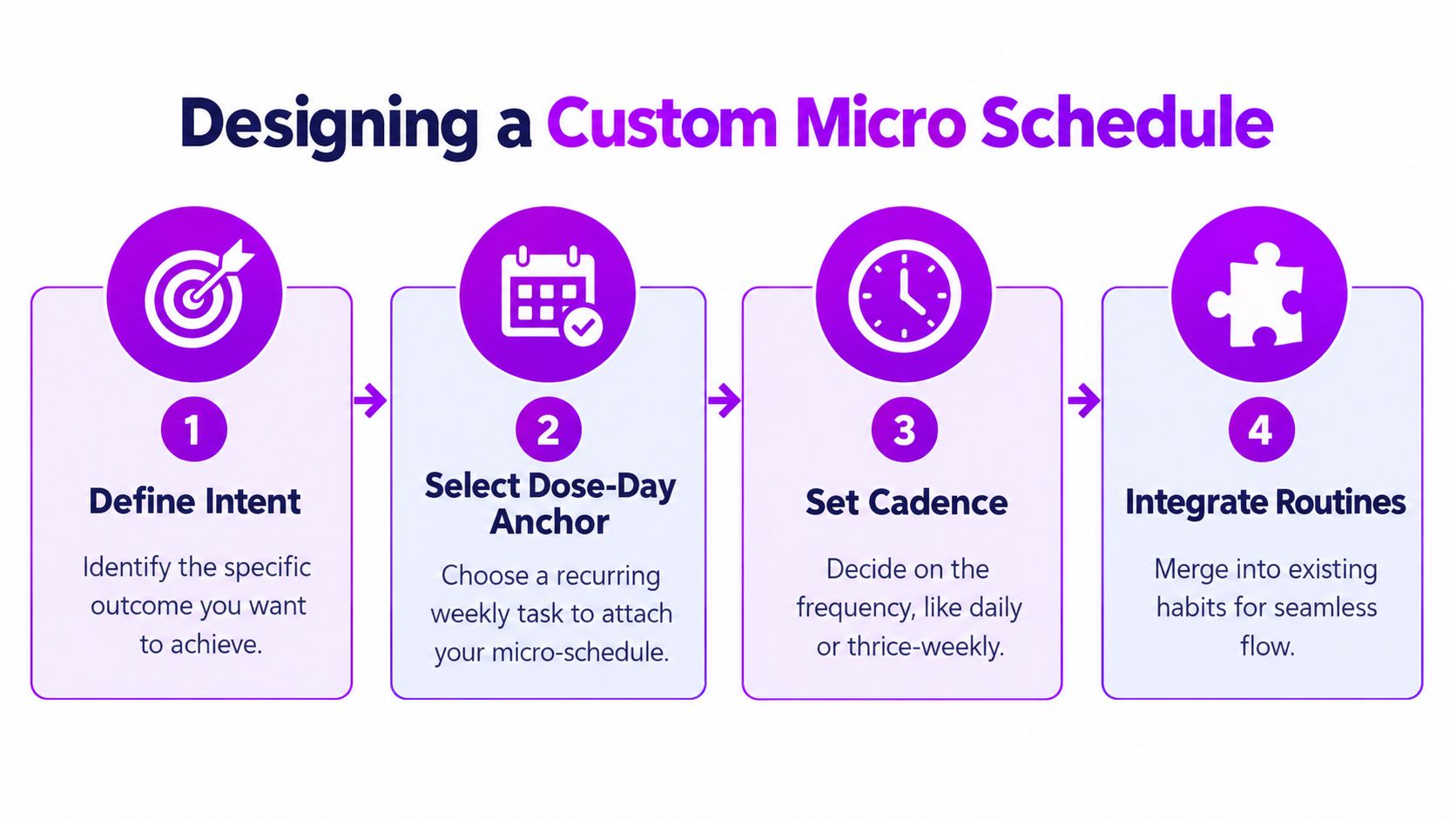
Make four decisions
Define the intent. Pick one primary outcome, such as steadier focus, less reactive mood, or a more reliable creative practice. “Feel better” is too broad to guide a decision.
Choose a dose-day anchor. Attach the dose day to a recurring event that reliably belongs to you. A Monday planning ritual may work better than “every third day” if your work calendar changes but your weekly reset doesn't.
Set the gap length. Decide whether you need one, two, or three non-dose days between sessions. Longer gaps create more baseline information. Shorter gaps may feel easier to integrate, but they give you less separation between observations.
Write override rules. Decide in advance when you'll skip, pause, or change the cadence. This prevents a stressful morning from turning into an improvised experiment.
Consider a 9-to-5 worker whose hardest days are Tuesday through Thursday. Monday may be the logical anchor because it offers time to observe the response before the demanding block. Wednesday could be a buffer or a second planned dose only if the first part of the week has been stable and the person has chosen that option in advance.
Protecting the weekend as a baseline can also be useful. It gives the person room to observe ordinary sleep, mood, and social energy without constantly layering a new decision onto the calendar. The point isn't to engineer a perfect week. It's to create a rhythm that makes comparisons possible.
Your first schedule is a testable hypothesis. Run it long enough to recognize a pattern, then change one variable at a time.
Plan the first version for two weeks, and log every dose, skipped session, and relevant disruption. Don't change dose and cadence together. If you alter both, you won't know which change produced the new result.
Putting Your Schedule Into Daily Practice
A schedule becomes usable when it attaches to something you already do. Choose a fixed cue, such as preparing morning coffee, and mark planned dose days in your phone calendar with one color. You don't need a complex reminder system. You need a visible signal that prevents memory from becoming the main control mechanism.
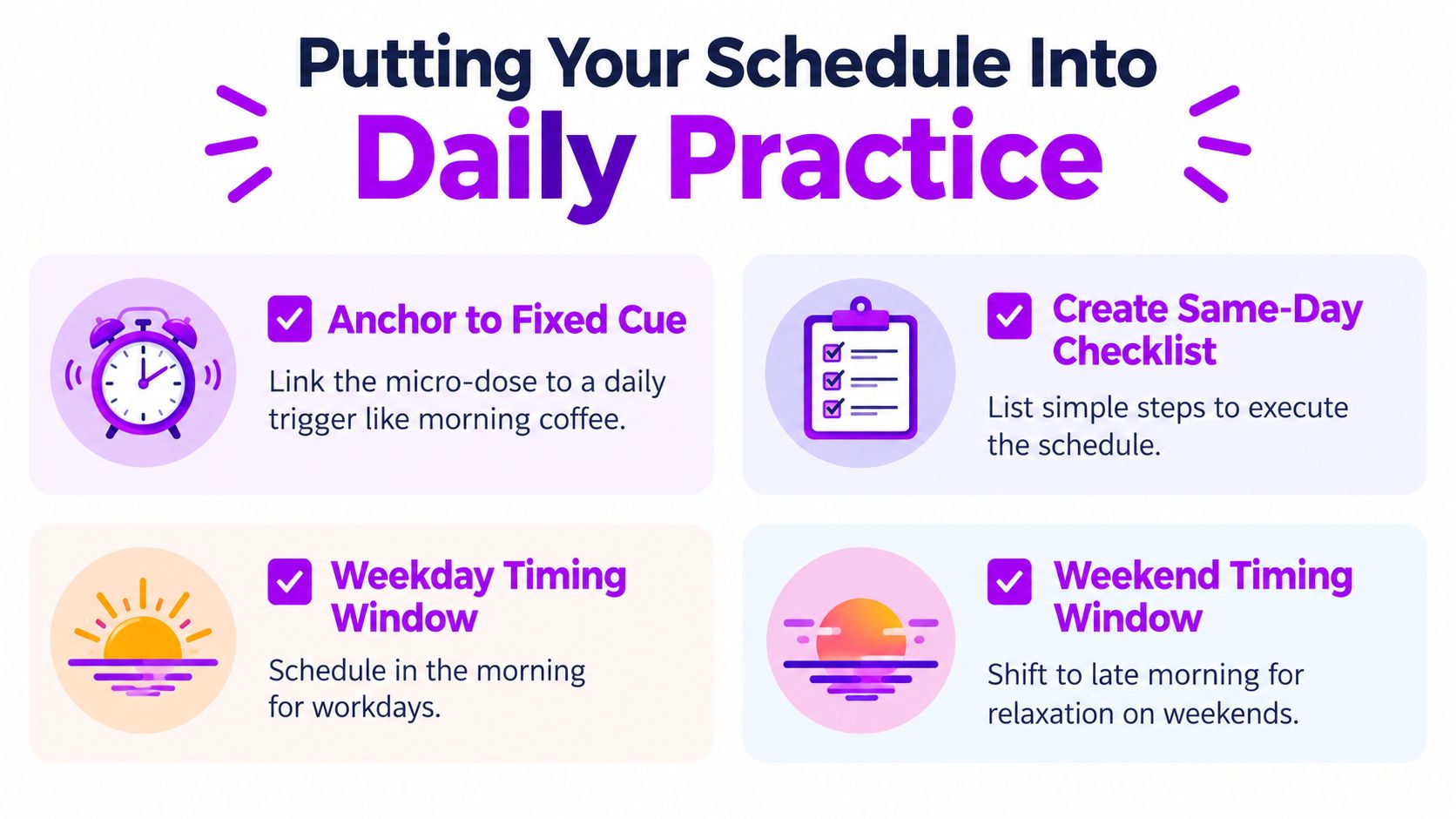
Use a small day-of sequence
For a weekday dose morning, keep the routine short:
- Take the planned dose only within your preselected plan.
- Drink water.
- Eat breakfast.
- Keep the next 90 minutes free from unnecessary decisions.
That last step isn't about promising a particular effect. It's a way to avoid interpreting the day through a rush of messages, meetings, and choices before you've noticed your starting state.
On weekends, a later morning window may fit better if sleep runs later. Don't force a weekday timetable onto a weekend if doing so reduces sleep or creates social friction. Pairing with caffeine deserves the same caution. Keep caffeine amount and timing stable while you're learning your response, rather than adding more stimulation on a day you hope will feel productive.
Alcohol is a poor companion for clean observation and can complicate mood, sleep, and judgment. Avoid treating it as part of the protocol. If a dose day lands on a high-stress meeting, travel day, or unpredictable shift, use the override rule you wrote earlier. A missed session is more useful than a rushed session you can't interpret.
On off days, stop thinking about the protocol. Optionally write one line about mood, energy, sleep, or focus, but don't turn every rest day into an assessment ritual. For practical digital logging, structured data entry for daily tracking can help keep entries brief and comparable.
If the schedule starts requiring willpower, the schedule is too complex.
When to Skip, Adjust, or Pause a Dose Day
A schedule should include failure handling before you need it. Consider someone following a one-day-on, two-days-off rhythm who reaches week three and notices poor focus, disrupted sleep, and a flat mood on the second off day. The wrong response is to add another dose immediately because the plan “isn't working.”
First, separate the event from the pattern. One difficult day may reflect workload, illness, poor sleep, or another factor. Record what happened, then use the following rules to decide what comes next.
Three override rules
- Skip a dose day during acute illness or serotonergic medication overlap. Medication interactions require professional guidance, not experimentation. If you're unsure whether a medication is serotonergic or whether timing creates a concern, ask a qualified clinician or pharmacist.
- Pause the whole schedule after three consecutive off-pattern days. Restarting from a clean baseline is easier to interpret than trying to reconstruct a broken rhythm.
- Adjust the cadence when the same unwanted signal repeats twice in one cycle. Repeated sleep disruption, agitation, or emotional flatness deserves a change in structure and clinical attention when appropriate.
The person in the example might skip the next planned dose, write “poor sleep and flat mood after prior cycle,” and observe the next ordinary days. If the problem disappears, that was a one-off skip or a signal worth monitoring. If it returns under the same arrangement, the person has a reason to adjust the cadence instead of just pushing through.
A structural adjustment changes the plan, such as creating a longer gap. A full reset pauses the routine and starts again only after the person has reviewed the circumstances. Don't hide either decision in a blank calendar square. A one-line reason turns disruption into data.
Skipping isn't failure. It means the schedule is doing its job because you're watching the response instead of defending the plan.
If symptoms are severe, persistent, or connected to a mental health crisis, stop experimenting and seek qualified medical support. A tracker can record an event, but it can't assess safety.
Tracking Outcomes and Spotting Real Patterns
Tracking should be small enough that you'll do it on an unremarkable day. Use a 10-point scale for mood, energy, and focus on dose days and the following off day. Add sleep quality as context, even if you don't include it in your main score, because a poor night can mimic or conceal a schedule response.
The minimum viable ritual is three numbers and one optional sentence each evening. Record the ratings whether the day was good, bad, or boring. Selective logging is one of the fastest ways to turn a useful tracker into a collection of flattering memories.
Review once a week
Ask three questions:
- What changed this week?
- Which dose day produced the best response?
- Which off day felt worst?
| Question | What to record | Decision trigger |
|---|---|---|
| What changed this week? | Sleep, workload, caffeine, illness, dose, and skips | A major confounder means interpret cautiously |
| Which dose day felt most useful? | Mood, energy, focus, and timing | A repeated pattern deserves observation |
| Which off day felt worst? | The day, symptom, and context | Repeated unwanted signals justify an adjustment |
After four weeks, compare average dose-day ratings with average off-day ratings. This isn't proof of causation, but it can expose whether your impression survives ordinary variation. The progress visualization approach for tracking patterns is useful when raw entries become difficult to review manually.
Don't change dose and schedule in the same week. Don't log only after productive days. Don't ignore sleep, caffeine, workload, or unusual stress. The tracker isn't a diary designed to capture every thought. It's a decision tool that helps you decide whether to continue, simplify, adjust, or pause.
Your 14-Day Micro Schedule Starter Plan
Keep four anchors in place:
- Pick one cadence.
- Attach the dose day to a recurring weekly task.
- Keep one gap-day rule.
- Log one rating each evening.
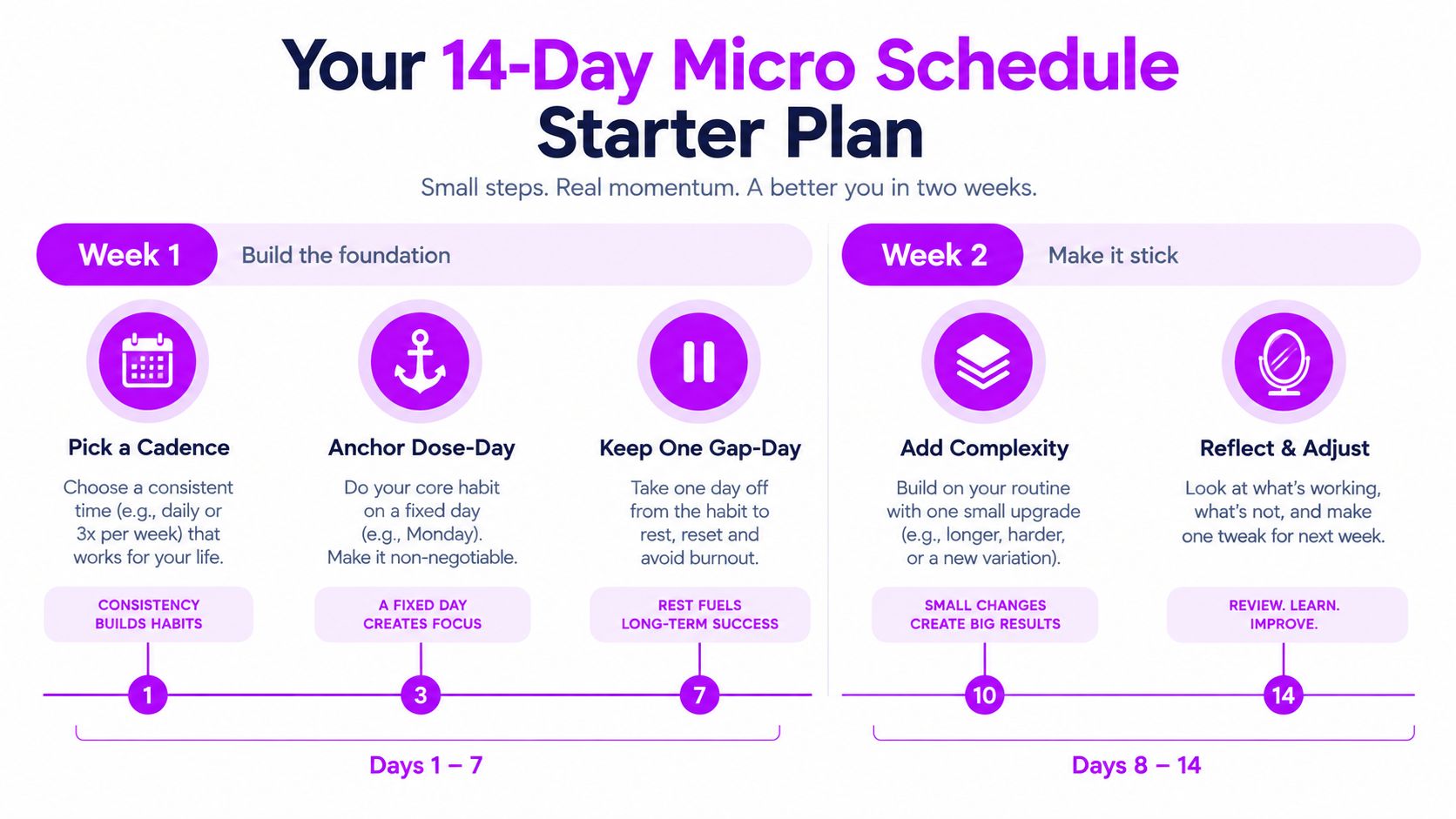
Days 1 through 14
Day 1: Set your intention, choose the cadence, and place dose and off days on your calendar. Use the morning reminder, then write one evening rating.
Days 2 and 3: Follow the gap rule. Record one rating each evening, including if you missed or skipped anything.
Day 4: Review the first few entries without changing the plan. Ask whether the routine was easy to execute.
Days 5 through 7: Continue the same cadence. On Sunday, spend 60 seconds answering, “What changed this week?”
Days 8 through 13: Repeat the schedule and keep the same rating scale. Add complexity only if the basic routine is stable.
Day 14: Review dose days, off days, sleep, and overrides. Decide whether to continue, simplify, or pause.
If you miss a dose day, log the miss and resume according to your written rule. If you have three consecutive off-pattern days, pause and reset rather than improvising. For the first month, watch one primary metric, such as focus, and keep mood and energy as supporting context.
Consistency beats perfection. Your micro schedule is finished only when you can explain it to a friend in under thirty seconds.
MicroTrack gives you a focused place to record planned and actual sessions, use Fadiman, Stamets, or custom rhythms, add skip and adjustment overrides, and review mood trends over time. Start your two-week experiment with a simple calendar and evening ratings by visiting MicroTrack, then use the record to decide what deserves changing.