Microdosing Placebo: What the Evidence Really Shows

Blinded trials haven't established that microdosing reliably beats placebo: in a 2021 trial of 191 people, active and placebo groups improved without a statistically significant difference between them. That doesn't prove every microdosing effect is placebo, but it means feeling better after a dose isn't enough to establish why.
The striking finding in Szigeti and colleagues' placebo-controlled trial was that improvements in mood, well-being, and cognitive outcomes also occurred without an active psychedelic. For someone keeping a journal, that changes the question from whether a good day happened to what could explain it.
The most useful response to the microdosing placebo debate is therefore practical: record expectation alongside experience. A log that preserves what you predicted before an observation is more informative than one that only records how convincing the experience felt afterward.
Table of Contents
- What Placebo-Controlled Microdosing Studies Found
- What Placebo Means in Microdosing
- Why Blinding Breaks Down in Microdosing Trials
- Separating Expectation From Drug Effects
- Why Personal Reports and Trials Disagree
- Design a Self-Experiment That Reduces Bias
- Decide Whether to Test Microdosing Without Fooling Yourself
What Placebo-Controlled Microdosing Studies Found
Controlled evidence hasn't established a reliable, general advantage over placebo. The findings are mixed, however, rather than proof that low doses have no pharmacological effects.
In the self-blinded citizen-science trial published in eLife, 191 participants followed a four-week at-home protocol, and psychological outcomes improved in both active and placebo groups without significant between-group differences. The important comparison wasn't whether participants improved from baseline. It was whether receiving an active microdose added improvement beyond participating in the same process without the active substance.
Placebo-controlled microdosing studies and their results
| Study | Design | Result |
|---|---|---|
| Szigeti and colleagues, 2021 | 191 people, four weeks, self-blinded at home | No significant microdose versus placebo difference; both groups improved |
| Reanalysis of the same 191-person dataset | Adjusted for participants guessing their condition | Nearly all small advantages lost significance; energy p ≈ 0.04, g = 0.34 |
| Double-blind psilocybin mushroom microdosing study | 64 measurement weeks | Condition identified correctly in 75% of weeks, 49 of 64 |
| Systematic review and meta-analysis, 2026 | 24 studies, 3,681 participants | Depression SMD -0.19, 95% CI -0.56 to 0.19; no reliable benefit beyond placebo established |
| Rapid review of placebo-controlled LSD and psilocybin studies | 19 studies | Blinding assessed in 12 studies; some results differed from placebo, but drug versus placebo origin couldn't be determined |
A rapid review of placebo-controlled microdosing studies identified 19 studies and found that blinding was assessed in 12, with above-chance blind-breaking reported in at least one condition in 11. Some experiments detected differences in subjective experience, physiology, neurobiology, affect, or cognition. A detectable effect, though, isn't automatically a durable improvement in daily functioning.
How to read the pooled results
The 2026 systematic review and meta-analysis, covering 24 studies and 3,681 participants, reported depression SMD -0.19 with a 95% confidence interval of -0.56 to 0.19, and anxiety SMD -0.20 with a 95% confidence interval of -1.11 to 0.71. Both intervals include zero, so neither estimate establishes a reliable benefit beyond placebo.
A standardized mean difference, or SMD, expresses a group difference relative to variability in the measurements. A confidence interval crossing zero leaves the result compatible with no average difference; it doesn't prove exact equivalence.
The practical conclusion is narrower than either side of the debate often suggests. The benefits people report are real to them, but controlled studies cannot yet confidently attribute those benefits to the drug.
What Placebo Means in Microdosing
A placebo effect is a change attributable to expectations and treatment context rather than the active ingredient's specific action. Improvement in a placebo group is broader still: it can also include natural recovery, ordinary mood variation, or changes in behavior.
Belief, ritual, attention, and context are distinct possibilities to record.
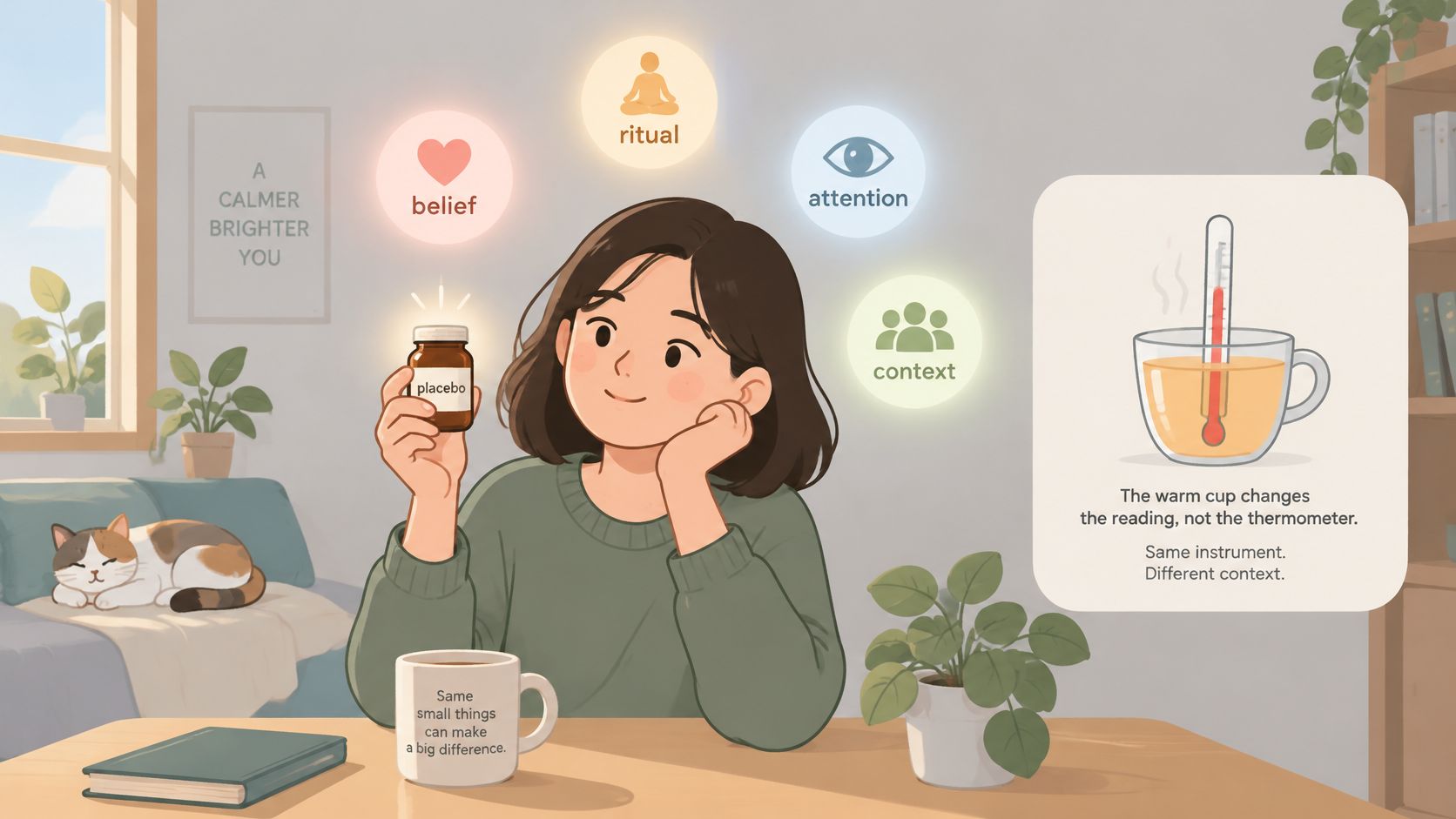
Think of a thermometer in a room full of people who expect it to warm up. If the reading rises, their prediction alone doesn't identify the heater. Likewise, an improved mood score records a change, not its cause.
Expectancy means what someone predicts will happen, such as expecting a brighter mood before dosing. Nocebo describes the opposite direction, when negative expectations contribute to feeling worse. Neither term means someone is inventing the experience.
Separate the possible contributors
A useful log leaves room for several explanations:
- The substance itself: A pharmacological effect may contribute.
- The ritual: Preparing for an observation and paying attention may change behavior.
- The schedule: A planned routine may coincide with more consistent self-care.
- The prediction: Expecting improvement may shape attention and interpretation.
The Berkeley Center for the Science of Psychedelics' microdosing overview describes a literature in which observational and self-report studies generally report more benefits than controlled laboratory studies; it also notes a prospective study in which baseline expectations explained approximately 5%–8% of variation in later outcomes. That's a measurable contribution, not an explanation for everything.
For another format for considering the topic, watch the accompanying video.
The analytical mistake is treating all unexplained improvement as either pharmacology or placebo. Sleep, relationships, work demands, and the act of beginning a new routine remain alternative explanations unless the design addresses them.
Practical rule: A placebo contribution doesn't make an experience meaningless. It does make a single good day weak evidence of a drug-specific benefit.
Why Blinding Breaks Down in Microdosing Trials
Blinding means concealing treatment assignment so participants' knowledge doesn't systematically shape their responses. In a double-blind trial, participants and the staff assessing them stay unaware of assignment for the duration of measurement.
That protection becomes fragile the moment someone notices a sensation and infers what they received. A shift in energy, attention, or bodily feeling can read as evidence of an active capsule, whether the inference is right or wrong. The same judgment works differently depending on the cues: a drink evaluated with its label visible produces a different verdict than one tasted blind.
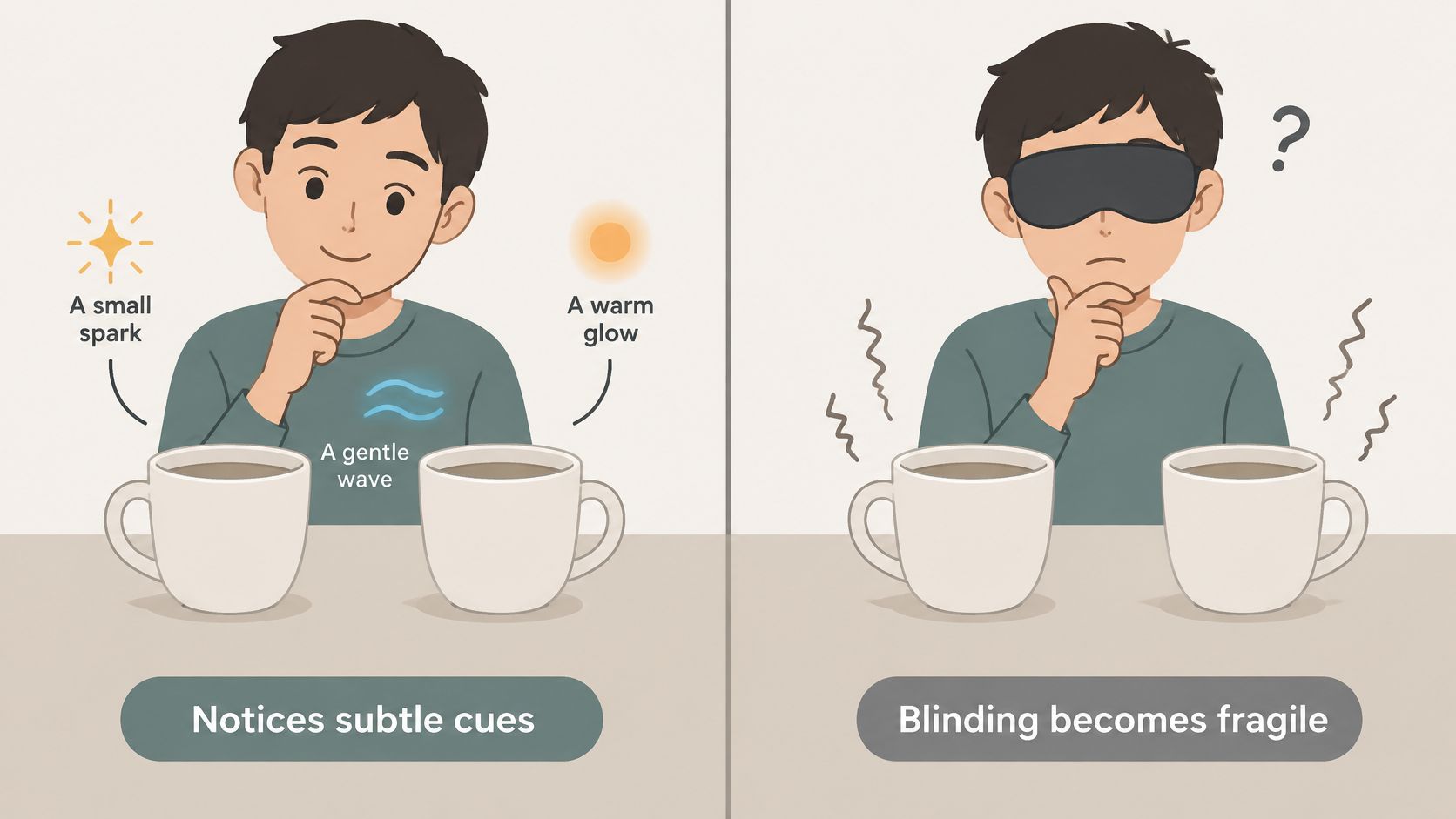
In the double-blind psilocybin microdosing study in Translational Psychiatry, participants identified their condition correctly in 49 of 64 measurement weeks, including 25 of 34 active-dose weeks. Correct identification during placebo weeks carries its own implication: participants can infer an inactive week from the absence of expected sensations, so concealment can fail even when no drug was taken at all.
Two signals can become tangled
- A physical signal: Someone notices a sensation and concludes that the capsule was active.
- An expectancy signal: Someone believes the capsule should work and interprets ordinary changes as confirmation.
A concrete case shows the problem. Someone follows a planned dose on Monday, feels sharper during work, and records a higher mood score. That single entry cannot distinguish a direct drug effect from relief that the dose seemed to work, a productive morning, or better sleep the previous night.
The order of events matters too. A sensation can drive a treatment guess, and that guess can color the mood rating that follows. The arrow also runs the other way: feeling better can make a participant guess they received the drug. A single diary entry leaves both directions plausible.
A correct treatment guess is evidence that concealment may have failed, not proof that expectation caused every reported change.
For personal records, keep planned condition, perceived condition, and observed outcome in separate fields. Written down this way, expectation stops being an invisible force on the results and becomes a column in the data. Save the expectation before the post-dose mood assessment, and preserve the original entry rather than rewriting it after deciding what the experience meant. Weeks later, those untouched guesses can be compared against what was scheduled, which is exactly the comparison a self-report needs.
Separating Expectation From Drug Effects
The strongest comparison isn't active versus inactive. It's a comparison in which the surrounding routine is similar, assignment is concealed, and participants' beliefs are measured rather than assumed away.
The Scientific Reports reanalysis of the microdosing dataset found that nearly all small advantages lost significance after accounting for participants' condition guesses; energy remained significant at approximately p = 0.04, but its effect size fell by about 40% to Hedges' g = 0.34. The authors examined assessment-expectancy bias, meaning distortion associated with participants inferring their treatment while reporting outcomes.
Study designs and what each can separate
| Design | What It Separates | What It Still Misses |
|---|---|---|
| Open-label self-tracking | Change over time after dosing | Expectancy, routine, and natural mood swings |
| Single-blind placebo capsules | Active versus placebo exposure when concealment holds; no-dose days provide a separate comparison | Participants guessing their own condition |
| Self-blinded placebo with confidence log | Outcomes grouped by how sure participants were of their condition | Expectations that develop across weeks and other changing circumstances |
| Double-blind with matched no-dose weeks | Active versus placebo effects when blinding holds, plus comparison with no treatment | Blind-breaking and imperfectly matched everyday conditions |
Confidence changes the interpretation
Consider a hypothetical log spanning six weeks. Days believed with high confidence to involve an active dose receive better ratings, while low-confidence active and placebo observations look similar.
That pattern would suggest that the difference tracks belief, but it wouldn't settle the mechanism. An actual drug effect could also generate both stronger sensations and greater confidence. Confidence is an interpretive variable, not a statistical eraser that automatically removes placebo.
This is the practical distinction between correlation and causation: two observations can move together without identifying which caused which.
A confidence log improves transparency because it makes competing explanations visible. It doesn't turn an informal comparison into a clinical trial, and adding no-dose observations doesn't make those observations blinded. The useful ranking is about which uncertainties each design reduces, not which design guarantees the truth.
Why Personal Reports and Trials Disagree
Enthusiasts and skeptics often share a mistaken assumption: a personal improvement and a trial's treatment effect answer the same question. They don't. A person asks whether life improved during a practice; a controlled trial asks whether the active ingredient added benefit under specified conditions.
A 2025 critical review of 57 human microdosing studies found that observational studies generally reported more benefits, while experimental studies more often produced null or inconsistent results, with expectations, context, and baseline state shaping outcomes. That difference doesn't require anyone to be dishonest or mistaken about feeling better.
Different questions produce different answers
Real-world use can combine the substance with intentional routines, supportive conversations, changed behavior, and participation by people already expecting benefit. A before-and-after journal records that entire package.
A controlled experiment tries to isolate the contribution of active exposure. Short observation periods may also leave delayed or cumulative effects unresolved, but that possibility is a limitation to investigate, not evidence that those effects exist.
The symptom-focused evidence described in that review includes a 96-person, three-week crossover study that found no difference between active psilocybin and placebo for anxiety or depression symptoms. A personal account of relief therefore shouldn't be converted into an antidepressant claim.
Differences between people also deserve careful attention. Reading about individual variation can help frame questions about baseline state and context without assuming that an average result predicts every individual experience.
Keep a clear safety boundary
For someone experiencing anxiety, depression, or PTSD, the consequence of a mistaken causal conclusion can be replacing established care with an unproven practice.
- Use consistent symptom measures: Don't switch scales when the trend disappoints.
- Record competing explanations: Include sleep, stress, therapy sessions, medication changes, and adverse effects.
- Define deterioration beforehand: Decide what worsening would prompt professional review, rather than explaining it away afterward.
MicroTrack is not a medical application and does not provide medical advice, diagnosis, or treatment. Involve a qualified clinician for significant symptoms, and never stop or change prescribed medication because of a journal trend.
The defensible position is neither that microdosing works as an established treatment nor that every effect is only placebo. It's that uncertainty requires careful measurement and appropriate care.
Design a Self-Experiment That Reduces Bias
Start with observation, not a commitment to use a substance. The following is a measurement framework for lawful, clinically appropriate circumstances, not a recommendation to obtain, prepare, or take psychedelics. You can use the same logging principles while recording an existing routine or a no-dose baseline.
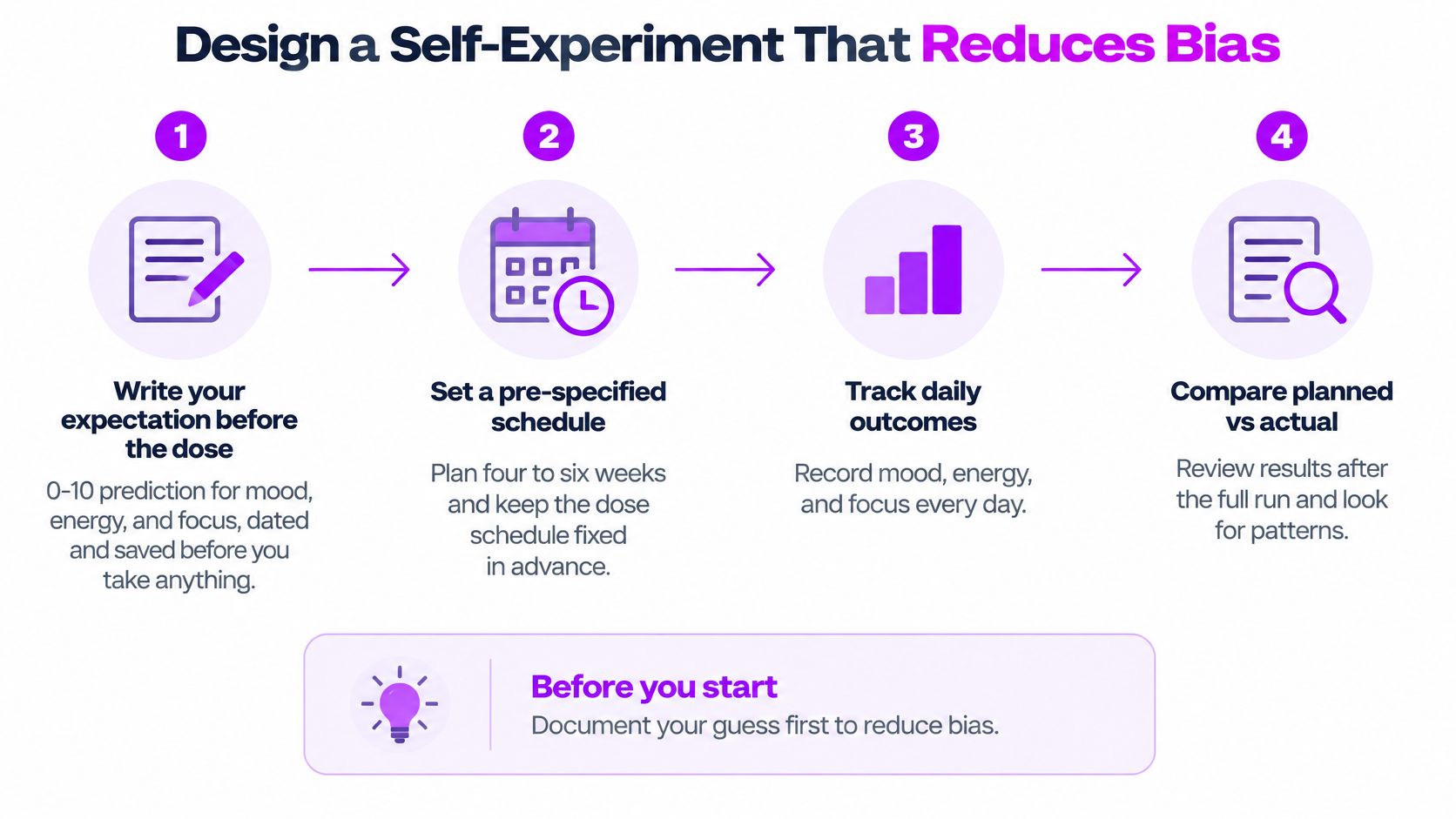
The overview captures the sequence: predict, precommit, record, then compare.
Preserve the record before interpreting it
Write your expectation first. As an example template, enter a 0–10 prediction for mood, energy, and focus, dated and saved before any exposure. Keep predicted scores separate from observed scores so hindsight can't replace the forecast.
Pre-specify the observation schedule. A proposed tracking window might span four to six weeks, including planned no-dose days and weeks; this is a logging example, not a validated dosing recommendation. Don't change the comparison whenever you feel low, because that ties exposure to the outcome you're trying to understand.
Use concealed allocation only within an appropriate lawful arrangement. The 2022 self-blinding study used randomized active or placebo capsules and QR-coded envelopes to conceal allocation. Where professionally supervised and appropriate, someone independent of outcome logging can hold the allocation record; don't treat capsule preparation as a casual home exercise.
Keep assessment timing consistent. Choose a repeatable time and record actual entry time. Comparing a calm evening with a rushed morning creates an avoidable ambiguity.
Record perceived condition and confidence separately. Use fields for active, placebo, no dose, or uncertain, plus confidence. On knowingly no-dose days, say so rather than pretending those observations are blinded.
Keep scale anchors stable. Define what the ends of your chosen scale mean and don't redefine them mid-run. Keep immediate ratings distinct from reflections written the following day.
Log confounders and unwanted effects. Record sleep duration, stress, exercise, therapy sessions, medication changes, and side effects. Missing entries and departures from the plan belong in the record too.
Compare only after the observation period. Examine planned versus actual exposure, active versus placebo observations where available, and matched no-dose observations. Split the results by confidence and look for patterns that persist across weeks.
Interpret patterns conservatively
A guide to tracing a pattern can help organize that review, but choose the comparison before examining which one looks most favorable.
A more credible signal persists across weeks, appears in high-confidence entries without existing only there, and remains interpretable after checking sleep, stress, and other changes. Similar findings in lower-confidence observations strengthen the case against a belief-only explanation.
Interpretation boundary: If an apparent advantage disappears when confidence is considered, treat it as expectation-sensitive evidence, not established efficacy.
Even a persistent difference remains a personal observation requiring cautious interpretation. A tidy graph doesn't resolve incomplete blinding, an unstable baseline, or a changing routine.
Decide Whether to Test Microdosing Without Fooling Yourself
Treat a self-experiment as a structured comparison, not a verdict. If significant symptoms are driving the decision, consult a qualified clinician before considering an experiment; better logging isn't a substitute for appropriate care.
Before collecting observations, apply a simple readiness gate:
- Prediction saved: Have you recorded what you expect before exposure?
- Comparison fixed: Is the schedule established in advance, including no-dose observations?
- Allocation concealed: Where a lawful placebo comparison is appropriate, can someone independent keep the assignment hidden?
If an answer is no, the record may still support reflection, but it can't cleanly separate the substance from belief and context. Improve the design or narrow the question to something the log can answer, such as whether symptoms and functioning changed during the observation period.
Choose a useful next action
MicroTrack is a wellness journaling and habit-tracking web application where entries can include mood, dosage, sensations, and side effects, with a 10-point granular mood scale for consistent ratings. Keeping those observations together can support a more orderly record, but no journal establishes whether a dose works.
The decision doesn't have to be start or stop. It can be to collect a baseline, discuss symptoms with a clinician, or continue observing without changing anything.
Treat expectations as data to record, not as reasons to begin, discontinue, or dismiss microdosing. The worthwhile outcome is a clearer account of what happened and what remains unknown.
MicroTrack offers structured journaling for mood, dosage, sensations, and side effects, helping you keep observations separate from later interpretations. Visit MicroTrack to begin a consistent record, and save your expectations before reviewing your outcomes.