Mindfulness Practice Log: How to Start and Stick with It
You sit down to meditate before the day starts, close your eyes, and return to your breath. Later, you remember only that the session felt “fine.” Was it easier than yesterday? Did the body scan help? Did the late hour make you sleepy, or did the quiet bedroom create the right conditions? Without a record, those details disappear quickly.
A mindfulness practice log gives your practice a calm, practical mirror. It isn't a scorecard, and it doesn't need to become another demanding habit. It helps you record what happened, notice patterns that memory misses, and make small adjustments based on experience rather than on an idealized version of your routine.
Table of Contents
- Why a Mindfulness Practice Log Changes Everything
- Core Fields Your Log Should Capture
- Three Log Formats and When to Use Each
- Ready-to-Use Prompts for Quick and Reflective Entries
- Reading Your Trends Over Weeks and Months
- Troubleshooting the Slips and Drop-Offs
- Backups, Exports, and Keeping Your Log Private
Why a Mindfulness Practice Log Changes Everything
Maya had been meditating most mornings for several weeks. She knew she was practicing, but the sessions had begun to blur together. On a stressful Tuesday, she couldn't remember whether breath counting or open awareness had helped. She also couldn't explain why one short evening session felt more settled than a longer sit earlier that week.
Her practice had become an unreliable narrator. Memory kept the general impression, but it lost the useful details: the time of day, the technique, the noise in the room, the mood she brought to the cushion, and the quality of attention that followed.
A log changes that relationship. It acts like a quiet witness that records the conditions around a session without judging them. You might write, “8:10 a.m., body scan, chair, 10 minutes planned, 7 minutes completed, distracted by email, felt less tense afterward.” That small entry contains more practical information than a polished paragraph about how peaceful the session was.
A practice log records the session you had, not the session you hoped to have.
This distinction matters because beginners often remember their most satisfying sessions and overlook the ordinary ones. They may also assume that a missed day means they lack discipline, when the actual pattern might be more specific. Perhaps evening sessions are consistently skipped, while a brief sit after making coffee happens easily. Perhaps loving-kindness practice feels useful on emotionally difficult days, while breath counting works better when the mind is restless.
Research on mindfulness adherence supports the value of capturing behavior accurately. A systematic review found that participants completed a pooled average of 64% of assigned home practice, with practice commonly recorded in paper diaries during weekly classes. The review also noted that adherence was often measured through completed practice or whether at least one session was logged during a week, rather than through a perfect daily record. Read the review of home practice in MBSR and MBCT
A log therefore gives you three useful things: honest adherence, a clearer view of what supports your attention, and a way to turn reflection into a practical next step. The benefits of mindfulness practice may matter to you, but the log helps you understand how your own practice unfolds. Explore the benefits of mindfulness practice
Core Fields Your Log Should Capture
A useful log records behavior, context, and experience. You don't need to document every thought that appeared during meditation. You need enough structure to answer the questions you'll naturally have later.
Start with when and what
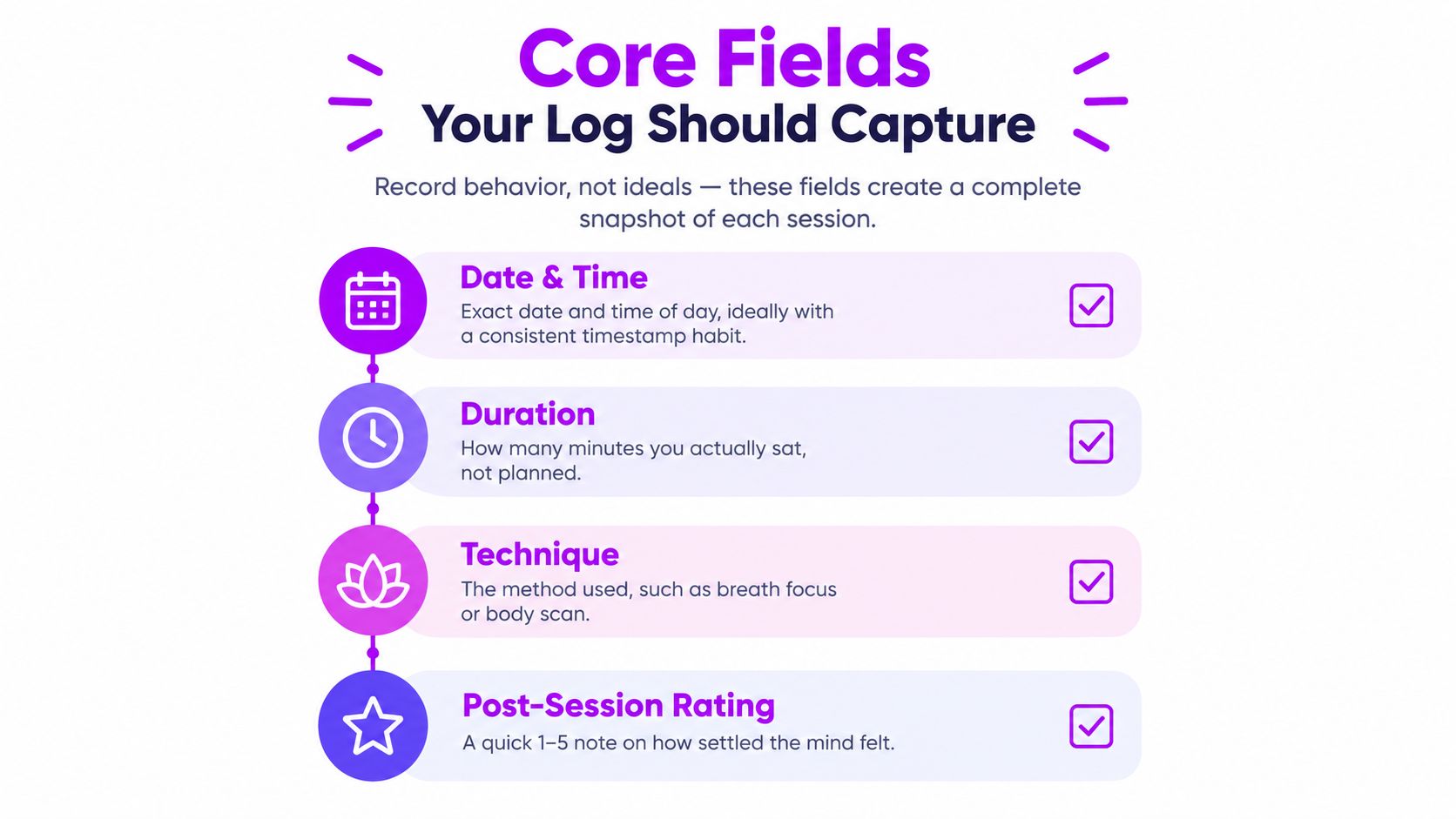
Record the date and exact time. A weekday label can help too, because “Tuesday morning” may reveal a different pattern from “Saturday afternoon.” Use a consistent timestamp habit, but don't abandon the entry if you only remember the approximate time.
Next, record the technique. Choose a plain label such as breath counting, open awareness, body scan, loving-kindness, or noting sounds. Then separate planned duration from actual duration:
- Planned: 10 minutes
- Actual: 7 minutes
- Reason for stopping: attention became restless
That distinction keeps a shortened session from looking like a failure. It tells you what your schedule expected and what your day realistically allowed.
Add the surrounding conditions
The environment can shape how practice feels. Note whether you sat in a bedroom, at a desk, in a park, or near a noisy kitchen. Include posture, such as cushion, chair, or lying down. These details may explain why the same technique feels different from one session to another.
Use separate ratings for focus depth and distraction level, both on a 1 to 5 scale. A session can contain frequent distractions while still showing steady returns to the breath. That is different from a calm session in which attention stayed shallow.
Mood can remain simple. Use a 1 to 10 scale, or choose three anchor words such as tense, neutral, and open. Record mood before and after practice if you want to see whether a technique changes your immediate state.
Leave room for one honest observation
End with a one-line note and a next-session intention:
- What stood out: “Mind kept jumping to email.”
- Next intention: “Begin with three slower breaths before counting.”
These fields help you explore practical questions, including which time of day suits you, which techniques fit particular moods, and where your routine tends to slip. A small set of well-being indicators can make those patterns easier to recognize without turning the log into a clinical assessment. See examples of well-being indicators
Three Log Formats and When to Use Each
The best format is the one you'll open when you're tired, busy, or mildly resistant. A beautifully designed system that you avoid won't teach you much. A plain record that you use consistently can reveal plenty.
| Format | Setup Effort | Per-Session Friction | Analysis Power | Best For |
|---|---|---|---|---|
| Paper notebook | Very low | Low if kept beside the practice space | Low to moderate, trends require manual review | Screen-free practitioners and tactile thinkers |
| Structured app | Low to moderate | Low once configured, but requires phone access | Moderate, often with reminders or summaries | People who want prompts, timestamps, or quick totals |
| Spreadsheet | Moderate | Moderate, especially at first | High, with filters and custom calculations | Data-focused users who want control and export options |
Paper keeps the practice contained
A small notebook reserved only for mindfulness can create a screen-free transition into practice. Write the date, time, technique, actual duration, and one observation. Paper won't create automatic charts or timestamps, so use a highlighter or a weekly review to find recurring conditions.
This format suits someone who already feels that the phone interrupts attention. It also makes missed days visible without turning them into notifications.
Apps reduce remembering
A structured app such as Insight Timer, Medito, Loop, or Streaks may suit someone who forgets to record entries or enjoys reminders. An app can make it easy to glance at practice history, but the phone itself may become part of the distraction. Disable nonessential notifications and decide whether you'll record before opening other apps.
Choose a generic habit tracker if you want a simple completion record. Choose a meditation-focused app if technique, guided sessions, or session duration matter more than streaks.
Spreadsheets support real comparison
Google Sheets, Notion, and Apple Numbers work well when you want one row per session and full control over the fields. You can filter by technique, mood, environment, or time of day. You can also export the record later, although setup takes longer and the system can become too fiddly.
Use this quick self-test:
- If you forget to open apps, use paper.
- If you forget where notebooks are, use an app.
- If you want to analyze trends seriously, use a spreadsheet.
Ready-to-Use Prompts for Quick and Reflective Entries
Open-ended journaling often rewards the most memorable sessions. A structured prompt captures the ordinary ones too, including the sit that felt distracted, rushed, or emotionally flat. That makes the record more useful.
Use a quick entry immediately after practice. Keep it short enough that you can complete it before reaching for your phone or moving on to the next task.
| Trigger | Quick Prompts (Post-Session) | Reflective Prompts (Weekly) |
|---|---|---|
| Before practice | Before sitting, I felt: ______ | What mood or situation appeared most often before practice? |
| Attention | My main focus was: ______ | Which technique supported attention most reliably? |
| Body | The body anchor that helped was: ______ | What physical conditions affected the session? |
| Distractions | The main distraction was: ______ | What repeatedly shortened, delayed, or interrupted practice? |
| After practice | My shift from before to after was: ___ / 5 | Which session felt different, and what surrounded it? |
| Next step | Next time, I will: ______ | What one small adjustment will I test next week? |
The quick set
Try these fillable lines:
- Before: “I arrived feeling ______.”
- Focus: “I returned to ______.”
- Body: “I noticed ______ in the body.”
- Distraction: “The strongest pull was ______.”
- Shift: “After practice, I feel ______, rated ___ / 5.”
- Next sit: “I'll keep, change, or test ______.”
The point isn't to produce a thoughtful essay. It's to preserve the details that disappear within minutes. If you can't answer every line, complete only the first, fourth, and fifth prompts.
The weekly set
Once a week, look across the entries and write brief answers:
- “The clearest pattern was ______.”
- “My easiest sessions happened when ______.”
- “The session that felt different was ______ because ______.”
- “I shortened or skipped practice when ______.”
- “One change I'll test next week is ______.”
Rotate the prompts so your answers don't become automatic. You might focus on technique one week and environment the next. Examples of useful journaling prompts can help when your own questions begin to feel repetitive. Browse practical journal prompt examples
Daily diary research offers a useful reason to connect mindfulness with changing circumstances. In a study of 157 undergraduates, participants completed daily questionnaires for one week, and the researchers examined how stress appraisals and mindful coping related to mood. Review the daily diary study of mindfulness, stress, coping, and mood A short prompt after each session gives you the kind of timely context that a later summary may lose.
Reading Your Trends Over Weeks and Months
A log becomes valuable when you read it back with a specific question. Don't begin by searching for proof that you're improving. Begin by asking what conditions appear alongside sessions that feel more workable.
Start with a weekly snapshot
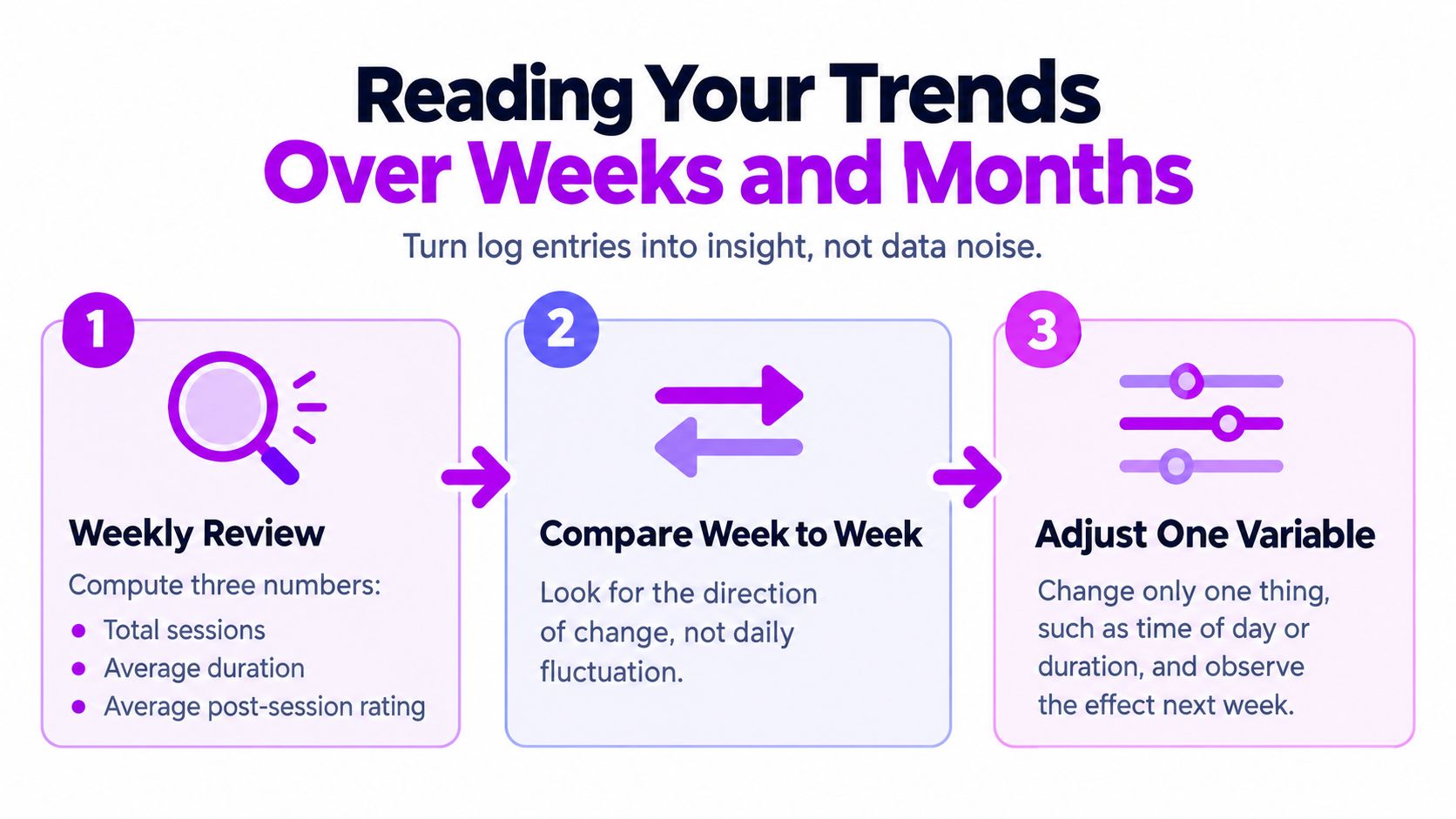
On a fixed review day, record three measures:
- Total sessions
- Average actual duration
- Average post-session mood shift
The third measure can be a simple difference between your before and after mood ratings. If you use words instead of numbers, describe the overall direction qualitatively, such as “more open after most sessions.”
Look for direction across weeks, not dramatic meaning in a single entry. A week with fewer sessions may still show useful information if the entries explain why. A week with many sessions may show that duration became too ambitious or that the practice felt rushed.
Compare conditions, not just totals
During a monthly review, cross-reference technique, environment, and time of day with the same three measures. You might discover that outdoor morning sessions tend to leave you more settled, while late bedroom sessions are easier to schedule but less focused.
Consider this illustrative example, not a benchmark to copy. A practitioner logs 18 sessions in a month and notices that early-morning outdoor sits produce a +2.1 average mood shift, while evening bedroom sits produce +0.4. Friday sessions are consistently skipped. The useful conclusion isn't that outdoor practice is universally superior. It's that this person's schedule and setting may support a small experiment.
For the following month, the practitioner could move one Friday session to a more available time while keeping the technique unchanged. Changing one variable makes the result easier to interpret. If time, technique, environment, and duration all change together, the next month's entries won't show what made the difference.
Keep the review gentle
The purpose is pattern recognition, not self-optimization. A distracted session isn't wasted data, and a larger mood shift doesn't prove that a technique will always work. Treat each pattern as a question:
- “Does this setting help me begin?”
- “Do shorter sessions fit this weekday better?”
- “Does this technique support this kind of mood?”
- “What happens when I practice after poor sleep?”
Tracking followed by reflection can strengthen self-awareness more than tracking alone. Research on tracking and reflection found that students using a web app reported stronger self-awareness from tracking, while a field experiment compared different reflection approaches over a longer period. Read the research on tracking and self-reflection
Troubleshooting the Slips and Drop-Offs
People often stop logging because they designed a system for their most motivated self. That version of you may enjoy detailed reflections, perfect fields, and daily reviews. Your real routine needs a system that still works on a crowded morning.
Match the fix to the failure
- Logging feels like a chore: Use a three-field minimum on busy days: date, actual duration, and one word for your state. If even that feels heavy, record one tap or a single word and keep the entry under 30 seconds.
- Entries feel repetitive: Rotate prompts and add only one new field per month. You might add environment first, then technique, rather than rebuilding the entire log.
- Several days go unrecorded: Forgive the gap. Replace a streak-reset rule with a total-sessions-per-month view, so one interruption doesn't erase the history that came before it.
- Privacy creates avoidance: Use a local-only notebook, a locked file, or a journaling app with a passcode. You won't write freely if you suspect someone else can casually read the entry.
Separate observation from evaluation
“Mind wandered to email seven times” is an observation. “I was terrible at meditation” is an evaluation. Keep those fields apart. The first helps you choose a response. The second turns a moment into an identity judgment.
A systematic review noted that retrospective self-report can introduce response bias and recommended standardized daily diaries or logs. Read the guidance on mindfulness adherence and self-report limitations Recording soon after practice, even with a minimal entry, helps preserve what happened instead of what you later wish had happened.
A quiet log is still data. A week filled with honest notes such as “couldn't focus” may reveal more than a month of polished entries that say “good session.” Your log should adapt to the practitioner you are, not demand that you become a different person before it works.
Backups, Exports, and Keeping Your Log Private
A mindfulness practice log can contain mood, stress, difficult thoughts, and personal reflections. Treat it with the same care you'd give a private diary, especially if the entries include sensitive health information.
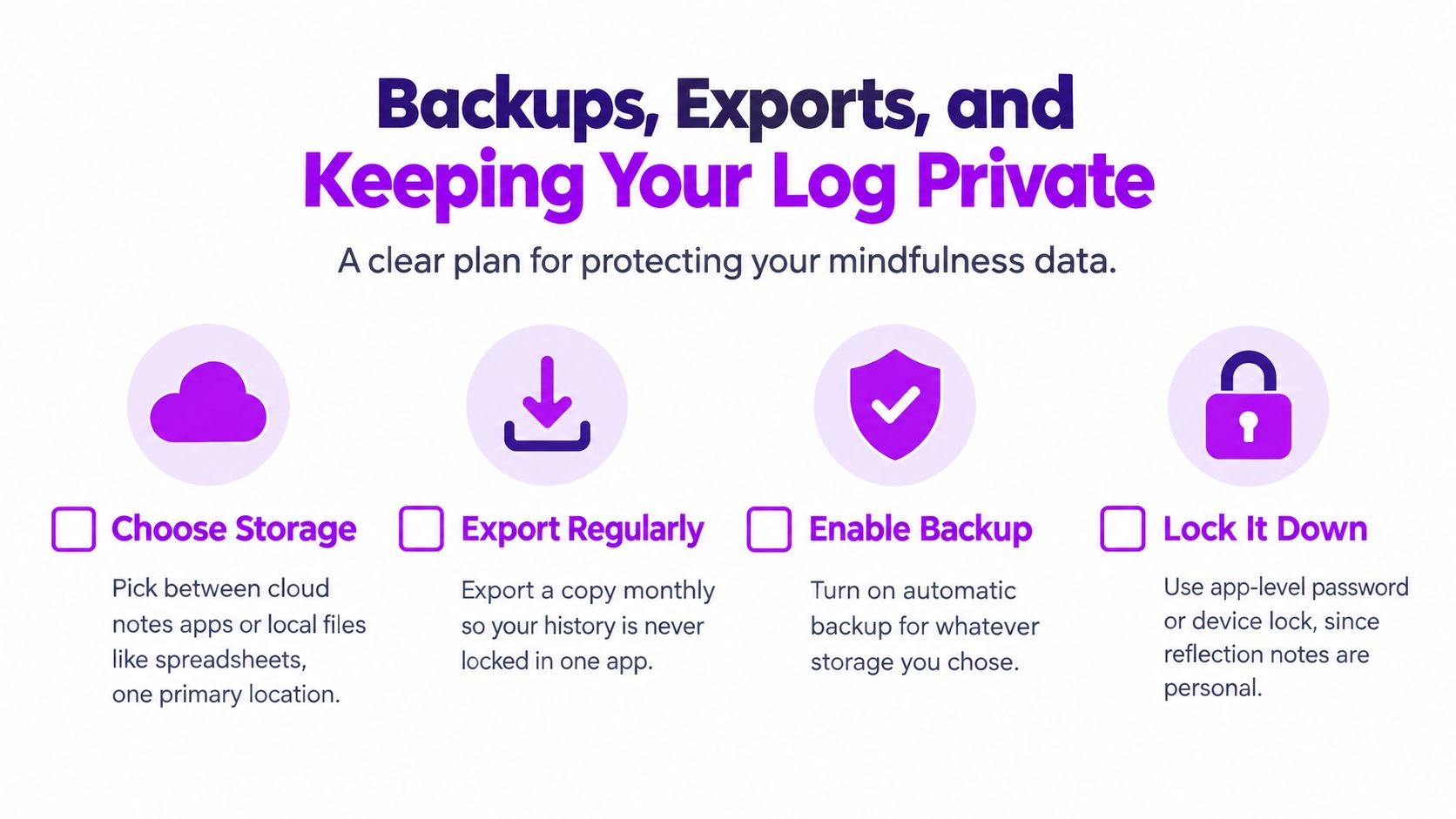
Your storage choice involves a trade-off:
- Cloud notes apps: Convenient across devices, but review sharing, synchronization, analytics, and account settings carefully.
- Local spreadsheets or documents: More direct control and easy offline access, but backups become your responsibility.
- Dedicated journaling apps: Often provide prompts, locks, and structured fields, but you depend on the app's export and privacy policies.
Create a simple export rhythm. On the first day of each month, export a CSV or PDF, store one copy in a cloud folder and another on a local drive, then open both files to confirm they work. An export is useful only if you can read it later.
Privacy requires more than a password. Check whether cloud sync is necessary, switch off optional analytics where possible, and review any AI training toggle before entering sensitive reflections. Add a passcode or biometric lock to the app and device. If you need the strongest separation from shared platforms, use an encrypted local file and keep the backup protected too.
Apple explains that its Health app allows users to export health data, while third-party apps must request permission to read or write Health data and explain why they need access. Review Apple's Health app privacy and data access information EU guidance also says consent for processing health data must be free, specific, informed, and explicit, and that users should be told clearly whether data is stored anywhere beyond the device. Read EU guidance on health data privacy
Take these steps now:
- Choose paper, a local file, or an app.
- Create the minimum fields for one session.
- Add a device or app lock.
- Review cloud sync and analytics settings.
- Record today's actual session, even if it was brief.
- Schedule a weekly review.
- Set a monthly export reminder.
Use MicroTrack as one structured option for recording a session first and adding reflections later, with mood entries, flexible context, trend views, and CSV export. Start with the smallest useful log today, review what your entries reveal each week, and let the record guide one gentle adjustment at a time.