How to Use a Mood Tracker and Read Your Patterns
You had a better afternoon than the last three, and you're already trying to name the cause. Was it the walk, the extra hour of sleep, or the change you planned yesterday? A mood tracker won't settle that question from one good day. It will keep the question honest, because each entry is dated, written the same way, and still there when the feeling has faded.
Table of Contents
- What a Mood Tracker Actually Measures
- Daily Log Fields and Entry Template
- How to Log Your Mood Every Day
- Reading Patterns Without Overclaiming
- A Four-Week Comparison Worked Example
- Limits, Misconceptions and When to Seek Care
- Privacy Checklist for Mood Data
- Start a Two-Week Tracking Trial
What a Mood Tracker Actually Measures
A thermometer on the kitchen wall tells you almost nothing if you glance at it once. 18°C on a Tuesday afternoon could be a mild day, a broken heater, or a window left open. The same thermometer, written down every evening for a month, shows when the cold snaps and when the heating fails. A mood tracker works the same way. One rating is a snapshot. A run of ratings is the season.
Think of Tuesday at 9 p.m. You tap a 6. That number is only how you felt at that moment, on a scale you chose and kept. It is not a diagnosis, and it is not a verdict on the week. The useful record is the line of dates around it: Monday's 4 after a short night, Wednesday's 7 after a calm morning, and the blank you almost left on Thursday because you were traveling.
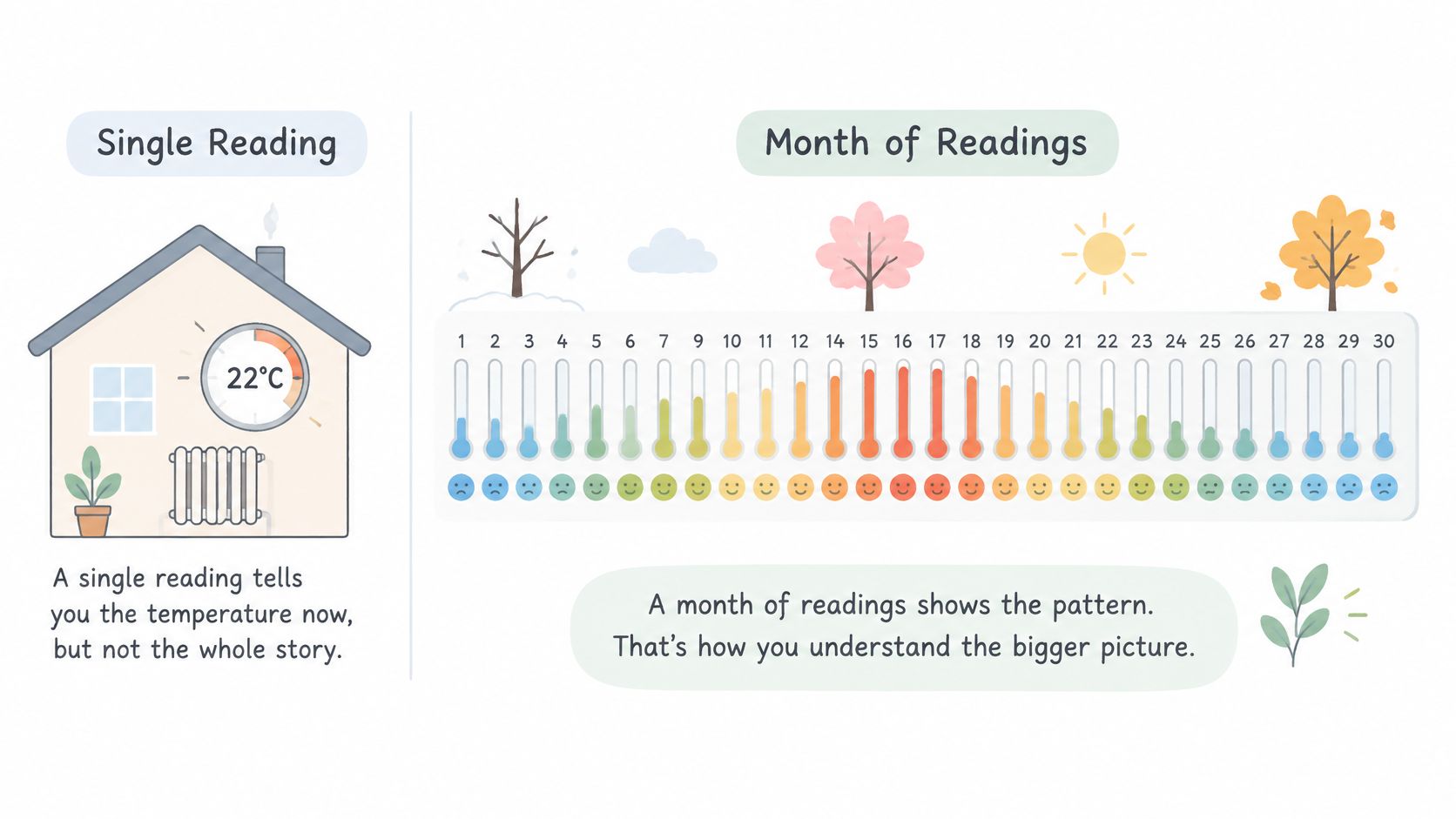
The method behind a good log is ecological momentary assessment. You record the experience close to the moment, instead of reconstructing last week from memory. Many trackers ask for a quick entry a few times a day, or once each evening, because a feeling recalled later gets rewritten by how the day ended.
A useful entry has three parts, and you can finish them in well under a minute:
- Rating: One number on a fixed scale, so a 6 in March means the same thing as a 6 in June.
- Timestamp: The clock time, so morning and evening don't get mixed into one blob.
- Context: One or two notes, such as sleep, a stressor, or a planned change, so the number has a setting.
Practical rule: If you change the anchors halfway through, the old scores and the new scores stop being the same measurement.
The tracker cannot tell you that you have a disorder, and it cannot prove that a dose, a workout, or a new bedtime caused the shift. A single score is one data point. The value shows up when you have a comparable record across at least two to four weeks.
Daily Log Fields and Entry Template
Copy this into a spreadsheet or a paper journal today. Each row is one field, what belongs in it, and a sample line. The set is small on purpose. Fields that take longer than a minute tend to get skipped on the days you most need them.
| Field | What to write | Example |
|---|---|---|
| Mood score | Rating from 0 to 10 on the same scale every day | 6 |
| Time of entry | Clock time and whether it is morning, midday or evening | 21:10, evening |
| Sleep | Hours slept and a quality rating from 1 to 5 | 6.5 hours, quality 3 |
| Stress | Main stressor and a rating from 0 to 10 | 4, deadline at work |
| Planned change or event | Name of any planned change (dose, routine or event) with the time | Morning walk, 7:30 |
| Side effects | Any physical or mental change, with its time | Mild headache at 14:00 |
| Context notes | One or two sentences on what happened | Good walk, skipped lunch |
| Missed entry | Mark the day as missed rather than leaving it blank | Missed, travel day |
Keep the 0 to 10 mood scale fixed. 0 is the lowest you have felt, 5 is an ordinary day, and 10 is the highest. Stress uses the same 0 to 10 logic, with 0 as no strain and 10 as the most strained you get. If you want a fuller walk-through of how to anchor those numbers, the guide on a daily mood rating scale covers the anchors without adding extra fields.
Why a blank is not a quiet day
The rule that matters most is the last row. A blank day is not a neutral day. If you were traveling, overwhelmed, or forgot, write Missed and a short reason. An empty cell looks, later, like an ordinary 5 that nobody bothered to type. That fiction will tilt every average you compute.
Sleep gets both hours and a 1 to 5 quality mark because six hours of solid sleep and six hours of broken sleep are different days. The planned-change row is generic on purpose. It can hold a dose and its clock time, a new bedtime, or "none." Side effects get a time too, even when the note is "none noticed." This table is the schema for every comparison that follows. Add a column later only if you will still finish the row on a bad day.
How to Log Your Mood Every Day
Two alarms beat a good intention. The flow below is the whole habit: two fixed times, a reminder for each, a 0 to 10 rating, and the rating made before you look at yesterday.
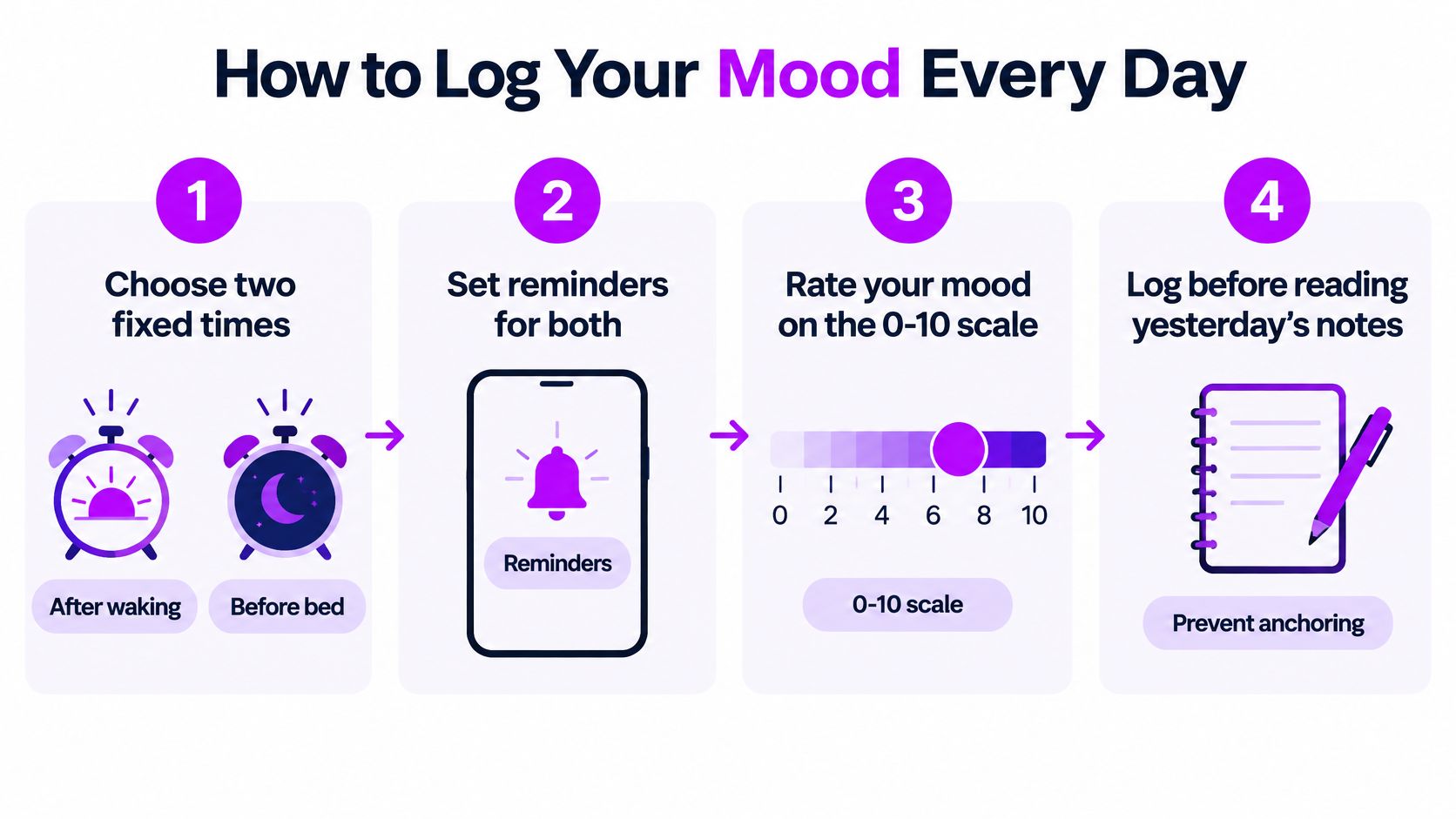
- Choose two fixed times, such as after waking and before bed, and set reminders for both. Mood moves across the day, so a random tap at lunch one day and at midnight the next isn't a fair comparison.
- Rate on the 0 to 10 scale before you read yesterday's notes. Yesterday's 8 will tug today's number upward if you see it first. Rate, then look.
- Log sleep and stress in under a minute. Hours, a 1 to 5 quality mark, the main stressor, and a 0 to 10 stress rating are enough. A longer essay is how busy evenings lose the entry.
- Record any planned dose or event with its clock time, or write none. "None" is data. A missing line later looks like you forgot, not like you skipped the change.
- Write one context sentence. "Deadline moved, skipped lunch" is more useful than a paragraph you'll resent typing tomorrow.
- If you miss an entry, mark it missed instead of backfilling from memory. Recalled ratings drift toward the mood you expected the day to have. A marked miss keeps the hole visible.
- Review the log once a week, not every evening. A daily reread turns one low number into a story. A weekly look lets the week speak.
The slips that quietly bend the score
Rating right after a strong coffee or a good meal captures the drink or the food, not the day. If your evening reminder lands in that window, move it by twenty minutes. Another common mistake is skipping the night entry on busy days, which are often the days with genuine stress. A marked miss is better than a score you invent on Sunday.
Daily logging is realistic when the entry stays short. In a 2024 six-month study of smartphone-based mood monitoring, participants completed daily ecological momentary mood assessments on 93.5% of study days, equal to 4,803 of 5,137 days, a figure published by JMIR researchers.
A short walk-through of a simple evening check-in can help the first week feel less improvised.
For the next four weeks, count your own completion rate: entries made, divided by entries you planned. A high completion rate is what makes the later averages worth trusting. If you're missing more evenings than you're keeping, shorten the note, don't add a new field.
Reading Patterns Without Overclaiming
Compare your scores with your own baseline, not with anyone else's chart. A personal rolling average tells you whether this week sits above or below your usual line. Someone else's 7 has a different floor, a different ceiling, and a different Tuesday.
Single-day swings mislead because mood moves inside a day for ordinary reasons: time of day, a meeting, hunger, a nap. A weekly average smooths that noise. It will not erase it. Within-person change is measurable and still noisy, and missed prompts are common. In a study of 171 university participants, a five-item smartphone mood measure given four times daily for two weeks found moderate reliability for detecting change within the same person over time (Rc at least 0.64 for positive and negative items, with conservative estimates around 0.56), and 23.3% of scheduled responses were missing, according to a University of Bristol publication on EMA mood reliability. Treat a gap as a gap. Don't paint it as a neutral day.
Patterns to test, not verdicts to keep
Each row below is a hypothesis. The middle column is the explanation to test first. The last column is the check, not the conclusion.
| Pattern in your log | Likely explanation | How to check it |
|---|---|---|
| Low scores after several nights of short sleep | Sleep debt | Compare scores on nights with 7 or more hours against nights under 6 |
| Mood rises a few days after a change | Regression to the mean or normal variation | Look at three to four weeks before deciding it mattered |
| Improvement only on days you expected it | Expectation effect | Check whether you rated the day before or after forming the expectation |
| Lower scores in high-stress weeks | Stress load | Compare weekly averages in stressful and calm weeks |
| Scores dip around the same days each month | Cycle or seasonal pattern | Review at least two months with cycle or season noted |
| Gaps during bad weeks | Missing-data bias | Count missed days and do not treat blanks as neutral |
| Large swings within one day | Normal daily variation | Use weekly averages instead of single entries |
| Persistent or worsening low scores | Possible clinical concern | Seek qualified support rather than adjusting the log alone |
A rise that shows up only on days you expected to feel better is the easiest pattern to misread. If you formed the expectation, then opened the tracker, the rating may be agreeing with the story. Rate first. The difference between a lead and a cause is the whole point of separating correlation and causation before you change a routine again.
A pattern is a hypothesis you can test next month. It is not a verdict on what worked.
If low scores persist or worsen, stop tuning the spreadsheet and talk with a qualified clinician. More weeks of self-analysis are not the check for that row.
A Four-Week Comparison Worked Example
The numbers in this walk-through are invented. They show the arithmetic, not a finding about any substance, workout, or schedule.
Say you logged four weeks. Week one is the baseline, before you treat any later change as special. You average those evening scores and get a personal floor for the comparison, and you notice the week already moves by more than half a point from one day to the next. That swing is the noise you have to beat.
Next you tag every later day as planned-change or no change. In this illustration the planned change is a dose on some mornings. The same tags work for a new run or a fixed bedtime. You then pair each dose day with a non-dose day that shares the weekday pattern and a similar sleep range. A Monday with 7 hours of sleep gets matched to another Monday near that sleep, not to a Sunday after a late night.
What the averages actually say
In the example, the matched dose days average 6.4 and the matched non-dose days average 5.9. The gap is 0.5 on a 10-point scale. You also count the days in each group and write both averages into the log, so the reasoning is still visible in a month.
Then the caveats change the reading. Four missed entries cluster in a high-stress week, so the weeks you kept are not a random sample of your month. And 0.5 is smaller than the day-to-day swing already sitting in the baseline. A gap that small, on an incomplete month, is not evidence that the change helped.
The honest reading is a small, uncertain difference. It supports one question: whether another four weeks, with the same pairing rules and fewer missed days, still shows a gap. It does not answer that question. Write the comparison in the log itself, with the number of days in each group, the sleep range you allowed, and the missed-day count. Whatever you are testing, those three notes are what keep a later you from remembering a cleaner result than you had.
Limits, Misconceptions and When to Seek Care
Three ideas cause most of the trouble, and each one sounds reasonable until you put it next to what a log can show.
"The score went up after the dose, so the dose did it." A line that rises afterward is a sequence, not a cause. Sleep, stress, expectation, and ordinary bounce-back can all lift the same week. A recent systematic review and meta-analysis of randomized controlled trials found no clear evidence that psychedelic microdosing immediately reduces depressive symptoms, anxiety, or stress. Depressive symptoms showed a standardized mean difference of -0.19 (95% confidence interval -0.56 to 0.19). Anxiety showed -0.20 (95% confidence interval -1.11 to 0.71, I² = 82.3%). Stress showed 0.02 (95% confidence interval -0.39 to 0.43). Because those intervals cross zero, the result does not establish a reliable benefit, as reported in this systematic review and meta-analysis.
"One low day means a disorder." A mood score is a momentary rating. It is not a depression inventory, an anxiety screen, or a PTSD measure. One 3 on a hard Tuesday is a data point. It becomes a concern when low scores persist or worsen, not when a single evening dips.
"If I track, I'm treating the depression or the anxiety." Tracking is observation. It can make a conversation with a clinician more concrete. It does not treat anything by itself.
Where the tool stops
MicroTrack is a journaling and tracking tool. It is not a medical application, and it does not provide medical advice, diagnosis, or treatment. Scores, charts, and notes stay descriptive. They don't become a care plan because they look precise.
Get qualified clinical support, rather than another round of self-analysis, when any of these show up:
- Deterioration that persists across weeks, not one rough day.
- Thoughts of self-harm, or any sense that you might act on them.
- Manic-like symptoms, such as a sharply reduced need for sleep with unusually sped-up behavior.
- Medication worries, including interactions or side effects you don't want to guess through.
If there is any immediate risk to your safety, contact emergency services or a crisis line in your region. Don't wait for the weekly review to decide that.
Privacy Checklist for Mood Data
Mood notes, trauma details, medication names, and substance-use entries are sensitive in a way a step count is not. Many mental-health apps are less private than their marketing suggests, and a tracker that feels useful can still expose you if entries are shared, retained, or visible on an open screen. Check the answers before you type the first honest line. A practical overview of data security and privacy helps you read those promises without treating a padlock icon as the whole policy.
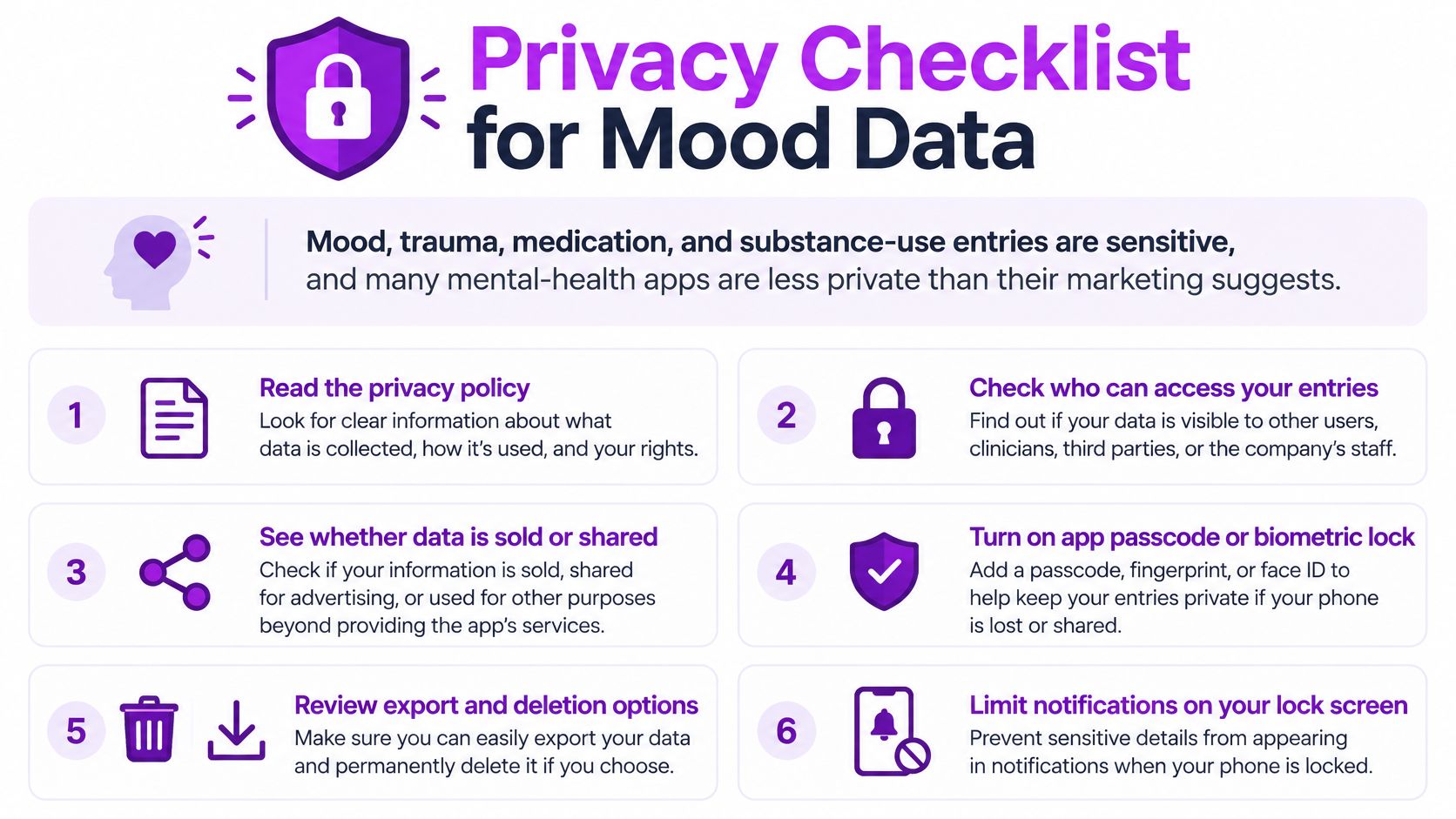
- Confirm the provider does not sell or share entries. We never sell or share users' journals, and we don't train AI models on them.
- Confirm whether entries are used to train AI models. If a policy is vague on training, assume the answer is not settled and don't log what you would hate to see reused.
- Confirm you keep ownership of your material. You retain ownership of your entries, notes, mood ratings, and uploaded images.
- Check what encryption covers. Protection in transit and at rest helps against interception and against a stolen server copy. It does not stop someone who has your phone open, and it does not cover a backup you stored in an open folder.
- Check the export format. A CSV export means you can leave with the history instead of starting from zero in the next tool.
- Test deletion. One-click removal should be real. Some records may still be kept where the law requires it, so the policy should name those narrow cases instead of promising that every copy vanishes in every situation.
- Review permissions for location, contacts, photos, and the microphone. Deny any permission the tracker doesn't need to store a rating and a note.
Write the answers down next to the app name. A tracker is a practical choice only when those answers are clear, not when the homepage sounds careful.
Start a Two-Week Tracking Trial
Two weeks is long enough for a first pattern and short enough that you can finish. Don't add a scoring game. Streaks push people to rate the day more kindly than they feel, and a flattering number wrecks the comparison.
- Choose the 0 to 10 scale and keep it for all fourteen days. Changing anchors on day six splits the trial into two incompatible logs.
- Set two reminders, one after waking and one before bed. If you move a reminder, move it for the rest of the trial, not for one busy night.
- Use the field set from the template and don't add fields midway. A new column on day eight leaves the first week unable to match it.
- Keep the trial calm. No points, no streak counter, no reward for a high score. The reward is a record you can read.
- On day fourteen, run the comparison on the first week's data the way the worked example does: baseline, tags, matched days, both averages, and the day counts.
- Count the missed entries and write the number down. That count belongs beside the averages, or the averages will look cleaner than the fortnight was.
- Write one question the log can address next. One question. "Did short sleep line up with lower evenings?" is a question. "Did this fix me?" is not.
Any tracker that keeps these fields can run the trial. MicroTrack is one option, with a 10-point mood scale and room for dosage, sensations, side effects, and notes in the same entry.
On day fourteen you have three decisions. Keep logging for another month if the entries were completable and the question is still open. Adjust the fields or the timing if you kept skipping the same slot. Bring the record to a qualified clinician if the trend is concerning. The record is what makes each of those conversations specific.
MicroTrack is a journaling space for timestamped mood scores, dose notes, and side effects, with trends across weeks and months drawn only from what you log. It stays a self-observation record, not a diagnosis and not proof that a routine worked. If you want that kind of log, start at MicroTrack.