Pattern Recognition Journal: A Template and Tracking Guide

You had a good morning on Tuesday and a flat one on Thursday, and now you're trying to remember which was the dose day. Maybe sleep was better. Maybe you expected Tuesday to feel different, so it did. Without a record made at the time, memory rewrites the week to fit the story you already believe.
A pattern recognition journal fixes that problem by ruling things out first. You log expectancy, sleep and stress alongside mood, so you can test those explanations before you credit a protocol. The goal isn't to prove that something worked. It's to see what still stands after the obvious confounders are accounted for.
Table of Contents
- What a Pattern Recognition Journal Records
- Schedules to Log and Impairment to Watch
- The Fields Every Entry Needs
- Daily Prompts That Turn Notes Into Patterns
- A Two-Week Worked Example
- Separating Real Patterns From Noise
- Choose a Tracker and Start Your First Log
What a Pattern Recognition Journal Records
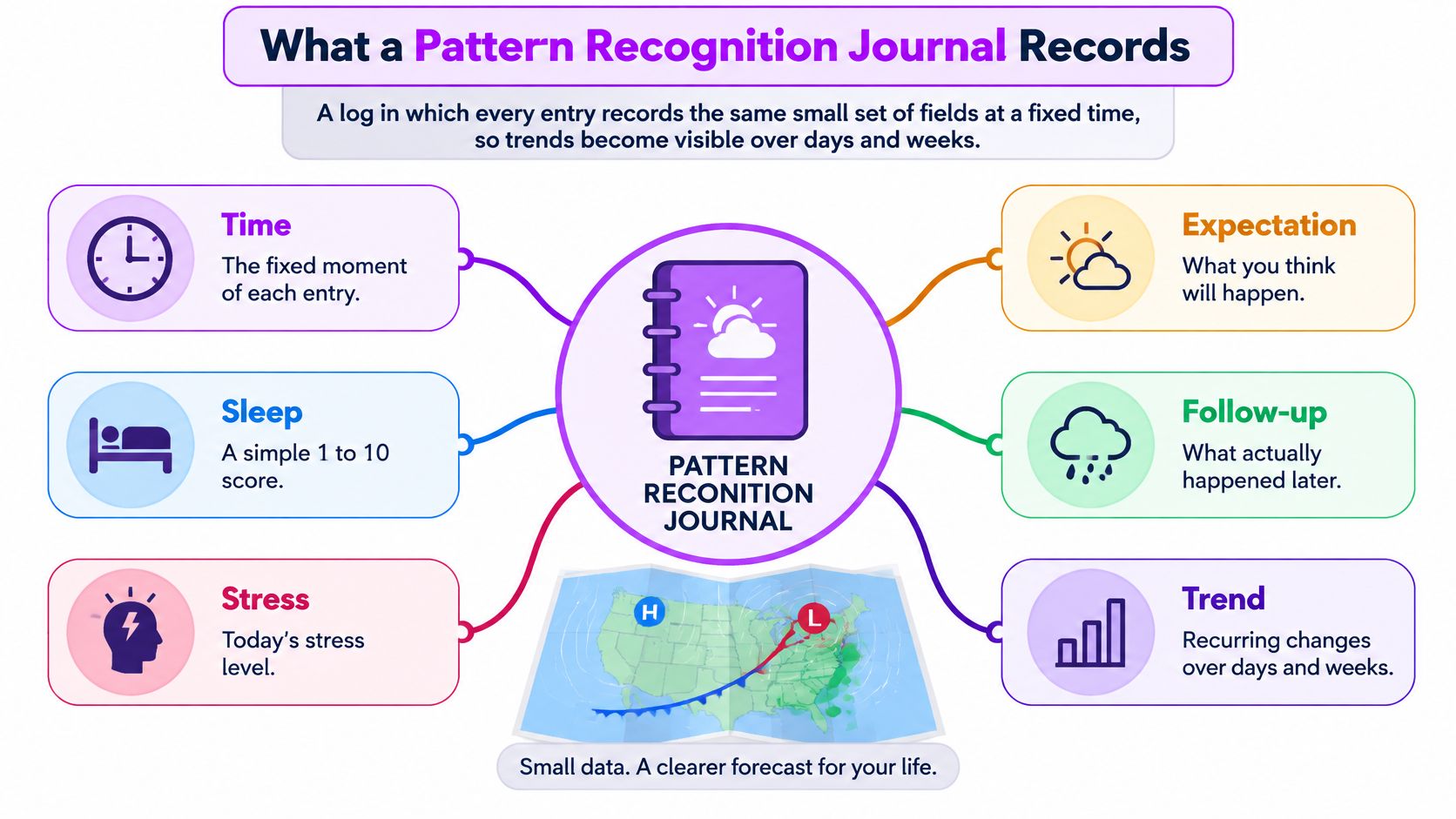
A log in which every entry records the same small set of fields at a fixed time, so trends become visible over days and weeks.
Think of a weather station log rather than a letter. A letter describes one day in rich prose, but you can't compare it cleanly with another letter. A station log records temperature, pressure and rainfall the same way every day, so one odd reading means little while a month of readings shows the climate.
The Three Parts That Make It Work
- Consistent fields: You record mood, sleep, stress and a few other items in the same format every entry.
- Fixed timing: You score at the same clock time, because a 9 a.m. mood and a 9 p.m. mood aren't comparable.
- Scheduled review: You read trends weekly or fortnightly instead of reacting to single days.
That structure suits microdosing schedules, mood, sleep and daily habits because each has a rhythm. A schedule repeats every few days, sleep varies by night, and stress clusters around work. None of that shows up in a single entry. It shows up across repeated entries laid side by side.
Be clear about the limit. This kind of journal can't prove cause, and it's not a diagnostic tool. It shows correlations inside one person's life, which you then have to question.
Ask yourself one test question. Do you want to know what changed, or only what happened? If it's the first, you need comparable data points, not a diary. MicroTrack is a tracking and journaling tool only and does not manufacture, sell, or distribute any controlled substances.
Schedules to Log and Impairment to Watch
Treat every schedule as a template for structuring the log, not as a validated prescription. The schedule's job is to create fair comparisons between dose days and rest days.
| Schedule | Pattern | Comparison unit |
|---|---|---|
| Fadiman | One day on, two days off | Three days |
| Stamets | Four days on, three days off | Seven days |
| Custom | A rule you write before day one | The cycle you defined |
With Fadiman's cycle, each dose day sits beside two rest days, so you compare a small, tight unit. With the Stamets pattern, compare dose-block days one to four with rest days five to seven, then trend week to week. A custom schedule only works if you write the rule down before you start, otherwise good or bad results will tempt you to move the goalposts.
What Sub-Perceptual Really Means
Beginners often get stuck on whether a dose should be completely unnoticeable. Controlled research doesn't settle that question. A controlled mushroom study summarized by the Oregon Health Authority reported noticeable subjective effects at a low dose but found no evidence of improved well-being, creativity, or cognitive function, alongside a few small changes suggestive of cognitive impairment.
That same summary notes a 2025 randomized clinical trial of repeated low-dose LSD found the regimen safe in an outpatient setting but not more effective than placebo for reducing ADHD symptoms. Read that carefully. Feeling something doesn't mean you gained a benefit, and not feeling impaired doesn't prove you weren't. Noticed and impaired are two different questions, so log them separately.
An Impairment Checklist to Log Separately
- Tasks completed: Did you finish what you planned, or drift?
- Focus during work: Could you hold attention on one task?
- Alertness tasks: Driving or anything needing quick reactions deserves its own honest note.
- Next-day functioning: Did anything carry over into the following morning?
Log perceived intensity, timing, anxiety, sleep and next-day functioning as separate fields. If you notice impairment or distress, pause and speak with a professional rather than adjusting and carrying on alone.
The Fields Every Entry Needs
Use this template for every entry, because structured data entry only works when the format never changes.
| Field | What to write | Example | Format |
|---|---|---|---|
| Date and time | Local time of the entry | 2026-05-04, 21:00 | Timestamp |
| Day type | Dose day or rest day from your schedule | Dose day, day 1 of 3 | Label |
| Dose amount | Exact amount and unit, weighed the same way each time | 0.10 g, same scale | Number and unit |
| Mood | Score at a fixed clock time | 6 out of 10 at 21:00 | 1 to 10 |
| Anxiety | Scored separately from mood | 4 out of 10 | 1 to 10 |
| Sleep | Hours and how restful it felt | 7 hours, restful | Hours plus rating |
| Perceived intensity | How noticeable any effect was | Faint | None, faint, clear, strong |
| Context | Stress, travel, illness, caffeine, exercise | Deadline week, two coffees | Short note |
| Reflection | Insight added later, after 24 hours | Dip on rest day two | Free text |
Why Separate Scores Matter
Mood and anxiety need separate fields. A single combined score hides which one moved. You might feel calmer but flatter, or brighter but more on edge, and one number would average that away.
Day type does similar work. It lets you compare dose days with rest days inside the same person, which is far more useful than comparing yourself with anyone else. The Stamets protocol page on iMicrodosing describes observational work reporting lower anxiety and depression among microdosers than non-microdosers, but that association can't establish causation or show that a particular protocol produced the difference.
Preserve repeated measurements instead of writing a retrospective weekly summary from memory. Show the sample count beside any trend, so three sparse entries don't look as solid as twenty.
Copy-ready template: Date and time: ___ | Day type: dose or rest (day __ of __) | Dose: ___ unit, same scale each time | Mood at fixed time (1 to 10): ___ | Anxiety (1 to 10): ___ | Sleep: ___ hours, restful? ___ | Intensity: none, faint, clear or strong | Context: ___ | Reflection, added after 24 hours: ___
On a busy day, log the minimum viable entry in under a minute. Record day type, mood at your fixed time, and sleep. Three honest fields beat nine guessed ones.
Daily Prompts That Turn Notes Into Patterns
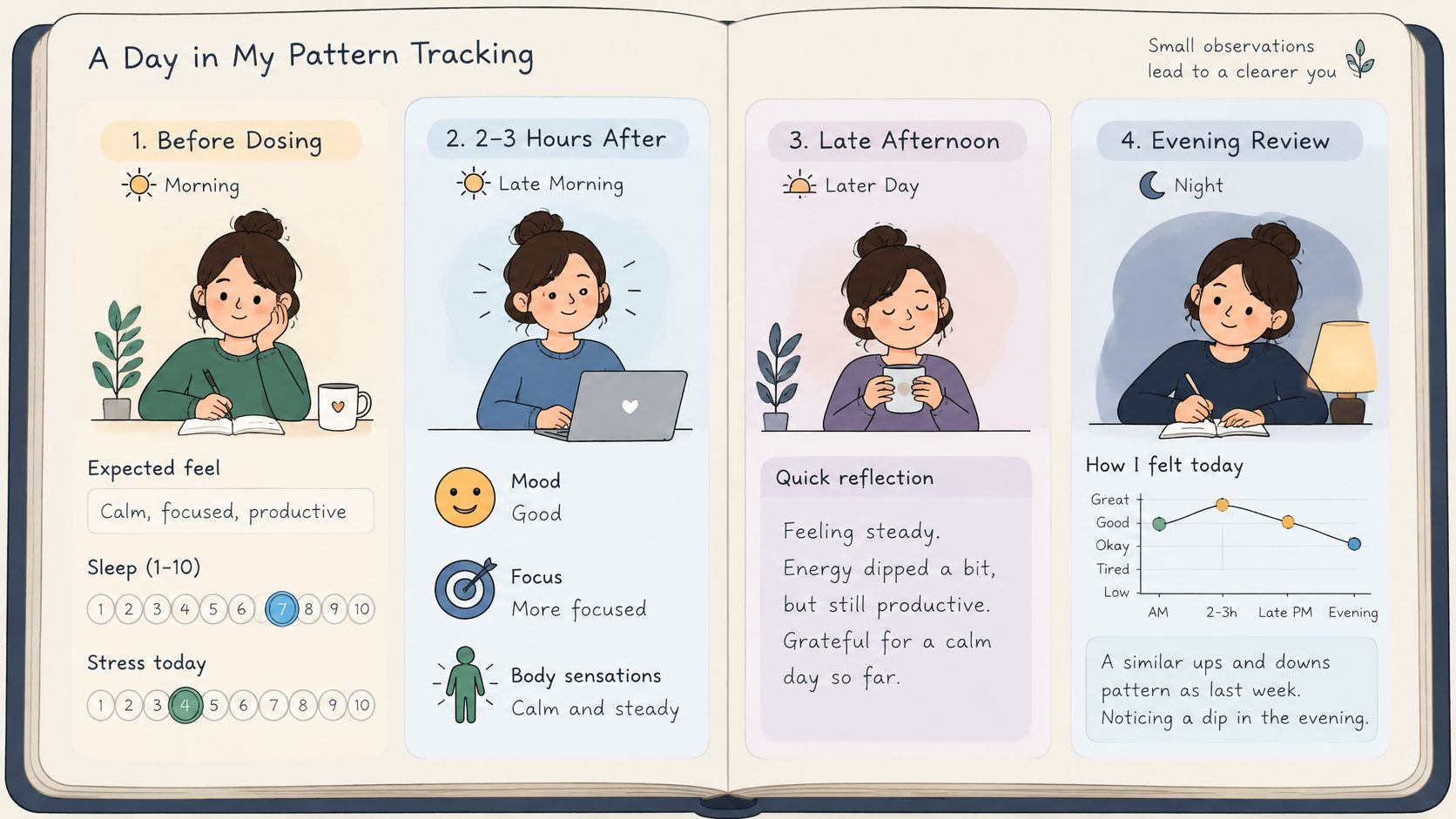
Fields give you numbers. Prompts give you the context that explains them, and these journal prompt examples follow the same four-moment rhythm.
Before Dosing
This group captures your starting point before anything can happen. Answer three questions in plain words.
- Expectation: What do I expect to feel today?
- Sleep score: What was my sleep like, from 1 to 10?
- Stress level: What's my stress level right now?
Two to Three Hours Later
This group captures the acute window at a scheduled time, not whenever you happen to remember. Keep each answer to a line.
- Noticeability: How noticeable is anything, if at all?
- Focus: Am I focused or scattered?
- Mood movement: What has my mood done since the morning?
The Next Morning
This group separates same-day impressions from carryover effects. Ask how you slept, whether anything carried over, and whether you'd change anything. Writing it the next day also stops a pleasant evening from rewriting a difficult afternoon.
Weekly Review
Once a week, ask what stood out, what didn't change, and what other events happened. The what didn't change question matters most, because beginners only hunt for improvements. A flat result is real information.
If this did nothing, what would this week look like?
That single prompt is the one many skip, and it's the most diagnostic. Writing your expectation before the entry is what later lets you separate expectancy from effect. Keep every prompt answerable in under a minute, and skip one rather than inventing an answer to fill the space.
A Two-Week Worked Example
Say a fictional freelance designer logs a Fadiman-style schedule for fourteen days. She doses on days 1, 4, 7, 10 and 13 and scores mood every night at 9 p.m. Her entries stay short on purpose.
Three Entries From One Cycle
- Day 1, dose day: Mood 6, anxiety 4, sleep 7 hours, intensity faint, context calm morning.
- Day 2, rest day one: Mood 7, anxiety 3, sleep 6.5 hours, intensity none, context client call went well.
- Day 3, rest day two: Mood 5, anxiety 6, sleep 5 hours, intensity none, context deadline moved forward.
Read those three lines as one unit. The Fadiman schedule overview on iMicrodosing describes it as a repeating one-day-on, two-days-off cycle, dose on day 1, days 2 and 3 off, then dose again on day 4. That creates a three-day recording unit, so you compare each dose day with the two rest days right after it rather than with the whole fortnight.
Notice day 3 in the example. A beginner might call that a rest-day dip caused by the schedule. The sleep line tells a simpler story, since five hours and a moved deadline explain a mood of 5 without any protocol theory.
Prepopulate dose and rest days in your calendar, then override any skipped or added days. That preserves the actual schedule you followed, not the one you intended.
The Week Two Review
After fourteen days, she averages the scores. Dose-day mood averaged 6.4 and rest-day mood averaged 6.0. That gap is too small to call meaningful, especially across only five dose days.
Sleep tells the clearer story. It dropped in the deadline week, and mood dropped with it on dose days and rest days alike. Her journal hasn't found a protocol effect. It has found a sleep effect she can act on.
Treat that result correctly. Five dose days is a small sample, so the outcome is a hypothesis to test over the next cycle, not a verdict. She keeps the same fields, protects her sleep during the next deadline, and checks whether the small gap survives.
Separating Real Patterns From Noise
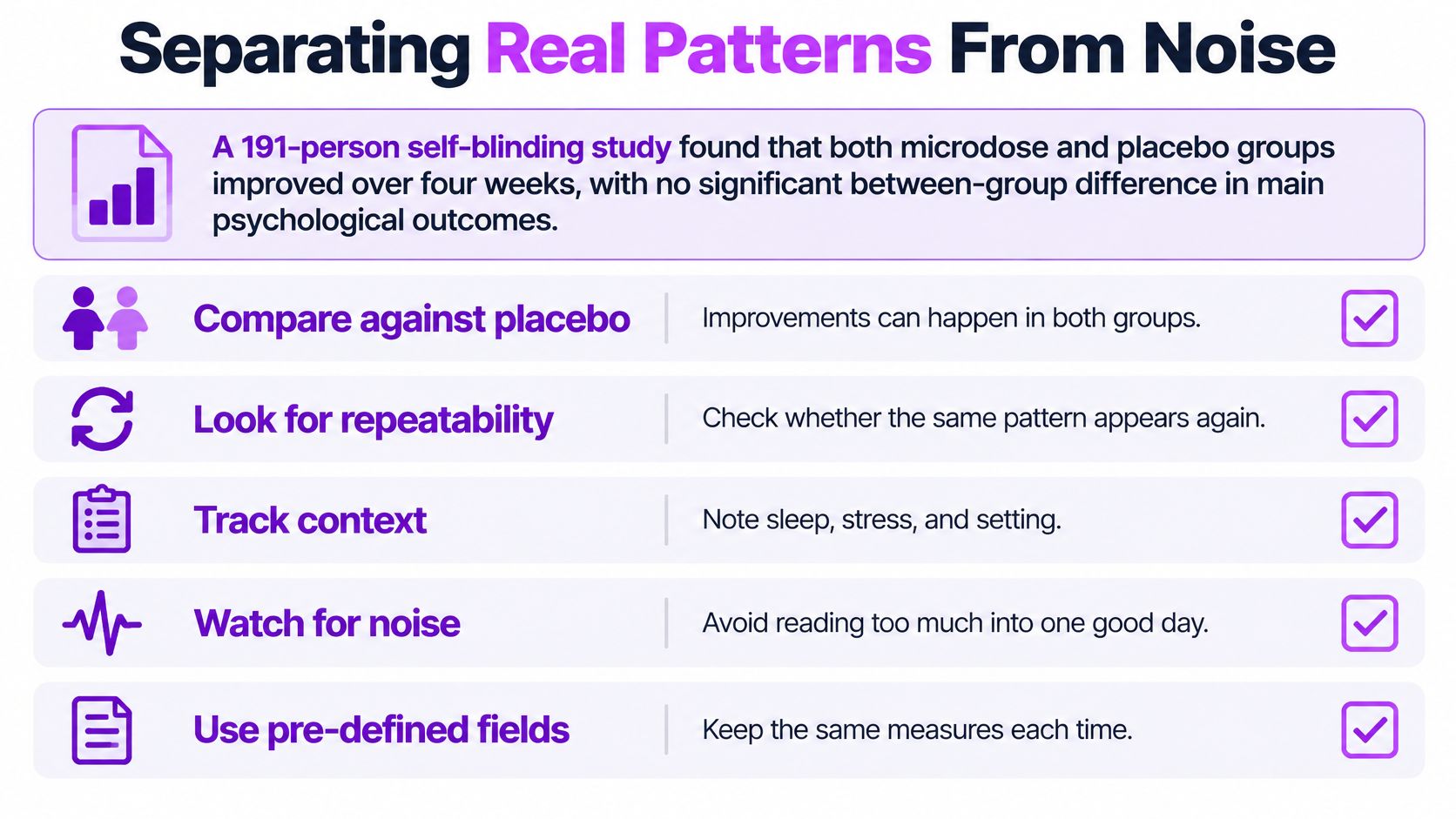
A higher mood score on dose days can feel convincing, especially when you expected to notice a change. Yet expectation, sleep, and stress may also explain the difference. A self-blinding study published in PMC found that both microdose and placebo groups improved over four weeks, with no significant between-group difference in the main psychological outcomes. That result is a reminder to check alternative explanations before linking a change to a protocol. Reviews of placebo-controlled microdosing trials have not settled whether any benefit exceeds placebo, so treat patterns in your own journal with similar care.
A journal can reveal correlations, not prove what caused them. Use the idea of correlation versus causation to guide each review: first ask whether sleep, stress, expectations, or another routine change could account for the apparent effect. The visual below offers a checklist for doing that before accepting a trend.
| Apparent pattern | Likely confounder | Check to run |
|---|---|---|
| Mood higher on dose days | Expectancy, because you know you dosed | Write the expectation before dosing and compare with rest days |
| Mood dip on rest day two | Poor sleep or stress that week | Compare sleep hours and the stress note for those days |
| Better week after starting | Seasonal change, new routine or schedule change | Check the context field for other changes in the same weeks |
| One very high score | Single-day fluctuation | Compare with the seven-day average |
| Anxiety lower on dose days | Fewer work days or more exercise on those days | Compare the context and exercise notes for the same days |
| Effect fading after two months | Novelty wearing off or a protocol change | Compare first-month and later-month averages and note any changes |
Count Your Entries Before Reading a Trend
Start by counting logged days each week. Missed entries often cluster in stressful periods, so a pattern based on sparse notes may reflect when you stopped recording rather than a change in your experience. If fewer than five of seven days have entries, treat the trend as a hypothesis to check again next cycle.
The short video below demonstrates the same checking habit in another format.
Keep four habits: record a baseline before dosing, separate immediate effects from next-day reflections, review three to four week trends instead of single high days, and include rest days in your comparisons. These steps make it easier to spot whether a pattern holds when expectations and daily circumstances differ.
A journal doesn't diagnose depression, anxiety or PTSD. If symptoms worsen or you have thoughts of self-harm, contact a clinician or local emergency service promptly.
Choose a Tracker and Start Your First Log
Apply this checklist to any tracker before you trust it with sensitive entries.
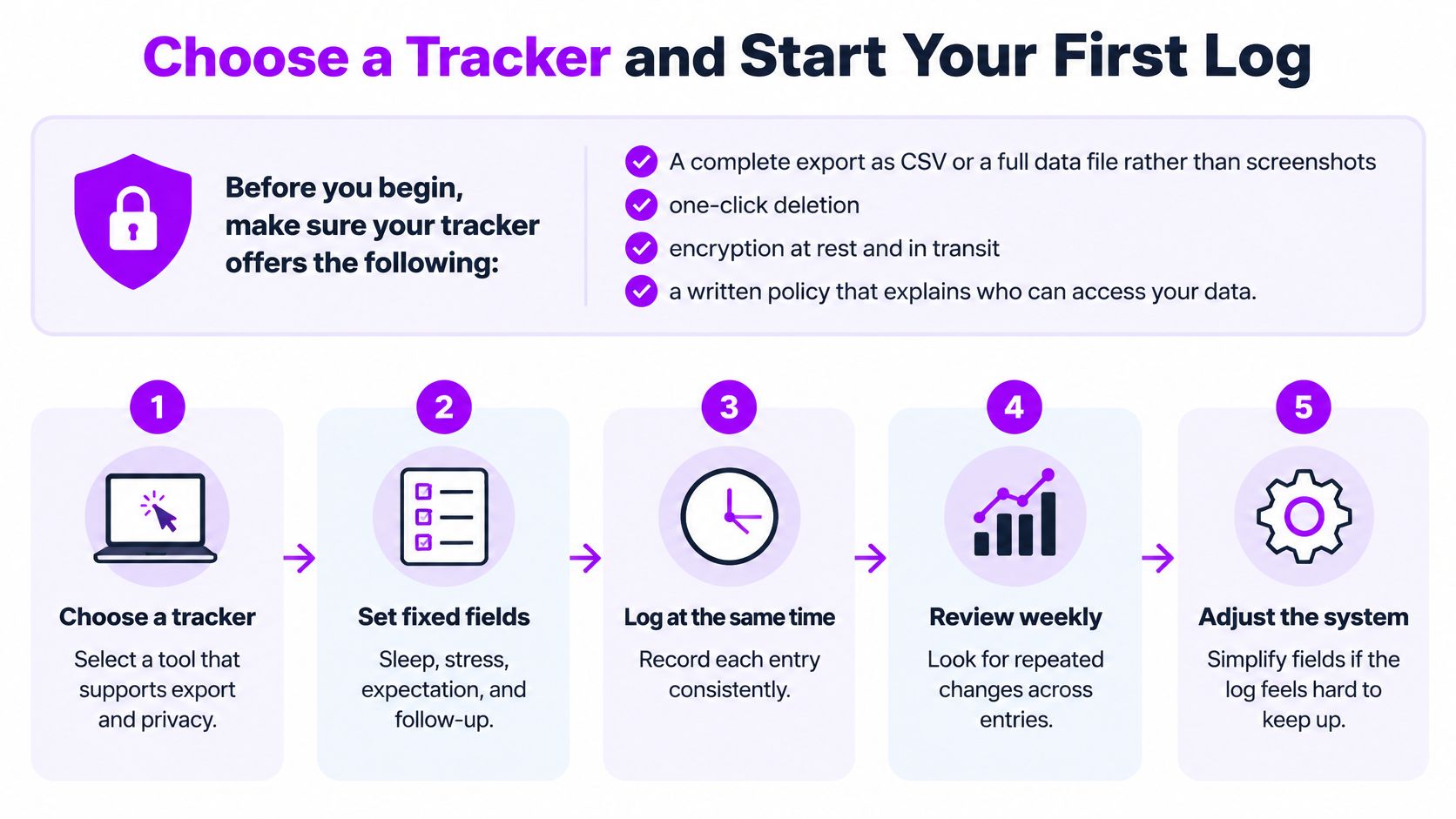
- Complete export: A CSV or full data file, not screenshots.
- Deletion: One-click deletion you can find without help.
- Encryption: Protection at rest and in transit.
- Data policy: A written statement on selling data or training AI. We never sell, share, or train AI models on users' journals.
- Useful structure: Two-phase entries, a 10-point mood scale and searchable history. Our entries let you record session details first and add reflections later.
Apple sets a fair benchmark here. Apple's Health app privacy documentation provides an “Export All Health Data” function and lets users review, edit, and delete health data. Before you commit to MicroTrack or any other tool, read its privacy policy, confirm the export format and deletion path, and run a test export with dummy entries.
Your First Fourteen Days
- Choose a schedule template or write your custom rule.
- Set dose-day and rest-day flags and override skipped days.
- Log the pre-dose expectation and baseline.
- Add the next-morning reflection.
- Review after two weeks against the misreadings table.
- Export the full log before changing the protocol.
Start a fourteen-day log this week.
MicroTrack gives your pattern recognition journal fixed fields, a 10-point mood scale and two-phase entries, so you can test expectancy, sleep and stress before crediting any schedule. Your history stays searchable, exportable and private. Start your first fourteen-day log with MicroTrack and let the comparisons do the talking.