Psilocybin for Depression: What the Evidence Actually Shows
You've tried an antidepressant that barely helped, another that stopped working, or therapy that offered insight without lifting the weight. Then a friend mentions psilocybin, or you see a headline promising rapid relief, and a difficult question follows: is psilocybin for depression a serious medical possibility, or just a polished version of hype?
The honest answer is more complicated than either extreme. Controlled trials of clinical-dose psilocybin with psychological support have produced meaningful improvements for some people with depression. Those studies don't test the same thing as taking a small amount of mushrooms at home every few days. Microdosing has a different dose, setting, purpose, and evidence base.
This distinction matters if you're considering treatment, already tracking a self-directed practice, or trying to understand what the research really says. The evidence can be encouraging without being a promise, and careful tracking can help you notice patterns without turning a personal experiment into a diagnosis.
Table of Contents
- Why People Are Talking About Psilocybin for Depression
- What Psilocybin Is and How Clinical Therapy Sessions Work
- What the Major Clinical Trials Actually Found
- Microdosing Versus Clinical-Dose Therapy
- How to Track Symptoms and Outcomes Safely
- Durability, Relapse, and the Limits of One Dose
- Safety, Legal Status, and Smart Next Steps
Why People Are Talking About Psilocybin for Depression
Consider someone who has lived with treatment-resistant depression for years. They've taken prescribed medication, attended therapy, and kept trying to function through low energy, poor concentration, disrupted sleep, and a shrinking sense of possibility. When they hear that a supervised psilocybin session helped some research participants, hope can arrive alongside understandable caution.
That reaction isn't irrational. Depression can make every option feel urgent, especially after standard treatments haven't delivered enough relief. At the same time, a compelling story from a friend can't tell you whether the same outcome would apply to your diagnosis, medication history, risk factors, or living situation.
Research interest has grown because controlled studies have tested psilocybin in carefully selected adults with major depressive disorder and treatment-resistant depression. These trials have examined a single higher dose, psychological preparation, support during the experience, and follow-up care. They've also measured outcomes with clinician-rated scales rather than relying only on whether participants said they had a good day.
A promising trial result is a reason to investigate carefully, not a reason to skip screening or professional care.
Public discussion often collapses several different ideas into one phrase. “Psilocybin therapy” may refer to a structured clinical protocol, while “microdosing” may mean taking a small, variable amount outside clinical supervision. Those practices shouldn't be treated as interchangeable. A useful overview of microdosing benefits also needs to distinguish personal reports from evidence that establishes treatment for major depressive disorder.
This guide focuses on that distinction. You'll see what the major trials measured, how to interpret response and remission, why durability deserves more attention, and how to track mood and functioning without mistaking correlation for proof. You won't find a promise that psilocybin will cure depression, or instructions for unsupervised use.
What Psilocybin Is and How Clinical Therapy Sessions Work
Psilocybin is the psychoactive compound found in certain mushroom species. After the body converts it into its active form, it can produce changes in perception, emotion, attention, and the sense of self. Those effects can be meaningful, difficult, or both, which is why clinical researchers treat the experience as a carefully managed intervention rather than an ordinary supplement.
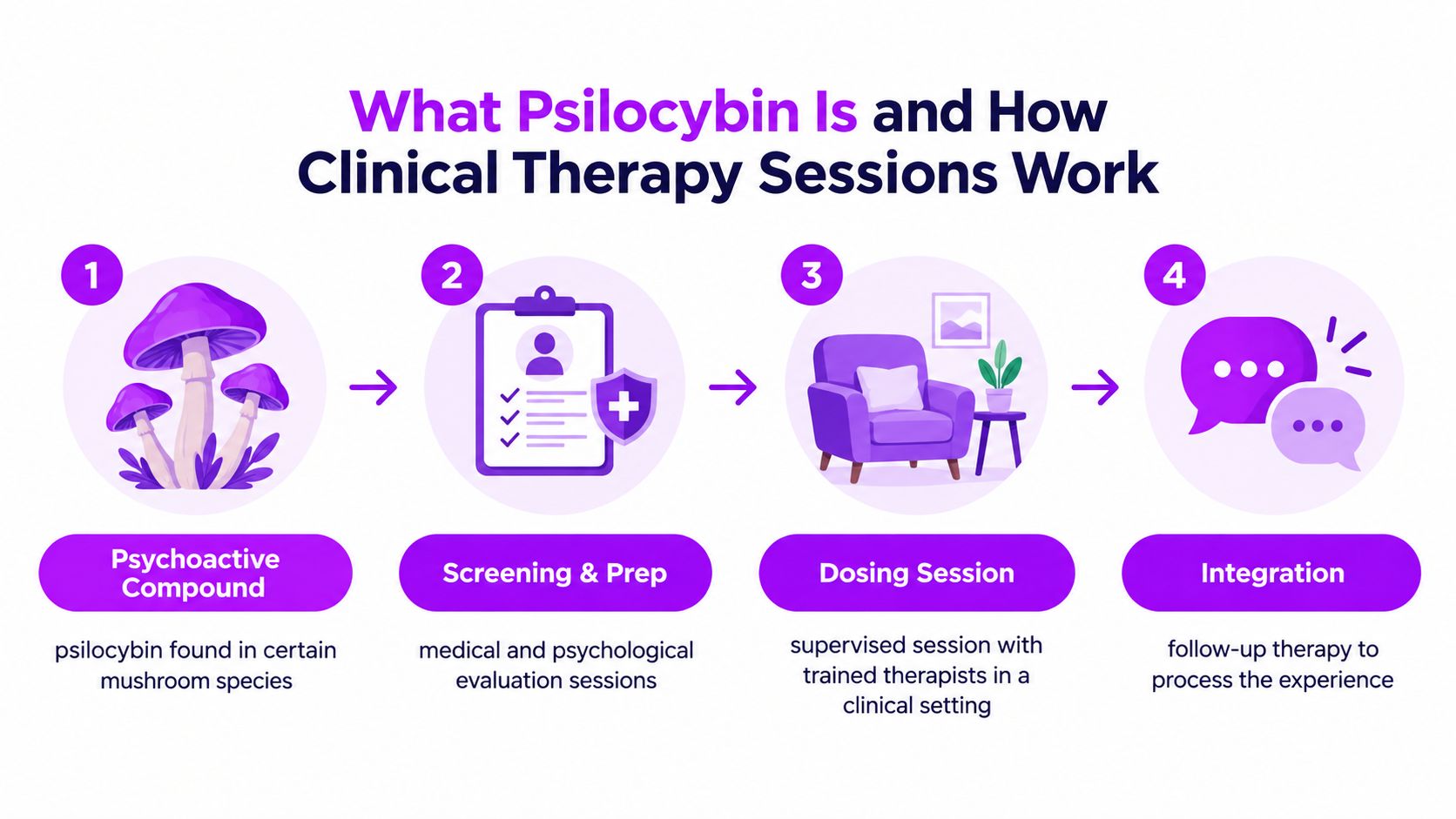
The clinical process has several parts
A research session usually begins before anyone receives a dose.
Screening and preparation: Researchers assess medical history, psychiatric symptoms, current medicines, family history, and safety risks. Preparation sessions help participants understand what may happen and establish ways to respond if anxiety or confusion appears.
Supervised dosing: Participants receive a measured dose in a controlled setting. In major depression trials, the studied intervention has often been a single 25 mg dose, administered alongside structured psychological support. The participant isn't expected to face the experience alone.
Support during the session: Trained professionals remain available while the effects unfold. The environment, interpersonal support, and expectations are part of the protocol because the experience can affect someone emotionally as well as physically.
Integration and follow-up: Later visits give participants space to discuss what happened, connect insights with daily life, and monitor symptoms. Integration isn't decorative conversation added after the “real” treatment. It helps researchers and clinicians understand how the experience relates to functioning and ongoing care.
A useful analogy is a guided medical procedure. The compound is one component, but the screening, setting, monitoring, and follow-up help shape how the intervention is delivered and evaluated. Taking an unmeasured mushroom product at home doesn't reproduce those conditions.
What scientists think may be happening
Psilocybin activates a serotonin receptor known as 5-HT2A. Researchers also study whether psychedelic compounds may temporarily increase forms of neuroplasticity, meaning the brain's capacity to change connections and patterns. These mechanisms are still being investigated, and a plausible biological explanation doesn't by itself prove that a treatment is effective or safe for every person.
The clinical setting may matter just as much as the pharmacology. A person's expectations, emotional state, support, and ability to process the experience can influence what follows. That's one reason trial results shouldn't be reduced to “a mushroom changed the brain.”
The following video offers a general visual introduction to the topic, but it isn't a substitute for clinical assessment.
What the Major Clinical Trials Actually Found
The headline results are encouraging, but they need careful reading. A response usually means symptoms fell by a predefined amount. It doesn't necessarily mean the person felt completely well, returned to every previous activity, or no longer needed care. Remission is a stricter outcome, but it also depends on the scale and threshold used.
The 2022 treatment-resistant depression trial
A phase 2 trial studied 233 adults with treatment-resistant depression. Participants received a single supervised dose of synthetic psilocybin at 25 mg, 10 mg, or 1 mg, with psychological support. Three weeks later, 37% of the 25 mg group met the response criterion, compared with 19% in the 10 mg group and 18% in the 1 mg group, according to the published trial report.
The response criterion meant at least a 50% reduction in MADRS score, not a subjective impression of improvement. Remission, defined as a MADRS score of 10 or lower, occurred in 29% of the 25 mg group, 9% of the 10 mg group, and 8% of the 1 mg group.
The average symptom change adds useful context. At week three, the least-squares mean MADRS improvement was 12.0 points from baseline for 25 mg, compared with 5.4 points for 1 mg. The between-group difference was 6.6 points, with a 95% confidence interval from 2.9 to 10.2 and P < .001. In plain language, the higher-dose group improved more on the depression scale than the low-dose control group, and the statistical result makes chance an unlikely explanation within this trial.
The pattern doesn't show that every participant improved, nor does it establish that lower-dose exposure works for depression. It shows that the tested clinical protocol produced a stronger average result at 25 mg than at 1 mg after three weeks.
Other controlled comparisons
A separate randomized trial followed adults with major depressive disorder who received 25 mg of psilocybin or niacin as an active placebo, alongside psychological support. Among participants with follow-up data, 42% in the psilocybin group maintained a depressive-symptom response, compared with 11% in the niacin group. The adjusted absolute difference was 30.3 percentage points, with a 95% confidence interval from 13.5 to 47.1, an odds ratio of 5.6, and P = .002, as reported in the randomized clinical trial publication.
In a separate phase 2 comparison with escitalopram, response rates on the QIDS-SR-16 were 70% versus 48%, and remission rates were 57% versus 28%. The remission difference was 28 percentage points, with a 95% confidence interval from 2 to 54. These results are informative, but the comparison involved a particular study design, clinical support model, participant group, and follow-up period.
A smaller placebo-controlled study measured outcomes 14 days after one psilocybin-assisted therapy session. On the clinician-rated MADRS, 58% of psilocybin participants responded, compared with 16% of placebo participants. On the self-reported Beck Depression Inventory, response occurred in 54% versus 12%, and MADRS remission was 54% versus 12%, according to the Lancet eClinicalMedicine study00538-7/fulltext). Its small sample and short follow-up mean these are early outcomes, not proof of lasting benefit.
| Trial | Dose | Comparator | Response rate | Remission rate | Follow-up |
|---|---|---|---|---|---|
| Phase 2 treatment-resistant depression trial | 25 mg, 10 mg, or 1 mg | Low-dose control | 37% at 25 mg, 19% at 10 mg, 18% at 1 mg | 29%, 9%, and 8% respectively | Three weeks |
| Randomized major depression trial | 25 mg | Niacin | 42% versus 11% | 25% versus 9.1% | Six-week study period |
| Psilocybin versus escitalopram comparison | Psilocybin protocol | Escitalopram | 70% versus 48% | 57% versus 28% | Study-specific follow-up |
| Smaller placebo-controlled study | Psilocybin session | Placebo | 58% versus 16% on MADRS | 54% versus 12% on MADRS | Fourteen days |
A standardized assessment tool can help explain why researchers use validated scales instead of relying only on memory. Even so, trial participants are screened, supported, and assessed under conditions that may not match everyday life. Short follow-up, selected populations, active-placebo problems, and differences in therapy support all limit how broadly the findings can be applied.
Microdosing Versus Clinical-Dose Therapy
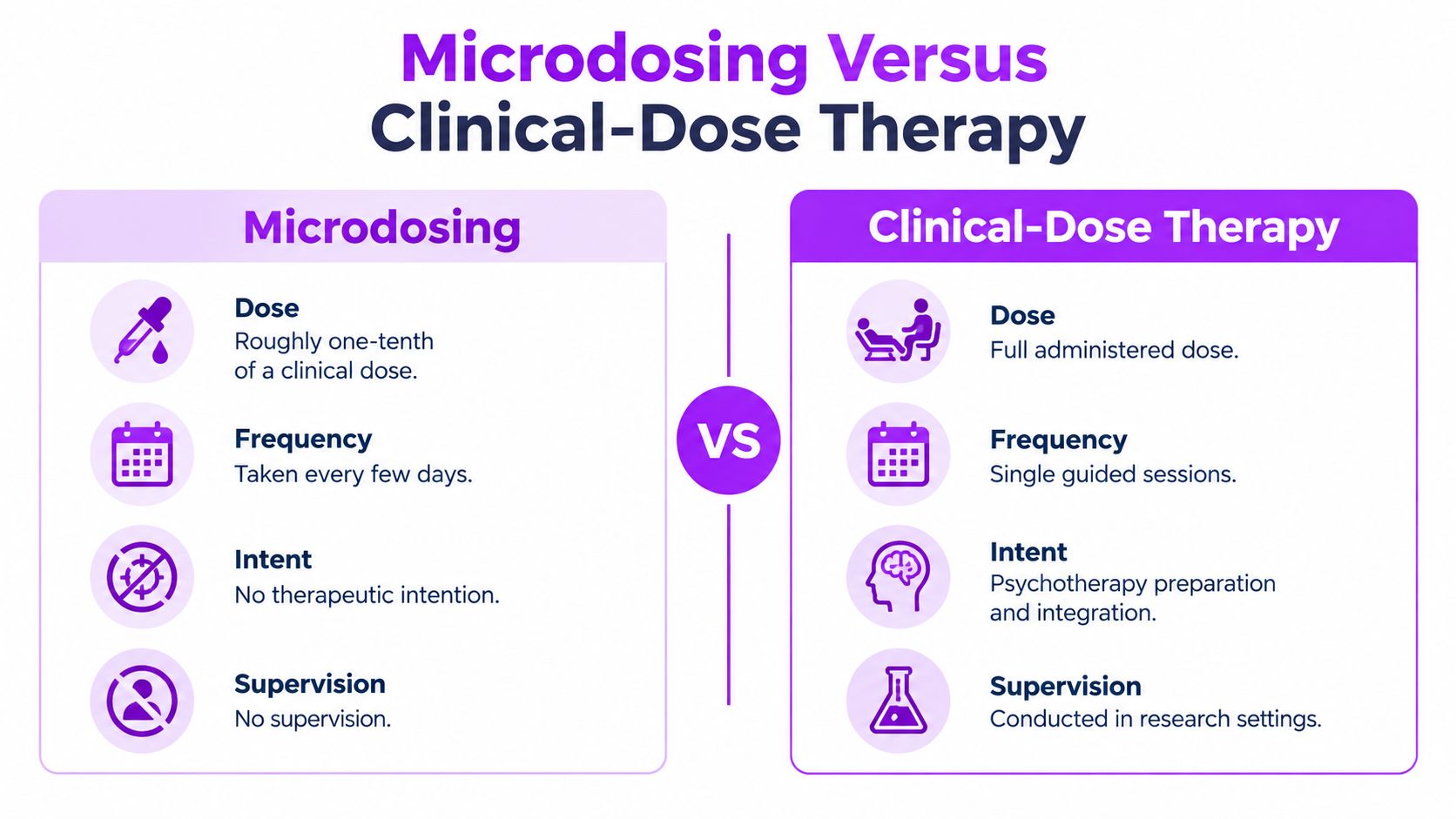
The word “psilocybin” can hide a major difference in what someone does. Microdosing generally refers to taking a small amount, often described as roughly one-tenth of a clinical dose, every few days. Clinical-dose therapy involves a substantially higher, measured dose delivered in a supervised session, usually with preparation and follow-up support.
| Feature | Microdosing | Clinical-dose therapy |
|---|---|---|
| Amount | Small and often variable | Measured administered dose |
| Pattern | Repeated use every few days | Usually a single guided session in a trial |
| Setting | Often outside clinical supervision | Controlled research or clinical setting |
| Psychological support | Usually absent or informal | Preparation, support, and integration |
| Evidence question | Whether small repeated exposure changes everyday outcomes | Whether a supervised intervention improves depression outcomes |
| What the evidence currently shows | Subjective and neurophysiological effects, but no consistent immediate antidepressant benefit | Meaningful responses in several controlled clinical trials |
Why the evidence can't simply be transferred
A recent controlled research synthesis estimated the effect of microdosing on depression at a standardized mean difference of −0.19, with a 95% confidence interval from −0.56 to 0.19, making the result statistically inconclusive, as reported in the microdosing evidence review. A standardized mean difference is a way to compare outcomes across studies using different scales. Here, the estimate is small, and the confidence interval includes no clear effect.
That doesn't prove microdosing never helps anyone. It means current controlled evidence doesn't establish microdosing as an effective treatment for major depressive disorder. Observational reports can be useful for generating questions, but they're vulnerable to expectation, selective memory, changing doses, sleep differences, medication changes, and placebo effects.
A person who microdoses may also change several things at once. They might start exercising, reduce alcohol, sleep more consistently, begin therapy, or pay closer attention to their mood. If symptoms improve, a personal log may show that improvement happened during the same period as microdosing, but it can't automatically identify the cause.
Clinical-dose findings answer one question. Microdosing experiences answer another. Similar substances don't make the study conditions equivalent.
For someone with depression, the practical conclusion is neither hype nor dismissal. Treat microdosing as an exploratory self-tracking question, not as an established antidepressant replacement. Use validated symptom measures, record context, and involve a clinician when symptoms are persistent, severe, or worsening.
How to Track Symptoms and Outcomes Safely
Tracking can be useful before, during, or after any decision about psilocybin. It gives you a clearer baseline and reduces the risk that one unusually good or difficult day will dominate your memory. It also makes conversations with a clinician more concrete.
Start with a 10-point daily mood scale, using the same meaning for each point. A score should describe your overall day rather than the strongest moment. Add a brief note about function, because mood and functioning can move separately. Someone may feel briefly hopeful while still being unable to work, care for themselves, connect with others, or complete ordinary tasks.
A simple daily record
Keep the daily entry short enough that you will use it.
- Mood: Record your consistent 10-point rating and one sentence about what influenced it.
- Sleep: Note duration, interruptions, and whether you felt restored.
- Function: Record one concrete marker, such as attending work, preparing food, exercising, or contacting someone.
- Exposure: If you're already using a substance, record the amount, timing, product information, and whether the dose was measured.
- Adverse effects: Note anxiety, headache, nausea, perceptual changes, agitation, unusual energy, or anything else that feels clinically relevant.
- Context: Include therapy, medication changes, alcohol or other substances, major stress, illness, and menstrual-cycle changes when relevant.
A weekly validated questionnaire, such as the PHQ-9, can complement daily notes. It shouldn't replace a clinician's assessment, especially if you report suicidal thoughts, severe agitation, loss of sleep with unusually high energy, hallucinations, or rapidly worsening symptoms.
MicroTrack is one option for recording dose details in the moment and adding reflections later through two-phase entries. It also provides mood trends, schedule information, and exportable history, which can make patterns easier to review. Its depression tracking guidance is most useful when you treat the journal as an observational record rather than evidence that a substance caused improvement.
Turn observations into safer decisions
Review your record at a consistent interval rather than checking it repeatedly for proof that a practice works. Ask practical questions:
- Did mood change alongside sleep or therapy?
- Did functioning improve, or only the daily rating?
- Did adverse effects appear after a dose or after a medication change?
- Did symptoms worsen when the schedule changed?
- Are there signs that need professional attention now?
Protect sensitive data. A mental-health journal contains information about symptoms, medication, and vulnerability, so understand where it's stored, who can access it, and whether you can export or delete it. Tracking can improve observation, but it can't diagnose depression, determine whether psilocybin is safe for you, or replace treatment.
Durability, Relapse, and the Limits of One Dose
“Lasting” doesn't mean permanent. In the phase 2 treatment-resistant depression trial, sustained response at 12 weeks was observed in approximately 20% of participants who received 25 mg, compared with 10% who received 1 mg, according to the trial follow-up data. That finding matters because an early response can weaken over time.
Follow-up data also reported a median time to depressive relapse of 189 days after 25 mg, compared with 43 days after 10 mg and 21 days after 1 mg. A median describes the midpoint of the observed times, not a deadline that applies to every individual. Some people relapsed earlier, while others remained well longer.
Build a relapse plan before you need it
A tracking routine becomes more valuable when it includes predefined actions. Decide what you'll monitor and who you'll contact before symptoms become overwhelming.
- Schedule check-ins: Review mood, sleep, functioning, medication changes, and adverse effects at regular intervals.
- Name early warning signs: Examples include withdrawing from people, missing work, losing interest in basic care, persistent sleep disruption, or a clear rise in hopelessness.
- Set an escalation point: Tell a clinician when symptoms cross the threshold you've agreed on, rather than waiting until a crisis.
- Plan urgent support: If you may harm yourself, can't stay safe, or experience severe confusion or psychosis, contact emergency services or a crisis service immediately and involve someone you trust.
A response is an outcome to monitor, not a guarantee that depression has been permanently removed.
The participants in these studies were screened and received structured psychological support. Their outcomes may not represent people with bipolar disorder, psychosis risk, complex medication regimens, or acute suicidality. A relapse plan can't make unsupervised use safe, but it can make symptom changes easier to recognize and communicate.
Safety, Legal Status, and Smart Next Steps
Psilocybin-assisted therapy remains an investigational intervention in many places. People with psychotic disorders, relevant bipolar-spectrum risks, acute suicidality, or medication interactions may need particular caution and specialist screening. Don't assume a clinical trial's safety findings apply to a product, dose, or setting outside the study.
Adverse effects are also part of the evidence. In one randomized trial, 82% of psilocybin recipients reported at least one drug-related treatment-emergent adverse event from dosing through day nine, compared with 44% in the niacin group, as reported in the trial publication. Psilocybin remains tightly controlled in many jurisdictions, and local rules can change, so check current guidance from an official authority before making assumptions about legality.
- Speak with an informed clinician: Bring your diagnosis, medication list, family history, and tracking record.
- Use structured observation: Track mood, sleep, function, exposure, and adverse effects without treating the log as proof of treatment.
- Avoid unstudied combinations: Don't stack psilocybin with supplements, medicines, or other substances without professional advice.
- Treat research protocols as medical care: Screening, preparation, supervision, and follow-up are not optional details.
MicroTrack gives you a structured place to record mood, dose details, sensations, side effects, sleep, and reflections while keeping your observations separate from clinical conclusions. Visit MicroTrack to start building a clearer record you can review with yourself or a qualified clinician.