Psychedelic Integration Coach: Role, Scope and Limits
The retreat ended four days ago. You have a notebook full of half sentences, a voice memo you recorded at 2 a.m., and no good answer to the question your partner keeps asking, which is what changed. Maybe it's quieter than that. You finished a month of microdosing on a one-day-on, two-day-off rhythm, the last week felt flat, and now you're deciding whether to continue, stop, or talk to someone who understands the territory.
That gap between having an experience and knowing what to do with it is where a psychedelic integration coach works. Not during the experience. After it. The useful part of the job is narrower than the wellness aisle suggests, and knowing exactly where the edges sit is what protects you.
Table of Contents
- What a Psychedelic Integration Coach Does
- Coaching Versus Clinical Care at a Glance
- Recognizing When Coaching Is Not Enough
- The Three-Stage Integration Process
- Tracking Integration Between Sessions
- Credentials and Questions to Ask a Coach
- Access, Consent and Cultural Fit
- Choose Integration Support With Clear Limits
What a Psychedelic Integration Coach Does
Picture someone three days back from a ceremony in the desert. They slept badly, cried twice, felt something enormous they still can't name, and by Thursday they're answering email again. Nothing in ordinary life has a slot for what happened.
The closest everyday comparison is the debrief after a long expedition. The person who debriefs you isn't the pilot and isn't the mechanic. They sit down with the logbook and help you sort what mattered, what frightened you, and what you'd change next time.
That's the shape of this work. Academic reviews describe integration as the intentional process of revisiting, making sense of, processing, and applying the effects of a psychedelic experience in everyday life, and the published review of integration research notes that coaching stays oriented toward reflection, meaning-making, behavior change, preparation, and post-experience support rather than implying medical treatment or psychedelic administration.

The dimensions a coach works across are broader than mood. Psychological, bodily, relational, lifestyle and spiritual material all surface, which is why clients arrive from very different places: microdosers who never had a single dramatic session, wellness clients processing a retreat, and people discharged from a clinic with a folder of notes and no follow-up plan.
One caveat shapes your expectations. Well-developed, published integration models mostly date from 2017 onward, and the same review reports that most clinicians trained in psychedelic-assisted therapies wanted a better understanding of integration. When the clinicians are still clarifying the boundaries, you should expect a coach to explain theirs out loud.
Two lists that keep the role clear
What a coach does
- Structured reflection that turns a jumble of memory into a narrative you can examine
- Goal setting that converts one insight into one scheduled behavior
- Referral coordination when symptoms point somewhere coaching can't go
What a coach does not do
- Diagnose anything, including depression, PTSD or dissociation
- Administer or supply psychedelics, or sit with you during a session
- Manage medication or advise on doses, interactions or tapering
Coaching Versus Clinical Care at a Glance
| Aspect | Integration coaching | Licensed clinical care |
|---|---|---|
| Main purpose | Reflection, meaning-making and habit change | Assessment, diagnosis and treatment of mental health conditions |
| Typical training | Varies widely; verify credentials and scope in writing | Licensed clinicians such as psychologists, psychiatrists or licensed counselors |
| Diagnosis | Not in scope | Core part of the role |
| Medication management | Not in scope | Within scope for prescribing clinicians |
| Psychedelic administration | Not in scope | Only in settings where it is legally permitted and supervised |
| Acute crisis response | Recognizes warning signs and refers to emergency care | Provides or coordinates urgent clinical response |
| Timing in the care pathway | After an experience, or alongside preparation | Preparation, supervised session, then integration |
Read the table left to right and the split becomes obvious. A coach supports meaning, reflection and habits. A clinician assesses, diagnoses and treats. The overlap is real, which is why the confusion persists: both roles involve a calm room, careful questions and undivided attention. The difference sits in what each one is trained and authorized to do with what comes up.
Established psychedelic-assisted therapy models divide care into three parts, preparation, a supervised medication session, and the integration work that follows, and a commonly cited clinical model places an integration session the day after dosing, as the Cochrane review of psychedelic-assisted therapy describes. A coach who holds an integration conversation is not thereby delivering psychedelic-assisted psychotherapy, even when the conversation sounds nearly identical to the one happening in a clinic.
The test that settles most cases: if the question is what this experience means for my week, coaching fits. If the question is whether this symptom is a condition that needs treatment, the answer belongs to a licensed clinician.
Coaching is not a cheaper version of therapy and shouldn't be sold as one. The pricing is lower because the scope is narrower, not because you're getting the same thing at a discount. If you're mapping the clinical route first, our guide to psilocybin therapy near me covers what regulated programs include and who staffs them.
The one difference that matters most is whether anyone in the room is assessing for and treating a diagnosable condition. Everything else, the tone, the questions, the length of sessions, can look the same from the inside.
Recognizing When Coaching Is Not Enough
A client leaves a session sounding steady, then texts at 2 a.m. that they have not slept in two nights and the room feels too loud. A warm reply is not a plan. Written escalation rules decide, before that night, which signs stop coaching and which licensed role takes over.
Screening happens before any work begins, not after something goes wrong. Five areas need a deliberate look at intake: acute mania or psychosis, severe suicidality, destabilizing trauma symptoms, problematic substance use, and medication or medical-risk concerns. A coach who skips this and starts with meaning-making is guessing.
Documentation comes next. Record the client's current mental state, how they're sleeping, whether they can work or care for themselves, and who they can call. Written crisis and emergency contacts should be in the client's hands before the first session, not assembled during a bad night. Those rules work like a fire-exit map: the coach can point to the door and name the route. They do not treat the emergency.
The warning signs that change the plan
Professional guidance on post-psychedelic care identifies a specific set of risks, including suicidality, mania, dissociation, insomnia, destabilization and functional decline, and expects practitioners to assess stability, recognize warning signs, and build a safety plan once risks appear, according to the New Mexico Department of Health guidance on post-session care. Immediately after a clinical session, the recommended checks include persistent psychological distress, emergent suicidal ideation, manic symptoms and severe anxiety.
| Warning sign | Coaching response | Escalation |
|---|---|---|
| Emergent suicidal thoughts | Stop the session and run a safety check | Emergency services or crisis line now |
| Acute mania or hypomanic activation | Pause the work, record sleep and check for immediate danger | Emergency care if acute; urgent licensed clinician referral otherwise |
| Psychosis-like symptoms such as paranoia or persisting hallucinations | Stop coaching and encourage contact with support | Emergency care |
| Worsening depression | Pause new practices and document changes | Licensed clinician referral |
| Persistent insomnia | Track sleep daily | Clinician review if it continues |
| Severe anxiety or dissociation | Ground the session and document duration | Licensed clinician referral |
| Problematic substance use | Note the use and raise it in the session | Addiction-qualified clinician referral |
| Functional decline, such as being unable to work or self-care | Assess available support | Licensed clinician referral, urgent if unsafe |
A 2025 qualitative study of 28 professionals, including integration coaches, psychotherapists, psychiatrists and retreat facilitators, identified six recurring difficulties: existential or ontological shock, anxiety and panic, altered self-perception, dissociation, resurfacing trauma, and disappointment when expectations go unmet. That study of difficult psychedelic experiences also found that integration remains poorly standardized and lacks strong empirical guidance, which is why written escalation rules beat good intentions.
Discomfort that eases with rest, grounding and a day or two of reflection can stay in coaching. Discomfort that persists, grows, or starts cutting into sleep, work or self-care moves to a licensed clinician. Further psychedelic use is not a response to any of these signs.
A coach who can name the referral pathway without looking it up is safer to work with than one who promises to handle everything.
If you're supporting someone through a rough patch and want plain harm-reduction language for what to watch, our psychedelic harm reduction guide covers the practical side.
The Three-Stage Integration Process
Good integration work has a sequence, and following it in order prevents the most common failure, which is interpreting an experience before you've recorded it.
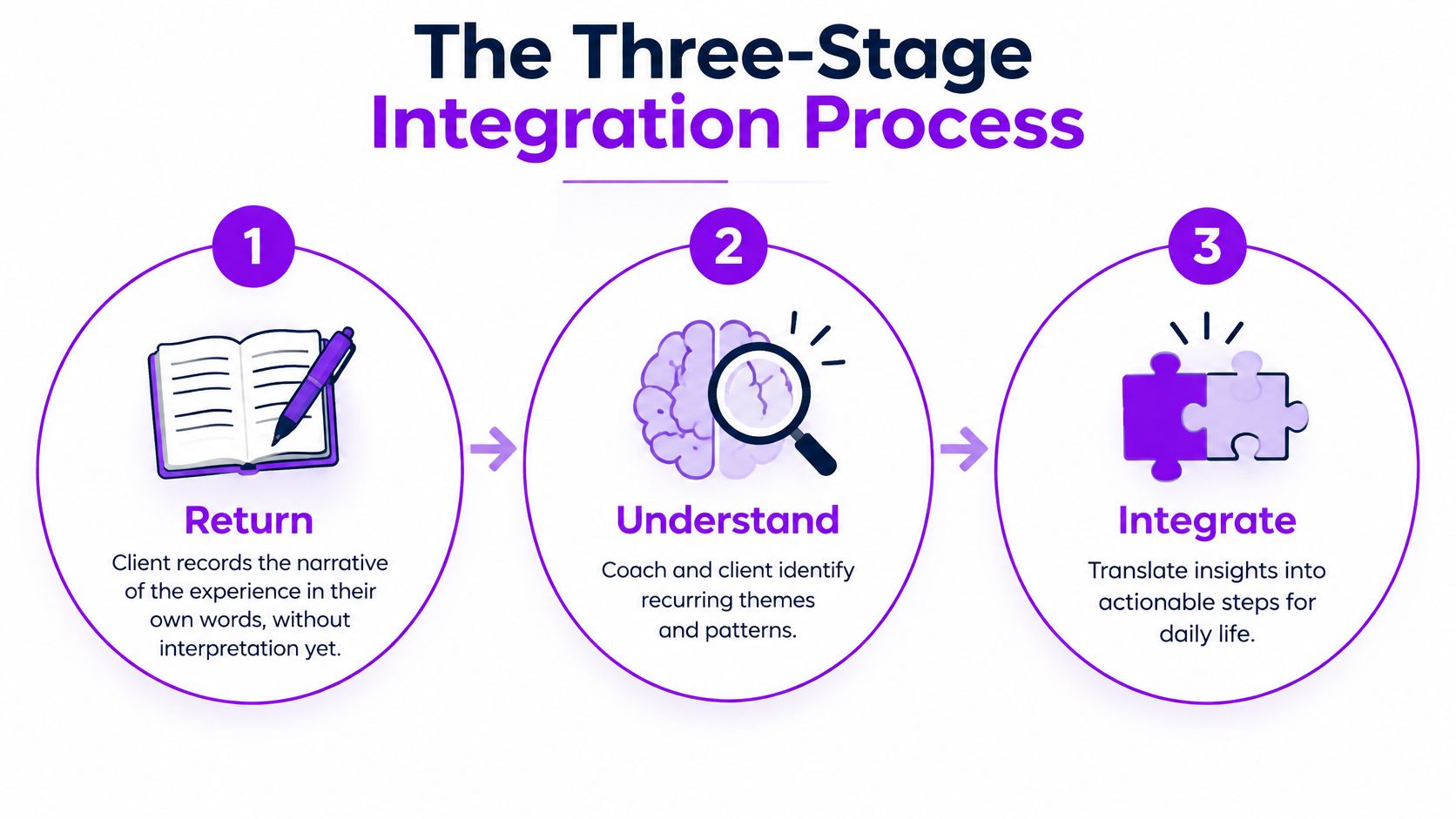
A peer-reviewed conceptual analysis sets out three operational stages: returning from the experience by recording its narrative, understanding it by identifying recurring themes and interpretations, and implementing concrete practices in daily life, as described in the conceptual analysis of integration stages. Here's how each one looks with a real client pattern.
1. Return. The client records the experience in their own words, without interpretation yet. If they write "I felt far away from my family all week, and I didn't call anyone," that's the raw material. The coach's only job at this stage is to get it written down close to the event, while detail is still intact.
2. Understand. Coach and client look for recurring themes and test each one against what the client noticed. The theme that emerges might be withdrawal, or it might be exhaustion that looks like withdrawal. Testing separates them. A coach earns their fee in that moment, because the story people tell first is rarely the whole one.
3. Implement. The insight becomes one concrete practice. Not "be more present with family" but a scheduled call every Sunday at seven, written into a calendar. A practice you can observe beats a resolution you can't.
The ACE model gives you a mechanism to run inside those stages: Accept the difficult material without suppressing it prematurely, Connect it to an insight that matters to this person, then Embody that insight in observable action. Skipping Accept is the most common error, because clients often want the lesson before they've tolerated the feeling.
Two weeks later, check the record. Did the Sunday calls happen, and did anything shift in mood or sleep alongside them? That check is where integration either becomes real or dissolves.
Keep one caution in view. These frameworks are useful for structuring the work, but the literature is explicit that they are not validated treatment protocols, and rigorous evidence comparing approaches remains insufficient. For more on building the daily habits themselves, see our guide to integration practices.
Tracking Integration Between Sessions
The single most useful design choice is separation. Record dose context in the moment, then add reflections later as separate, time-stamped entries. When the reflection is written from memory of how the day felt, recall drifts toward whatever mood you're in while writing.
Fields worth recording
| Field | What to record | What it reveals |
|---|---|---|
| Mood | One number a day on a 10-point scale | A comparable line across weeks, not a memory of how the month felt |
| Sleep | Hours plus a simple quality rating | Whether an insight is landing alongside a change in rest, or riding on exhaustion |
| Function | Work, care responsibilities, contact with people | Whether the change shows up outside the journal |
| Adverse effects | Anxiety, headache, irritability, dissociation, and duration | The part of the picture a client is least likely to volunteer |
| Reflection | Free text, written later and time-stamped separately | Whether the meaning you gave the experience still holds two weeks on |
Read the record for trends across weeks rather than reacting to a single day, and compare any claimed insight with later changes in sleep, routines or relationships. A 2024 synthesis covering 75 clinical trials and related publications found that integration studies use heterogeneous approaches, most commonly humanistic-experiential methods, and that available evidence is insufficient to determine which therapeutic orientation is effective, as the synthesis of integration research reports.
That finding has a practical consequence for your log. Because no orientation has been shown superior, the log should capture baseline and post-session measures, adverse effects, sleep and functional impact, not merely perceived benefits. A record that only shows what the client hoped for is a marketing document.
Label every entry as self-report. The log is evidence for a conversation, not a diagnosis, and a coach who treats it as clinical outcome data has stepped outside the role.
Credentials and Questions to Ask a Coach
Oregon gives you a measurable yardstick. Under the state's regulated psilocybin-services framework, facilitator applicants must be at least 21, hold a high-school diploma or equivalent, pass a criminal background check, complete an approved training program and pass a licensing exam with a score of at least 75%. The required training structure in 2024 included 120 hours of coursework plus a 40-hour in-person practicum, with at least 30 hours observing psilocybin-service delivery and 10 hours of consultation training, according to the survey of Oregon's psilocybin workforce.
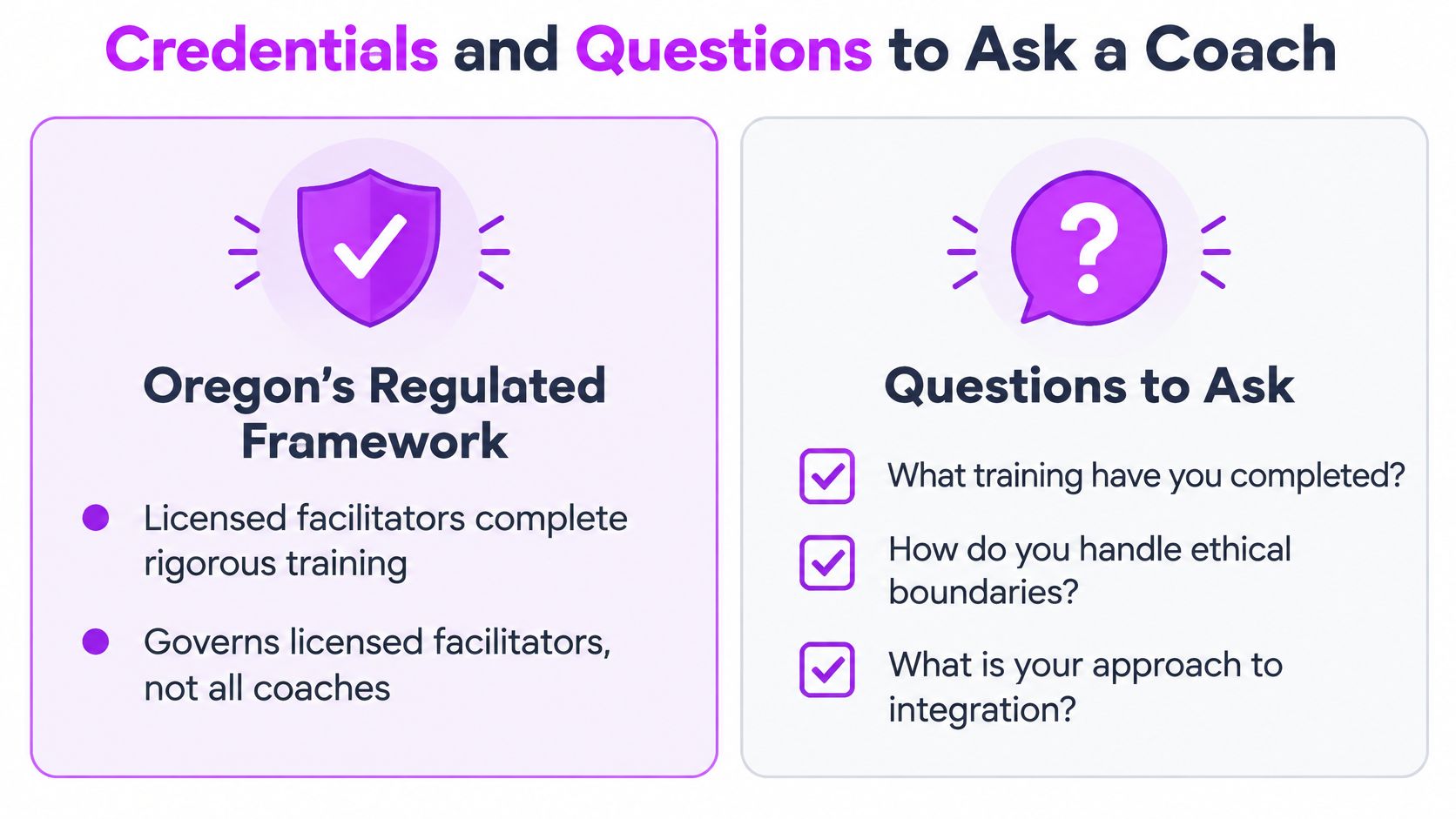
That same workforce survey found the average program ran 8.1 months across 15 programs, with a range of 3 to 12 months. Use these numbers as a benchmark, not a requirement, because the framework governs licensed facilitators rather than every coach working in the integration space.
Questions that separate a professional from an enthusiast
- Training and hours. What did your training involve, and how many hours did it take?
- Role clarity. Do you provide coaching, clinical therapy, or regulated psychedelic services?
- Referral pathway. What do you do when symptoms worsen, and who do you refer to?
- Consent and records. How do you document consent, and who can see your notes?
- Licensure. Are you licensed or certified, and in which state or country?
Ask for each answer in writing. A coach who can't put their scope on paper hasn't defined it.
Access, Consent and Cultural Fit
Two coaches look similar on a training page. One fee covers three months. The other would force you to stop halfway. Cost is the first filter, so ask about it directly. Look for sliding-scale fees, group or peer-supported formats, and a payment plan you can sustain, rather than an open-ended series you abandon in month two.
Language is the next filter. Confirm the coach can work in your first language, or that an interpreter is available and included. Insight work is hard enough without translating your own memories in real time. Remote sessions remove transport barriers for people with disabilities or long commutes. Before you say anything sensitive, ask how notes and any recordings are stored.
Written consent is the fence line of this role. It should name what the coach records, who can see it, and the point where coaching stops. Imminent risk of harm is the standard break in confidentiality. That break calls emergency services, not a longer coaching conversation. Clinical care starts on the other side of that line.
If a coach dismisses your cultural or spiritual framework as noise, or pressures you to skip a referral step, look elsewhere.
A 2025 ethics review found that psychedelic research has been drawn largely from affluent, educated, White participants, as the ethics review of psychedelic integration practice sets out. People whose communities rarely show up in that research still need a coach who treats their framework as part of the work.
Ask how the coach handles cultural or Indigenous frameworks, and whether they have experience with communities different from their own. Privacy needs the same scrutiny when disclosure could affect employment, immigration status, family relationships, or legal exposure. The consent form should name those risks and the referral that follows them.
Choose Integration Support With Clear Limits
No single integration method has been proven best. A systematized review covering 75 publications, including clinical trials, treatment manuals, protocols, qualitative studies, reviews and opinion papers, concluded that rigorous research on integration frameworks remains insufficient and that most available evidence wasn't empirical enough to support definitive claims about which approach works best, per the review of integration frameworks.

That limits what anyone can promise you. A coach should describe their techniques as structured reflection and supportive practice, not as validated mechanisms for preventing harm or treating PTSD, anxiety or depression. Anyone offering certainty about outcomes is selling past the evidence.
Here's the sequence that keeps the decision grounded.
- Name the goal. Meaning, habit change, or preparation before an experience. Write it down in one sentence and revisit it in a month.
- Screen for the warning signs. Run through the escalation list before the first session, not after the third.
- Confirm credentials and scope in writing. Training, role, licensure, and what happens when things go sideways.
- Agree on referral and crisis contacts. Names and numbers, in the client's possession, dated and signed.
- Start a between-session log for two to four weeks and review it together before deciding whether to continue.
For step five, MicroTrack is one practical option. It keeps dose context, a 10-point mood scale and later reflections in separate, two-phase entries, so session details get recorded first and interpretations added afterward. Trend views across weeks and months show whether an insight is moving anything, and CSV export gives a coach or clinician the underlying record.
The decision in front of you isn't which method is most powerful. It's whether this person's scope, records and referral plan match the limits of what you're dealing with.
MicroTrack gives you a calm place to record dose context, daily mood on a 10-point scale, and reflections added later, so the record stays a timeline instead of a memory. Trend views across weeks and months show what shifted, and CSV export means a coach or clinician can review the same data you're looking at. Start free at MicroTrack and bring a real record to your next conversation.