Self Improvement Journal: How to Track What Really Changes
A notebook sits by your bed with eleven pages filled and thirty empty. The filled ones are a jumble: a to-do list from a Tuesday, half a page about a difficult phone call, one line that reads "bad day, no idea why." You meant to keep a self improvement journal this year. You lasted about two weeks, missed a night, missed three, and now the sight of it feels like a small accusation.
The problem usually isn't discipline. It's that the notebook was given two incompatible jobs at once: hold your feelings in full and prove that something changed. Feelings need room. Proof needs repetition. A page asked to do both ends up doing neither, and you quit around day 14.
This guide treats a self improvement journal as a small measurement system instead. Fewer fields, fixed scales, honest weekly reviews. You'll see which fields earn their place and why a six-field entry beats a sixteen-field one, how to log a full entry in five minutes, how to turn a vague wish into a target your own numbers can settle, and how to tell a real change from a good week. You'll also see where tracking turns against you, because it sometimes does.
Table of Contents
- The Core Fields Every Useful Journal Tracks
- How to Run a Daily Entry in Five Minutes
- Set Goals You Can Check Against Your Entries
- Reading Weekly Trends Without Fooling Yourself
- When Tracking Starts Doing Harm
- Why Apparent Progress Can Mislead
- Pick Your Journal Setup and Start This Week
The Core Fields Every Useful Journal Tracks
A diary asks you to write whatever comes up, in whatever order, with whatever words you have that night. A measurement system asks the same six questions at roughly the same moment each day, which is what makes a Tuesday in March comparable to a Thursday in June. The comparison is the whole point. The writing is just the recording step.
Core fields and formats for every entry
| Field | What to record | Format | Why it matters |
|---|---|---|---|
| Mood | Overall state at the time of entry | 10-point scale with fixed anchors | Makes trends comparable across weeks |
| Energy | Physical and mental energy | 1 to 10 scale | Separates tiredness from low mood |
| Anxiety or stress | Tension level at the moment | 0 to 10 scale | Shows early warning signs |
| Sleep | Hours slept and how rested you felt | Hours plus 1 to 5 quality rating | Allows checks on next-day mood |
| Context | Key event, place or company | One phrase or tag | Explains outlier entries |
| Practice or intervention | What you did and when | Checkbox plus time | Links actions to outcomes |
The format column does quiet work here. Scales and checkboxes keep an entry fast enough to finish on a bad night, and they produce numbers you can line up later, where a paragraph of prose would produce only impressions.
Six fields look thin beside a page of prompts, and the thinness is the design. The two fields people skip most often are the two that pay off later. Energy separates a flat mood caused by tiredness from a flat mood that arrived after nine hours of sleep, and those need different responses: one calls for an earlier night, the other for a harder look at the day itself. Anxiety or stress gets its own zero-to-ten rating because tension moves independently of mood. You can have a good day and a clenched jaw, and only one of those numbers tells you the deadline is costing you.
Anchors matter more than the field list. Decide before you need them what 1, 5 and 10 mean: 1 is the worst day you can imagine, 5 is neutral, 10 is the best day you can recall. Without written anchors the ruler drifts. A hard fortnight recalibrates what you call normal, and a 6 in June stops meaning what it meant in March. Write the definitions at the top of the template so each rating is checked against a fixed meaning rather than this week's weather.
This is the same logic researchers use when they replace end-of-week recall with brief mood entries taken close to events. In a UK university sample of 171 young adults, a brief ecological momentary assessment mood measure showed very high between-person reliability (RkR ≥ 0.98) and moderate within-person reliability (Rc ≥ 0.64 for positive and negative mood dimensions), with two principal components explaining 75.8% of the variance, separating positive and negative affect, as reported in University of Bristol research on ecological momentary assessment of mood.
Why six fields is the ceiling
Every field you add is a field you'll skip on a bad night, and skipped fields break the comparison that justified the whole exercise. Six is about as much as people will complete consistently while still recording entries close to the moment they describe. Timestamps add a second benefit: with a time on each entry, you can check whether a poor night's sleep or a morning practice shows up in the afternoon rating. That pairing of a checkbox and a clock is what turns the last field into evidence, since "walked at 7 a.m." can later be set against a 3 p.m. slump in a way that "walked today" never can.
A usable template takes about ten minutes to build from this table: six fields, written anchors, one line each. If you want to see how these fields connect to a wider picture of how you're doing, this overview of well-being indicators is worth reading before you finalise your list.
How to Run a Daily Entry in Five Minutes
It's 10:40 p.m., the dishes are done, and the last thing you want is a writing assignment. That is exactly the night a daily entry has to survive. A long, open-ended session suits a quiet Sunday, but the version that holds up on a tired weeknight is short, fixed in shape, and attached to something you already do, such as clearing the dinner plates or brushing your teeth. Five minutes is the ceiling, not the target. The entry works like a quick instrument reading: same dials, same order, every night.
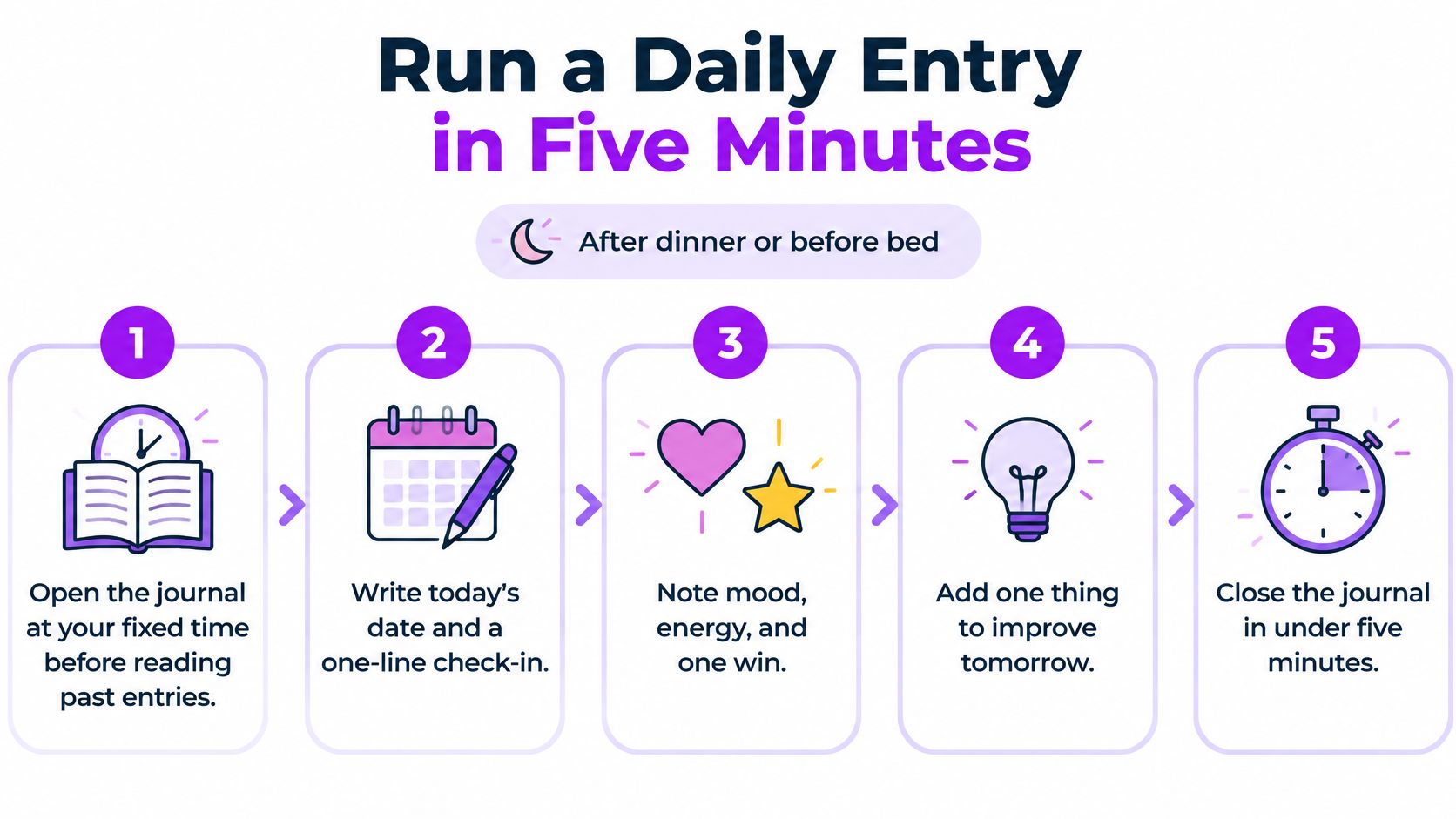
Here's the whole routine in one picture.
The six steps
- Open the journal at your fixed time, before reading any past entries. Yesterday's ratings anchor today's, and the pull is strong enough to flatten a week's real variation. The common slip is scrolling back to "remember where you were," which turns a fresh observation into a comparison.
- Rate mood against your anchors, then energy, anxiety and sleep. Same order every night, so no field gets skipped because you're bored of it. Skipping the anxiety field on calm days is the slip; the calm days are what the trend line compares against.
- Add one context phrase. "Deadline," "long walk," "difficult call with Mum." A phrase is enough to explain an outlier later. A paragraph isn't, because you won't reread it, and if you do, it drags you into analyzing instead of recording.
- Log any practice or intervention with the time it happened. Morning walk at 7:40, dose at 9:15, therapy at 4. The timestamp is what lets you ask later whether a morning action showed up in an afternoon rating.
- Write one neutral sentence about what you noticed. "Slept badly, mood flat, walked at lunch" is a good entry. "Terrible day, failed again" is not an entry, it's a verdict, and verdicts invite argument at 11 p.m.
- Save and stop. Set a five-minute timer if you're the type to keep writing. Closing the notebook while you still have something to say is what keeps tomorrow's entry easy.
Notice what this sequence really is: a measurement ritual, not a writing practice. Every field answers in the same units on the same scale, which is what makes tonight's entry comparable to one from three weeks ago. The moment the routine turns into composition, the measurement part suffers, because tired people skip whatever feels like homework.
Practical rule: If an entry took more than five minutes twice in a week, cut a field or shorten the note. Length is the first thing to break, and it never announces itself.
Signs the routine is holding: entries finish under five minutes, most days have every field filled, and your notes read as observations rather than judgments. When those start slipping, treat it as a design problem. Shorten the entry before you question the habit, because a routine that fails on bad nights was never calibrated to real life in the first place.
Set Goals You Can Check Against Your Entries
A target you can't check against your own numbers is a mood, not a goal. "Be less stressed" can never be settled by evidence, so it survives every review regardless of what your week looked like. The fix is mechanical: one outcome per goal, one threshold, one review interval, held steady for at least four weeks.
Vague goals rewritten as checkable goals
| Vague goal | Measurable version | Review interval |
|---|---|---|
| Be less stressed | Stress rating averages 4 or below on weekdays | Weekly |
| Sleep better | Sleep at least 7 hours on 5 of 7 nights | Weekly |
| Exercise more | Three 20-minute walks logged per week | Weekly |
| Feel more focused | Focus rating 7 or higher on at least 3 workdays a week | Every two weeks |
The sequence that makes these work: pick one goal, read two weeks of entries to see where you are, convert the wish into a threshold, set the review interval, and decide in advance what counts as enough. That last step is the one people skip, and it's why a good week and a bad week can both "prove" the same story.
Say your stress ratings have averaged 6 on weekdays for two weeks. A checkable version is 4 or below on weekdays, reviewed every Sunday, for four weeks. Now the question isn't whether you feel calmer, it's whether the average moved and whether enough entries exist to say so. Same numbers, much harder to fool.
The habit is not the goal. Writing daily is a useful secondary tracker, and it's the first thing to check when entries start thinning. If it becomes the main outcome, the journal starts rewarding compliance instead of change: you'll hit a thirty-day streak and learn nothing about your stress. Keep the streak in the background where it belongs, and treat a missed day as a data point rather than a debt. If scheduling is where your attempts tend to collapse, this guide to building a habit schedule covers how to attach a new routine to an existing one.
Write it in one line: Stress at 4 or below on weekdays, from a baseline of 6, reviewed Sunday for four weeks.
Reading Weekly Trends Without Fooling Yourself
Tracking earns its keep when the record is tied to a specific behavior and reviewed for change, not collected as free-form reflection. That's not a philosophy, it's a measured effect. A systematic review and meta-analysis of 19 randomized intervention studies involving 2,800 adults found that self-monitoring produced a statistically significant short-term reduction in total sedentary time, with Hedges' g = 0.32 and a 95% confidence interval of 0.14 to 0.50, published in the International Journal of Behavioral Nutrition and Physical Activity.
Read that carefully. It shows that feedback from measurement can shift behavior. It does not show that journaling improves mood, and anyone who tells you otherwise is selling something. What transfers is the mechanism: you measure, you look, you adjust.
The weekly review is where the looking happens. Fifteen minutes, same day each week, following this order.
- Average each field for the week and set it against your baseline. Two prior weeks is enough to start. Write the number down; a remembered average drifts toward whatever you believe about yourself.
- Count the blanks. More than two missing days and the average is weak evidence, so label it that way rather than building a decision on it.
- Compare exposure days with non-exposure days. Walked on four days, skipped on three? Average mood on each set, and note how many entries sit behind each number. Three entries versus four is a hint, not a finding.
- Check lagged links. Did three poor sleep nights predict a lower mood the following day? Lag is where most journal users find their one useful pattern, because same-day effects are usually muddled by everything else happening.
- Look at the spread, not just the average. One unusually good Saturday can drag a week's mean upward. If the range is wide, the average is hiding the story.
- Write one sentence about the pattern and one question for next week. "Mood higher on walk days, but I only walked on sunny days. Does the weather explain it?" That sentence is the entire output of the review.
A pattern is a question to test, not a conclusion to keep. Write it as a question and next week's entries answer it.
When Tracking Starts Doing Harm
A journal works like a thermometer: useful when checked on schedule, noisy when held under the tongue all day. A 2025 systematic review of 77 mood-monitoring and ambulatory-assessment studies found that 19% reported adverse events and 26% reported usability problems, with privacy concerns, frustration and negative psychological effects among the issues identified, though the authors noted causality was uncertain because adverse events were underreported, as detailed in JMIR Mental Health's review of mood monitoring.
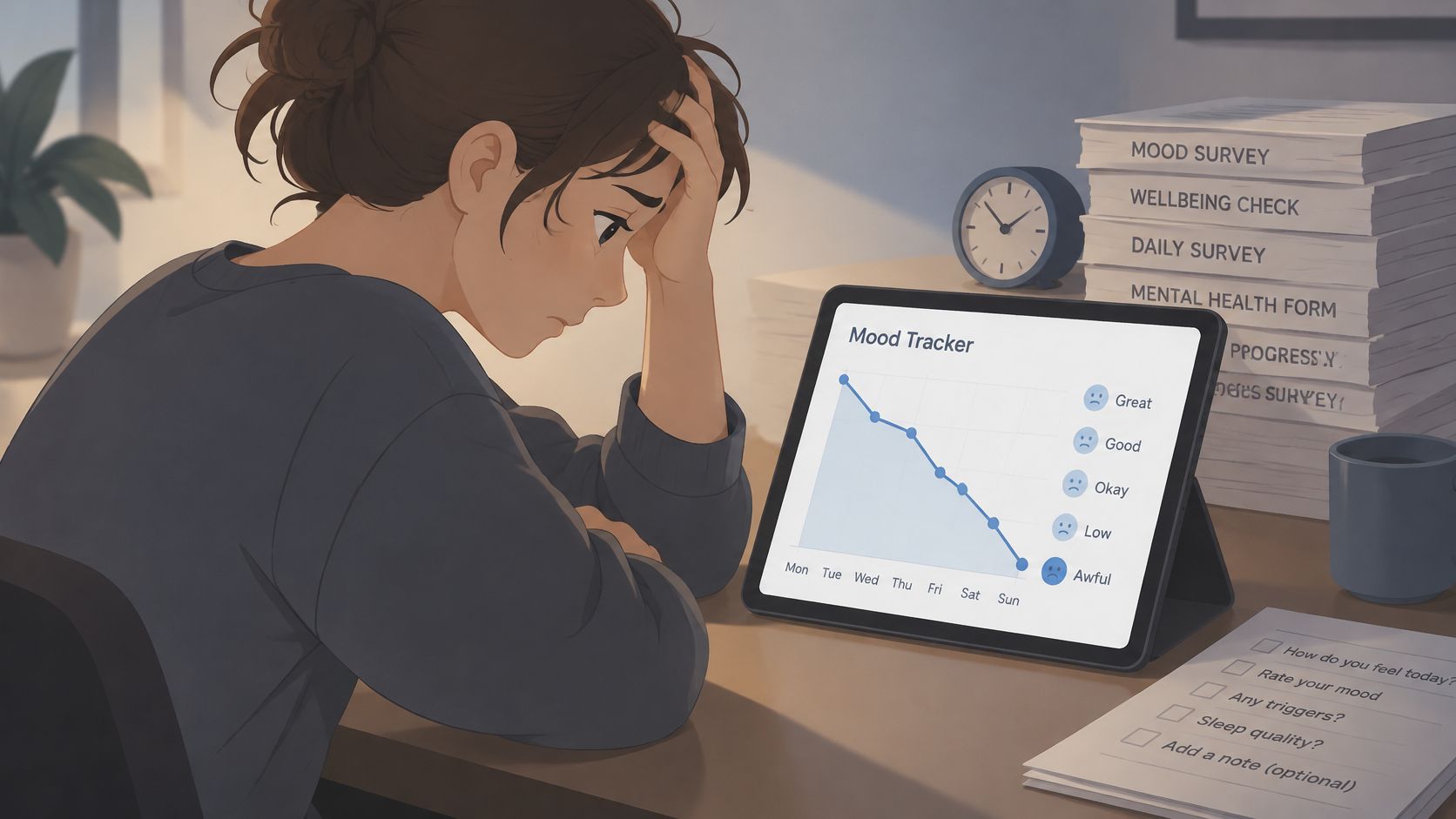
Those negative experiences describe a specific mechanism worth naming: tracking can turn attention toward negative emotion and add a burden of its own. The line between reflection and rumination shows up in behavior before it shows up in wording.
Warning signs worth acting on
- Checking several times an hour. A nightly log has no need for a mid-morning refresh.
- Pressure to produce a positive record. Rounding a 4 up to a 6 makes the chart calmer and the measurement worse.
- Every dip read as personal failure. Mood moves; a bad Tuesday is weather passing through a longer climate.
- Entries getting longer and more anxious. Length creeps up when the writing starts doing worry's work.
- Avoiding activities so nothing uncomfortable gets logged. The journal is steering when choices bend around the chart.
Guardrails that keep tracking useful
Make entries optional, so a missed day counts as information instead of debt. Take planned breaks of a week or two each quarter and see whether you miss the record or feel lighter without it. Keep sessions bounded, and write neutral observations instead of forced positivity. If tracking is raising your distress rather than explaining it, stop and talk to a qualified clinician. When mood sits beside a substance routine, treat each fluctuation as one clue among many; most of a day has causes beyond any dose. Smaller, steadier tracking usually teaches more than maximal collection.
Why Apparent Progress Can Mislead
You start something new on a Monday. By Friday you've slept better, snapped at fewer people, and the week feels like proof. It might be. It might also be a good week that would have happened anyway, and the difference matters if you're going to keep doing the thing for months.
Expectation is the first trap. When you believe you're improving, you tend to rate your mood a little higher, and the rating is the outcome you're measuring. That's not dishonesty; it's how self-report works. Placebo response is the second. In controlled conditions, the inactive group often improves too: a 2024 review in the American Journal of Psychiatry described a placebo-controlled trial with 109 participants without psychiatric disorders that found no psychological benefit from microdosing compared with placebo, and concluded that rigorous controlled-trial evidence doesn't support the efficacy or safety of microdosing any psychedelic for a psychiatric disorder.
Regression to the mean is the third and the most common. You start tracking because a stretch was unusually bad. Unusually bad stretches end, and the following weeks look better whether or not you changed anything. Confounders are the fourth: sleep, exercise, social contact, holidays and seasons all move the same scores you're watching, often at the same time as the habit you're testing.
Practical checks, then. Write the outcome and the comparison you plan to make before you start. Record changes in other habits alongside the outcome, so a new walking routine doesn't get credited to something else. Compare against your baseline rather than against your worst week. Judge trends across at least four to six weeks. Use "associated with" instead of "caused by" until you have that much data, and be honest that a personal journal can't establish whether any treatment is safe or effective; persistent anxiety, depression or PTSD symptoms belong in front of a qualified clinician, records in hand. For a fuller treatment of the distinction, this explanation of correlation versus causation is a good companion.
The test: would the pattern still hold if you set aside your favorite explanation? If the answer is no, you've found a hypothesis, not a result.
If you log a substance, record the exact dose, date, frequency, skipped doses, physical symptoms and cumulative duration of use rather than mood alone. That's not box-ticking. A 2024 rapid review identified 19 placebo-controlled studies of low-dose LSD and psilocybin and found that none had investigated long-term safety, while flagging a theoretical cardiac concern from chronic exposure to 5-HT2B receptor agonists even at low doses, according to research on the safety of repeated low doses. Frequency and duration are the fields a clinician will ask about first.
Pick Your Journal Setup and Start This Week
Test any notebook or app against five criteria before you commit: an entry takes under a minute, basics can go in first and reflections added later, the history is searchable, the data exports, and the whole thing stays private. Fail two of those and you'll be rebuilding your system in a month. MicroTrack, a wellness journaling and habit-tracking web application, is one option to hold against the same list, and paper works equally well as long as the fields and scale stay fixed.

The first week has five moves.
- Pick five or six fields from the table. Not seven. If you can't decide, drop context before you drop sleep.
- Write one goal on a single line with its baseline, threshold and review date.
- Set a fixed daily entry time and attach it to something you already do at that hour.
- Book a 15-minute weekly review on the same day each week, in your calendar, with a reminder.
- Set a 30-day checkpoint to ask whether these fields still answer your question. Some will, and one usually won't.
A finished first month looks unremarkable from the outside: a rough baseline from week one, twenty or more entries, a weekly review you attended, and one clear question about what moves your outcome. That question is the product. Everything else is bookkeeping.
MicroTrack is built for exactly this kind of light system: a 10-point mood scale, entries you can start in under a minute, session details recorded first with reflections added later, and mood trends across weeks and months when you're ready to review. There are no streaks and no scores to protect, so a missed day stays a data point instead of a failure. Start with five fields tonight, then visit MicroTrack and see what a month of honest entries tells you.