Shrooms and Epilepsy: Seizure Risk and What to Do
If a small dose feels manageable, does that mean it's safe for someone with epilepsy? That question misses something important: the amount taken, the actual ingredients, and the person's medication can't be assessed separately.
The evidence on shrooms and epilepsy doesn't establish a safe pattern of use. The practical task is to identify which uncertainties apply to you, recognize when an exposure needs urgent care, and bring the right information to a neurologist rather than trying to settle the question through self-experimentation.
Table of Contents
- What Research Shows About Psilocybin and Seizures
- What the High-Dose Case Teaches
- Who Faces the Highest Risk and Which Medicines Matter
- Why Mushroom Products Are Unpredictable
- What to Do After an Unplanned Exposure
- Legal Status and What a Tracker Can Show
- Research Directions and Open Questions
- Harm-Reduction Plan and the Neurologist Decision
What Research Shows About Psilocybin and Seizures
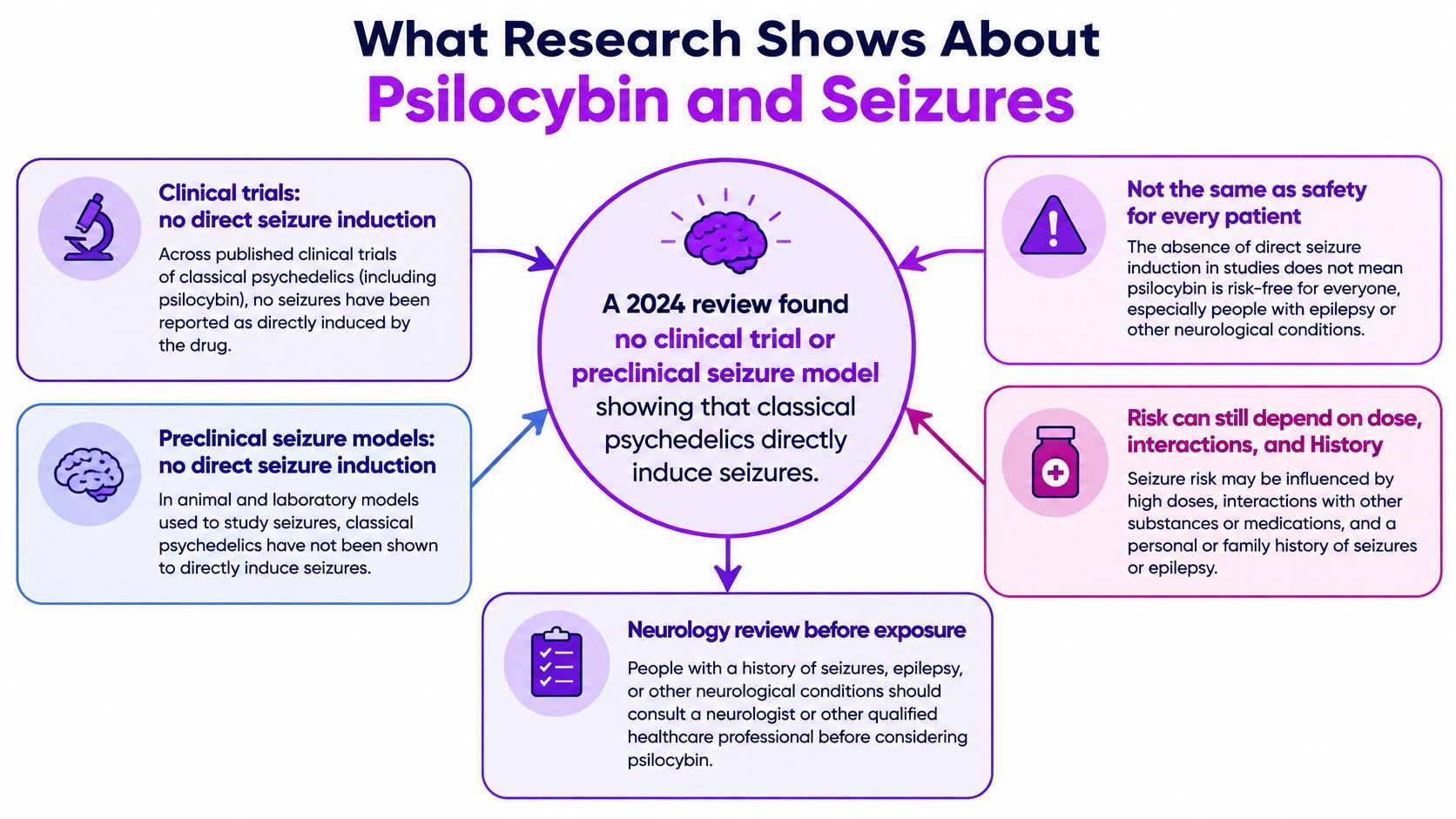
A 2024 review of psychedelics and seizures found no clinical trial or preclinical seizure model demonstrating that classical psychedelics directly induce seizures. That's a narrower conclusion than saying psilocybin can't provoke a seizure, and much narrower than saying it's safe for someone with epilepsy.
The distinction matters because researchers can only draw conclusions about the people, compounds, doses, and conditions they studied. Clinical trials commonly exclude people with current epilepsy or seizure histories. Reassuring findings from selected participants therefore don't automatically apply to someone taking antiseizure medication or living with recurrent seizures.
A smoke detector that has never gone off doesn't prove a building is fireproof. Likewise, an absence of demonstrated seizure induction isn't proof that every susceptible person can tolerate an exposure.
Separate the evidence into distinct questions
- What happens in supervised settings? Available evidence doesn't establish a consistent seizure-provoking effect when classical psychedelics are administered under controlled supervision.
- Has safety been established for epilepsy? No. Findings from people without epilepsy can't answer that question on their own.
- Are there warning signals? Yes. A monitored case showed a dose-related contrast in epileptiform activity, which warrants caution without proving causation.
The evidence map below captures that distinction between a negative finding and a safety guarantee.
Why attribution remains difficult
Some adverse-event reports involved alcohol, other drugs, or concomitant medicines. When several exposures occur together, a seizure afterward doesn't identify which substance caused it, whether an interaction contributed, or whether the person's underlying epilepsy accounted for the event.
That uncertainty cuts both ways. It prevents confidently blaming psilocybin for every reported seizure, but it also prevents dismissing those seizures as unrelated. An analyst's conclusion should preserve both limits rather than choose whichever interpretation sounds more reassuring.
Working rule: Treat dose, timing, sleep, medication, and symptoms as separate variables. A change in one doesn't cancel out uncertainty in another.
For someone with epilepsy or a seizure history, the actionable answer is neurology review before any use. Recording an exposure may help a clinician reconstruct events, but self-tracking can't provide the supervision or electrical monitoring needed to establish neurological safety.
What the High-Dose Case Teaches
The most informative human warning comes from a person whose brain activity was recorded, rather than reconstructed entirely from memory. A 2023 case report described a 31-year-old man with refractory frontal epilepsy whose implanted responsive neurostimulation device recorded increased epileptiform activity after mushroom exposure.
A responsive neurostimulation device measures electrical activity directly. That makes the observation more informative than a report based only on how intoxicated someone felt or whether a companion noticed convulsions. It doesn't, however, turn an uncontrolled exposure into a clinical experiment.
Dose contrast in the monitored case
| Exposure | Reported dose | Observed outcome | Limit of interpretation |
|---|---|---|---|
| High-dose exposure | 3.6 g of psilocybin-containing mushrooms | 32 prolonged epileptiform episodes, each at least 30 seconds | One patient; potency varies; not a safe threshold |
| Lower-dose exposure | 1.5 g of psilocybin-containing mushrooms | No change to baseline seizure frequency | One patient; does not establish safety at this dose |
The higher exposure was associated with a marked increase in recorded activity, whereas the later, lower exposure didn't change baseline seizure frequency. That contrast is a warning signal, not a boundary separating dangerous use from safe use.
What the device could and couldn't establish
The limitations belong in a specific order. First, the report concerned a single patient with a particular form of difficult-to-control epilepsy. His response can't define what would happen in someone with a different seizure disorder or medication regimen.
Second, mushroom weight doesn't establish the exact amount of active compound consumed. Without confirmed composition and potency, the reported mass can't be translated into a dependable psilocybin dose.
Third, there was no control group. The observation can identify a concerning sequence, but it can't isolate every contributor or prove that dose alone caused the difference.
A lower exposure without an observed increase is not a dose recommendation for the next person.
The common inference that a small amount must be harmless fails for the same reason. A reassuring result in one person doesn't identify who else might react differently, and it doesn't tell you whether another mushroom batch represents the same exposure.
Turn the observation into useful clinical information
The practical lesson isn't to reproduce either exposure. People with epilepsy shouldn't use dose escalation or repeated trials to discover their personal limit.
If exposure has already occurred, report the amount, product, timing, medication schedule, and symptoms to the treating clinician. Distinguish what you know from what you estimated: a weighed amount, a package serving, and a guessed portion aren't equivalent records. That distinction gives the clinician something assessable rather than a falsely precise account.
Who Faces the Highest Risk and Which Medicines Matter
Seizure risk by epilepsy status and medication
| Situation | What the evidence shows | Action before any use |
|---|---|---|
| Refractory or active epilepsy | Case report: 32 prolonged episodes after 3.6 g, one patient | No-go unless a neurologist directs otherwise |
| Epilepsy controlled on medication | No trial or model establishes direct seizure induction, but most trials exclude epilepsy | Neurologist review before any decision |
| Seizure history without diagnosis | Safety hasn't been established for this situation | Neurology evaluation first |
| Taking lithium | 2 of 6 online reports of lithium plus psilocybin involved seizures | Disclose to prescriber; don't stop lithium abruptly |
| Taking lamotrigine | 0 of 10 online reports involved seizures | Disclose; observational data only, not clearance |
| Taking other antiseizure medicines | Reliable interaction evidence is insufficient | Pharmacist and neurologist interaction check |
| Recent sleep loss, alcohol or other drug use | Contextual contributors and confounders in reported adverse events | Avoid combining; record in a log |
Read this as a situation lookup, not a validated risk score. Active or refractory epilepsy deserves particular concern because the strongest monitored warning involved that setting. Controlled epilepsy still requires review, and a previous unexplained seizure calls for evaluation rather than an assumption that no diagnosis means no risk.
Lithium requires a separate conversation
The Psychiatric Times clinician's guide to pharmacological interactions describes 2 of 6 online reports involving lithium plus psilocybin as involving seizures, compared with none of 10 involving lamotrigine plus psilocybin. These are observational online reports, not controlled trials or individual risk estimates.
Lithium already carries seizure and delirium concerns, and clinicians have described its combination with psilocybin as strongly contraindicated. Don't try to resolve that concern by abruptly stopping lithium or substituting another medicine. Tell the prescriber what you take and what exposure you're considering.
The lamotrigine finding is less reassuring than it first appears. No reported seizures in a small, selected collection of accounts doesn't establish compatibility, demonstrate protection, or justify changing treatment.
Review the whole medication list
For other antiseizure medicines, insufficient interaction evidence means a pharmacist and neurologist need to assess the actual regimen. Include antidepressants and other psychiatric prescriptions, not just medicines labeled for seizures; the discussion of mushrooms and antidepressants can help you prepare questions without clearing a combination.
Sleep loss, alcohol, and other drugs also belong in that conversation. They make the clinical context harder to interpret and shouldn't be treated as background details.
No row identifies a safe dose. If you match a row and have a seizure history, stop planning an exposure and book a neurology review. The table sorts the questions that need answering; it can't answer them for an individual.
Why Mushroom Products Are Unpredictable
A product labeled mushroom or psilocybin may not contain a predictable amount of psilocybin. Product identity is therefore a clinical question, not merely a shopping detail.
A review of medication and product-quality concerns discusses the CDC investigation of Diamond Shruumz microdosing chocolates, in which severe illness included seizures and central-nervous-system depression. Products were associated with compounds including muscimol, ibotenic acid, psilocin, and psilocybin, making a simple explanation based on a mushroom label inadequate.
Product types and their seizure-relevant concerns
| Product type | Compounds reported | Seizure-relevant concern |
|---|---|---|
| Laboratory-verified psilocybin product | Psilocybin, as stated by the test report | Dose is known to the extent established by testing, but interaction and epilepsy risks still apply |
| Mushroom chocolates or edibles | Muscimol, ibotenic acid, psilocin or psilocybin, per CDC findings | Dose unpredictable; seizures and CNS depression reported in severe cases |
| Amanita-associated products | Muscimol and ibotenic acid | Not psilocybin; neurologically active compounds |
| Unknown or mixed product | Unconfirmed ingredients or mixtures | Potency, contents and interactions unknown |
Predictable contents don't mean established safety
Laboratory verification can reduce uncertainty about what was tested. It doesn't establish that the identified compound is appropriate for a person with epilepsy, and it doesn't resolve an interaction with that person's medicines.
Chocolates and other edibles add a different problem: a familiar food format can make an uncertain drug exposure seem standardized. A serving description isn't a substitute for an analysis identifying the compounds and their amounts.
Amanita-associated products require a separate assessment because their relevant compounds aren't psilocybin. Unknown mixtures leave even the starting question unanswered: which substance should the clinician evaluate?
Controlled study findings can't be transferred to products with unconfirmed ingredients. The person, dose, and setting may already differ from a trial, and an uncertain product adds another gap.
What to record about a product
- Identity: Keep the full product name, manufacturer information, and packaging.
- Batch evidence: Ask for a laboratory report tied to the specific batch, rather than treating a general marketing statement as verification.
- Listed compounds: Transcribe ingredient names exactly and flag anything the label leaves unspecified.
- Uncertainty: Write unknown when composition or amount can't be established.
Don't assume that a psilocybin label means psilocybin is the only active ingredient. Record the product name and batch with any exposure entry so a clinician can distinguish an identified compound from an unidentified mixture.
What to Do After an Unplanned Exposure
If you or a companion has already taken a product, triage symptoms before completing a log. Information gathering must not delay emergency care.
Follow the seizure action plan if a seizure starts. Call emergency services if it exceeds the plan's threshold, repeats without recovery, or involves injury or breathing difficulty. If there's no plan or you're unsure what's happening, seek emergency help rather than guessing.
Treat confusion, unusual drowsiness, or slowed breathing as urgent. These can indicate a serious neurological reaction, including central-nervous-system depression. Don't assume the person merely needs to sleep off the exposure.
Preserve the product information. Keep packaging, batch details, and any remaining product securely for identification, and write down the amount, time, alcohol, medicines, and other drugs taken. Don't handle an uncertain product as though its label proves its contents.
Contact the neurologist or prescriber the same day, even without an obvious seizure. Electrical abnormalities aren't always visible to a companion. Describe what happened without declaring the exposure harmless because there were no convulsions.
Don't improvise medication changes. Don't take extra antiseizure medicine, skip prescribed doses, or stop lithium to offset the exposure. Follow an existing rescue prescription as directed and ask a clinician about anything outside that plan.
Don't drive, and avoid being alone if you have a seizure history. Ask a trusted person to stay available while you obtain clinical advice. A companion can notice deterioration and communicate when you can't.
Build a timeline once immediate needs are addressed. Record sleep, sensations, symptoms, and any witnessed event, including what the observer saw. Guidance on overdose on shrooms offers additional context, but reading it shouldn't postpone urgent assessment.
What to tell the clinician
Separate confirmed facts from estimates. A clear account of an uncertain exposure is more useful than a precise-looking dose you can't substantiate.
Legal Status and What a Tracker Can Show
In the United States, psilocybin remains a Schedule I controlled substance under the federal Controlled Substances Act, and it has no FDA-approved indication, according to this clinical discussion of psychedelic indications, risks, and benefits. The discussion describes access as generally limited to research settings and highlights the legal and purity uncertainties associated with personal use.
The DEA definition of Schedule I includes high potential for abuse, no currently accepted medical use in treatment, and a lack of accepted safety for use under medical supervision. That classification isn't the same question as whether a particular molecule can ever have therapeutic effects, but it does matter when someone interprets personal use as approved medical treatment.
A diary records observations, not electrical activity
A journal can organize the timing of symptoms, medication, sleep, and exposures. It cannot detect electrical brain activity, verify a seizure diagnosis, or demonstrate that a substance prevented an event.
A period without a recorded seizure may reflect what the person noticed and documented. It doesn't establish what monitoring would have found, and an improvement in mood doesn't establish an improvement in epilepsy.
A diary can document an experience. It can't certify neurological safety.
Use entries as a record to share with a clinician, who can decide whether symptoms need further evaluation or monitoring. Avoid labeling an ambiguous sensation as a confirmed seizure, or treating an uneventful entry as proof that a product is safe.
The practical distinction is between supporting clinical assessment and replacing it. A useful log makes uncertainty visible: unknown contents, estimated amounts, missed observations, and symptoms that need interpretation.
Neither a legal assumption nor a personal record makes unsupervised use safe for someone with epilepsy. A logged improvement is not evidence that psilocybin is a clinically validated epilepsy therapy.
Research Directions and Open Questions
What evidence would let a neurologist assess the risks of psilocybin for a person with epilepsy? The most useful studies would address specific seizure disorders, medicines, and products rather than treating psychedelics as a single exposure.
Study the people and exposures that matter
Studies involving people with epilepsy could show whether findings from selected psychedelic-trial participants apply to this population. Safeguards would be needed, and inclusion in a study would not establish that exposure is appropriate for everyone with epilepsy.
Studies using verified doses alongside EEG or implanted-device monitoring could examine dose-response relationships more directly than mushroom weight or visible symptoms alone. The aim would be to identify concerning patterns and possible risk boundaries, not to declare a dose safe because no event was observed.
Medication research should examine specific combinations, including lithium and antiseizure medicines such as lamotrigine. Prescribers need evidence about each combination, rather than a general claim that psychiatric medicines and psychedelics are compatible or incompatible.
Make products and reports interpretable
- Use standardized, preregistered protocols: Studies in people with epilepsy should specify the product and dose, define how seizure outcomes are assessed, and report those outcomes clearly.
- Test individual batches: Laboratory identification of compounds, including muscimol and ibotenic acid, would let investigators classify exposures by contents rather than marketing names.
- Standardize adverse-event records: Reports should capture dose, product identity, batch, medications, sleep, and co-substances so clinicians can assess competing explanations.
These research questions depend on one another. A dose-response result is difficult to interpret if the product's contents are unknown, while an interaction report is limited if the medication schedule is missing.
Better evidence could clarify which combinations warrant avoidance, whether any dose boundary can be supported, or whether a particular interaction should lead a prescriber to advise against exposure. Until those questions are answered, repeated personal trials cannot establish safety.
Harm-Reduction Plan and the Neurologist Decision
A harm-reduction plan starts with deciding whether exposure should happen at all. It's not a checklist that turns an unestablished use pattern into a safe one.
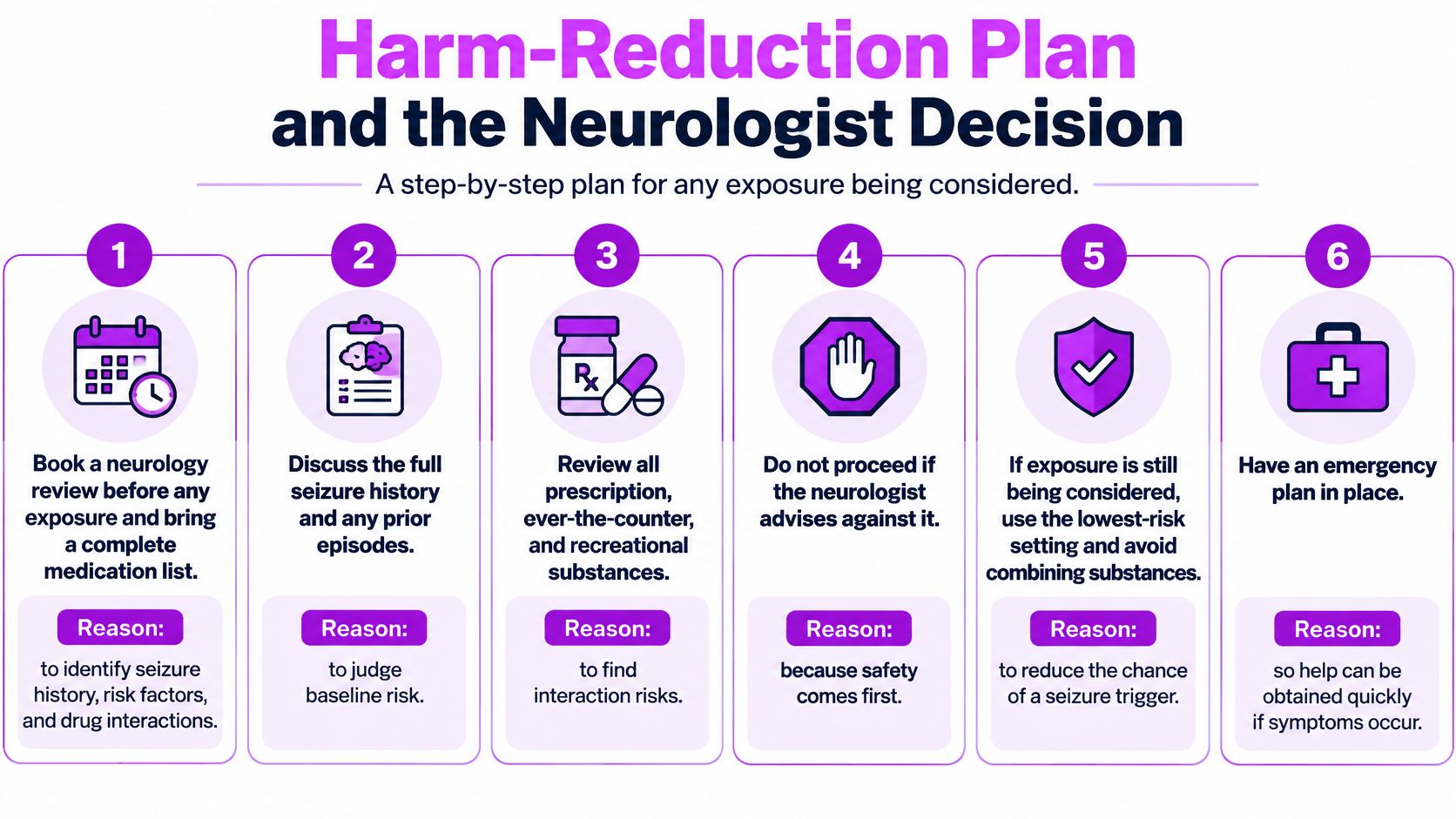
Use the following visual as a prompt for the clinical conversation, not as clearance to proceed.
Put the clinical review before the exposure
Book a neurology review and bring the complete medication list. Include prescriptions, over-the-counter products, supplements, and recreational substances. The clinician needs the full picture to assess seizure history and potential interactions, not just the medicine you consider most relevant.
Ask a pharmacist to check each medication combination. Flag lithium separately rather than burying it in the list. If interaction evidence is absent, ask what that uncertainty means for the decision instead of interpreting a missing warning as approval.
Identify the proposed product. Bring the source information, label, batch details, laboratory report, and intended amount. Treat an unidentified product as unknown, and don't substitute a different batch or formulation without acknowledging that the proposed exposure has changed.
Avoid alcohol, other drugs, and sleep deprivation. Don't plan an exposure around a night of drinking or inadequate sleep. These factors complicate both the clinical risk assessment and any attempt to interpret symptoms afterward.
Keep the antiseizure schedule unchanged unless the prescriber directs otherwise. Don't abruptly stop treatment or make room for a psychedelic by skipping medication. Ask for instructions if you're unsure how an unexpected exposure affects the next scheduled dose.
Agree on a seizure action plan. Specify whom to contact, when emergency care is needed, and exactly when prescribed rescue medication applies. Make sure any companion can find and follow that plan rather than inventing a response during an event.
Maintain a dated record for the clinician. Include date, time, product, amount, sleep, medication timing, sensations, and possible seizure activity. A tracker such as MicroTrack can support that conversation; our journal entries can include mood, dosage, sensations, and side effects, but they don't replace clinical assessment.
Act on emergency signs rather than waiting for certainty. Seek emergency care if a seizure doesn't stop as planned, seizures repeat without recovery, or confusion or breathing difficulty develops. A suspected reaction doesn't need a confirmed ingredient analysis before it deserves urgent help.
The decision belongs in the neurology appointment
Bring your medication list, seizure type and history, planned product and amount, and sleep and alcohol patterns. Ask directly whether the neurologist advises against exposure and what features of your history drive that recommendation.
The neurology appointment comes before every other decision. If the advice is not to proceed, changing the setting, keeping better notes, or choosing a smaller portion isn't a workaround.
For broader preparation, use this psychedelic harm-reduction guide alongside, not instead of, individualized medical advice. Educational material can help organize questions, but it can't assess your epilepsy.
The accompanying video is supplementary educational material, not individualized medical guidance.
The evidence does not establish a safe use pattern for people with epilepsy. The most actionable next step is a clinical review, not a test dose.
MicroTrack offers a journal for recording mood, dosage, sensations, and side effects in a dated record. If you're preparing to discuss an exposure with your neurologist, visit MicroTrack to organize those observations without treating them as proof of safety or a substitute for care.