Stamets Protocol: Dosage, Schedule, and Evidence

You're probably here because you want a routine that feels structured, not random. Maybe you've seen people talk about the Stamets protocol as if it's a hack, a stack, or a shortcut, and you want the clean version: what it is, what it isn't, and how to evaluate it without fooling yourself.
The useful mindset is simple. Treat the Stamets Protocol as a self-managed experiment with a fixed schedule, a defined ingredient set, and a careful log, not as a validated treatment or a promise of results.
Table of Contents
- What the Stamets Protocol Actually Is
- How the Four Days On and Three Days Off Schedule Works
- The Three-Ingredient Stack Explained
- Proposed Mechanisms vs Known Science
- What the Research Says About Efficacy
- Safety Considerations and Side Effects to Watch
- How to Implement and Track Your Protocol with MicroTrack
What the Stamets Protocol Actually Is
A lot of people first encounter the Stamets protocol when they're looking for a repeatable routine that takes the guesswork out of microdosing. The name comes from mycologist Paul Stamets, and the community usually uses it to describe a structured stack built around psilocybin mushrooms, Lion's Mane, and niacin. In practice, it's a framework people use to organize their own observation, not a medically validated prescription.
That distinction matters because the word “protocol” can sound clinical when the evidence isn't. An internal overview of microdosing protocols describes the Stamets approach as a community-derived regimen, and the same source notes that a 2021 survey-based study found psilocybin was the most commonly used microdosing substance, reported by 85% of participants, while stacking with Lion's Mane and niacin was already recognizable by then (Microdosing protocol overview). That tells you the practice is established in the community, but it doesn't tell you it works better than anything else.
What people often misunderstand
The biggest confusion is treating a named routine as if it were a proven medical method. Public descriptions often talk about regular rest periods and a repeatable cadence, but that's a description of how people organize use, not proof that the structure itself creates the result. If you're approaching this seriously, the right question isn't “Is this the official way?” It's “What exactly am I tracking, and what would count as evidence either way?”
Practical rule: if you can't describe the dose, the timing, and the outcome you're watching, you don't have a protocol yet, you just have a habit.
If you want a broader framing of protocol design, the clearest next step is to compare this stack with other microdosing schedules and decide what kind of logging discipline you're willing to keep. A good starting point is this guide to the microdosing protocol, because the schedule only becomes meaningful when you can measure it.
How the Four Days On and Three Days Off Schedule Works
The core idea is a seven-day cycle. You dose for four consecutive days, then stop for three days, and repeat. That makes the schedule easy to remember and gives you a built-in break for observation, which is the part many people skip when they get excited about a routine.
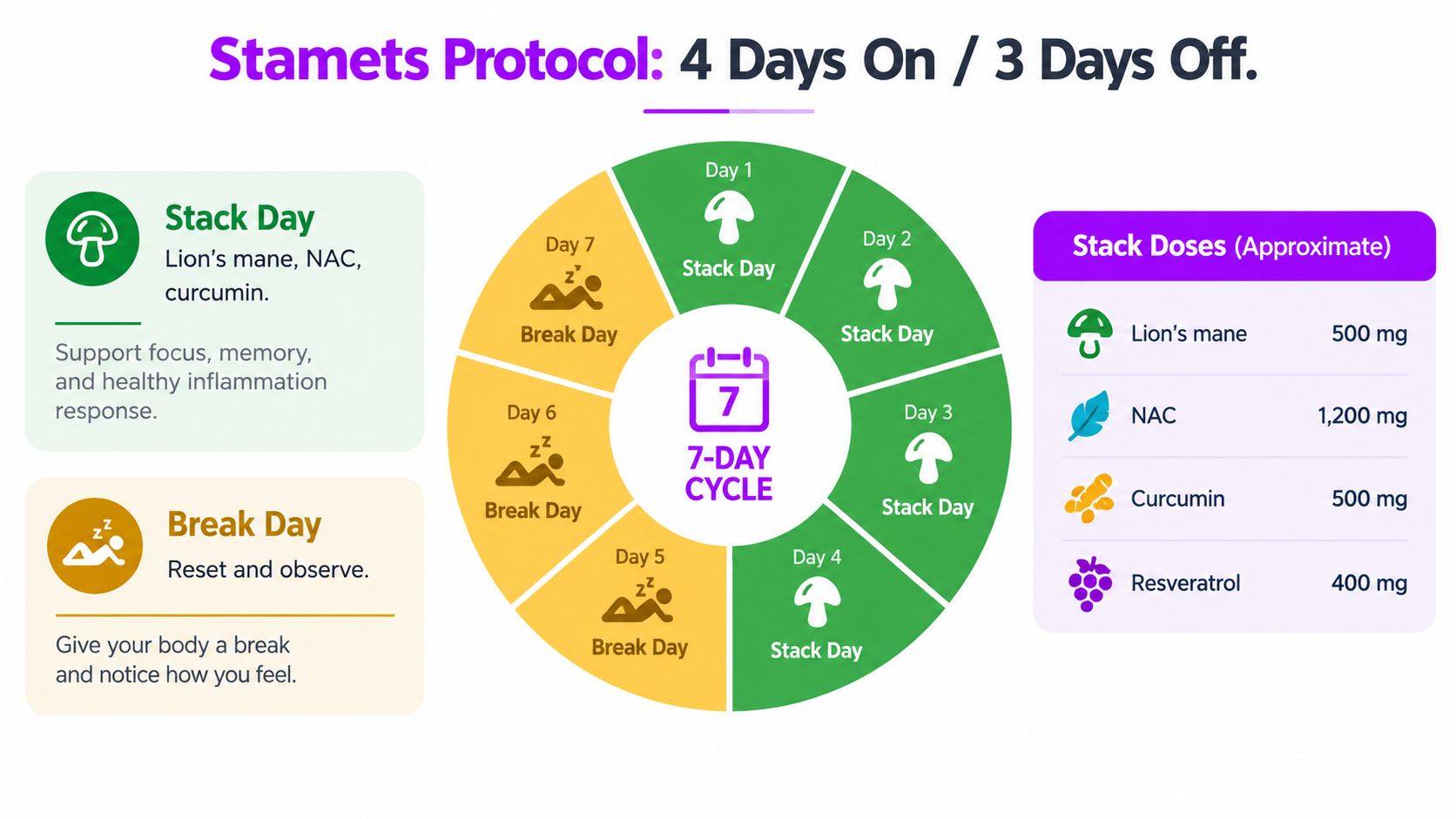
The general public-facing description of the schedule is that the rest days help reduce tolerance pressure and create space to notice changes without dosing noise. That's a reasonable organizing principle, but it's still a principle, not established clinical proof. The National Institute on Drug Abuse defines microdosing more broadly as about 5–10% of a typical recreational dose, low enough to avoid hallucinations, and says research has not established microdosing as safe or effective (NIDA psilocybin overview).
How to think about the rhythm
The four-on, three-off pattern isn't magic. It's a structure that creates two kinds of days, dosing days and non-dosing days, so you can compare how you feel across each part of the week. If every day looks the same in your notes, the schedule isn't helping you learn much.
A simple way to approach it is to define three things before you start:
- Dose-day behavior: what time you take it, whether you take it with food, and what else is in your system.
- Break-day behavior: what you avoid changing, so your observations stay interpretable.
- Observation target: mood, sleep, anxiety, focus, body sensations, or all of the above.
The schedule should be treated as a template, not a law. If you don't track it, you can't tell whether the pattern itself matters or whether you're just following a ritual that feels organized.
The break days are where the experiment becomes legible.
The Three-Ingredient Stack Explained
The “stack” part of the Stamets Protocol usually refers to three separate ingredients, and each one plays a different conceptual role. Psilocybin mushrooms provide the psychoactive component, Lion's Mane is the non-psychedelic mushroom, and niacin is a vitamin, not another psychedelic agent. That split matters because it helps you think clearly about what might be causing a change and what might be causing a side effect.
A rapid review of microdosing evidence notes that the stack is usually presented in those three parts, but current evidence doesn't establish the optimal dose, ingredient ratio, or long-term safety of the combination (PMC rapid review). So even if the logic sounds tidy, the science doesn't yet validate the recipe as a complete package.
What each ingredient is supposed to do
Psilocybin is the main active substance people are trying to keep below perceptual threshold. Lion's Mane is often included because it's framed as a non-psychedelic mushroom with its own wellness identity. Niacin is included as a vitamin, but the familiar flush people associate with it is not evidence that the stack is “working.”
If you're logging your experience, don't let the flush become your proxy for efficacy. A body reaction is still just a body reaction. It may be relevant as a side effect, but it doesn't prove cognitive improvement, mood change, or anything else you want to attribute to the stack.
For a grounded look at the mushroom side of the combination, this overview of Lion's Mane fungus is a useful companion read. It helps separate the mushroom's identity from the claims people attach to it in microdosing circles.
Proposed Mechanisms vs Known Science
A person trying the Stamets protocol may hear a tidy story about how it works, but each ingredient rests on a different kind of evidence. Psilocybin is converted to psilocin, which acts mainly at serotonin 5-HT2A receptors. Lion's Mane is proposed to affect neurotrophic signaling, and niacin is included because its flushing effect is thought to support peripheral distribution through vasodilation. Those ideas can make the stack sound coherent, yet they do not prove that the full combination works as intended.
The ideas are not absurd, they are just untested. As the rapid review notes, the niacin-delivery rationale has not been validated pharmacologically, and no randomized clinical trial has tested the complete stack or compared the schedule with alternatives (PMC rapid review). That places the protocol in the category of community-derived practice, not evidence-validated treatment.
Why mechanism talk can mislead you
Mechanism language feels convincing because it sounds specific. If one ingredient is said to open a pathway and another to aid distribution, the stack can seem more rational than the evidence allows. Biological plausibility and human evidence are different standards, and only the second one tells you whether people benefit.
For a self-managed experiment, that distinction matters. Record the dose, timing, and ingredient mix, then log the outcome and any adverse effects. If you only note the good days, you can mistake a side effect for a benefit or miss a pattern that points to poor tolerability.
A useful filter is simple. If the explanation sounds stronger than the evidence, slow down and track more carefully.
The safest reading is also the least exciting one. The mechanism may be interesting, but observation still has to do the work.
What the Research Says About Efficacy
The best quantitative evidence for the Stamets Stack comes from observational research, not from a randomized trial of the exact protocol. A 2021 study of more than 8,000 participants followed adults who reported microdosing and tracked mood, mental health, and psychomotor performance over about 30 days. That makes it a substantial dataset, but it still cannot separate the effect of the four-days-on, three-days-off schedule from expectancy, self-selection, or other daily habits.
The core limitation is simple. In observational studies, people choose their own substances, doses, and schedules, so the results are blended with baseline differences and everything else happening in real life. Reports on that research identify a subgroup using psilocybin plus Lion's Mane and niacin, but the exact combination has not been tested in a controlled human trial.
A 2022 observational study in Scientific Reports found no measurable improvement in mood or mental-health outcomes from adding Lion's Mane and niacin to psilocybin beyond broader microdosing associations, and the authors noted that synergistic effects had not been directly tested (Scientific Reports study). For a protocol you manage yourself, that means the log matters more than the story.
Read this evidence like a lab notebook, not a slogan. It can show what people report and which patterns deserve more study, but it cannot prove the protocol caused the change.
Use a clear record of dose, timing, sleep, mood, and side effects so you can separate a real shift from a week that merely felt better in hindsight. A practical overview of what people hope to track is outlined in this guide to microdosing benefits, which is useful as a comparison point for your own notes.
Safety Considerations and Side Effects to Watch
Safety comes first, because a protocol you cannot tolerate stops being useful. Niacin is not risk-free. Flushing and gastrointestinal effects can matter for people with liver disease, diabetes, ulcer disease, gout, or medication interactions, so a qualified clinician should review anything that can affect mood, circulation, or sleep before you start.
A 2026 review in Frontiers in Psychiatry described the evidence base as low-certainty and heterogeneous. It also catalogued serious experiences including intense anxiety, panic attacks, psychosis symptoms, suicidal ideation, and worsening Crohn's disease in at least one study (Frontiers review). Mild effects appeared more often in many reports, but repeated mild effects still matter if you are trying to detect a pattern rather than tell yourself a reassuring story.
Write the same discipline into your log that you would use for any self-run experiment. Track body symptoms, sleep quality, anxiety spikes, and delayed effects, then compare them with non-dose days and ordinary life changes. A notebook that captures only “good” or “bad” misses the warning signs.
If a side effect changes your behavior, it belongs in the log.
The same review noted an open-label 2026 palliative-care study using 1–3 mg daily for three weeks that reported no serious adverse events, while mild or moderate events such as lightheadedness and anxiety still occurred. Mixed findings like that are useful because they show why the key question is not only whether a protocol has any upside, but whether your records can separate normal fluctuation from a safety signal.
How to Implement and Track Your Protocol with MicroTrack
If you choose to run the Stamets Protocol, the disciplined move is to log it like a structured experiment. Start by entering the exact formulation, the estimated psilocybin amount, the Lion's Mane preparation and mass, the niacin dose, timing, sleep, caffeine or other psychoactive substances, baseline mood, and delayed reflections. A technically useful tracking schema should also compare within-person changes against non-dose days and pay attention to missingness, time trends, and adverse-event frequency, not just average mood scores (Scientific Reports study).
That's where a dedicated journal helps. MicroTrack is one option for logging a Stamets-style schedule, recording dose days, mood, sleep, reflections, and schedule changes on a calendar, then reviewing trends over time. Used correctly, a tool like that doesn't tell you what the protocol means, it just makes the data easier to read.
A simple logging discipline
Start with the same few fields every time, then resist the urge to improvise. Consistency matters more than detail overload.
- Before dosing: note baseline mood, sleep, caffeine, and any other substances already in your system.
- At dosing: record the day in the cycle, ingredient amounts, and the time you took them.
- Later that day: capture mood shifts, focus changes, body sensations, and any discomfort.
- Next day and break days: note delayed effects, headaches, anxiety, sleep disruption, or a return to baseline.
You're not trying to prove the stack works. You're trying to see whether your experience is stable enough to trust, noisy enough to ignore, or concerning enough to stop. If your notes can't answer that, the protocol is running you instead of the other way around.
If you want a cleaner way to test a microdosing routine without guessing, use MicroTrack to log the schedule, mood, sleep, and side effects in one place. It's built for people who want a structured, private journal for self-experimentation, so you can compare dose days with break days and decide based on your own data instead of hype.