What Is Microdosing: The Practical Guide

Microdosing involves taking about one-tenth to one-twentieth of a typical nonclinical dose of LSD or psilocybin, aiming for subtle effects without a full psychedelic experience. But if the dose is meant to be “too small to feel,” why do so many people still report a noticeable change?
Table of Contents
- What Is Microdosing Defined
- The Science Behind Sub-Perceptual Doses
- Do Benefits Exceed Expectancy Effects
- Common Microdosing Protocols Compared
- How to Track and Evaluate Your Results
- Safety, Legal, and Ethical Considerations
What Is Microdosing Defined
What does microdosing mean when the same amount can feel different to different people?
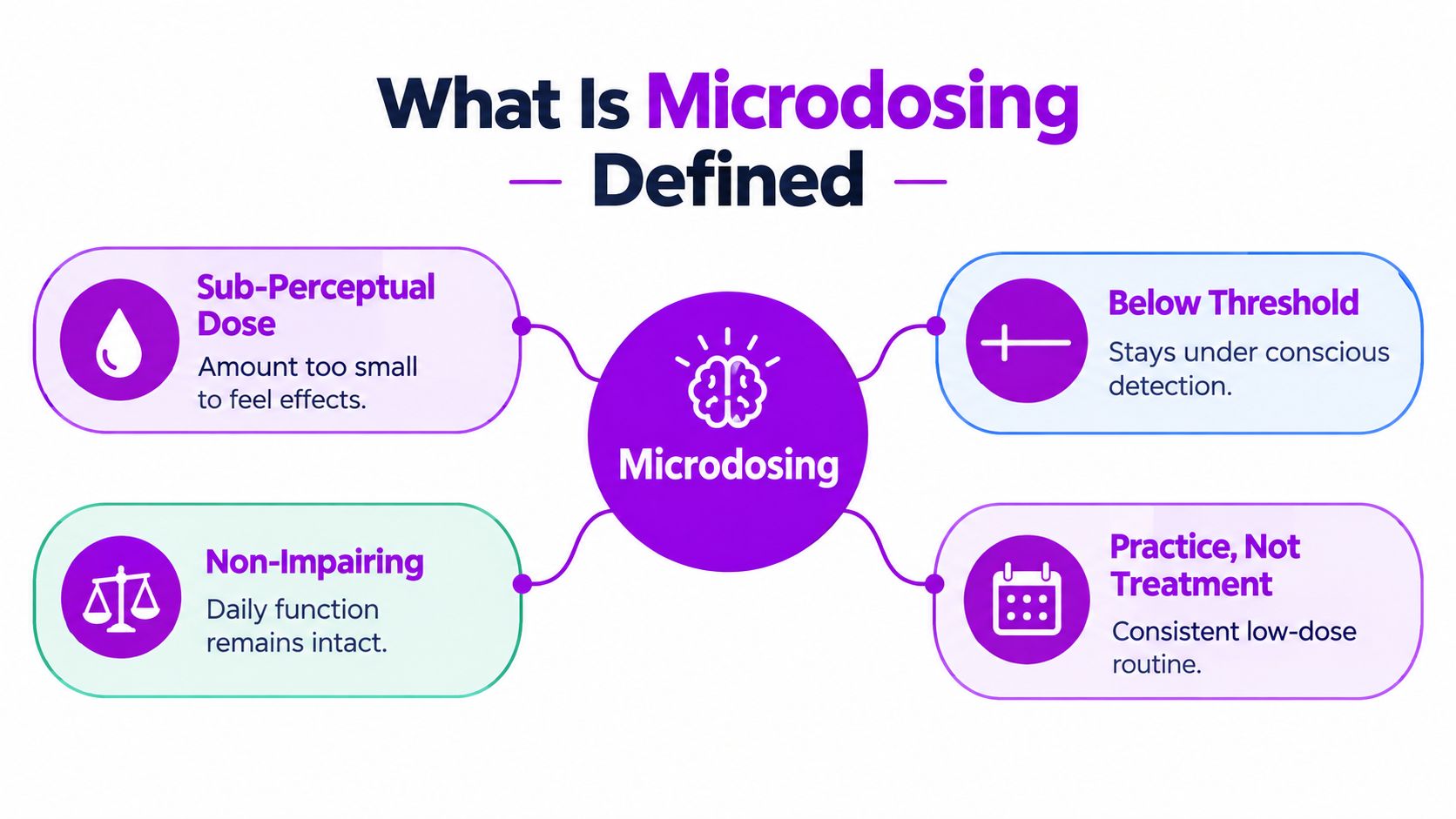
It generally means taking a psychedelic repeatedly in a sub-perceptual dose, with the intention of staying below strong perceptual changes. The U.S. National Institute on Drug Abuse describes the amount as about one-tenth to one-twentieth of a typical nonclinical dose NIDA's overview of psychedelic and dissociative drugs.
The word micro describes the amount, not a guaranteed experience. Some people may notice subtle changes in mood, energy, focus, or body sensation even when they do not experience obvious visual or perceptual shifts. Feeling different, however, does not by itself show that a dose produced a measurable benefit.
Why the definition gets messy fast
The label hides a measurement problem. The same nominal dose can produce different effects across substances, while mushroom material can vary because it is biological material rather than one pure compound.
Practical rule: record the substance, amount, timing, and context separately. Without those details, you cannot reliably identify what you took or explain how you felt afterward.
For that reason, microdosing is better understood as a practice than as a single universal dose. A useful journal also records sleep, caffeine, stress, and daily performance. MicroTrack can help organize those entries, making it easier to compare a subjective impression with patterns in measurable outcomes.
From a user's perspective, the useful dividing line is between below-threshold and clearly impairing, and the two do not always line up. A dose may feel subtle while still affecting attention or coordination. Careful logging helps separate a pharmacological effect from expectancy, routine, or an unusually good day.
The Science Behind Sub-Perceptual Doses
Thresholds are not fixed
What counts as sub-perceptual can shift with the substance, dose, and person. Controlled LSD research found detectable effects around 5 to 10 micrograms, with more clearly perceptible effects around 10 to 20 micrograms. Responses generally increased as the dose rose, showing that “sub-perceptual” is not a fixed property of every microdose.
Mushroom doses are harder to compare because dried material varies. A controlled psilocybin-mushroom trial described commonly reported mushroom microdoses as roughly 0.1 to 0.5 grams of dried material, yet 0.5 grams produced significant subjective effects in participants the controlled psilocybin study. A quantity often labeled a microdose can therefore produce a noticeable experience.
Why exact measurement matters
A useful journal records more than “took a microdose.” Track the substance, estimated amount, timing, setting, sleep, food, stress, and subjective effects as separate fields. MicroTrack can organize these entries so a strong impression can be compared with patterns in daily performance and other measurable outcomes.
If one week feels better than another, the difference may reflect the dose, a changed routine, better sleep, or lower stress. A person can stay convinced they found the right dose while changing three other variables at the same time without noticing.
The practical interpretation of what is microdosing is a low-dose experiment with uncertain boundaries, not a standardized clinical intervention. The scientific question is whether a reported improvement remains visible in records and performance after expectancy and ordinary life changes are considered. A felt effect is useful information, but it is not the same as a measured benefit.
Do Benefits Exceed Expectancy Effects
Could a noticeable change in mood or focus come from expectation rather than the substance? Microdosing is popular because people report better mood, sharper focus, and greater creativity. The harder question is whether those changes arise from the substance itself, self-selection, expectation, or changes in daily routine. A 2024 systematic review addresses that uncertainty directly.
What controlled research keeps finding
A systematic review of 48 studies found that benefits were common in self-reports, while placebo-controlled research produced substantially fewer significant effects. The authors concluded that current evidence does not conclusively attribute improvements to the drug itself a systematic review in the International Journal of Neuropsychopharmacology. This does not make people's experiences false. It shows that feeling better alone cannot establish a pharmacological benefit.
A separate placebo-controlled psilocybin trial found that 0.5 grams of dried mushroom material did not significantly improve creativity, cognition, physical activity, or self-reported mental health and well-being. Subjective effects were reliable, while performance effects were negligible or sometimes suggested impairment the controlled psilocybin study. In plain language, participants could feel something without improving on the outcomes that matter most.
Why expectation is such a strong confounder
Microdosing often begins alongside efforts to sleep better, work more effectively, or feel calmer. A good week can then look like a drug effect, even when a new routine, greater attention to habits, or hope explains part of the change. Memory also favors striking days, which makes personal impressions less dependable than repeated records.
MicroTrack's guidance on reported benefits recommends comparing dose days with ordinary days rather than relying on memory alone. A journal can separate subjective ratings, such as feeling creative, from observable measures, such as completed tasks or time spent focused. Repeated entries cannot remove every confounder, but they can show whether an impression appears consistently.
Key insight: if a practice feels successful only when you remember the best days, hope may be part of the result.
Microdosing may produce meaningful subjective change for some people, while evidence for a reliable drug-specific benefit remains unsettled. Recording both feelings and measurable outcomes makes the evidence easier to judge. That is why “what, exactly, changed?” is often a more answerable question than “does it work?”
Common Microdosing Protocols Compared
People talk about microdosing as if the schedule itself were the main ingredient. In reality, schedules vary a lot, and the recorded benefits often blur together with expectancy and habit. A large self-blinding trial used an average of about 13 micrograms of LSD or 0.2 grams of psilocybin mushrooms every 3 to 4 days, and the placebo and active groups improved in similar ways the self-blinding trial.
How the common schedules differ
The most discussed routines are the Fadiman protocol, often described as a 1 day on, 2 days off cycle, and the Stamets stack, often described as 4 days on, 3 days off with supporting nutrients. MicroTrack's Fadiman protocol guide gives a practical example of how users try to keep schedules consistent while leaving room for rest days.
The schedule matters less than many beginners expect, because consistency gives you something to compare against. A routine that changes every week makes it much harder to see whether your body is responding to the dose or to the rhythm around it.
Clinical research uses different structures too
Even clinical studies don't settle on one template. One registered phase 3 palliative-care trial specifies 2 or 3 milligrams of psilocybin daily, four days per week, for two consecutive weeks, while a separate phase 2 depression protocol specifies four weekly 2-milligram doses over four weeks, followed by another four weeks of weekly psilocybin dosing ClinicalTrials.gov protocol NCT07063862. That variation shows how far the field still is from a single standard microdosing model.
The shared lesson is simple. Protocol details matter, but they matter most because they make later comparison possible. If you don't know what schedule you used, you can't tell whether a pattern is real.
How to Track and Evaluate Your Results
A good journal turns a vague feeling into a testable pattern. If you want to know whether microdosing changes anything, define the outcomes first, then measure them the same way on dose days and non-dose days. That is the only way to separate a possible drug effect from the noise of everyday life.
What to record every time
Start with a short list of metrics that matter to you. Mood, sleep, anxiety, task completion, and side effects are more useful than a vague note like “better day.”
- Mood rating: Use the same scale each time, so changes mean something.
- Sleep duration or quality: Bad sleep can mimic both benefits and side effects.
- Anxiety or calmness: Record this separately from general mood.
- Task completion: Note whether you finished the work you expected to do.
- Adverse effects: Write down headache, restlessness, or cognitive fog right away.
The point is not to create a perfect scientific notebook. The point is to make memory less influential. The body can feel different for many reasons, and a clear log helps you sort the dose from the rest of the day.
Why non-dose days matter
The strongest practical lesson from the meta-analytic evidence is that subjective changes can appear without meaningful shifts in cognition or sustained mood the meta-analysis of 24 studies. That makes non-dose days essential, because they give you a baseline instead of a memory.
A tracker like MicroTrack can help by letting you log dose details in the moment, add reflections later, and compare trends over weeks and months. Its value here is practical, not mystical, it keeps the data organized enough to spot patterns without pretending a good afternoon proves anything.
Useful habit: review a few weeks at a time, not just the last session, because one unusually good day can mislead you.
MicroTrack's effectiveness evaluation guide is relevant if you want a simple framework for judging whether your own notes show a real pattern or just a memorable spike. That kind of review matters more than any single diary entry.
Safety, Legal, and Ethical Considerations
Could a small dose still carry meaningful risks? Microdosing is not an established treatment for depression, anxiety, PTSD, or stress. Research remains mixed, and NIDA's safety and legality summary reports that safety and effectiveness have not been established. Given the mixed evidence, caution should be the default stance.
Boundaries that deserve attention
Short studies have reported temporary anxiety, headache, sleep disturbance, blood-pressure changes, and cognitive interference. Long-term cardiac and psychiatric safety remains unresolved. A history of mental-health problems, use of psychoactive or serotonergic medicines, poor sleep, or emotional instability can make the risks harder to assess.
Avoid unidentified mushrooms entirely. A mistaken identification can lead to poisoning, while hallucinogens can also trigger panic reactions or psychosis, particularly at larger doses. If symptoms worsen, stop and seek qualified medical help rather than adjusting the dose alone.
Legal status is not uniform
In the United States, psilocybin is federally classified as a Schedule I controlled substance, although some states and the District of Columbia have decriminalized or deprioritized possession, according to the NIDA-linked legal summary. Local rules can differ from federal status, so check the law that applies where you live.
Ethical use means presenting microdosing as experimental, not as a replacement for proven care. A journal can also reduce overconfidence: MicroTrack records dose details, mood, sleep, side effects, and timing, then compares dose days with ordinary days. That comparison helps separate a subjective feeling from a measurable pattern, including changes that may reflect expectancy rather than pharmacological benefit.
If you use it, review your records over time and discuss concerning changes with a qualified clinician.