Microdosing Schedules and Evidence: A Balanced Guide
If a dose is too small to feel, how would you know it's doing anything? That question sits under almost every microdosing conversation, and it usually gets answered with a personal report: better mood, sharper focus, less anxiety. The trouble is that the feeling of improvement and the cause of improvement are two different things, and only one of them can be tested at home.
What follows separates the schedule from the evidence. It covers the protocols people use, how many people use them, what controlled trials measured, and how to run a four-week test on yourself that doesn't fool you. Nothing here decides for you. It gives you the numbers and the method.
Table of Contents
- Microdosing Schedules at a Glance
- Who Is Microdosing and How Common It Is
- What Controlled Trials Show About Benefits
- Why Expectations Mimic Dose Effects and How to Track Them
- Safety Signals and Who Should Speak to a Clinician First
- Decide Whether to Start and How to Track It
Microdosing Schedules at a Glance
Microdosing generally means taking roughly one-tenth to one-twentieth of a typical recreational dose on a regular schedule. The U.S. National Institute on Drug Abuse stresses that this describes the size and repeating nature of the dose, not a proven therapeutic standard, and that research has not yet established whether microdosing is safe or effective. No schedule below is a clinically validated protocol. They're patterns people use, and each one is easier or harder to evaluate.
| Protocol | Pattern | Typical user | Practical note |
|---|---|---|---|
| Fadiman protocol | 1 day on, 2 days off | Beginners | Simplest pattern to log and compare against off days |
| Stamets stack | 4 days on, 3 days off | Users wanting longer off-periods | Often described with added supplements; no controlled evidence favours it |
| Research pattern | Every 3 to 4 days for 4 weeks | Study participants only | Study doses were far larger than home routines; not a template for home use |
| Custom schedule | Any fixed pattern you log | Users tracking their own response | Useful only when dose days and non-dose days are both recorded |
The Fadiman pattern wins on logistics, not on evidence. One day on and two days off gives you two comparison days for every dose day, which is the whole point of logging: you need something to compare against. The Stamets pattern of four days on and three days off buys a longer weekly break, and it's frequently described alongside added supplements, though nothing controlled favours the combination.
The research pattern deserves its own warning. In a 191-person trial described in a cardiovascular safety review in Pharmacological Reports, participants took an average of 13 micrograms of LSD or 0.2 grams of psilocybin mushrooms every three to four days for four weeks. Those are reference points for reading the literature, not home amounts.
A microdose needs a kitchen scale, not a pinch. Record the substance, the measured amount, the time and anything you noticed, because a named routine guarantees nothing on its own.
Safety gate: if any condition or medication in the safety section below applies to you, talk to a clinician before you pick a pattern.
Who Is Microdosing and How Common It Is
A RAND analysis puts the scale in plain numbers. It estimates that about 9.55 million U.S. adults, roughly 3.7% of the adult population, microdosed at least one of psilocybin, LSD or MDMA in the previous year.
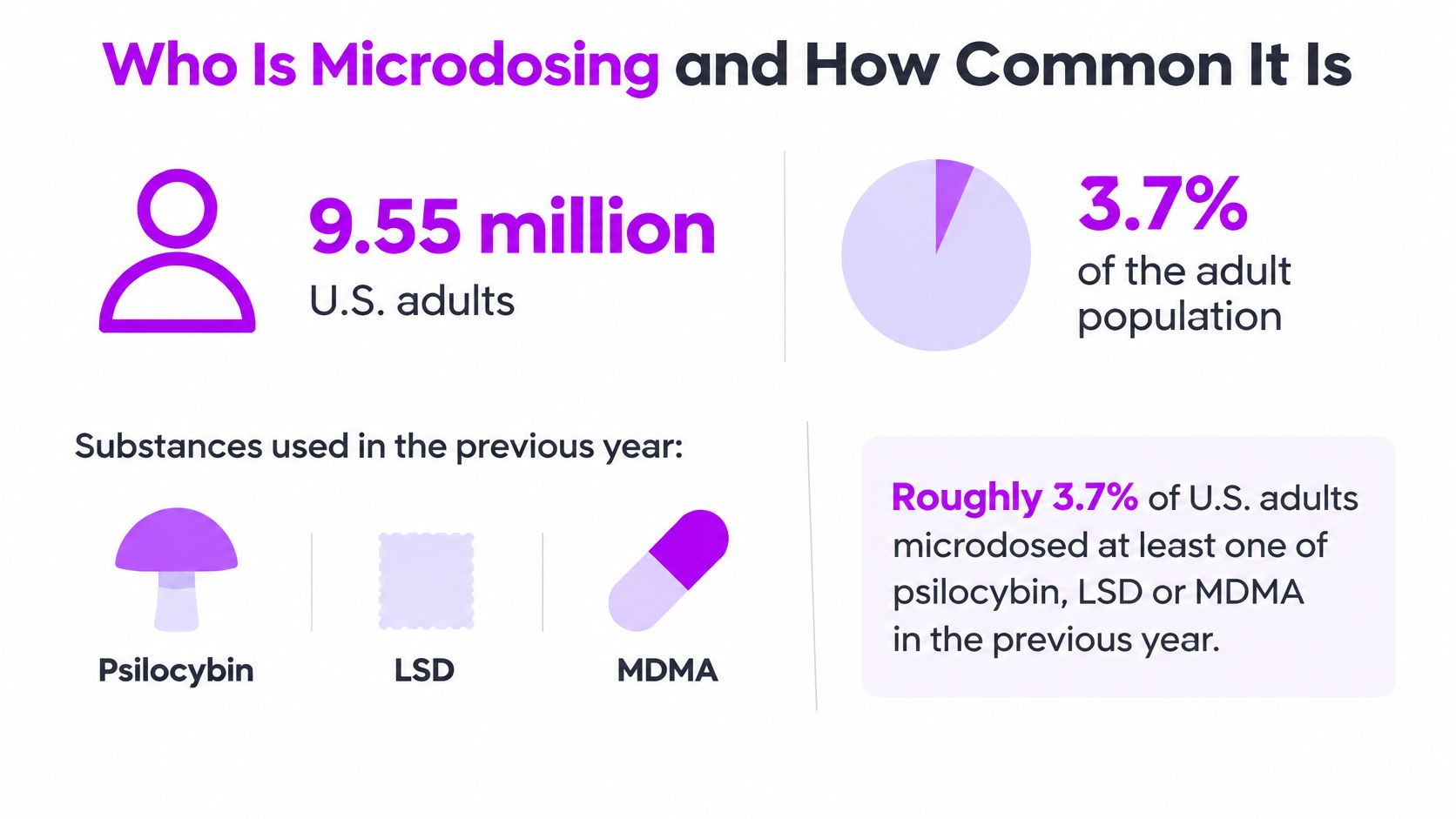
Among adults who reported using each substance in that period, an estimated 69% had microdosed psilocybin, 65% MDMA and 59% LSD at least once. The same analysis estimated more than 200 million days of psilocybin use in the United States during the year, with nearly half of those days involving microdosing.
Those figures sit beside much smaller ones from earlier work, and the gap is mostly the denominator. A 2020 online survey of 2,347 respondents found about 17% had microdosed at some point and about 4% were current microdosers; among 317 people who named their compounds, LSD accounted for 48.58% and psilocybin 26.18%. Lifetime use, past-year use and microdosing among recent users of a substance each produce a different percentage, so check which one a headline is using.
Both are survey estimates. The 2020 sample was recruited online and wasn't a probability sample of any population, and neither number says microdosing works or is safe.
What Controlled Trials Show About Benefits
A systematic review and meta-analysis of randomised controlled trials of LSD and psilocybin microdosing found measurable subjective or neurophysiological changes but minimal and inconsistent behavioural benefits. The immediate symptom results are the ones worth reading line by line.
| Outcome | Standardised mean difference | 95% confidence interval | Reading |
|---|---|---|---|
| Depressive symptoms | -0.19 | -0.56 to 0.19 | No clear effect; the interval includes zero |
| Anxiety | -0.20 | -1.11 to 0.71 | Too imprecise to support a conclusion |
| Stress | 0.02 | -0.39 to 0.43 | No effect; the interval includes zero |
A confidence interval is a range of effects the data can't rule out. Every interval in that table crosses zero, which means each result is compatible with no effect at all. The anxiety estimate is the widest, running from a meaningful benefit to a meaningful worsening, so it tells you almost nothing except that the studies were too small and too varied to settle the question. The review's conclusion was blunt: no consistent immediate symptom reduction in healthy adults, and a need for larger, better-controlled trials.
Depression is where the gap between marketing and evidence shows most clearly. A 2025 phase II randomised study in adults with mild-to-moderate major depressive disorder tested 2 mg of psilocybin weekly. It reported no significant reduction in depressive symptoms, positive signals on anxiety and quality of life, and participants who identified the active condition better than chance, according to the trial report.
Practical rule: report acute effects and delayed outcomes separately. A calm afternoon and a better month are different claims, and only one of them belongs in a symptom score.
Trials also need to record the harms, including insomnia, anxiety, gastrointestinal discomfort, headache, impaired focus and mood worsening, because a journal that logs only the good days isn't a record. On current evidence, microdosing is not an established treatment for depression, anxiety or PTSD, and the evidence base remains small enough that a single well-run trial could move it.
Why Expectations Mimic Dose Effects and How to Track Them
The strongest test so far was built to remove expectation, and it failed to find a drug effect. In a 191-person, four-week, self-blinded, placebo-controlled study, both the microdose and placebo groups improved significantly from baseline, with no significant between-group differences on the primary psychological outcomes, according to the eLife paper. Small acute differences in mood, energy, creativity and emotional state did appear, and the researchers reported those could be explained by participants correctly guessing whether they had taken the active dose.
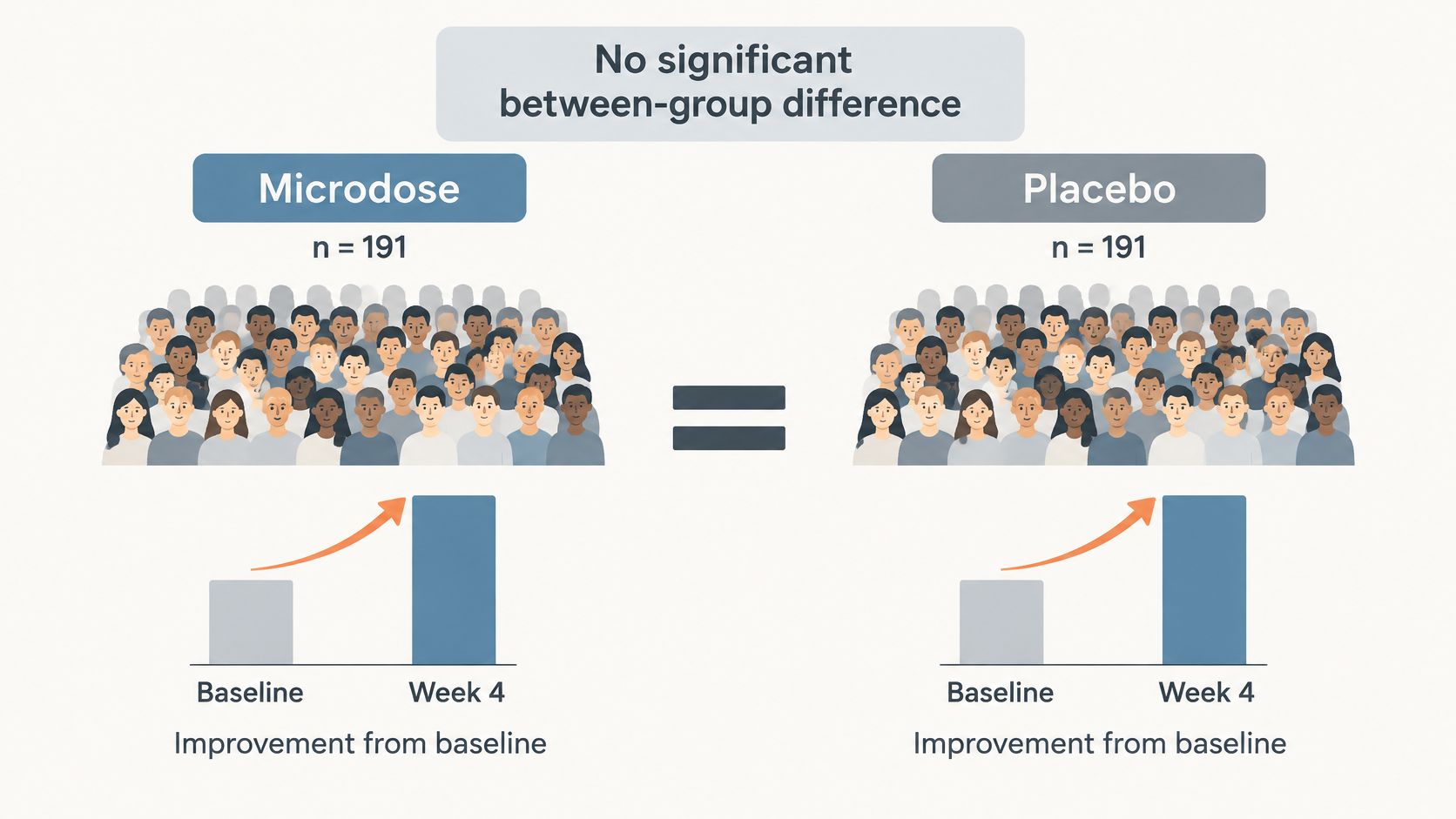
Read that result carefully. It doesn't say people imagined their good weeks. It says the good weeks arrived in both arms, which is what you'd expect if expectation, ritual and hope are doing much of the work. A substance doesn't have to be pharmacologically active to feel active.
The placebo question isn't settled either
A 2025 systematic review of 48 studies found self-reported benefits substantially declined once placebo-controlled designs were included, becoming more mixed and bidirectional, as reported in the International Journal of Neuropsychopharmacology. The same review argued it's premature to conclude microdosing is mainly placebo, because the trials tend to use small samples, few doses, non-clinical volunteers and possibly subtherapeutic doses.
That's the honest state of play. Subjective improvement can be real and meaningful without proving a pharmacological effect, and a weak trial can fail to detect a real effect just as easily as a strong one can manufacture a false one.
Ask this instead: not "does microdosing work?" but "which outcomes persist under blinded conditions, for whom, at what dose, and over how long?"
Run a four-week test on yourself
Start with a baseline mood rating on a day you don't dose, and keep rating on the same scale every day after that. Dose days alone prove nothing, because the days you skip are your control group. Without them you're measuring your memory of the week, not the week.
Here's the video walkthrough of what blinded comparisons look like in practice:
Then watch for regression to the mean. People usually start microdosing during a bad stretch, and bad stretches end on their own. If your mood was at 3 out of 10 when you began and it's at 6 six weeks later, the schedule is only one of several explanations, alongside sleep, season, workload and the simple passage of a rough patch. This is the same reasoning laid out in this explanation of correlation versus causation, and it's the reason a fixed schedule beats an improvised one.
| Field | What to record | Why it matters |
|---|---|---|
| Substance and amount | Substance name and measured amount | Makes dose comparisons possible |
| Dose timing | Date, time and whether it was a dose day | Separates dose days from non-dose days |
| Mood baseline | 10-point rating before dosing | Shows whether a dose day differs from normal |
| Mood follow-up | 10-point rating at set intervals | Reveals the time course of any change |
| Sleep | Hours slept and quality | Sleep changes can mimic or hide a dose effect |
| Caffeine and medications | Amount and name of each | Common confounders for mood and focus |
| Anxiety and side effects | Level and type of each | Tracks adverse effects such as insomnia or headache |
| Life stress | Work or personal stress rating | Explains mood shifts unrelated to the dose |
A sample entry looks like this. Tuesday, dose day, 8am, measured amount written down, mood 6 out of 10 before, 7 out of 10 at noon, seven hours of sleep, two coffees, a deadline at 5pm, mild headache at 3pm. Wednesday, no dose, mood 5 out of 10, slept badly, no headache. Repeat that for four weeks and the pattern starts arguing with you instead of agreeing with you.
Track outcomes separately, not as one score
A double-blind, placebo-controlled study of 34 participants found that microdosed magic mushrooms significantly changed closed-eye EEG theta activity but produced no statistically significant differences from placebo in cognition, perception, creativity, self-reported mental health, wellbeing or physical activity after correction for multiple comparisons, according to the published results. Attention, inhibition, processing speed, anxiety, affect, stress and Fitbit-measured activity all came back flat.
That's why one mood number can't carry the whole verdict. If focus improves and sleep collapses, a single score hides both. Rate the outcomes you care about, one at a time, for at least four weeks.
- Set a baseline first. Rate mood on two non-dose days before you begin.
- Log the blank days. A skipped day with a score is data, not a gap.
- Write down the confounders. Sleep, caffeine, alcohol, medication and deadlines.
- Book a review date. Four weeks out, in the calendar, before you start.
Safety Signals and Who Should Speak to a Clinician First
Low doses can still have adverse effects. The National Center for Complementary and Integrative Health lists reported problems including insomnia, increased anxiety or depression, poor mood, low energy, gastrointestinal discomfort, headache, poor focus, impaired cognition, reduced social functioning, disrupted sensory processing and temperature changes in its overview of psilocybin's reported effects.
A dose can be subtle and still affect sleep, attention or daily functioning. Notice changes in how you feel and function, not only whether you experience an obvious effect.
| Group | Safety concern | Action |
|---|---|---|
| Schizophrenia or schizoaffective disorder | Symptoms may worsen; medical supervision is needed | Seek qualified medical advice before any use |
| Severe bipolar disorder | Symptoms may worsen; medical supervision is needed | Seek qualified medical advice before any use |
| Borderline personality disorder | Symptoms may worsen; medical supervision is needed | Seek qualified medical advice before any use |
| Depression, anxiety or PTSD | A low-dose trial found no significant reduction in depressive symptoms | Keep current treatment and discuss any use with a clinician |
| Taking prescription medications | Possible interactions and altered effects | Review with a prescriber or pharmacist |
Prescription medications warrant an interaction review. If you are considering microdosing to self-treat depression, anxiety or PTSD, do not replace existing care with a schedule or journal. A guide to reported microdosing side effects covers concerns to watch for.
Legal status varies by location. Check the rules where you live before obtaining anything, and keep a record of what you take so a clinician or pharmacist can review it.
Stop signals: Worsening mood, unusual distress or impaired daily functioning are reasons to stop and seek medical help, not to adjust the schedule.
Decide Whether to Start and How to Track It
The direct answer: the evidence doesn't show that microdosing reliably improves mood, anxiety or cognition, personal benefits may be driven partly by expectation, and the risk depends heavily on your health context. That's not a no. It's a description of what you'd be testing and what you'd be risking.
Work through it in order.
- Check the high-risk list first. If a condition or medication from the table above applies, speak to a clinician before anything else.
- Protect existing treatment. If you're being treated for depression, anxiety or PTSD, keep that treatment and share your log with the clinician who manages it.
- Pick one schedule and freeze it. The Fadiman 1-day-on, 2-days-off pattern is the easiest to start with because the comparison days are built in.
- Set a baseline before your first dose. Two non-dose days of ratings give you something honest to measure against.
- Review at four weeks. Look at dose days against non-dose days, not at your memory of the month, using the approach in this guide to tracing a pattern over time.
If you want a place to keep that record, MicroTrack includes a Fadiman schedule of 1 day on and 2 days off, a 10-point mood scale, trend views across weeks and months, and CSV export. It's a wellness journal, not a medical application, and it doesn't provide medical advice, diagnosis or treatment.
The first action takes a minute: write the baseline entry today, before you choose a protocol. A record that starts the day you begin dosing has no control group in it.
If you're going to test a schedule on yourself, test it properly. MicroTrack gives you the Fadiman 1-day-on, 2-days-off pattern, a 10-point mood scale, and trend views that put dose days next to the days you skipped, so the comparison is in front of you rather than in your memory. It's a journal, not a medical app, and everything you record can be exported as CSV when you want to look closer or hand the record to a clinician.