Microdosing for ADHD: What the Evidence Really Shows
A 2025 placebo-controlled trial of 53 adults with ADHD found symptom improvement in both the LSD and placebo groups, with no significant between-group difference (2025 placebo-controlled trial). That does not mean participants imagined feeling better. It means improvement alone could not show that LSD caused it, because expectancy, sleep, routine, and time can move symptoms too.
For anyone weighing microdosing for ADHD, separate three records: what you felt, what changed in daily functioning, and what a controlled comparison can establish about the drug. A journal can capture the first two. A clinician can help interpret the third.
Table of Contents
- What the Evidence Shows About Microdosing for ADHD
- What the 2025 Placebo-Controlled Trial Found
- Why Feeling Better Is Not Proof of Treatment
- Microdosing With Prescribed Treatment, Legal Status and Access
- How to Track Your Response Without Fooling Yourself
- Working With a Clinician and Confirming the Plan
What the Evidence Shows About Microdosing for ADHD
In a 2020 survey of 1,102 people who reported psychedelic microdosing, 19.5% said they had an ADHD diagnosis, and 10.9% named ADHD treatment as a primary or secondary reason for use. ADHD is one of the more visible self-reported targets in microdosing research. No controlled study has shown that microdosing treats ADHD better than placebo, and the positive evidence comes mostly from people describing their own experience.
The surveys summarized in an ADHD psychedelics review also include a 2019 sample of 1,122 adult microdosers. Neither survey randomly assigned treatment, so neither can separate the drug from expectation, daily routine, or concurrent care.
Microdosing for ADHD study designs compared
| Study | Design | Participants | Main finding | Key limit |
|---|---|---|---|---|
| 2020 cross-sectional survey | Self-report survey | 1,102 people who reported psychedelic microdosing | 19.5% (about 215) reported an ADHD diagnosis; 10.9% named ADHD treatment as a primary or secondary reason | Participants chose themselves; doses were self-reported |
| 2019 survey of adult microdosers | Self-report survey | 1,122 adults, 410 with a mental-health diagnosis | Among respondents with ADHD-related concerns, microdosing was rated more effective than conventional treatment, OR 11.66; 95% CI 3.46 to 39.34 | Subjective treatment comparisons; expectancy could influence ratings |
| Four-week prospective studies | Observational | Adults with ADHD or severe ADHD symptoms who microdosed | Self-reported symptoms and emotion-regulation measures improved | Selection bias, expectancy, concurrent changes; no placebo comparison |
| Double-blind placebo-controlled LSD trial (2025) | Randomized, double-blind | 53 adults with ADHD, 27 LSD and 26 placebo | Symptoms improved in both groups; no significant difference between them | Screened sample without major psychiatric or somatic disorders |
The observational findings summarized in a review of prospective microdosing studies included decreased self-reported ADHD symptoms, increased trait mindfulness, reduced neuroticism, and improved emotion-regulation measures over four weeks. Those findings describe changes that coincided with microdosing; they cannot show that the drug caused them.
Read the design before the result
A cross-sectional survey can identify who reports microdosing and what they believe it does. Following participants over time adds information about when symptoms changed. Without a credible comparison group, it still cannot isolate a drug effect.
The odds ratio in the survey row needs careful interpretation. It concerns participants' subjective treatment ratings. It does not mean clinical effectiveness, attention span, or probability of recovery multiply by the same factor.
Evidence rule: A strong preference for a treatment is evidence about preference. It is not automatically evidence that the treatment works.
Read each row according to its design rather than the enthusiasm of its finding. The observational evidence supports an association with perceived benefit, not established efficacy, safety, or superiority over prescribed ADHD treatment.
What the 2025 Placebo-Controlled Trial Found
The surprising result wasn't that people improved while taking low-dose LSD. It was that people taking placebo improved at least as much on the reported symptom measure.
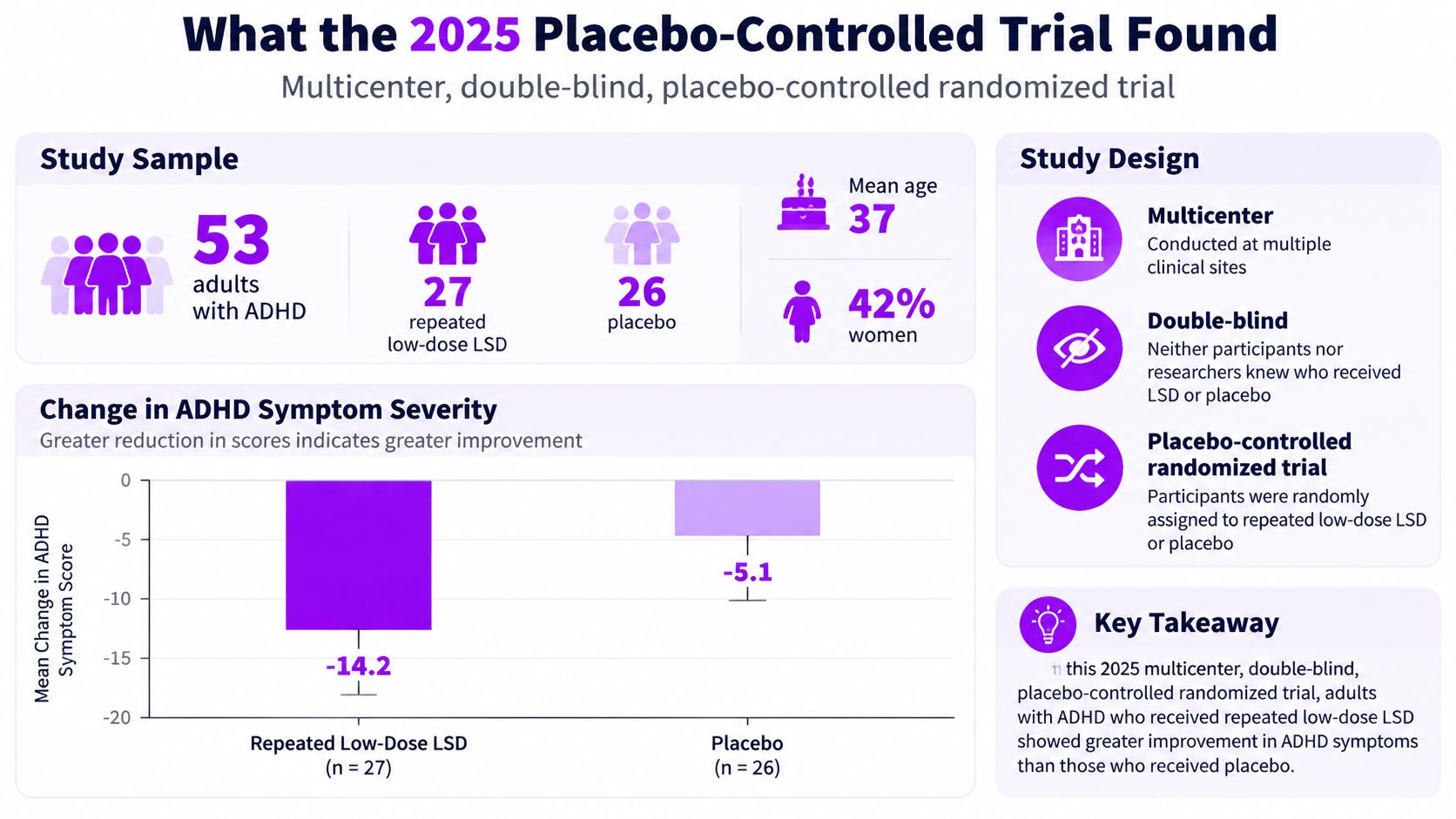
The multicenter randomized clinical trial assigned 53 adults with ADHD to repeated low-dose LSD or placebo, with 27 receiving LSD and 26 receiving placebo; participants had a mean age of 37 years, and 22 participants, or 42%, were women.
The infographic summarizes the allocation and symptom results.
What researchers actually tested
The ADHD Evidence summary of the trial describes 20 micrograms of LSD twice per week for six weeks, with participants and study staff unaware of allocation until the trial ended; it also reports nearly twice as many adverse events in the LSD group.
That regimen is a research reference point, not a self-treatment recommendation. A measured research preparation, eligibility screening, and clinical oversight aren't interchangeable with an estimated amount obtained outside a trial.
On the Adult ADHD Investigator Symptom Rating Scale, mean scores changed by −7.1 points in the LSD group, with a 95% confidence interval of −10.1 to −4.0, compared with −8.9 points in the placebo group, with a 95% confidence interval of −12.0 to −5.8. Improvement was significant within both groups, but the difference between groups wasn't statistically significant.
What the result does and doesn't mean
The relevant test is the difference between conditions, not whether the LSD group improved from its own starting point. If improvement also occurs without the active substance, a before-and-after comparison can't establish drug-specific benefit.
The result doesn't prove that every psychedelic, dose, or population would produce the same outcome. It does mean this tested regimen failed to demonstrate an advantage on the reported ADHD symptom measure, and it doesn't justify a claim that another untested regimen works.
The screened population also limits interpretation. Adults with major psychiatric or somatic disorders weren't included, so tolerability in this setting doesn't establish safety for people with more complex health histories.
The accompanying video offers another format for considering the trial.
For a personal journal, the implication is specific: a better week is an observation worth recording, not a treatment effect already established. If a placebo group improves too, what does one person's better week prove?
Why Feeling Better Is Not Proof of Treatment
A diary that records only good days is like a weather log that notes only sunny afternoons. It records something real, but it doesn't tell you what caused the pattern or what you missed.
The problem isn't that subjective experience has no value. It's that several explanations can fit the same experience, and your preferred explanation doesn't become correct because it feels convincing.
Alternative explanations to keep visible
- Expectancy: Believing an intervention will improve focus can influence how you notice and rate your day. A subtle change may receive more attention when you're actively searching for it.
- Regression to the mean: You might start a new routine during an unusually difficult stretch. When symptoms return toward their usual level, the timing can look like a treatment response.
- Concurrent changes: Sleep, exercise, caffeine, therapy, medication, and workload can change alongside microdosing. Without recording them, you can't distinguish their contributions.
- Uncertain exposure: Inconsistent potency and estimated amounts make it difficult to know whether different entries represent the same intervention.
Selection adds another complication. People who choose to microdose may already be motivated, hopeful, and willing to change their routines, so their experience doesn't necessarily predict what would happen in a broader ADHD population.
A worked example
Suppose someone starts microdosing during the same week they establish a regular bedtime and reduce caffeine. They finish more work and feel less scattered, then attribute the entire change to the psychedelic.
Their improvement may be genuine. But the record supports several possibilities: better sleep helped, reduced caffeine changed how they felt, expectations influenced their ratings, the substance contributed, or several factors acted together.
Keep the observation and the explanation separate: better task completion is an observation; the substance caused it is a hypothesis.
Understanding correlation versus causation helps preserve that separation. You don't need to dismiss your experience, but you do need to avoid treating the timing of improvement as proof of its cause.
A practical journal should therefore capture ordinary days, difficult days, and non-intervention days, not just entries that confirm your hopes. Record a disappointing response as carefully as an encouraging one.
Microdosing With Prescribed Treatment, Legal Status and Access
Adults exploring microdosing may already take stimulants, atomoxetine, antidepressants, sleep medication, or treatment for anxiety. Don't stop, start, or change prescribed medication independently, and disclose psychedelic use to a licensed clinician before continuing.
The ADHD-focused review of psychedelics and treatment context identifies a substantial gap: the available studies don't provide controlled evidence about combinations with prescribed treatment or about safety across common comorbid conditions. A lack of a detected difference in an observational subgroup isn't equivalent to a controlled interaction study.
The questions that remain unanswered
For someone taking prescribed medication, the useful question isn't whether microdosing might help attention. It's whether the combination changes sleep, anxiety, heart rate, blood pressure, appetite, or adherence, and whether any perceived benefit can be attributed to a particular intervention.
Bring those questions to a clinician rather than trying to answer them by separating substances on different days. A calendar arrangement isn't evidence that a combination is safe.
- Medication effects: Ask whether the proposed exposure could complicate evaluation of your existing treatment.
- Health history: Disclose cardiovascular problems, psychiatric symptoms, and substance-use history, including concerns you haven't previously discussed.
- Treatment continuity: Explain whether you have skipped prescribed doses or considered doing so to accommodate microdosing.
- Uncertain identity: State what you believe the substance is and what remains unverified.
A clinician can only assess what you disclose. Describing an exposure as a tiny amount doesn't supply the missing information about identity, potency, interactions, or personal vulnerability.
Legal access is a separate decision
Psychedelics such as LSD are controlled substances in most countries, and possessing, buying, or sharing them can carry legal risk. Some jurisdictions offer only restricted research or medical-access routes, so check current local law before acquiring anything.
Don't infer legality from a seller's willingness to ship, a social-media post, or another person's experience elsewhere. Confirm the rules for the actual substance and activity in your location through the relevant government authority.
Medication access and prescribing arrangements also differ by country. A supervised option available to someone elsewhere may not be accessible or lawful where you live.
Safety boundary: Legal availability, clinical effectiveness, and medical suitability are separate questions. A positive answer to one doesn't answer the others.
Unregulated supply creates a further practical problem: an estimated amount isn't the same as a verified exposure. Detailed notes can document that uncertainty, but they can't remove it or make an unsafe plan safe.
Someone unable to access satisfactory ADHD treatment deserves a concrete clinical discussion about that barrier. It doesn't follow that an unproven substitute becomes effective because established care is difficult to obtain.
How to Track Your Response Without Fooling Yourself
A useful tracking routine measures function and adverse effects, not enthusiasm or an unbroken streak. It's appropriate for documenting existing experiences and preparing a clinical conversation, not for authorizing unsupervised use.
The American Academy of Family Physicians adult ADHD guidance recommends reassessment within 30 days of starting or changing medication and monthly until symptoms stabilize, then every three to six months once stable, with review of symptoms, adherence, side effects, and functional progress. These are ADHD medication checkpoints, not a validated microdosing monitoring schedule.
A routine that limits selective interpretation
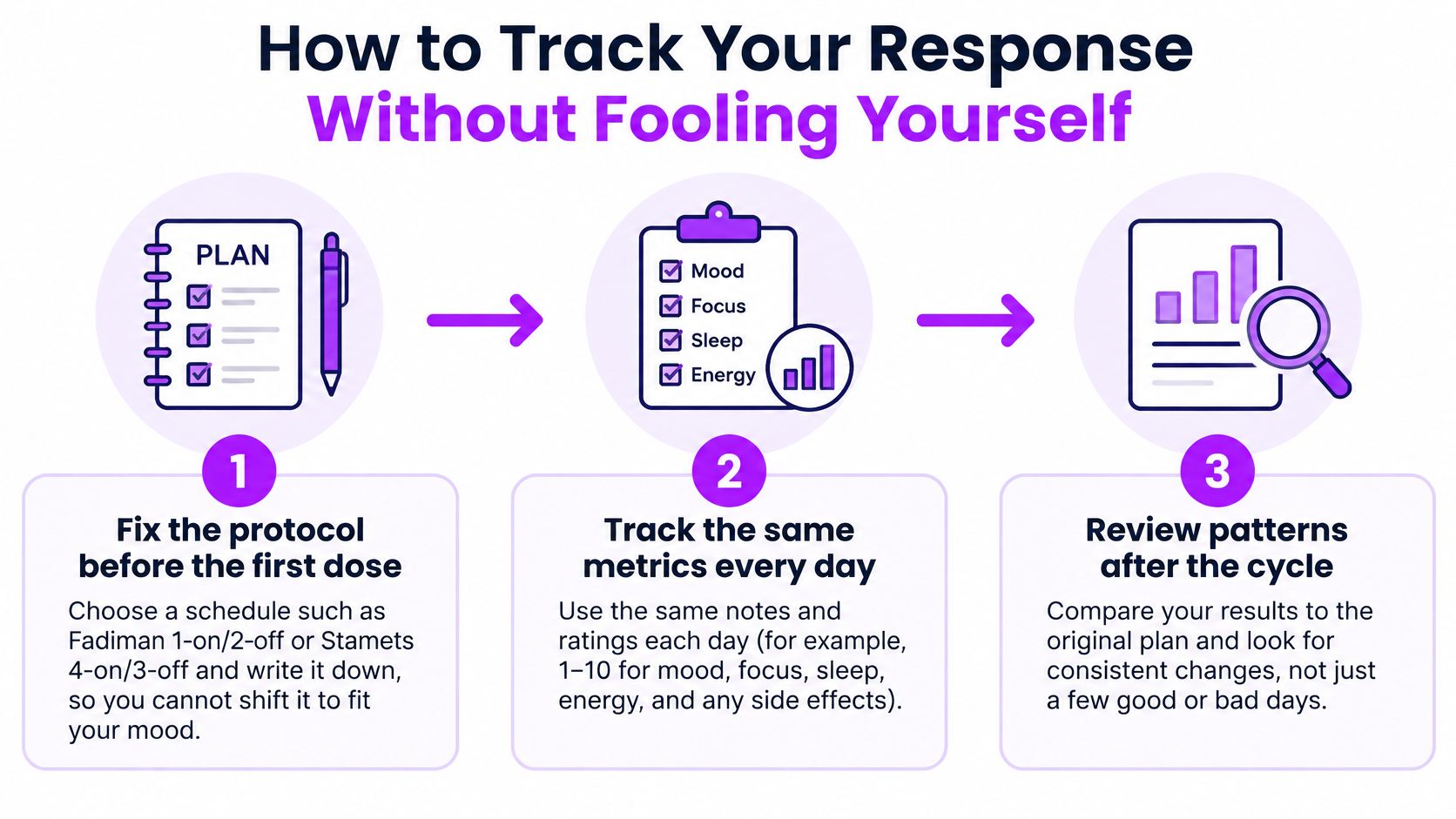
Write down the plan before exposure. If you're considering a schedule such as Fadiman's one day on, two days off, or Stamets' four days on, three days off, discuss it with a clinician rather than treating its name as clinical validation. Record the agreed boundaries so you can't later change the comparison to fit your mood.
Choose two or three outcomes before reviewing results. A practical set is a clinician-selected validated ADHD scale, predefined everyday tasks, and sleep.
Record exposure separately from response. Note substance identity, estimated amount, timing, sensations, and adverse effects. Don't let a pleasant sensation automatically become a better attention rating.
Use the same symptom scale at the same time each week, following its instructions. Record brief functional observations on both dosing and non-dosing days so the comparison doesn't exclude inconvenient results.
Capture competing explanations. Include caffeine, prescribed medication, exercise, stressors, and sleep changes. Mark unknown amounts as unknown instead of inventing precision.
At a planned review, for example after at least four weeks, compare the predefined outcomes across dosing and non-dosing days. This is an organizational checkpoint, not a proven treatment duration or a reason to continue despite problems.
Contact a clinician promptly for concerning changes. Palpitations, racing thoughts, unusual mood shifts, or lost sleep shouldn't wait for the review date; chest discomfort or severe symptoms may require urgent assessment.
The visual routine emphasizes consistency rather than a particular dosing recommendation.
Make every field answer a question
Tracking fields and what each one reveals
| Field | What to record | Why it matters |
|---|---|---|
| Dose | Substance, estimated amount, time taken | Identifies the intervention and its timing |
| ADHD symptoms | One validated scale, same time each week | Provides a consistent basis for comparison |
| Task completion | Predefined tasks done on dosing and non-dosing days | Tests functional change rather than mood alone |
| Sleep and appetite | Hours slept, meals skipped or reduced | Flags changes clinicians monitor |
| Anxiety and mood | Rating on a fixed 1–10 scale | Helps distinguish a persistent pattern from a single good day |
| Warning signs | Palpitations, chest discomfort, racing thoughts, unusual mood shifts | Signals when to seek clinical assessment promptly |
| Confounders | Caffeine, prescribed medication, stressors, exercise | Makes alternative explanations visible |
For a hypothetical example, suppose someone completes their predefined tasks on 9 of 12 dosing days, compared with 4 of 10 non-dosing days. That's worth discussing, but differences in workload, sleep, expectations, or which days were selected could still explain the pattern.
A journal about microdosing for focus is more informative when it defines focus as an observable activity, such as completing a planned work block. Feeling energized and completing the right task aren't interchangeable outcomes.
Working With a Clinician and Confirming the Plan
Clinicians assess more than whether you feel focused. Baseline blood pressure, heart rate, cardiac history, psychiatric history, substance use, and sleep can all affect the assessment of a proposed psychoactive exposure.
The VA ADHD clinician guide describes monitoring of cardiovascular measures, weight, appetite, sleep, mood, adherence, misuse risk, and function; its Oregon adult ADHD algorithm recommends review one to two weeks after a stimulant dose increase, three to four weeks after a non-stimulant dose increase, and every three to six months during maintenance. Those timings concern established medication care, not proof that psychedelic combinations are safe.
Bring information that changes the decision
If you take ADHD medication or another psychoactive treatment, seek a clinician's assessment before a first dose, not after a problem develops. Even without prescribed medication or a significant health history, share the proposed plan rather than assuming no known diagnosis means no relevant risk.
Bring a concise record that the clinician can review:
- Journal export: Include ordinary days, adverse experiences, missing entries, and relevant non-dosing days.
- Exposure details: List substance identity, estimated amount, source uncertainty, timing, and any proposed schedule.
- Medication list: Include every prescription with its dose, plus supplements and nonprescription products.
- Other substances: Record caffeine, alcohol, cannabis, and other psychoactive exposures without leaving out occasional use.
- Specific questions: Ask which symptoms require a call, which require urgent care, and whether the plan should proceed at all.
The purpose isn't to obtain a generic approval stamp. It's to identify whether the clinician sees a reason to advise against the plan, investigate a symptom, or address an unmet ADHD treatment need.
A clinician may reasonably recommend that you don't proceed. A detailed journal doesn't override that judgment or convert an unproven intervention into established treatment.
Confirm boundaries rather than assuming them
Book a dedicated conversation if the topic can't be addressed adequately during a routine refill request. Explain what you're hoping to improve in concrete terms, such as starting essential tasks, keeping appointments, or reducing impulsive interruptions.
Then confirm what will be monitored, who will review it, and what triggers stopping and seeking help. A stop rule should be decided before enthusiasm, disappointment, or an unusual mood state makes interpretation harder.
Agree on a review date rather than treating ongoing logging as sufficient oversight. A review around a month later can be a practical proposal, but the clinician should set the timing according to your circumstances, and concerning symptoms warrant earlier contact.
A standardized assessment tool can make symptom reporting more consistent. It still needs to be interpreted alongside functioning, adverse effects, and health history rather than used as a standalone diagnosis.
Disclosure makes monitoring possible. Keeping exposures secret deprives the clinician of information needed to interpret new symptoms.
Keep the journal in its proper role
At MicroTrack, we offer a 10-point granular mood scale, and journal entries can include mood, dosage, sensations, and side effects. Mood ratings can support reflection, but they aren't a substitute for a validated ADHD symptom measure.
MicroTrack is not a medical application and does not provide medical advice, diagnosis, or treatment. Treat a log or export as a conversation aid, not a safety assessment or evidence that a substance is effective.
The most useful conclusion may be narrower than you hoped: you felt better, but functional outcomes didn't change; tasks improved, but sleep deteriorated; or the pattern remained too inconsistent to interpret. Those are worthwhile findings because they help you and your clinician make a more informed decision without overstating what personal observations can prove.
MicroTrack offers structured journaling for mood, dosage, sensations, and side effects, helping you keep perceived benefits separate from unwanted changes. Visit MicroTrack to organize your observations and bring a clearer record to your clinician, without treating a personal pattern as proof that microdosing treats ADHD.