Microdosing for Focus: How to Test Schedules That Work

The only significant cognitive-control result in one pooled analysis was a small impairment, not an improvement, with an effect size of d = -0.34, according to the analysis indexed in PubMed. That doesn't mean everyone who tries microdosing for focus will perform worse. It means feeling sharper isn't enough to establish that your attention has improved.
A useful tracking plan separates how work feels from what you complete accurately. It also defines when to pause before you're tempted to explain away poor sleep, rising anxiety, or worse concentration. The aim isn't to find a schedule you can defend. It's to find out whether there's a repeatable benefit worth considering at all.
Table of Contents
- Choose a Schedule Before You Start
- Attention Metrics and a Daily Tracking Template
- Warning Signs That Mean Pause and Reassess
- How to Run a Four-Week Focus Trial
- What the Research Shows About Focus Gains
- Decide to Keep, Change or Stop Your Protocol
Choose a Schedule Before You Start
Microdosing schedules compared
| Protocol | Pattern | Dosing Days per 7 Days | Best Fit |
|---|---|---|---|
| Fadiman protocol | 1 day on, 2 days off, a 3-day cycle | About 2.3, averaged across cycles | Beginners who want a light rhythm and longer observation periods between doses |
| Stamets protocol | 4 days on, 3 days off, a 7-day cycle | 4 | Readers who want a steadier weekly routine and accept more dosing days |
| Custom schedule | Your own on and off pattern | Set by you | People who already know their response and need flexibility around work or sleep |
The Fadiman pattern offers the simplest comparison for beginners. Its off days let you observe the following day and a later no-dose day separately. Don't assume those are biologically clean control days, though. An off-day label records what you took, not proof that every possible effect has ended.
The Stamets pattern follows the same weekly calendar, which can make planning easier. Its limitation for analysis is the consecutive run of active days: a change in sleep or workload can overlap with the entire run. This table compares scheduling only, not the additional ingredients sometimes associated with a Stamets stack.
A custom schedule can accommodate travel, changing shifts, or disrupted sleep. But flexibility needs documentation. Record every skipped, added, or moved day, including the reason, rather than updating the calendar afterward to make it look consistent.
Choose for Comparison, Not Frequency
None of these patterns should be treated as an established focus-enhancement prescription. A familiar protocol name tells you how someone organizes dosing, not whether that pattern improves attention or is appropriate for your health.
Consider your actual working week. If active days always coincide with uninterrupted writing mornings while off days contain meetings, the comparison is tilted before you begin. Choose a pattern that allows reasonably similar tasks and working conditions on both kinds of day.
Practical rule: Pick the schedule whose off days give you the clearest comparison, not the schedule with the most dosing days.
For someone who has never tracked before, the simplest pattern is the most manageable default, provided a clinician has addressed relevant safety questions. Keep the planned pattern unchanged during the four-week observation period unless a warning sign requires stopping. A calendar organizes observations; it doesn't establish a focus gain.
Attention Metrics and a Daily Tracking Template
Attention metrics and how to record them
| Metric | How to Record It | How Often |
|---|---|---|
| Focus block completed | Tasks finished in one timed 60-minute work session, checked against a planned list | Daily, same time of day |
| Error rate | Mistakes in a fixed proofreading or checklist task | Three times a week |
| Reaction time | Score from a phone reaction-time test taken at the same hour | Three times a week |
| Sleep | Hours slept and a 1-to-5 quality rating | Every morning |
| Caffeine | Cups taken and time of last intake | Every day |
| Anxiety | Rating on a 0-to-10 scale with a short trigger note | Daily |
| Dose status | Tag each entry as dose day or no-dose day | Every day |
These are suggested tracking conventions, not validated diagnostic thresholds. Entering the results should take under five minutes; the work session and attention tests themselves take additional time. Keep the recording process short enough that you'll also complete it on difficult days.
There's a reason to include performance rather than mood alone. In a double-blind, placebo-controlled study of 34 participants, psilocybin microdosing significantly reduced closed-eye EEG theta power but didn't improve tested cognitive or attentional performance after correction for multiple comparisons. A detectable change in brain activity wasn't the same thing as better task execution.
Make the Task Comparable
Before starting the focus block, write a short list of concrete deliverables. Use units such as reviewing comparable documents, checking records, or completing a defined set of practice questions. Don't compare a demanding analysis assignment with routine inbox clearing and call the difference improved attention.
For proofreading, record both mistakes and the amount checked. A lower error count means little if you reviewed substantially less material. Use comparable passages or checklists rather than repeatedly testing yourself on content you've memorized.
Keep the same phone, reaction-time test, and testing conditions. Treat the result as a personal observation, not a clinical attention assessment. Familiarity with the test is another reason not to interpret an isolated faster score as a drug effect.
Read the Rows Together
A day with more completed tasks and more errors isn't a straightforward win. Neither is a highly productive afternoon followed by disrupted sleep and poor next-day concentration. Evaluate accuracy, output, and the cost to the following day together.
Use a consistent daily order:
- Morning: Enter sleep duration and quality, then start the caffeine record.
- Midday: Complete the planned focus block and any scheduled attention test.
- Evening: Confirm dose status, update caffeine timing, and record anxiety, mood, and unusual events.
Add a brief expectation note before the work session: do you expect better, unchanged, or worse focus? That keeps your prediction separate from your later interpretation.
One day never settles the question. As a practical review minimum, collect at least 10 entries before looking for a pattern, without treating that number as statistical validation or a reason to continue through adverse effects.
Warning Signs That Mean Pause and Reassess
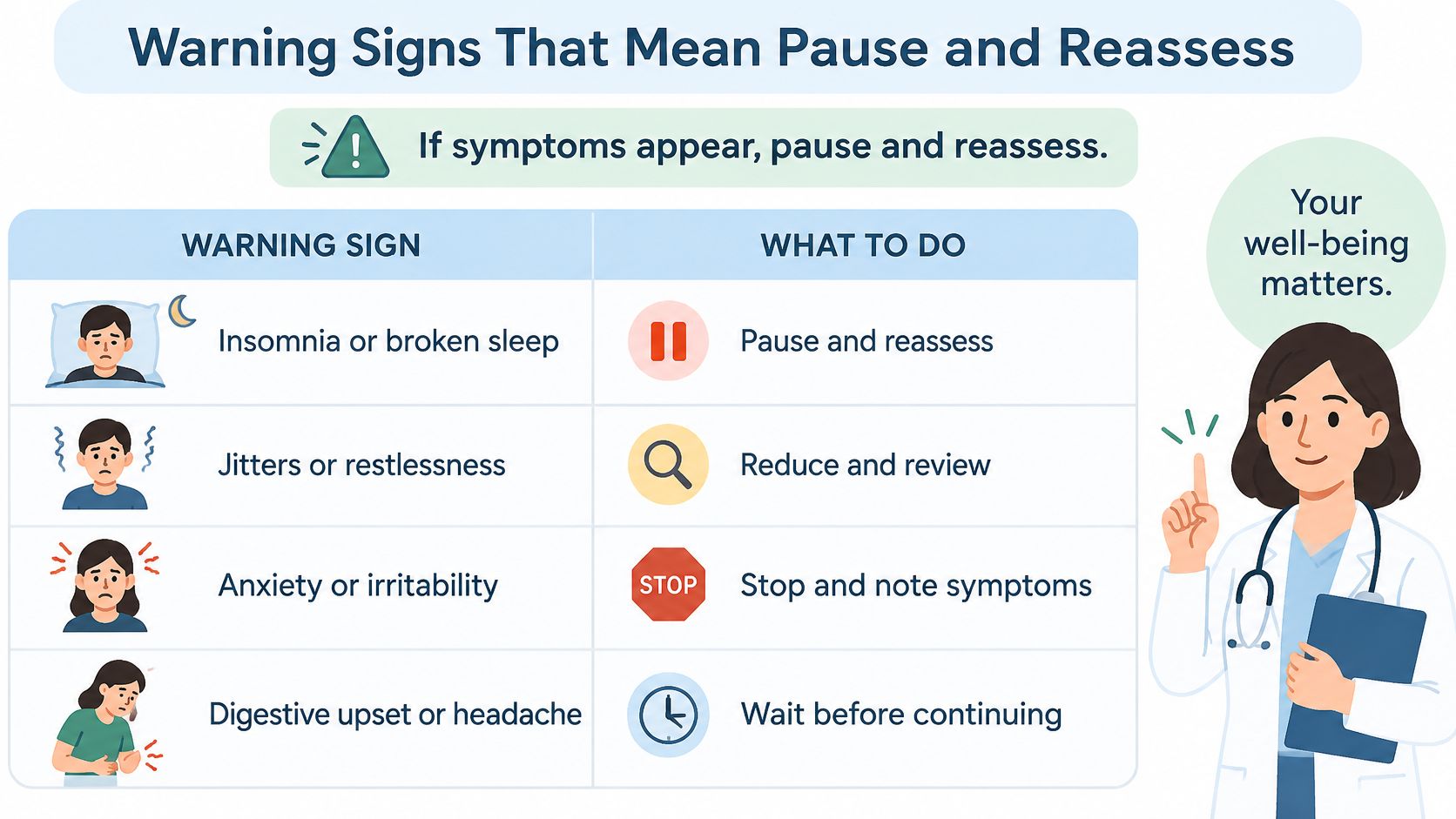
Journals that record only good days miss possible harm. A focus log needs space for unwanted effects, including those that appear after the day you hoped would be productive.
The U.S. National Center for Complementary and Integrative Health lists potential adverse effects of psilocybin microdosing including insomnia, increased anxiety or depression, low energy, headaches, gastrointestinal discomfort, poor focus, and impaired cognitive functioning. Those aren't peripheral concerns when your goal is reliable attention.
Warning signs, what to log and what to do
| Warning Sign | What to Log | Action |
|---|---|---|
| Insomnia or poor sleep | Hours slept and wake time | Skip the next scheduled dose and track sleep for a week |
| Rising anxiety | Rating on the 0-to-10 scale and triggers | Pause the protocol and review triggers |
| Poor focus or impaired thinking | Next-day focus block score | Stop any increase and compare dose and no-dose days |
| Low energy or low mood | Energy and mood ratings for each day | Pause and discuss with a clinician |
| Headache or stomach discomfort | Symptom, timing, and duration | Note the pattern and seek advice if severe or lasting |
| Heart symptoms or medication interaction | Medication list and any available readings | Contact a clinician before the next dose |
Use this visual as a reminder to record adverse changes, not just perceived benefits.
Write the Pause Rule in Advance
The actions in the table are conservative monitoring suggestions, not medical clearance or validated clinical cutoffs. For example, you might predefine three consecutive nights of poor sleep, or any rise above your usual anxiety level, as a reason to pause and review what changed. Don't wait for a threshold if symptoms are severe, frightening, or impair your ability to function.
A pause means withholding further dosing while you assess the problem. It doesn't mean taking more to overcome low energy or adjusting upward because concentration feels disappointing. Record timing, caffeine, workload, physical symptoms, and any uncertainty about what you took.
A safety rule written before an experiment is more useful than an explanation written after an adverse day.
Chest pain, fainting, severe shortness of breath, or other potentially urgent symptoms require prompt medical assessment, not another journal entry. Don't delay emergency care while collecting readings or waiting to see whether a pattern repeats.
Make the Clinician the Decision Point
People with anxiety, depression, PTSD, heart conditions, or prescription medication should speak with a clinician before considering a dosing practice. A tracking plan can't establish that an interaction is safe, and it shouldn't replace care for ongoing attention or mental-health difficulties.
A review of microdosing safety describes adverse effects including anxiety, increased blood pressure, and cognitive impairment. That supports treating worsening concentration as a possible adverse outcome, not automatically as evidence that the schedule needs intensifying.
Our microdosing side-effects guide can help organize the issues to discuss. MicroTrack is a tracking and journaling tool, not a medical application, and we don't provide medical advice, diagnosis, or treatment. The clinician, not the app, is the decision point for symptoms and medication questions.
How to Run a Four-Week Focus Trial
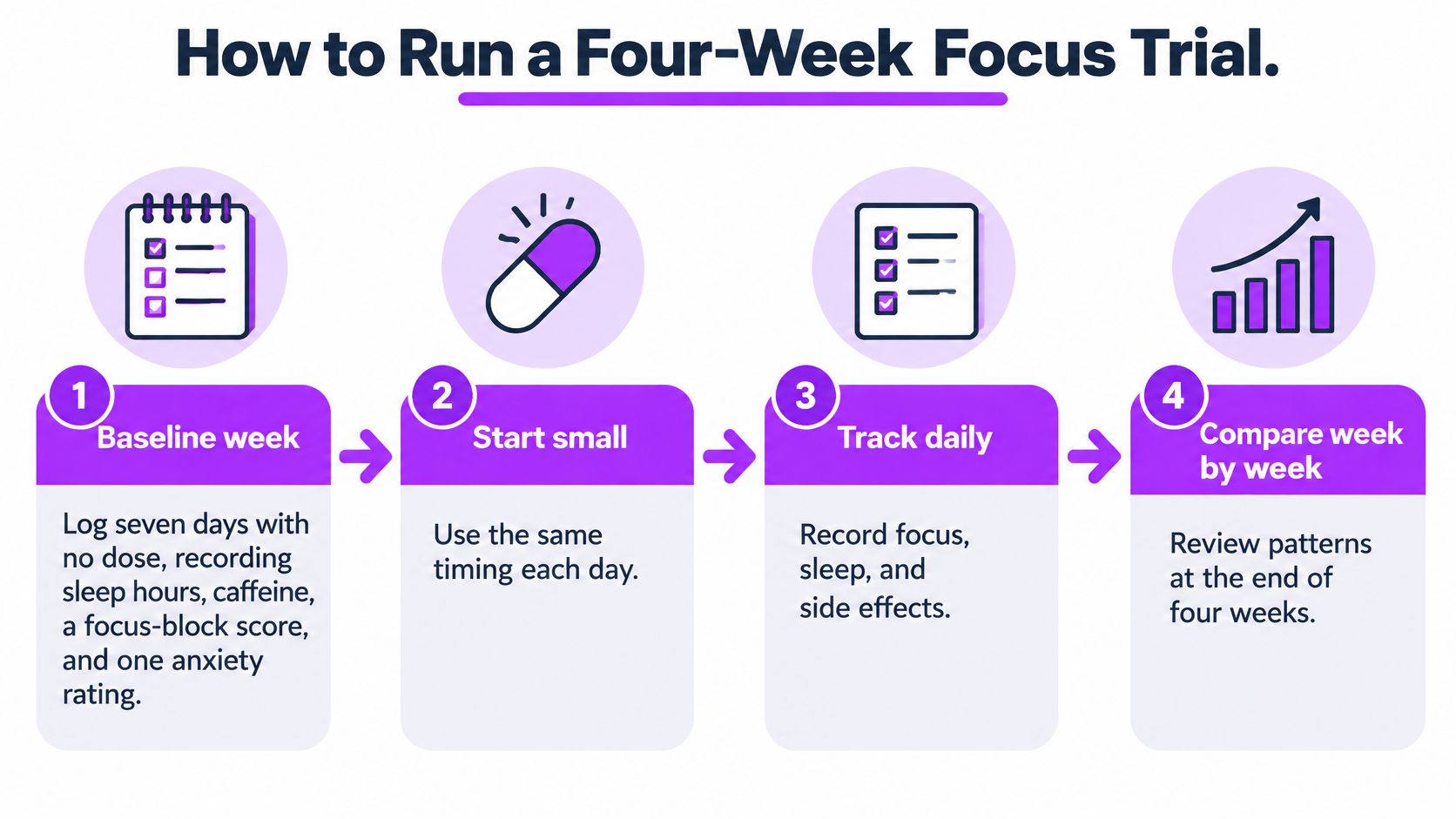
Treat this as an observational tracking exercise, not a recommendation to begin using psychedelics. A no-dose baseline is useful even if you ultimately decide not to proceed. The baseline week comes before the four-week comparison period.
Keep this overview alongside your calendar.
Fix the Plan Before Collecting Results
Record a baseline week. Log seven no-dose days, including sleep hours, caffeine, a focus-block score, and an anxiety rating each day. This gives you an ordinary-week reference rather than a memory of how productive you usually feel.
Choose a schedule and write the dose-day calendar before any active observation begins. Include workdays and rest days so you can see whether the planned comparisons involve similar demands.
Record timing consistently. If you proceed within a lawful, clinician-reviewed plan, document the time taken on every scheduled day. Record deviations rather than silently moving the observation window to whichever part of the day felt best.
Keep the planned dose unchanged during the observation period, unless safety concerns require stopping. Raising it after a flat week changes the experiment, so the later entries no longer test the original plan.
Compare active days with both off days and baseline days, not with your best-ever work session. Review similar task types together and include next-day performance, sleep, and anxiety.
Change only one variable in a subsequent comparison. If you alter the schedule, don't simultaneously introduce a supplement, a new caffeine routine, and a different attention test. You otherwise won't know which change deserves further investigation.
Keep meals and sleep times reasonably steady where practical. Avoid introducing other supplements during the same window, and label unusual days, such as travel or illness, rather than deleting them. Preserve both the full record and any separately reviewed set of comparable days.
Research Doses Aren't Personal Targets
A self-blinding trial involving 191 participants followed a four-week schedule with average reported doses of about 13 micrograms of LSD or 0.2 grams of psilocybin mushrooms every three to four days. Active-dose and placebo groups improved by similar amounts, without a clear advantage attributable to the psychedelic dose.
Separately, the controlled LSD experiment summarized in the controlled-study research notes accompanying the psilocybin evidence used four 15-microgram doses; doses above roughly 60 micrograms typically produce noticeable psychedelic effects. These are research reference points, not starting-dose recommendations, safety thresholds, or instructions to titrate upward.
Write the starting amount and calendar before the observation period. If results remain flat without warning signs, any later dose change would require a new baseline and a separate comparison, not an extension of the original result. Review the pause rules and discuss medication questions with a clinician before considering further dosing.
For another format to accompany your written plan, this video is available.
A usable outcome is a difference that repeats across weeks, or a clear absence of improvement. Neither proves causation in an unblinded personal log. Apply the distinction between correlation and causation before attributing a change to the substance rather than the routine surrounding it.
What the Research Shows About Focus Gains
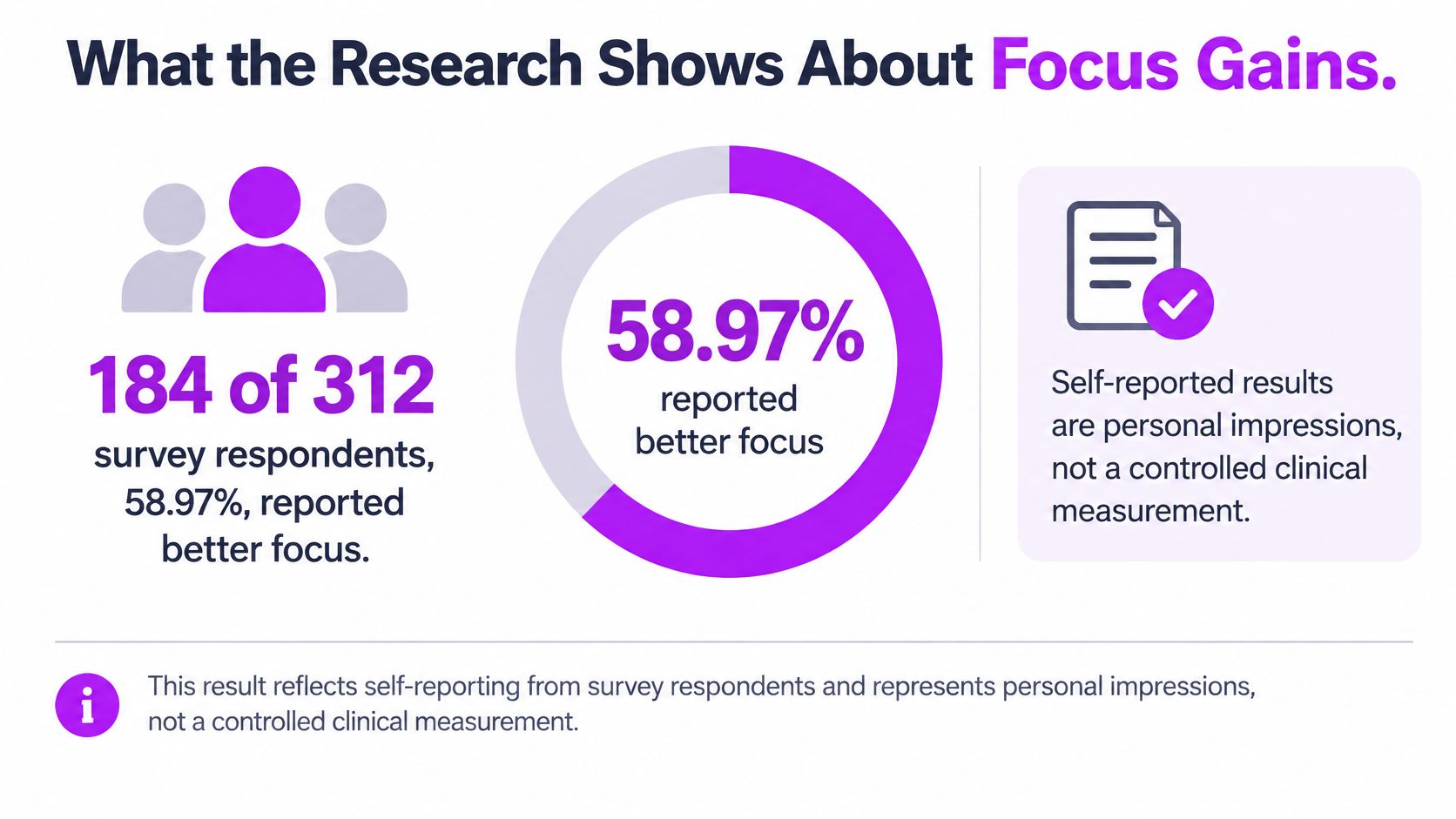
184 of approximately 312 respondents, or 58.97%, reported improved attentional focus in a 2020 international survey analysis. That's evidence that perceived benefits were common among respondents, not evidence that their work became more accurate or their sustained attention improved.
The distinction matters because the question measured personal experience. A respondent could feel more engaged, less frustrated, or more confident without completing more correct work. The survey couldn't isolate the dose from expectations, mood, or working conditions.
Focus findings from microdosing studies
| Study | Participants | Design | Focus Finding |
|---|---|---|---|
| International survey analysis (2020) | Approximately 312 respondents answered the attention item | Self-report survey | 184, or 58.97%, reported better focus while microdosing |
| Randomized LSD study | 48 healthy volunteers | Placebo-controlled | Women averaged 308 ms reaction time versus 335 ms on placebo, with fewer lapses; subgroup pattern only |
| Psilocybin EEG study | 34 participants | Double-blind, placebo-controlled | No attention or cognitive gains after multiple-comparison correction |
| Largest cited self-blinding trial | 191 participants | Four-week self-blinded schedule | Active and placebo groups improved by similar amounts |
| Observational study | 17 participants | Naturalistic, no placebo | No significant change in sustained attention |
The table brings together the controlled studies discussed earlier and a naturalistic observational study of 17 participants, which found no significant improvement or decline in sustained attention or related cognitive domains. Its lack of placebo control limits causal conclusions, while its null finding also cautions against assuming that everyday use necessarily improves cognition.
What the Differences Actually Mean
The women's reaction-time result is an isolated subgroup finding, not a general effect established across participants. It doesn't show that women as a population should expect improved focus, or that faster responses would translate into better professional work. Subgroup results need replication before they support broad recommendations.
The EEG finding answers a different question: did the substance produce a measurable biological change? That isn't interchangeable with asking whether participants performed better. For productivity decisions, a brain signal is less directly relevant than accurate, repeatable task completion.
Likewise, improvement from baseline doesn't establish an active-drug benefit when a placebo group improves similarly. Participants may change their routines, monitor themselves more closely, or expect improvement. Those possibilities matter even when the subjective improvement feels genuine.
Interpretation standard: Treat a good week as a hypothesis to test, not a verdict about what caused it.
Apply a Narrower Definition of Success
The evidence is small, mixed, and insufficient to establish reliable focus enhancement. Null findings don't prove that no individual could benefit, but positive personal impressions don't override controlled comparisons either.
Keep different outcomes separate when reading about psilocybin microdosing benefits. Feeling emotionally better, generating ideas, reacting faster, and sustaining accurate attention are distinct claims. Evidence for one doesn't automatically support another.
For your own logs, the strongest defensible conclusion is modest: under the conditions you recorded, a particular pattern was associated with better, unchanged, or worse performance. That's more useful than declaring that microdosing works based on enthusiasm alone.
Decide to Keep, Change or Stop Your Protocol
Make the final comparison side by side: average completed focus-block tasks and error counts for dose days, off days, and baseline days, alongside sleep and anxiety averages. Check that task difficulty and the amount of work reviewed were reasonably comparable before interpreting the differences.
Use these decision rules:
- Keep under consideration: Active days repeatedly outperform both comparison groups on completed work and accuracy, with no warning signs. This supports further discussion and observation, not proof of effectiveness or safety.
- Change the tracking plan: Results are flat and there are no adverse effects. Consider whether task selection or scheduling prevented a fair comparison before considering a different pattern; change one variable and collect a fresh baseline.
- Stop and reassess: A warning sign persists or worsens. Contact a clinician before any further dosing rather than trying to compensate with a new schedule.
A null result is valid information, not a failed practice. You don't owe a protocol another attempt just because you've invested time in it, and an apparent productivity gain isn't worth ignoring deteriorating sleep or mental health.
Our MicroTrack journal entries can include mood, dosage, sensations, and side effects, with your task metrics recorded alongside them in notes. The decision to continue belongs to you and, where relevant, your clinician. The immediate action doesn't require a dosing decision: begin recording your no-dose baseline today.
MicroTrack is free forever, with no paywalls, and you can start journaling in under a minute. Visit MicroTrack to begin your baseline week today, recording ordinary focus, sleep, mood, and symptoms before drawing conclusions about a protocol.