Microdosing Guide: Build a Safe, Trackable Practice
You've read the threads, saved the protocol charts, maybe even weighed out capsules, and now you're staring at a blank notebook wondering what you're supposed to write down. Mood? Focus? A vague sense that Tuesday felt lighter? Most beginners don't quit because the schedule is hard. They quit because they can't tell if anything changed, or why.
Table of Contents
- Why Research Runs Ahead of Practice
- Setting Up Before Your First Dose
- Comparing the Most Common Protocols
- A Dose-Day Workflow That Actually Sticks
- How to Tell If It's Actually Working
- Safety, Stop Rules, and Medication Interactions
- Reviewing Trends and Adjusting Your Protocol
Why Research Runs Ahead of Practice
That blank-page moment is more common than confident forum posts suggest. I see it constantly in people setting up their first log. They arrive with a named protocol and a strong hope, but no baseline, no definition of success, and no plan for an ordinary bad day that has nothing to do with a dose.
Awareness runs far ahead of practice, and the survey numbers show it. In a 2020 online survey of approximately 2,200 participants, 59% reported familiarity with psychedelic microdosing, about 13% had microdosed at some point, and 4% identified as current microdosers. A separate Southern California study of young adults found far lower awareness, which tells you something important. Prevalence depends heavily on who you ask, where they live, and how you ask.
So don't treat any single percentage as a global truth. Online and regional surveys can overrepresent people already interested in psychedelics. What matters for you is the gap itself. You can spend weeks reading precisely because you're trying to reduce uncertainty before you act.
That instinct is reasonable. Reading without a testing plan just turns uncertainty into delay.
Treat Popularity as a Reason to Track Carefully
Public interest moved faster than rigorous testing. Reporting on search trends described an approximately 1,250% increase in internet searches for microdosing since 2015, with microdoses often described as roughly one-tenth to one-twentieth of a full dose. That range is a broad descriptive convention, and no medical standard exists behind it. Potency differs across substances and products, so copying someone else's amount is sloppy practice.
Shared routines also need context. One large international online sample surveyed thousands of microdosers, yet it was observational and self-selected. It cannot prove microdosing caused the reported mood or health differences.
Treat popularity as a reason to track carefully, not as evidence that a schedule will work for you.
That's why this microdosing guide starts with measurement before enthusiasm. You're building a personal record clean enough to answer one question later. Did your dose days differ from your own non-dose days in a way that matters, without costing you sleep, stability, or functioning?
If you can't answer that, you don't have a practice yet. You have a habit with good marketing.
Setting Up Before Your First Dose
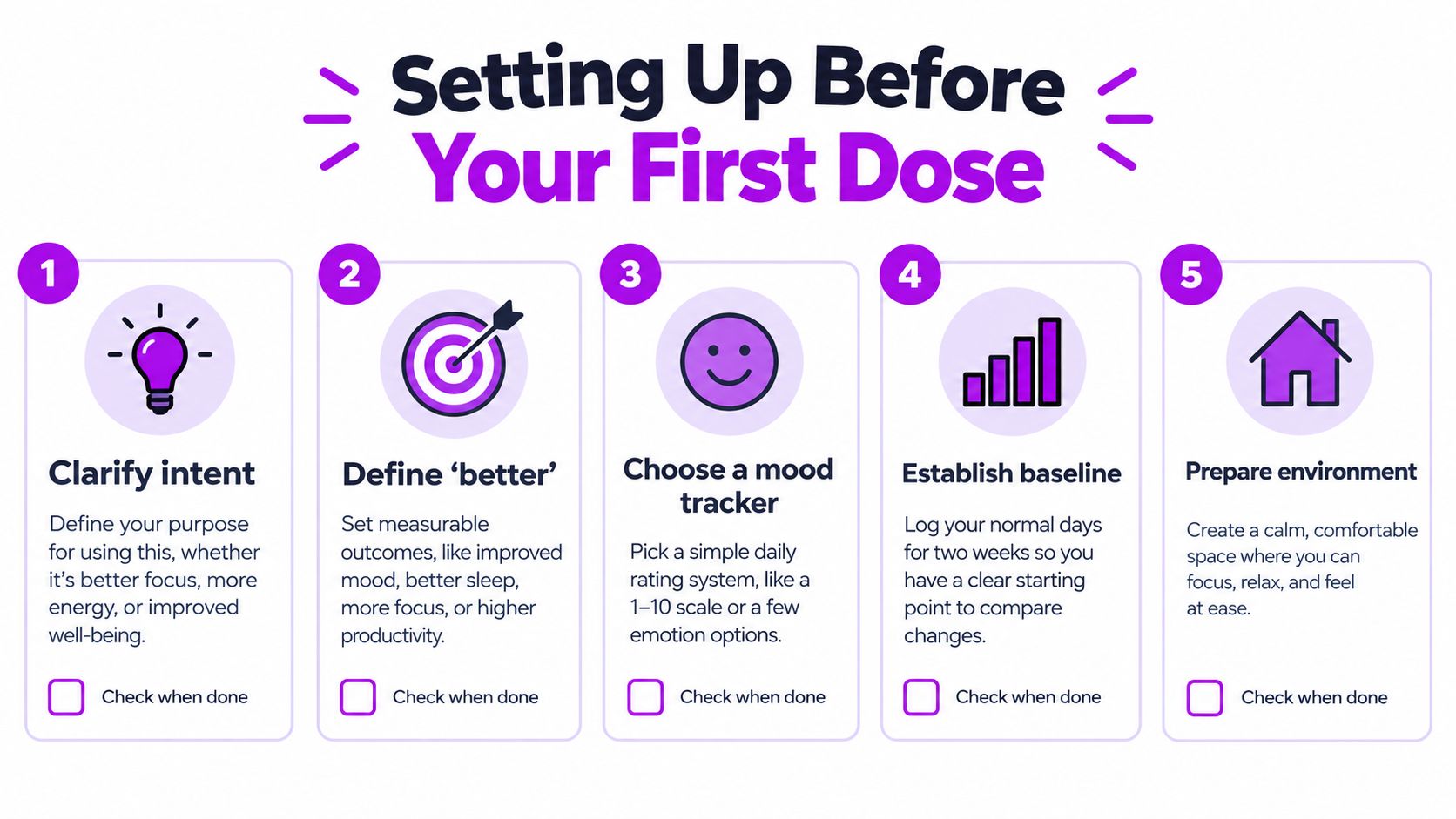
Don't pick a protocol until you've defined what you're testing. A clean first month depends on boring preparation, and that's exactly why it works. You're creating a baseline you can trust when dose day feels unusually good or unusually rough.
Use the checklist below to set your intent, measures, and environment before anything else changes.
Define Better Before You Start
Write one primary outcome in plain language. Better might mean steadier afternoon mood, easier task initiation, or fewer anxious spirals after work. Pick one primary outcome and one guardrail, such as no increase in anxiety or insomnia.
Define your success rule in advance. For example, you'll continue only if your weekly average mood improves against baseline without worse sleep or functioning. If you invent the rule after a great day, you'll fool yourself.
- Intent: State why you're experimenting and what would make you stop.
- Primary measure: Choose mood, anxiety, focus, or functioning as your main signal.
- Guardrail: Name the cost you won't accept, such as poor sleep or agitation.
- Observation window: Commit to a fixed review date before you judge results.
Build a Usable Baseline
Log normal days first, before dose one. Record sleep duration, baseline mood, anxiety, caffeine, alcohol, medications, major stressors, and how well you functioned. Use the same 10-point ratings every day, at roughly the same times.
Keep other variables as stable as you realistically can. Don't launch a new supplement stack, overhaul caffeine, and start microdosing in the same week, then credit the capsule for everything. Change one thing, or accept that your data will stay muddy.
Your pre-dose record should also include substance plans, source or batch notes, and any relevant health context you may later need to review with a qualified clinician. If you want a deeper walkthrough of this stage, use a structured approach to baseline measurement before your first dose day arrives.
Coaching rule: If you didn't record your ordinary days, you have nothing honest to compare your dose days against.
Prepare a calm, predictable first setting. Choose a low-stakes morning, know your obligations, and don't schedule your first experiment around travel, conflict, or a deadline. Preparation isn't superstition. It's variable control.
Comparing the Most Common Protocols
Pick a schedule you can follow and measure. I don't recommend hunting for the perfect protocol. I recommend narrowing to two credible candidates, choosing the one that fits your calendar, and holding it steady long enough to learn something.
The Fadiman protocol is the most familiar option. In a review describing the Fadiman cycle as dose on day zero, two observation days, then dose again on day three, typically for 4 to 8 weeks followed by a 2 to 4 week break, reported amounts included 1 to 3 mg of psilocybin per 70 kg or approximately 0.1 to 0.2 g of dried mushrooms every three days. Those figures describe reported practices, not validated self-treatment instructions.
Its popularity is measurable. In a large survey where 1,203 respondents, or 24.3%, selected the one-day-on, two-days-off Fadiman schedule, it was the most commonly reported regimen. That's useful for tracking categories. It isn't proof of effectiveness.
How the Options Differ in Daily Life
The Stamets rhythm is commonly described as four days on and three days off, often paired in community practice with other ingredients. It creates a denser block of dose days, which some people prefer for routine building. It also gives you fewer clean off-day comparisons inside each week, and stacking adds variables that make interpretation harder.
Clinical research uses tighter designs than informal community schedules. One registered trial administering either 2 or 3 mg of psilocybin daily, four days per week, for two consecutive weeks also includes a placebo group on the same schedule. Don't copy a trial design casually. Use it as a reminder that real testing controls timing, dose, and comparison conditions.
| Protocol | Cadence | Typical reported amount | Best fit for | Tracking implication |
|---|---|---|---|---|
| Fadiman | 1 day on, 2 days off | Reported in reviewed literature, varies by substance and product | Beginners who want clear off days | Strong dose day versus off day comparison |
| Stamets | 4 days on, 3 days off | Community reported, often with added ingredients | People who prefer weekday blocks | More variables, harder attribution |
| Custom | Fixed days you define | Keep consistent once chosen | Irregular schedules or shift work | Works only if planned versus actual days are logged |
Choose by Fit, Not Reputation
If you're anxious, sensitive to sleep disruption, or new to tracking, I favor the sparser rhythm. More off days give you more comparison data and more recovery space. If your life only allows a predictable block, a custom schedule you follow beats a famous schedule you constantly override.
Ask three direct questions. Can you keep this cadence for several weeks without improvising? Can you log on off days, not just dose days? Can you keep dose, timing, and context stable long enough to review fairly?
The best protocol for learning is the one that produces the cleanest comparison, not the one with the strongest online following.
Write down your planned schedule, your intended break, and your review date. Then stop shopping for protocols. Constant switching destroys the experiment you're claiming to run.
A Dose-Day Workflow That Actually Sticks
A workflow survives when it's fast at the moment of dosing and reflective later. If your log takes ten minutes in a busy morning, you'll abandon it by week two. Build for the rushed version of you, not the motivated version.
The photo below captures the right spirit, a brief seated check-in rather than an elaborate journaling ritual.

Morning Capture in Under a Minute
Before you dose, record the essentials. Note substance, measured or estimated amount, batch or source, time, sleep duration, baseline mood, anxiety, caffeine or alcohol plans, medications, and your expectation for the day. That expectation field matters more than people think.
Rate mood before effects could plausibly be felt. If you only log after you feel good, you're building a highlight reel. A pre-dose rating protects you from rewriting the morning later.
Keep the format identical on off days. Same scales, same rough time, same short context note. Your off days are not empty days. They're your control condition.
Midday and Evening Without Overlogging
Later in the day, add a second short rating. Capture mood, anxiety, focus, functioning, and any adverse effects such as headache, jitteriness, nausea, irritability, or feeling perceptibly altered. If you felt obviously impaired, write that plainly. Don't soften it into enhanced sensitivity.
In the evening, add reflection. What did you do? Did you start tasks faster, avoid conflict better, sleep worse, or expect more from the day? Separate behavior from vibe. Behavior is harder to fake to yourself.
This two-phase pattern, fast capture now and reflection later, is where a structured tool can help. MicroTrack offers two-phase entries, a 10-point mood scale, calendar views for planned and actual dose days, and CSV export, which fits this workflow without turning logging into a second job.
The short video below is useful as a pacing reminder while you set up your own routine.
Missed Days and Social Days
Missed entries happen. Mark them as missing instead of reconstructing perfect data three days later. A gap you can see is more honest than a memory you polished.
On social or travel days, log context and move on. Note alcohol, poor sleep, unusual stress, or a skipped dose. Don't throw out the whole week because life interfered. Your review can account for messy context if you recorded it.
- Dose time: Substance, amount, time, expectation, baseline ratings.
- Later check: Mood, anxiety, functioning, adverse effects.
- Evening note: Sleep expectation, behavior, one honest sentence.
- Off days: Same ratings, no dose fields invented after the fact.
At week's end, spend a few minutes checking completeness. You're not judging efficacy yet. You're checking whether future you will have enough clean data to judge anything at all.
How to Tell If It's Actually Working
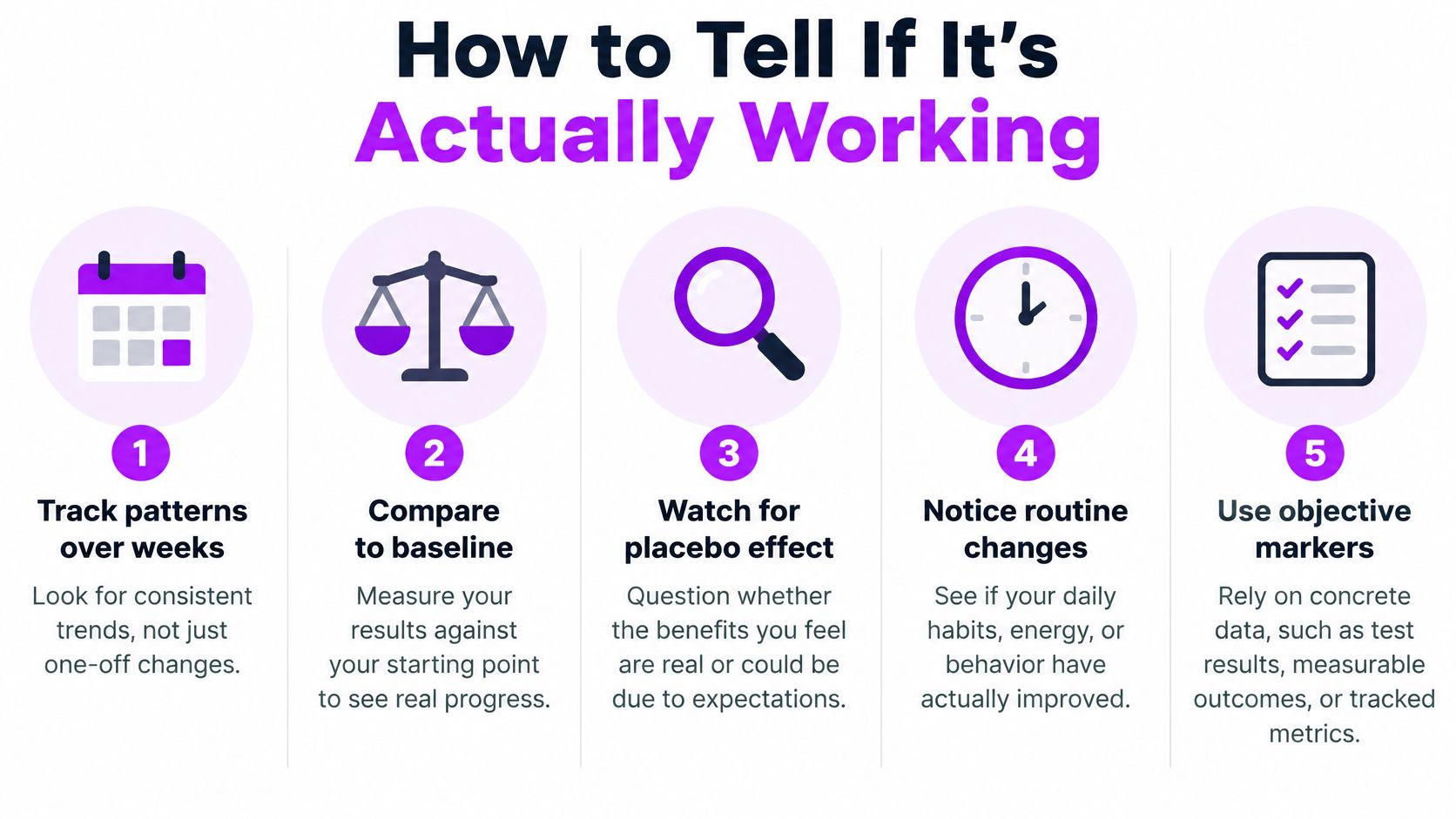
One great dose day proves almost nothing. You might have slept well, finished a hard project, expected a lift, or bounced back from a low point. I want you skeptical of your best day and your worst day. Look for repeatable patterns.
Start with the visual checklist below, then apply it to your own averages rather than your memories.
Expectancy Can Inflate Your Results
Placebo and expectancy effects aren't insults. They're normal human responses, especially when you hope a practice will help and you can often tell a dose day feels different. In a 191-person placebo-controlled study where adjusting for accidental expectancy bias reduced an estimated effect from 5.69 points to 3.04 points, conventional analysis risked overstating benefit. Your personal log has the same vulnerability.
Regression to the mean also tricks people. If you start during a rough patch, some improvement may happen as life normalizes. Confirmation bias then helps you remember confirming days and forget flat ones. Written ratings beat memory every time.
Controlled evidence should keep your expectations grounded. A 2026 systematic review and meta-analysis covering 24 studies and 3,681 participants found minimal effects on cognition, creativity, or sustained mood, with no clear immediate symptom reduction for depression, anxiety, or stress. That doesn't mean your experience is imaginary. It means durable benefit can't be assumed.
Compare Averages, Not Highlights
Use rolling weekly or biweekly averages. Compare dose days with matched non-dose days in the same period, not with a miserable week last month. Look at sleep and anxiety alongside mood, because a small mood lift bought with insomnia isn't a win.
- Dose versus off days: Is the difference consistent across several cycles?
- Baseline versus current weeks: Did average functioning move, or only dose-day optimism?
- Costs: Are adverse effects repeating on dose days or the nights after?
- Missing data: Are you logging less on bad days, which would bias the picture?
Acute perceptible effects also need separating from durable outcomes. A review of 14 controlled LSD microdosing studies found acute effects on measures including blood pressure, sleep, and mood, but repeated dosing did not reliably change mood or cognition. Feeling something today isn't the same as functioning better over a month.
Review ritual: Judge the trend across cycles, including costs and missing entries, before you let one productive afternoon make the decision.
If off days match dose days, believe your data. That result is useful, even if it's disappointing. A structured experiment that gives you a clear no is more valuable than a popular protocol that keeps you guessing.
Safety, Stop Rules, and Medication Interactions
Tracking supports observation. It doesn't diagnose, treat, or make experimentation safe for someone whose symptoms are worsening. If you're seeking relief from depression, anxiety, or PTSD, don't use a log as a substitute for licensed clinical care.
Short-term trials generally report mild, transient effects, but uncertainty remains. An evidence synthesis noting effects such as anxiety, headache, increased blood pressure, sleep disturbance, or cognitive interference, while long-term cardiac and psychiatric safety remains unresolved should make you cautious about months of casual use. Incomplete adverse-event reporting in parts of the literature adds to that uncertainty.
Pause and Get Help Early
Write your stop rules before you start. Pause and seek qualified medical help if you notice escalating anxiety, severe insomnia, agitation, perceptual disturbance, unusual energy, impulsivity, suicidal thoughts, or manic or psychotic symptoms. Don't increase the dose to push through warning signs.
- Sleep: Repeated disruption after dose days.
- Mind: Racing thoughts, paranoia, perceptual changes, or loss of touch with reality.
- Mood: Suicidal ideation, severe anxiety, agitation, or unusually high mood.
- Body: Concerning blood-pressure symptoms, chest discomfort, or persistent physical effects.
- Function: Impairment at work, in caregiving, or while doing tasks that require full attention.
Medication context belongs in every relevant entry. Record prescribed and recreational substances, dose changes, alcohol, and caffeine. If you're reviewing general risk practices, read a practical overview of psychedelic harm reduction and discuss your own situation with a qualified professional.
Some groups face specific warnings. NCCIH states psilocybin is not safe for people with psychotic conditions such as schizophrenia or schizoaffective disorder, or severe bipolar disorder. Registered trial protocols have also treated SSRI and some antipsychotic use as a relative contraindication. Don't interpret theoretical risk language as personal clearance.
Higher doses aren't microdoses. If you're impaired, the experiment has changed category. Stop, record what happened, and prioritize safety and legality where you live.
Reviewing Trends and Adjusting Your Protocol
Your review turns entries into a decision. Use weekly and monthly trend views, dose frequency, time-of-day patterns, and planned versus actual schedule adherence. Then compare your primary outcome and guardrails against the rule you wrote before starting.
The screenshot below shows the kind of calm trend view that makes that review easier than rereading scattered notes.

If dose days and off days look the same, extend the break or end the experiment. If benefits appear only when sleep is good, fix sleep before changing dose. If timing creates evening restlessness, test earlier timing as one isolated change, or stop if safety flags repeat.
For a structured method, follow a weekly trend analysis routine at your four-week review. Export a clean CSV if you're sharing context with a coach or clinician, including missing days and adverse effects.
Schedule that 20-minute review now. Let your own logged pattern, not a forum thread, decide whether you continue, adjust one variable, take a longer break, or stop.
Build your experiment before your next dose day with structured two-phase logging, dose and off-day calendar comparisons, trend views, and exportable records from MicroTrack. Set your baseline, define your stop rules, and give yourself data that's clean enough to trust at review time.