Microdosing Psilocybin Benefits, Risks, and Research
A noticeable shift after taking psilocybin can feel like strong evidence that microdosing works. It isn't. A change in mood or focus can be real as an experience and still fail to show that the substance caused it, that it will recur, or that it amounts to a health benefit.
The harder question is not whether someone felt different, but whether a pattern holds up when expectations, ordinary mood variation, sleep, and other influences are considered. Research on microdosing psilocybin remains limited and mixed, so careful observation matters, but it can't replace clinical evidence or medical care.
Table of Contents
- Why Microdosing Feels Convincing
- Understanding Psilocybin Microdosing
- What the Science Can and Cannot Show
- Comparing Perceived Effects and Measured Outcomes
- Safety Boundaries and Warning Signs
- Legal Questions Vary by Place and Context
- Build a Personal Microdosing Journal
- Make an Evidence-Centered Decision
Why Microdosing Feels Convincing
Someone takes a small amount, notices that work feels easier or the day seems brighter, and wonders whether the change proves the practice is effective. The experience deserves to be taken seriously as a personal observation. But a memorable day, even a positive one, can't by itself tell us whether psilocybin caused the change or whether it would have happened anyway.
Expectations can shape how people interpret subtle sensations. So can sleep, stress, caffeine, social context, and the simple fact that mood naturally fluctuates. When someone is already hoping to feel more focused, a productive morning may stand out, while a restless evening or an ordinary day may be easier to forget.
That doesn't mean every reported benefit is imaginary. It means perception and proof answer different questions. A person can feel more alert without showing improved attention on a task, and a short-lived sense of ease doesn't establish a reliable effect on depression or anxiety.
A useful way to approach the subject is to compare patterns, not isolated experiences. The evidence review linked below describes a small and mixed controlled literature, with open questions about lasting effects and clinically relevant outcomes. A structured journal can help someone notice whether a change appears repeatedly alongside other conditions, but it can't turn self-observation into proof of causation.
A useful distinction: “I noticed a change” is a valid observation. “Psilocybin caused a reliable benefit” is a much stronger conclusion.
This guide treats microdosing as a question for careful analysis, not a formula or a treatment recommendation. It considers what the research can establish, what it can't, which safety issues deserve attention, and how a journal can help a person make a more informed decision.
Understanding Psilocybin Microdosing
A low-intensity dose is sometimes compared to turning down the volume on a perceptual experience rather than switching it off completely. The analogy conveys an important point: an effect may be subtle without being absent. A person might notice a change in mood, sensory experience, or bodily state even when they aren't experiencing the pronounced effects associated with a full psychedelic experience.
Microdosing generally refers to repeated use of a small amount intended to avoid a pronounced psychedelic experience. The intended experience is subtle and functional, rather than a full trip. But informal definitions vary, and estimates based on mushroom weight can be imprecise: the amount of psilocybin in a preparation isn't necessarily clear from how much the material weighs.
That matters because a dose that looks similar on paper may feel different to different people, or even to the same person on different occasions. A person who slept poorly or feels anxious may respond differently from someone who is rested; the preparation itself can also affect how predictable the experience is. These examples illustrate why a label such as “microdose” doesn't guarantee a particular effect.
Three ideas help keep the concept clear:
- Intended intensity: The amount is meant to be low, not to produce a pronounced trip.
- Possible perception: “Low” doesn't mean “unnoticeable.” People can experience subjective or physiological changes.
- Outcome: Feeling something is not the same as showing improved health, cognition, or day-to-day functioning.
Researchers have measured changes in neurobiology, physiology, subjective experience, affect, and cognition in controlled low-dose studies, but that range of measured effects doesn't mean a consistent benefit has been established. An observable reaction is a result to record, not a verdict about whether the practice is helpful. That distinction is why informal schedules should be treated as personal experiments, not guaranteed formulas.
What the Science Can and Cannot Show
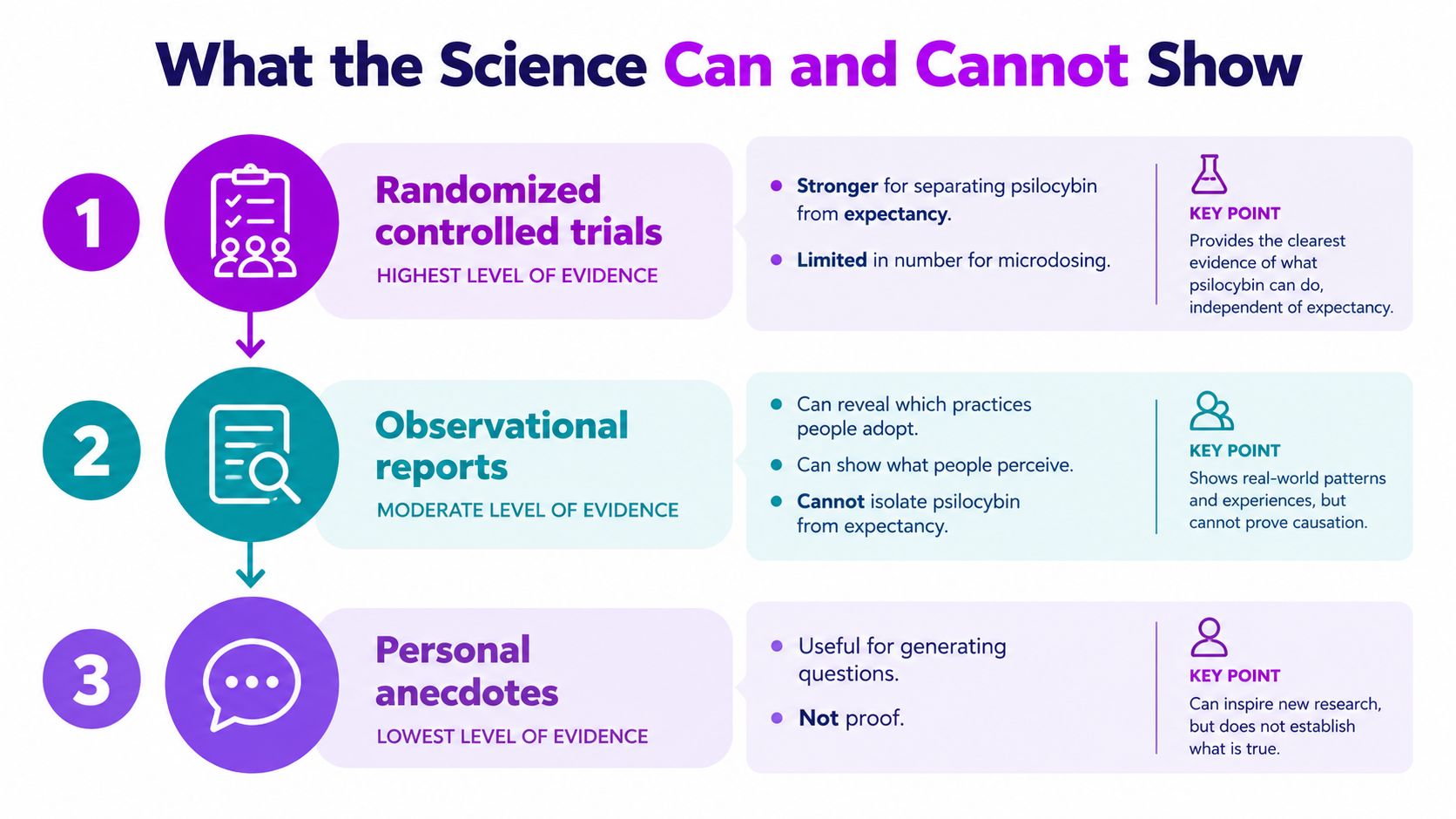
Different research designs answer different questions. Observational reports can show what people say they do and how they describe the experience, but they can't reliably separate the substance from expectations, changes in routine, or ordinary shifts in mood. Controlled trials can make a stronger test of cause and effect by comparing an active condition with a placebo, though their conclusions still depend on study design and the outcomes measured.
A 2024 rapid review identified 19 placebo-controlled laboratory studies examining low-dose LSD or psilocybin. A separate 2024 review concluded that most available evidence still comes from observational research rather than randomized trials. The psilocybin-specific evidence is especially small: the reviewed literature included only two controlled psilocybin experiments, using truffle preparations equivalent to approximately 0.8 mg and 1.5 mg of synthetic psilocybin. These findings are discussed in a review of controlled low-dose psychedelic research.
A controlled experiment can find a measurable effect without demonstrating a meaningful clinical benefit. In a landmark double-blind, placebo-controlled study published in 2022, psilocybin microdosing reduced resting-state EEG power, but researchers found no significant difference in auditory oddball event-related-potential responses. In everyday terms, one brain-activity measure changed while another measured response did not show a significant difference. Neither result, by itself, establishes a benefit in daily life.
Interpreting trial results also requires caution. Confidence intervals that cross zero mean the data don't clearly distinguish an observed effect from no effect. If researchers test many outcomes, some apparent differences may occur by chance unless they account for multiple comparisons. An active placebo can help address expectations, but participants may still guess what they received if they notice a distinctive effect. Studies also vary in how they define outcomes, making results harder to compare.
For a plain-language explanation of why a pattern occurring alongside an experience doesn't prove that the experience caused it, see correlation and causation in self-tracking. The key point is that mixed results neither prove effectiveness nor establish that microdosing is harmless. Current evidence does not establish microdosing psilocybin as an evidence-based treatment for depression, anxiety, PTSD, or other conditions.
For another overview of why trial design matters, the following video provides background:
Comparing Perceived Effects and Measured Outcomes
Claims about microdosing often blend three separate layers: what a person notices, what a study measures, and what controlled research can establish. Keeping those layers apart makes it easier to take subjective experience seriously without treating it as proof of improved functioning or clinical benefit.
| Claim Type | What It Describes | How to Interpret It |
|---|---|---|
| Perceived effect | A person reports feeling more alert, more at ease, or more focused. | It describes an experience, but doesn't show what caused it or whether it will recur. |
| Measured outcome | A study records a change in a task, physiological measure, or self-report. | It shows what changed under the study conditions, not necessarily that the change improves everyday life. |
| Clinical claim | Microdosing is said to treat a condition or reliably improve functioning. | It requires evidence that the benefit is meaningful and distinguishable from placebo and other influences. |
A double-blind, placebo-controlled study illustrates the difference. Participants received 0.5 g of dried psilocybin mushrooms, an amount capable of producing noticeable subjective effects and altered EEG rhythms. Compared with placebo, the dose did not improve creativity, cognition, physical activity, or self-reported mental health and well-being. Some tasks showed a trend toward impaired performance, including attentional-blink and Stroop measures, as reported in the controlled study of psilocybin mushroom microdosing.
The practical implication isn't that every person will have the same response. It's that a dose can feel perceptible without producing measurable functional gains. Subjective ratings and behavioral outcomes should therefore be considered separately, particularly when someone is evaluating whether they can safely perform tasks such as driving or operating equipment.
This distinction also applies to broad claims about mood, cognition, and creativity. A systematic review and meta-analytic summary of randomized trials reported estimates for depressive symptoms, anxiety, and stress that weren't consistently distinguishable from placebo. Some apparent changes in mood, cognition, or social functioning also disappeared after researchers corrected for multiple comparisons. A summary of randomized-trial evidence describes the limits of those findings.
A narrow, specific effect may be more plausible than a universal claim that microdosing boosts every kind of performance. One recent synthesis described a possible difference in originality relative to fluency in divergent thinking, without improvement across other divergent- or convergent-thinking measures. Even a promising signal of that kind needs cautious interpretation. A journal can help someone examine whether a personal pattern recurs, but self-tracking alone can't establish what caused it.
Safety Boundaries and Warning Signs
Subtle doesn't mean risk-free. A safety-first approach begins with three questions: who shouldn't improvise, what changes deserve attention, and when professional support should take priority.
Who should avoid self-experimentation without clinical guidance? The National Center for Complementary and Integrative Health states that psilocybin isn't considered safe for people with psychotic conditions, including schizophrenia or schizoaffective disorder, or severe bipolar disorder. Someone with a diagnosed mental health condition, a history of serious symptoms, or questions about psychiatric medication should involve a qualified clinician rather than treating a journal or online protocol as a substitute for care.
What should be monitored? Possible problems associated with psilocybin microdosing include insomnia, increased anxiety or depression, poor mood, low energy, gastrointestinal symptoms, headaches, disrupted sensory experience, temperature dysregulation, impaired focus and cognition, and reduced social functioning. The NCCIH overview of psilocybin and mental health describes these potential concerns. A guide to microdosing side effects can also help organize observations, but it can't assess an individual's medical risk.
- Record changes: Note sleep, mood, anxiety, energy, physical symptoms, and cognitive functioning rather than recording only what felt positive.
- Treat impairment seriously: A noticeable effect may matter for attention, judgment, or safety-critical tasks, even if it doesn't feel like a full psychedelic experience.
- Coordinate care: Don't use microdosing as a reason to stop prescribed treatment or change psychiatric medication without professional guidance.
When should someone pause or seek help? Severe or worsening anxiety, mania-like symptoms, psychosis, suicidal thoughts, dangerous blood-pressure symptoms, or persistent physical effects call for prompt professional assessment. If someone may be in immediate danger, contact local emergency services. Monitoring is for noticing changes, not for deciding alone that a serious reaction is safe to wait out.
Legal Questions Vary by Place and Context
There isn't a universal yes-or-no answer to whether psilocybin is legal. Rules depend on location and can distinguish among possession, cultivation, purchase, personal use, clinical treatment, and scientific research. Permission for a research setting doesn't automatically mean that consumer possession or use is permitted.
The exact substance and preparation matter, too. A rule concerning psilocybin compounds may not answer every question about mushrooms or a particular product. Nor should a person assume that a local policy in one place applies in another. Traveling with a controlled substance can raise separate legal questions from possessing it at home, so local permission shouldn't be treated as permission to cross a border or jurisdiction.
A practical check is to look up current information from official authorities for the exact location and activity under consideration. Confirm the status of the specific substance and preparation, and distinguish research or clinical access from personal use. If legal consequences are plausible, seek qualified legal advice rather than relying on a general online summary.
The safe conclusion is modest: resolve legal uncertainty before contemplating use, not after a problem occurs. A tracking schedule doesn't change the legal status of a substance, and a research protocol isn't a general authorization for personal use.
Build a Personal Microdosing Journal
A journal can make reflection more disciplined without turning it into a clinical test. The aim is to identify whether a change seems consistent, while keeping open the possibility that other factors explain it.

Start with a baseline. Before drawing conclusions from later observations, record ordinary patterns in sleep, mood, stress, energy, focus, and relevant physical symptoms. A baseline helps distinguish a change from the person's usual range, though it can't eliminate expectation or other sources of bias.
Choose the question first. Pick one outcome, or a small number, to observe. “Do I feel more focused in the morning?” is easier to assess than “Is my life better?” Define what would count as a change before looking for one, and use the same wording or scale over time.
Record context, not just the dose. When relevant, note dose details, timing, sleep, baseline mood, expectations, stress, caffeine, alcohol, menstrual cycle, physical effects, focus, and adverse experiences. On non-dose days, continue to record the same outcomes. That gives you a more useful comparison than a record that captures only days when you expected something to happen.
- Separate ratings: Keep subjective impressions apart from practical outcomes, such as whether you finished a planned task.
- Watch longer patterns: One memorable day can dominate recollection. Trends across weeks are more informative, though they still don't prove causation.
- Log schedule changes neutrally: Record a skipped day or adjustment without immediately attributing a later mood shift to it.
- Pause when needed: Stop treating self-tracking as the priority if symptoms worsen or you need clinical assessment.
A structured mood-tracking journal can help someone keep observations organized. MicroTrack is one option for logging dose details, mood, sensations, sleep, side effects, and later reflections, with schedule tracking and trend views. Any journal or app can improve record-keeping, but none can validate a treatment effect or substitute for a clinician's assessment.
Make an Evidence-Centered Decision
Before making a decision, ask whether you have a clear personal question, understand that the evidence is limited and mixed, and can distinguish subjective effects from measured outcomes. Consider whether you've reviewed relevant safety concerns and health history, discussed diagnosed conditions or medication questions with an appropriate professional, and checked current law in your exact location.
A journal may sharpen reflection, but it can't turn an uncontrolled observation into causal evidence. If an apparent benefit coincides with better sleep, less stress, or changed expectations, those factors belong in the interpretation rather than being treated as background noise.
The balanced conclusion is that psilocybin microdosing may produce noticeable or meaningful subjective changes for some people, but current controlled research doesn't support broad promises about productivity, mood, creativity, or treatment. A careful decision may mean continuing to observe, reconsidering the practice, or seeking professional guidance. Uncertainty is a reason to stay precise, not a reason to overstate either benefits or risks.
MicroTrack offers structured logging for dose details, mood, sleep, sensations, and later reflections, which can help keep personal observations organized without presenting them as clinical proof. If you want a product-neutral way to review your notes over time, visit MicroTrack.