Mushroom Microdosing Guide: Protocols, Doses and Tracking

What if the day you felt sharper was not a dose day at all, and you only noticed because you expected to? That's the gap most advice skips. This mushroom microdosing guide treats your journal as a blinded self-experiment, not a diary of hopes. You'll pick a schedule in advance, weigh dried mushroom accurately, set stop rules, and compare dose days with planned off days before you decide anything worked.
Table of Contents
- Pick a Microdosing Protocol Before Your First Dose
- How Much Mushroom to Dose and How to Convert It
- Safety Limits, Red Flags and When to Stop
- How to Prepare Doses and Set Up Your Schedule
- Track Results and Decide Whether to Continue
Pick a Microdosing Protocol Before Your First Dose
Start with the Fadiman protocol, 1 day on and 2 days off. It's described as ideal for beginners, and the two off days give you a clean comparison instead of a blur of dose days. If you can't tell a dose day from an ordinary Tuesday, you haven't learned much, no matter how popular the schedule sounds.
Popularity isn't proof. A systematic review of psilocybin microdosing studies found that the most commonly reported schedule was “1 day on, 2 days off,” while research also documented daily dosing, every-other-day dosing, five-days-on/two-days-off schedules, weekly or fortnightly use, and flexible as-needed schedules. Reported mushroom amounts in that review ranged from below 0.1 g to above 0.5 g of dried material, which tells you real-world practice varies a lot and no single schedule has been clinically established as standard.
Microdosing Schedules and What Each One Means
| Protocol | Pattern | Best for | What to know |
|---|---|---|---|
| Fadiman | 1 day on, 2 days off | Beginners | Most commonly reported schedule; clear off days for comparison |
| Stamets stack | 4 days on, 3 days off | Readers who want more frequent dosing | More dose days make it harder to separate effects from normal variation |
| Daily | Every day | Short experiments only | Hardest schedule to compare against baseline days |
| Every other day | Dose every second day | Readers who want a regular rhythm | Reported in research; off days alternate predictably |
| Five on, two off | 5 days on, 2 days off | Readers who want a weekday routine | Reported in research; keep the same weekdays each cycle |
| Weekly or fortnightly | Once per week or every two weeks | Minimal-exposure experiments | Reported in research; few dose days to learn from |
| Custom | Days set by the reader | Irregular schedules | Write the rule down before starting so it does not drift |
MicroTrack includes a Fadiman protocol schedule of 1 day on and 2 days off and a Stamets protocol schedule of 4 days on and 3 days off, so you can set either rhythm before you start. Don't treat that menu as evidence one works better. It just stops you from reinventing the calendar mid-cycle.
Why frequency changes what you can learn
Dose more often, learn less clearly. With Stamets or five-on, two-off, most of your week is dose days, so a stressful meeting, poor sleep, or extra coffee can look like a mushroom effect. With weekly dosing, the opposite problem appears. You get so few dose days that one unusually good morning can dominate your impression.
Say you run Fadiman for three cycles. You get dose days spaced out, transition days, and fully off days, all under the same rule. If you switch to every-other-day after one flat week, you've changed the experiment before it produced readable results. Keep one schedule for several full cycles unless a safety reason tells you to stop.
Practical rule: A protocol you keep steady for three cycles teaches you more than three protocols tried for one week each.
Custom schedules need the tightest discipline. Write the rule in plain words, such as dose on Mondays and Thursdays only, and don't add a Friday because the week felt hard. As-needed dosing is the hardest pattern to interpret because you tend to dose when you already expect, or need, a better day.
Do this today. Pick one protocol, mark its dose days on a calendar, and decide in advance the two outcomes you'll track, such as mood and sleep quality. That small commitment turns a vague intention into a test you can read later.
How Much Mushroom to Dose and How to Convert It
Dried weight is the only amount you can measure at home. A scale tells you grams of mushroom, not how strong that mushroom is. Potency varies between species, batches, and even parts of the same batch, so a number from a study describes weight in that study, not a guaranteed effect for you.
That distinction matters at the high end of common discussion. In a 2022 double-blind, placebo-controlled study, researchers recruited 34 people beginning to microdose Psilocybe cubensis and tested a 0.5-gram dried-mushroom dose. Participants correctly identified whether they had received psilocybin or placebo in 49 of 64 measurement weeks, or 75% of the time. In plain terms, 0.5 g was often noticeable, so it isn't automatically sub-perceptual just because someone calls it a microdose.
Dose Levels Reported in Published Research
| Dose level | Dried mushroom | Context from research |
|---|---|---|
| Lowest reported range | below 0.1 g | Smallest amounts in published schedules |
| Starter dose | 0.1 g | Used for two weeks before any increase in one long-running study |
| Step-up dose | 0.125 g | Given three times per week in a study lasting at least two years |
| Blinded study reference dose | 0.5 g | Participants guessed their condition correctly in 75% of measurement weeks |
| Highest reported range | above 0.5 g | Largest amounts in reviewed protocols; more likely to produce noticeable effects |
Read the table as a map of what's been reported, not a ladder you're meant to climb. The 0.1 g starter and later 0.125 g step-up come from one long-running schedule, not a universal prescription. The gap between 0.1 g and 0.5 g is fivefold, so treating every amount in between as interchangeable makes your notes useless.
Expectancy complicates the picture further. In that blinded work, stronger acute effects clustered among people who correctly guessed their condition. If you can clearly feel it, you may rate creativity, mood, or focus higher because you know it's a dose day. That's why the amount, the time, and your rating window all need to stay consistent in this mushroom microdosing guide.
Weighing and Converting a Batch
Use a scale that reads to 0.01 g when you're portioning near 0.1 g. A kitchen scale that rounds to the nearest gram can't distinguish 0.08 g from 0.14 g, yet that difference is large at this scale. If you're unsure how milligram readings translate, review how to measure milligrams accurately with a home scale before you portion anything.
Work through one batch slowly. Say you have a hypothetical 10 g batch of dried, ground mushroom and your chosen portion is 0.1 g. Divide 10 by 0.1 and you get 100 portions, so each portion is one-hundredth of the batch. If your portion were 0.125 g instead, the same math gives 80 portions. The arithmetic is simple, but it only works if the powder is mixed evenly and each portion is weighed, not counted by caps or pinches.
Don't convert by mushroom count. One large stem and one small cap don't weigh the same, and they may not contain the same amount of active compounds. Fresh and dried weights also aren't interchangeable because fresh mushrooms carry water weight. Log dried weight every time, with the batch and preparation noted beside it.
Start at the lowest level you can weigh accurately. Change only one variable at a time, either the weighed amount or the schedule, never both in the same cycle. If you change both and feel different, you won't know which change mattered.
Safety Limits, Red Flags and When to Stop
Microdosing is not a treatment for depression, anxiety, PTSD, or any other condition. If you're looking for relief from a diagnosed condition, a self-run experiment shouldn't replace qualified clinical care. That boundary comes first, before dose charts and tracking tips.
The U.S. National Center for Complementary and Integrative Health psilocybin overview states that microdosing safety and effectiveness remain unclear and lists possible problems including insomnia, anxiety, low mood, poor focus, increased heart rate or blood pressure, nausea, and impaired functioning. It also warns against psilocybin use in people with psychotic conditions, severe bipolar disorder, or related psychiatric vulnerability. Long-term, frequent community use is especially understudied, so absence of reported harm in short trials isn't a safety guarantee.
What to Do in Each Situation
| Situation | What to do |
|---|---|
| Psychotic conditions or severe bipolar disorder | Do not use; seek clinical care |
| Taking SSRIs or other serotonergic medications | Get medical review before any dose because interactions are possible |
| Blood pressure or heart conditions | Check with a clinician first; mild blood-pressure increases have been observed |
| Anxiety, agitation or poor sleep | Pause, log the episode and do not raise the amount |
| Nausea, headache or dizziness | Usually short-lived; contact a clinician if it lasts beyond 48 hours |
| Chest pain, fainting or severe headache | Seek emergency care immediately |
Medication questions need a clinician, not a forum. Medical literature raises concerns about possible serotonergic and metabolic interactions with SSRIs, while emphasizing that evidence is still incomplete. Incomplete doesn't mean safe. It means you shouldn't guess, and you shouldn't adjust a prescribed medication on your own to make room for an experiment.
The common adverse effects readers should expect to log are nausea, headache, dizziness, transient anxiety, and mild blood-pressure rises. In controlled settings these have typically been short-lived, so persistence is the signal to act. If symptoms last beyond 48 hours, worsen, or interfere with work, driving, or sleep, stop and get medical advice. For a fuller symptom list, see this overview of microdosing side effects and warning signs before your first dose, not after a bad day.
The Stop Rule
Set your stop rule while you're calm. Pause when anxiety, agitation, sleep disruption, perceptual changes, or impaired function appears. Don't increase frequency or amount to chase a better mood score, because that turns a safety signal into a dosing error. Treat any apparent gain as provisional, especially if it shows up only on days you knew you'd dosed.
If you need to argue with your own stop rule, that's the moment to follow it.
Sourcing changes risk too. Product identity and potency can vary substantially, and uncertain or adulterated sources make your weighed grams even less meaningful. Prefer legal, tested products where lawful access exists, and don't use material you can't identify. A precise scale can't fix an unknown substance.
MicroTrack is not a medical application and does not provide medical advice, diagnosis, or treatment, and neither does this guide. Your main safety tool is an adverse-event log with date, time, symptom, severity, and duration. Bring that log to a clinician, because a clear timeline helps them help you far more than a vague memory that you felt off last week.
How to Prepare Doses and Set Up Your Schedule
Good preparation makes later decisions boring, in the best way. You're removing avoidable variation so the remaining differences mean something. Start with the baseline and calendar, shown here, before you weigh a single portion.
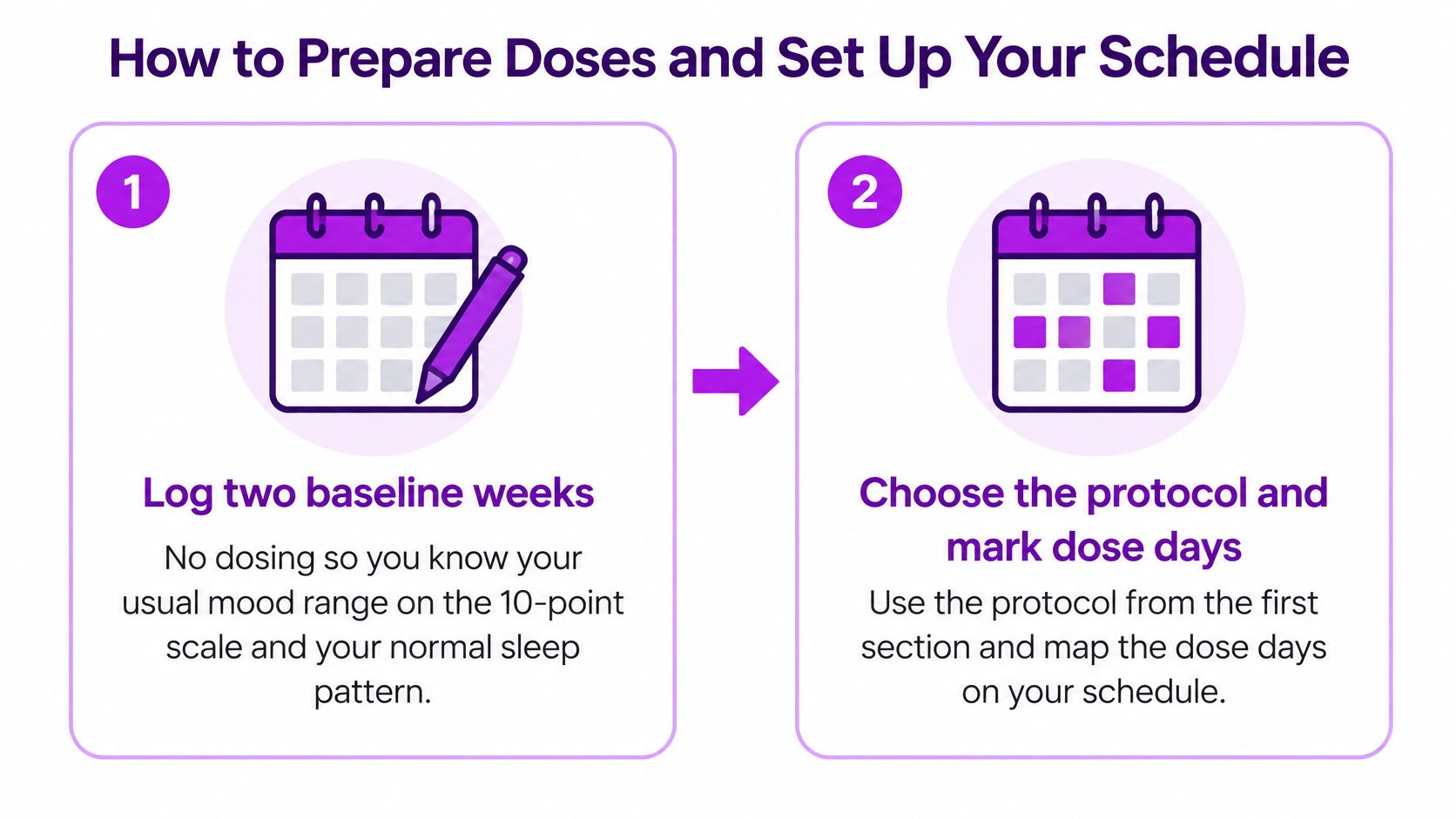
- Log two baseline weeks with no dosing so you know your usual mood range on the 10-point scale and your normal sleep pattern. Without that range, you can't tell a real shift from your ordinary good and bad days.
- Choose the protocol and mark dose days on a calendar so the pattern is fixed before motivation fluctuates. Use skip and add overrides only for days you cannot dose, and note why.
- Zero an empty container on the scale, then weigh to 0.01 g so the container doesn't inflate the reading. Check the scale on a flat surface away from drafts, because tiny portions drift easily.
- Grind and homogenize the material into a fine, even powder so each portion has similar content. Store it airtight, dark, and dry, because moisture and light degrade both quality and consistency.
Watch the weighing and setup sequence once before you handle your own batch.
- Divide the powder into equal-weight portions and label each with weight and date so you aren't weighing in a rush on dose mornings. Keep portions out of reach of children and pets, in a container that doesn't look like food or candy.
- Enter dose, time, and a mood rating in the first entry before the day gets busy. Journal entries can include mood, dosage, sensations, and side effects, so capture the basics while they're fresh.
- Add the reflection entry at a set time later so your morning rating isn't colored by how the afternoon turned out. Separating the two entries is what lets you compare expectation with outcome.
- At week four, check that every day has an entry and no days are missing. Gaps make later comparisons unreliable because people tend to skip logging on flat or bad days.
Mistakes That Ruin the First Month
- Skipping the baseline: You end up comparing dose days with a memory of normal, and memory edits itself.
- Weighing on a scale that drifts: Your 0.1 g portion becomes a different amount each week.
- Changing protocol halfway through a cycle: You create two half-experiments and learn from neither.
Prepare on a calm day, not the morning of your first dose. If weighing, labeling, and logging feel fiddly at first, that's normal. The routine gets fast, and its consistency is the point.
Track Results and Decide Whether to Continue
A good day proves little. You might've slept well, skipped a difficult call, or expected the dose to help. The job of tracking isn't to collect encouraging anecdotes. It's to make expectancy show its hand.
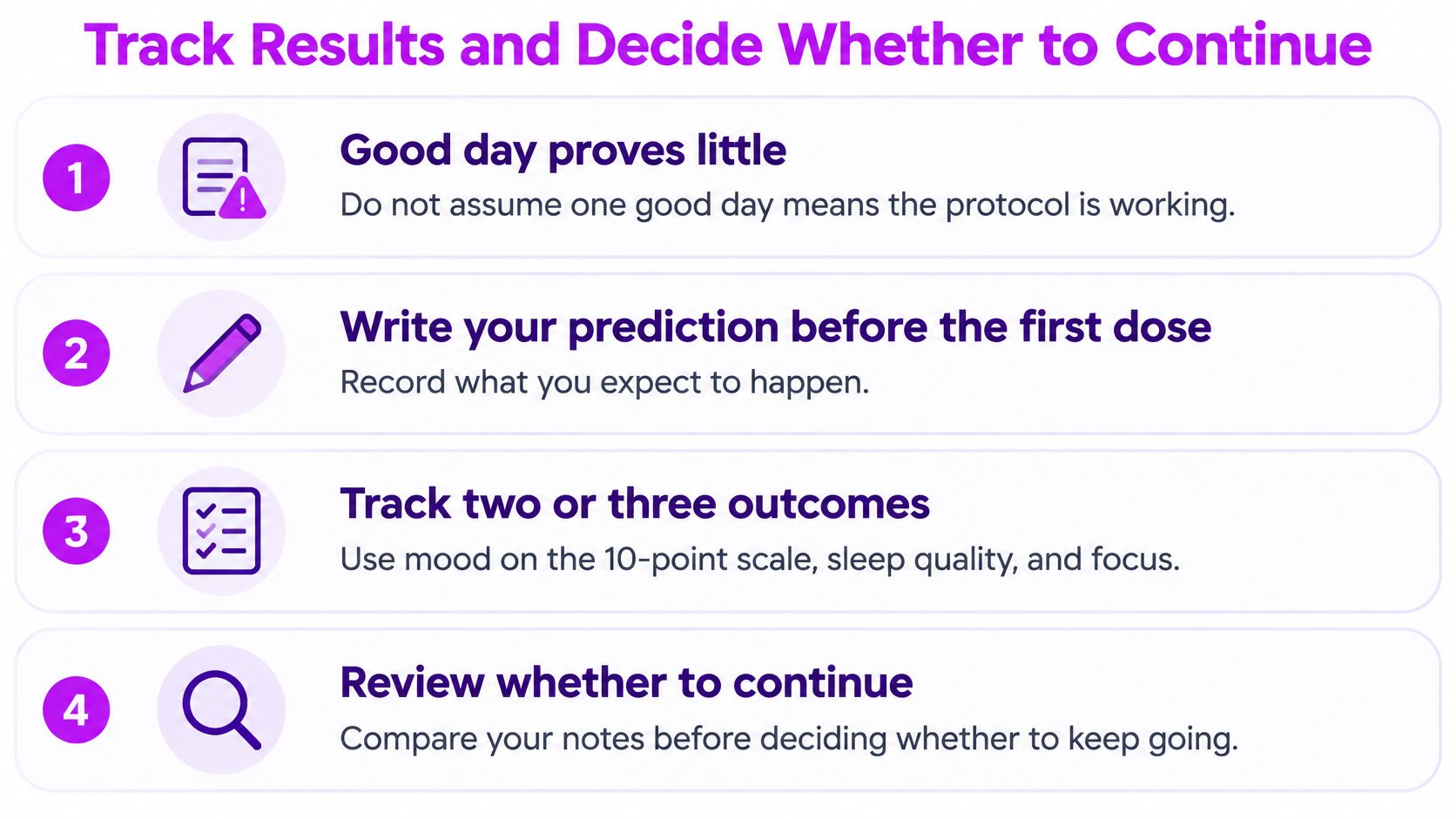
The checklist below sums up the order. Predict first, measure second, decide last.
Set the Test Before the First Dose
Write your predicted effect in one sentence, such as I expect dose days to show higher focus by midday. Then pick two or three outcomes, for example mood on the 10-point scale, sleep quality, and focus. MicroTrack offers a 10-point granular mood scale, and as a wellness journaling and habit-tracking web application it's built for this kind of repeated self-rating, not for diagnosis.
Record baseline mood before dosing begins. Rate at the same time each day, and lock each rating before reading any reflection you wrote earlier. If you peek at yesterday's hopeful note before rating today, you're grading your own homework with the answer visible.
Log the confounders with every entry. Sleep, caffeine, alcohol, stress, and concurrent medications can each move mood and focus more than a small dose plausibly would. Say your three best focus days were all Saturdays after full nights of sleep. That's useful information, but it isn't a mushroom finding.
Write the prediction before the first dose, because a prediction written afterward is just a story.
Compare Dose Days With Planned Off Days
Compare dose-day averages with planned non-dose-day averages over at least three cycles. Treat any single positive day as noise. You're looking for a difference that survives ordinary week-to-week variation, not a highlight reel.
There's a strong reason for that caution. In a randomized, double-blind, placebo-controlled crossover study in Translational Psychiatry, participants completed two measurement weeks separated by one washout week, using 0.5 g of homogenized dried mushrooms in capsules in one week and an equivalent capsule containing an edible mushroom in the other. No measured outcome showed a significant active-versus-placebo difference after correction for multiple comparisons. If a blinded study can produce a null result at 0.5 g, your unblinded good day deserves skepticism.
That doesn't make tracking pointless. It makes honest tracking the whole point. Personal tracking can generate a hypothesis about your own patterns, but it can't establish treatment efficacy, and the blinded sample in that study was also too small for definitive conclusions.
Use the trends view for weekly and monthly averages and time-of-day patterns, but treat each pattern as a lead to test in the next cycle. If afternoons look better on dose days, don't declare victory. Predefine that afternoon rating for the next three cycles and see if it holds. For help reading those charts without fooling yourself, this walkthrough on how to trace a pattern in your tracking data shows the comparison step by step.
Read a Null Result Honestly
A null result is informative. If dose days and off days look the same after three cycles, this protocol isn't showing a benefit for you at this amount and schedule. That's a successful experiment with an unwelcome answer, and it's far more valuable than months of hopeful guessing.
Watch for the quieter trap. Many readers only log carefully on dose days and rush off-day entries, so dose days look richer and more positive by construction. Give off days the same rating time, the same fields, and the same thirty seconds of honesty.
Continue, Adjust, or Stop
- Continue: The dose-day difference holds across cycles, your confounder log doesn't explain it, and no adverse events have appeared. Keep the same amount and schedule so the next cycles can confirm or weaken the signal.
- Adjust one variable: Results are unclear, so change either the schedule or the weighed amount, never both at once. Run the new version for several cycles before judging it.
- Stop and talk to a clinician: Adverse effects persist, sleep or work suffers, or you feel you need the mushroom to function. Dependence on the ritual is itself a finding worth taking seriously.
When you speak with a clinician, share the CSV export rather than summarizing from memory. Dates, amounts, ratings, and adverse events in one file let them see frequency and timing at a glance. That conversation matters more than any trend line if you're dealing with depression, anxiety, or PTSD.
Your first action this week is small. Write the one outcome you'll judge on and set the review date before the next cycle begins. A mushroom microdosing guide can give you structure, but only your predefined test can tell you whether the structure revealed anything real.
Use MicroTrack to run this mushroom microdosing guide as a real self-experiment, with Fadiman and Stamets calendars, separate dose and reflection entries, and dose-day versus off-day trend views. Start your two baseline weeks today, write your prediction before any dose, and let the comparison, not expectation, make the decision.