Psilocybin Microdosing Protocol: Fadiman and Stamets

A psilocybin microdosing protocol is a repeating schedule of dose days and rest days, with the two most common approaches being Fadiman's one-day-on/two-days-off cycle and the Stamets four-days-on/three-days-off stack. These are informal observation frameworks, not clinically validated prescriptions.
You might already have a calendar open, trying to work out whether “every third day” means Monday and Thursday, or whether a missed day means starting over. The confusion usually comes from treating a protocol as a dosing reminder rather than a plan for comparing different kinds of days.
The useful question isn't just when to take something. It's what you can reasonably learn from the pattern, what could distort your interpretation, and when safety should take priority over the calendar.
Table of Contents
- What a Psilocybin Microdosing Protocol Actually Is
- How the Fadiman Protocol Works
- How the Stamets Stack Works
- Other Microdosing Schedules People Use
- What Research Says About Microdosing Results
- Safety Screening and When to Pause
- Building a Microdosing Protocol You Can Track
What a Psilocybin Microdosing Protocol Actually Is
Think of a protocol like a training plan rather than a collection of random workouts. A training plan distinguishes activity, recovery, and review. A psilocybin microdosing protocol similarly separates exposure from observation, while leaving room to stop rather than automatically continue.
That distinction matters because following a named schedule doesn't establish that the substance is effective or appropriate for you. It only gives your notes a more consistent structure.
The building blocks of a usable protocol
A complete observation plan needs more than highlighted dose dates:
- Dose day: Record what was taken, its preparation, the approximate amount, and the time.
- Rest days: Record what happens without another dose, including any continuing discomfort or perceived changes.
- Cycle length: Define the repeating calendar pattern and distinguish it from the longer period over which you're observing.
- Planned break: Mark an extended pause separately from ordinary rest days.
- Observation window: Decide when you'll record immediate experiences, later reflections, and overall patterns.
The calendar components fit together like this:
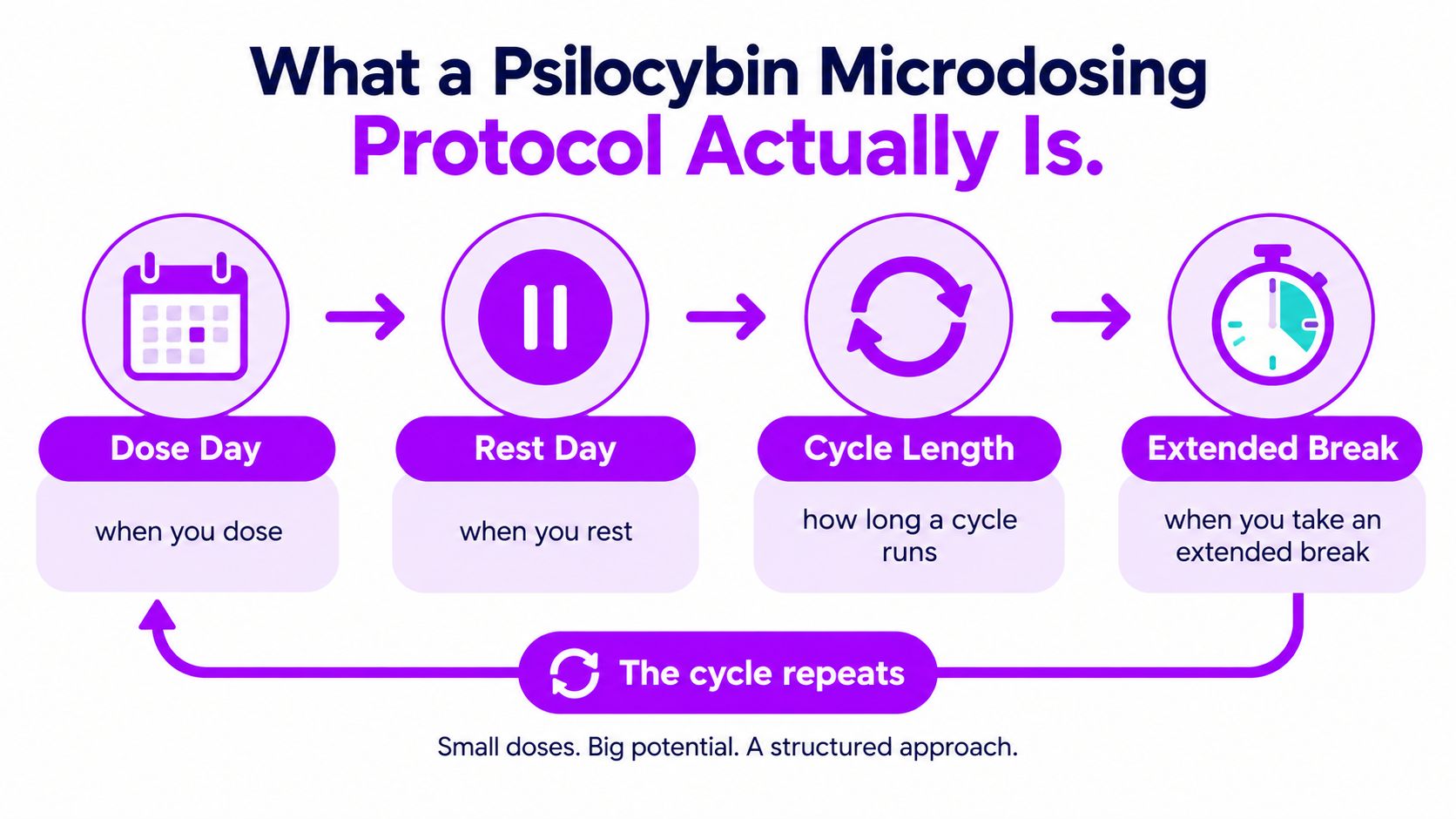
The observation window sits around that calendar. It tells you when to pay attention, rather than assuming every entry describes the same stage of an experience.
Mushroom weight isn't active-compound weight
A systematic review found reported mushroom or truffle amounts ranging from 0.05 to 1.0 g, with administration ranging from a single dose to daily use. The authors identified substantial variation that prevents reliable dose-response conclusions, including differences in species, preparation, potency, and batches (systematic review of microdosing methods).
That range describes research heterogeneity, not a recommended dose range. A weight of dried mushrooms measures mushroom material, not a standardized amount of psilocybin.
For your records, “capsule” is therefore an incomplete description. Preparation, product information, and batch details can help explain why apparently similar entries aren't necessarily comparable.
Practical rule: A protocol should make your observations easier to interpret, not make uncertain exposure look medically standardized.
Fadiman and Stamets-style schedules differ most visibly in how they arrange dose and rest days. Neither name resolves the uncertainty about what's in a preparation.
How the Fadiman Protocol Works
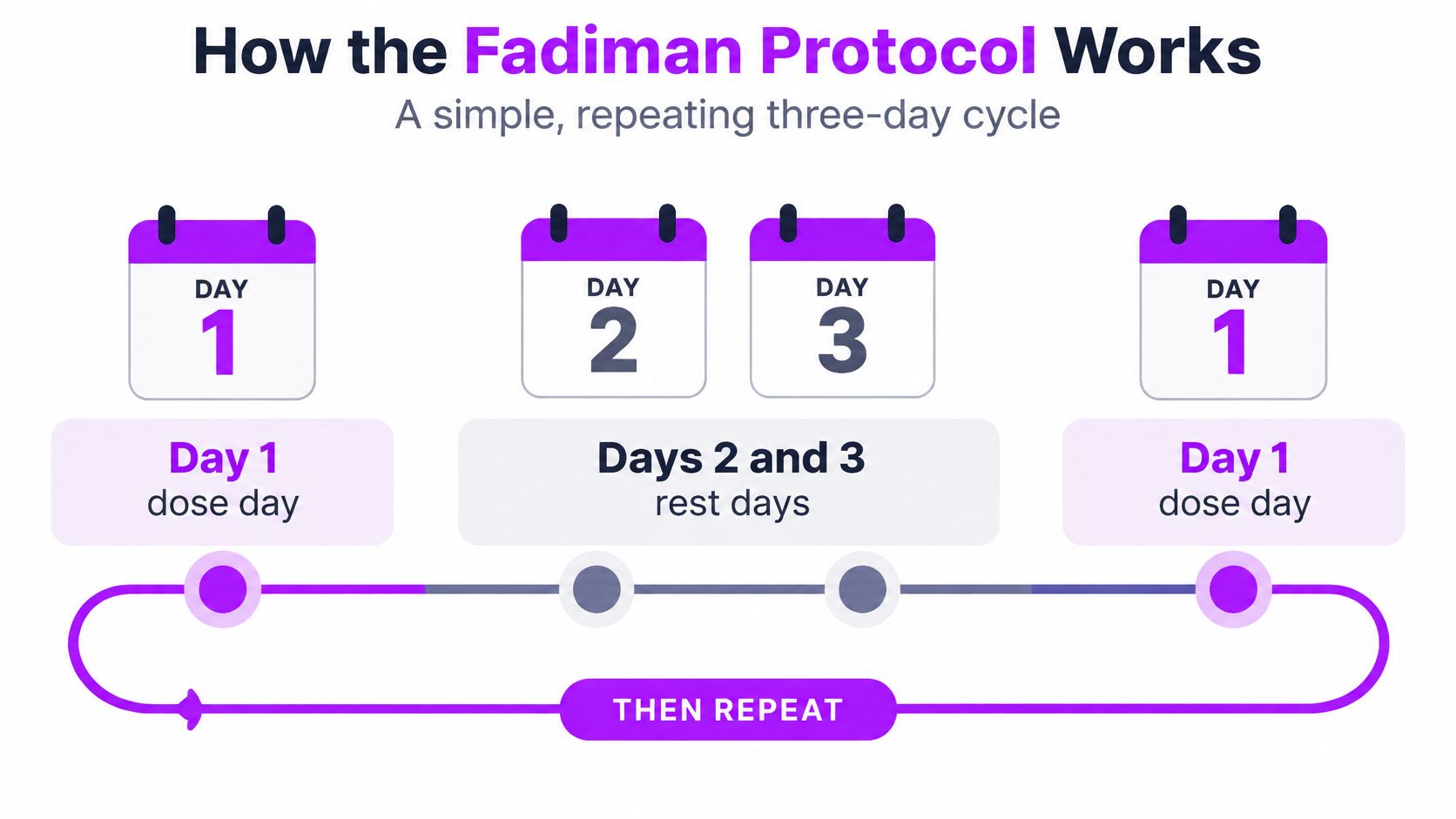
The Fadiman schedule repeats across the calendar rather than resetting at the beginning of each week. That's the detail beginners most often miss.
The three-day cycle consists of a dose day followed by consecutive non-dosing days. In a large survey, 1,203 regular microdosers, or 24.3% of that subgroup, reported this schedule, making it the most widely reported approach in that dataset; reported longer practice periods commonly lasted 4–8 weeks, followed by 2–4-week breaks, although these are descriptions of practice rather than medical guidance (survey overview and protocol discussion).
The diagram shows the repeating unit, not a fixed weekly appointment:
Reading the calendar correctly
Using Monday as an illustrative starting point, the dose date falls on Monday, followed by non-dosing Tuesday and Wednesday. The next cycle begins Thursday, not the following Monday.
Here's how to distinguish the observations:
- Dose day: Note the day's experiences without assuming every change came from the compound.
- Following rest day: Look for perceived residual effects, delayed discomfort, or a return toward your usual state.
- Later rest day: Compare how you feel farther from the dose, while still recording ordinary influences such as work demands.
People sometimes describe the later rest day as a “clean baseline.” That's a useful intention, but an overly strong conclusion. A non-dosing day isn't automatically free of lingering effects, expectations, or unrelated changes.
Rest days are observation days. Leaving the dose field empty shouldn't mean leaving the journal empty.
Repeating cycles and longer pauses
The short repeating cycle and the longer practice period answer different questions. The former organizes nearby comparisons; the latter sets a boundary for review rather than letting the routine continue indefinitely.
A planned break deserves its own calendar label. Otherwise, you may later mistake an intentional pause for forgotten entries or inconsistent adherence.
Popularity explains why Fadiman is a common reference point in beginner discussions. It doesn't establish that this is the safest starting schedule, that it's appropriate for your circumstances, or that completing the planned period is a goal worth pursuing despite adverse symptoms.
For an additional explanation of the schedule, the video below offers another format:
How the Stamets Stack Works
A Stamets-style calendar groups dose days together, followed by a block of rest days. Unlike the Fadiman pattern, the commonly described rhythm fits neatly into a week.
The four-days-on/three-days-off schedule is discussed in the clinical literature as an informal protocol, not a clinically validated prescription (review of protocols and controlled research). A Monday start would place the dose-day block from Monday through Thursday and the rest-day block from Friday through Sunday.
The schedule and the stack are different things
The approach associated with Paul Stamets also uses the term stack for combining psilocybin with lion's mane mushroom and niacin. That describes an informal formulation concept, not a standardized medicine with a universally accepted composition.
Keep these distinctions separate:
| Term | What it describes | What it doesn't establish |
|---|---|---|
| Schedule | The placement of dose and rest days | A clinically proven frequency |
| Stack | Combining ingredients | Proven added benefit from the combination |
| Product | A particular preparation | Equivalence with other products bearing the same label |
Someone can follow a Stamets-style calendar without having a standardized version of the stack. Equally, recording “Stamets” in a journal doesn't tell a clinician which ingredients or preparations were involved.
Don't assume that adding ingredients makes the approach more effective. For observation purposes, each additional ingredient also creates another possible explanation for an experience.
A denser calendar requires more careful interpretation
The weekly alignment may appeal to someone who prefers recurring weekday reminders. That's a convenience judgment, not evidence that consecutive exposure suits their health or improves their results.
Clustered dose days also complicate interpretation. If your experience changes across the block, your notes alone can't establish whether tolerance, accumulated expectations, sleep, the preparation, or ordinary circumstances explain the difference.
Useful questions include:
- What changed within the block? Record whether the experience felt different across consecutive dose days without assigning a cause.
- What changed during rest? Compare comfort, functioning, and mood rather than looking only for positive effects.
- What else was included? List accompanying supplements and substances separately instead of hiding them under the word “stack.”
A tidy weekly calendar can make adherence easier to describe. It cannot confirm that the exposure is safe, that rest days adequately address tolerance, or that a combination produces the effects claimed for it.
Other Microdosing Schedules People Use
Real-world practice is more varied than a choice between named protocols. A 2024 qualitative study of 199 reported psychedelic microdosers documented several patterns, including every-third-day, workweek-style, alternate-day, and daily use (qualitative study of reported microdosing practices).
The shares below come from that study. The “Typical Best Fit” column is an editorial comparison of calendar convenience and observation goals, not a clinical recommendation or a finding about which people benefited.
Reported Microdosing Schedules at a Glance
| Schedule | Pattern | Share of Users | Typical Best Fit |
|---|---|---|---|
| Fadiman | Every third day | 38%, 75 people | Beginners seeking a straightforward way to understand dose/rest comparisons |
| Workweek-style | Five days on, two off | 8%, 16 people | Routine-driven users who prefer weekday alignment |
| Alternate-day | Alternating dose and non-dose days | 6.1%, 12 people | People who prefer a simple alternating calendar |
| Stamets-style | Four days on, three off | 2%, 4 people | People comparing a clustered block with a separate rest block |
| Daily | No scheduled rest days | 5.6%, 11 people | Poor fit when the aim is dose-day versus rest-day comparison |
These are selected reported patterns, not a complete breakdown of the sample. They also describe psychedelic microdosing practices, so they shouldn't be interpreted as a universal distribution of psilocybin-only use.
Choose the question before the calendar
If you're trying to understand how dose days differ from ordinary days, lower-frequency designs offer more calendar space for comparison. That's an observation advantage, not a claim that they deliver better health outcomes.
If recurring weekday reminders matter most to you, a weekly pattern may be simpler to manage. But comparing a demanding workday with a relaxed weekend can create a misleading contrast: you're changing both exposure and context.
Daily use removes the scheduled non-dose comparison entirely. A detailed journal can still describe experiences, but it can't reconstruct a comparison that never occurred.
Choose a schedule for the question you want to examine, not because its name sounds more advanced.
Unexpected changes need their own record, too. An extra rest day because of poor sleep, an omitted dose during travel, or an unplanned addition should remain visible rather than being edited into an apparently perfect schedule.
That honesty matters more than adherence for its own sake. A useful calendar reflects what happened, including decisions not to continue.
What Research Says About Microdosing Results
A person starts a structured routine, protects their sleep, and takes more breaks at work. Their mood improves. A journal can record that change, but it cannot show which part of the routine caused it. Controlled studies help separate those possibilities, though their findings remain limited.
In an early placebo-controlled citizen-science study, 191 participants completed a four-week self-blinding protocol. Psychological outcomes improved from baseline in both the microdose and placebo groups, but the study detected no statistically significant difference between groups (review describing the controlled mushroom study). That result does not prove that no one experiences an effect. It means this comparison did not demonstrate an advantage for microdosing.
A systematic review of 24 studies involving 3,681 participants described subjective and neurophysiological effects, while finding minimal effects on cognition, creativity, or sustained mood. The clinical review also notes limits in the evidence, so these findings do not establish reliable benefits beyond expectancy or placebo effects.
The infographic below presents comparisons between microdosing and placebo groups. Read it as a visual summary, not as proof that a change was caused by the substance.

Feeling better and identifying the cause
Expectancy is the influence that anticipation can have on what someone notices and reports. A placebo comparison asks whether outcomes differ when people follow a similar process, but some participants do not receive the active substance.
A controlled mushroom study using 0.5 g of homogenized dried material reported no improvement in well-being, creativity, or cognitive function, and observed changes toward cognitive impairment on dosing days. This was the study's exposure, not a suggested amount.
For self-observation, separate three kinds of notes:
- Subjective experience: Did you feel focused, sociable, calm, or uncomfortable?
- Everyday functioning: Could you complete ordinary tasks and manage responsibilities?
- Alternative explanations: Had sleep, stress, expectations, or other substance use changed?
The guide to microdosing psilocybin offers context on schedules and their limits. Personal tracking can reveal patterns to discuss, but it cannot establish efficacy or reproduce a controlled trial.
Safety Screening and When to Pause
A calendar can be perfectly organized while the decision to self-experiment remains inappropriate. Screening comes before schedule selection, especially when someone is seeking relief from distress rather than only recording experiences.
People with medical or psychiatric conditions, potential medication interactions, or a history of bipolar or psychotic disorders should obtain qualified clinical advice. Microdosing isn't an established treatment for depression, anxiety, PTSD, or other diagnoses (clinical trial protocol and supervision context).
Questions to bring to a clinician
Before considering any schedule, discuss the context that a protocol list can't assess:
- Mental-health history: Have you experienced mania, psychosis, or been diagnosed with a bipolar or psychotic disorder?
- Current care: Are you receiving psychiatric treatment or actively managing depression, anxiety, trauma symptoms, or another condition?
- Medications and substances: What prescriptions, nonprescription products, supplements, and other substances are involved?
- Support and legality: Is the proposed activity lawful locally, and can you access qualified help if symptoms worsen?
Don't stop or change prescribed medication to accommodate a microdosing schedule. A journal should support communication with your clinician, not replace medication review.
Reported side effects and reasons to stop
Safety reporting is incomplete. In a review, only four of 11 studies reported side effects, including nausea, stomach pain, appetite effects, and anxiety-related symptoms; one report noted suicidal ideation at higher doses, although it wasn't classified as an adverse event (review of mental-health outcomes and safety reporting).
Sparse reporting isn't evidence that adverse effects are rare. It limits what can responsibly be said about safety.
Use conservative pause triggers:
- Mood worsening: Stop and seek clinical advice rather than assuming distress is a necessary adjustment.
- Rising anxiety: Record the change and prioritize assessment over completing a cycle.
- Sleep disruption: Pause rather than treating disturbed sleep as an acceptable trade-off.
- Medication changes: Revisit the plan with the prescribing clinician before continuing.
If you develop suicidal thoughts, lose touch with reality, or feel unable to stay safe, seek urgent local medical or emergency support. Don't wait for a scheduled review.
The guide to microdosing side effects can help you organize what to discuss. Legal status and clinical access vary by country, so neither online advice nor a familiar protocol name settles your local risk calculation.
Building a Microdosing Protocol You Can Track
If qualified clinical advice and local law allow you to consider an observation plan, make the record understandable before making it elaborate. A paper journal or spreadsheet can work if you consistently distinguish planned dates from actual events.
Start by writing down the question you want to examine. “How does my everyday functioning compare across different day types?” is more useful than “Is this working?” because it asks for observations rather than a verdict.
Set up the record before reviewing trends
Use a short preparation sequence:
- Select a calendar pattern: Keep the initial plan visible, even when you later deviate from it.
- Document exposure consistently: Record preparation, approximate amount, batch information, timing, and accompanying substances.
- Define the review window: Allow enough time to include the relevant dose and rest portions of the cycle, without treating completion as an obligation.
- Record before interpreting: Separate what happened from your explanation of why it happened.
Keeping preparation and approximate exposure consistent can reduce some ambiguity, but it doesn't eliminate potency uncertainty or make self-experimentation safe. Don't increase exposure just to produce a more noticeable journal entry.
Use baseline measurement to establish how you'll describe your ordinary state before judging a change. Keep the wording of your questions consistent so that later entries remain comparable.
Match the entry to the day
On dose days, record exposure details and same-day experiences. On rest days, record residual experiences and ordinary functioning; during longer breaks, note how your usual routines and symptoms develop without a scheduled dose.
Across all day types, include sleep, stress, expectations, discomfort, and deviations from the plan. Add later reflections separately rather than rewriting an earlier impression.
MicroTrack is one option alongside paper and spreadsheets, offering Fadiman and Stamets presets, custom schedules with skip/add overrides, a 10-point mood scale, two-phase entries, and trend visualizations for reviewing dose-day and rest-day patterns.
Review trends as prompts for questions, not proof of causation. An unfavorable pattern is a reason to reassess, not a challenge to overcome through stricter adherence.
Visit MicroTrack to put your chosen calendar and daily observations in the same journal, with dose details recorded first and reflections added later. If proceeding is lawful and clinically appropriate, pick a protocol, log the first full cycle including rest days, then review the trends before deciding what to discuss with your clinician.