Can LSD Cause Schizophrenia? What the Evidence Shows
Current evidence doesn't show that LSD directly causes schizophrenia in most users; estimates of psychedelic-induced psychosis range from 0.002% to 0.6%, depending heavily on who is screened into or out of a study. Those figures describe psychosis after psychedelic exposure, not the chance that an individual LSD user will develop schizophrenia.
The distinction matters if you're considering microdosing, have noticed unusual symptoms, or are worried about someone else's drug use. The useful question isn't whether LSD is safe on average. It's whether your psychiatric history, current symptoms, and circumstances put you outside the groups in which researchers have observed relatively few serious reactions.
Table of Contents
- The Short Answer on LSD and Schizophrenia
- Who Faces the Highest Risk From LSD
- Causing Schizophrenia Versus Triggering Psychosis
- How Psychosis Progresses to Schizophrenia
- Harm-Reduction Steps Before Any LSD or Microdose
- Warning Signs and When to Seek Help Now
The Short Answer on LSD and Schizophrenia
In uncontrolled trials that enrolled people already living with schizophrenia, 3.8% developed long-lasting psychotic symptoms after psychedelic exposure. In population studies of largely unscreened users, the figure was a small fraction of a percent. Both numbers can be true at once, and the space between them is the short answer.
LSD can trigger severe, sometimes persistent psychosis in a small minority of people, particularly those with an existing or emerging vulnerability. Whether LSD independently creates schizophrenia in otherwise unaffected people is a different question, and current evidence doesn't settle it.
A 2024 systematic review and meta-analysis of nine human studies estimated psychedelic-induced psychosis at 0.002% in population studies, 0.2% in uncontrolled clinical studies, and 0.6% in randomized controlled trials excluding participants with previous psychotic symptoms. Those aren't three estimates of the same thing. Each describes a different group of people.
Psychosis rates by study setting
The participant counts and setting-specific estimates below appear in the systematic review published in European Psychiatry.
| Study setting | Participants | Psychosis rate |
|---|---|---|
| Population studies | 123,800 | 0.002% |
| Uncontrolled clinical studies | 6,535 | 0.2% |
| Randomized trials excluding prior psychotic symptoms | 563 | 0.6% |
| Uncontrolled trials including people with schizophrenia | Not separately reported | 3.8% long-lasting psychotic symptoms |
Most underlying studies were low quality, which limits how confidently anyone can apply these estimates to an individual. The final row measures long-lasting symptoms in a distinctly vulnerable group, not an equivalent outcome in an equivalent population, so it can't be compared directly with the rows above it.
The Nature review also describes a 10-year follow-up of 247 healthy people who underwent LSD sessions: researchers identified one prolonged psychosis case after three sessions, requiring roughly one week of hospitalization. That documents a serious adverse outcome under supervised conditions. It doesn't establish a later schizophrenia diagnosis or prove that LSD alone caused it.
Why screening changes the answer
A denominator is the group against which researchers count events. Change the group, and the same drug can produce a very different rate.
A trial that screens out anyone with previous psychotic symptoms, uses a known substance, supervises the session, and arranges follow-up is measuring risk under near-ideal conditions. Recreational use happens without those protections, in people whose vulnerabilities were never assessed. A low rate in the first group tells you little about the second. Part of the gap between settings may also reflect how symptoms are detected and defined, not only differences in drug exposure.
Practical rule: A low rate in selected volunteers isn't personal clearance to use LSD.
Averaging across broadly healthy participants produces a reassuring number. For someone whose psychiatric history places them outside those trials, that pooled percentage answers the wrong question. The right starting point is an individual clinical assessment.
Who Faces the Highest Risk From LSD
Start with psychiatric history, not the intended dose. Someone who has previously experienced psychosis has a different safety profile from someone who hasn't, even if both plan to take a small amount.
The NHS guidance on causes of psychosis identifies LSD among drugs associated with psychosis and explains the central uncertainty: drugs may directly produce symptoms, or they may trigger illness in someone already susceptible. A person's emerging illness can also influence their substance use, making the direction of cause difficult to untangle.
Risk level and practical rule by personal situation
These categories are practical screening guidance, not a validated scoring system that calculates your probability of harm.
| Situation | Risk level | Practical rule |
|---|---|---|
| Personal history of schizophrenia or psychosis | High | Avoid LSD and microdosing |
| Bipolar disorder with mania or psychotic features | High | Avoid LSD and microdosing |
| Immediate family member with schizophrenia | Elevated | Talk with a clinician before any use |
| Prior unusual perceptual or suspicious experiences | Elevated | Seek assessment before any use |
| Cannabis or stimulant use, or sleep deprivation | Additional risk factor | Avoid combining, protect sleep |
| No personal or family history | Individual risk not established; trial findings aren't personal clearance | Monitor and follow stop rules |
Bipolar disorder matters, especially when someone has experienced mania, psychotic symptoms, or both. Feeling unusually energized isn't always improved well-being, particularly when it comes with reduced sleep, impulsive decisions, or an exaggerated sense of importance.
A strong family history also warrants caution. It doesn't mean that psychosis is inevitable, but it gives a clinician relevant information that an app, informal checklist, or online discussion can't adequately interpret.
Notice changes before considering exposure
Early difficulties can be less obvious than hallucinations. Increasing withdrawal, suspiciousness, unusual perceptual experiences, or trouble organizing thoughts deserve attention, especially when they're new or worsening.
Trauma, heavy cannabis or stimulant use, stress, and sleep deprivation can complicate the picture. They may coexist with LSD use and make it harder to identify which factor contributed to a change in mental state.
Resources about nervous system dysregulation can help you describe stress-related experiences, but that label shouldn't substitute for assessment when reality testing changes. Being overwhelmed and developing fixed beliefs that others can't verify aren't interchangeable experiences.
A personal history of schizophrenia or psychosis should be treated as a high-risk reason to avoid LSD and microdosing entirely. Don't try a small dose to test whether that vulnerability still applies.
Causing Schizophrenia Versus Triggering Psychosis
LSD may act like a spark in already vulnerable wiring, rather than building the wiring itself. The analogy is imperfect, and people aren't faulty systems, but it separates a precipitating event from the underlying susceptibility that makes the event dangerous.
Psychosis describes symptoms involving impaired contact with reality, such as hallucinations, delusions, or severely disorganized thinking. Schizophrenia is a clinical diagnosis that requires assessment of the broader pattern, persistence, functioning, and alternative explanations, not merely the presence of hallucinations during intoxication.
The diagram illustrates that distinction conceptually, not as a diagnostic test.
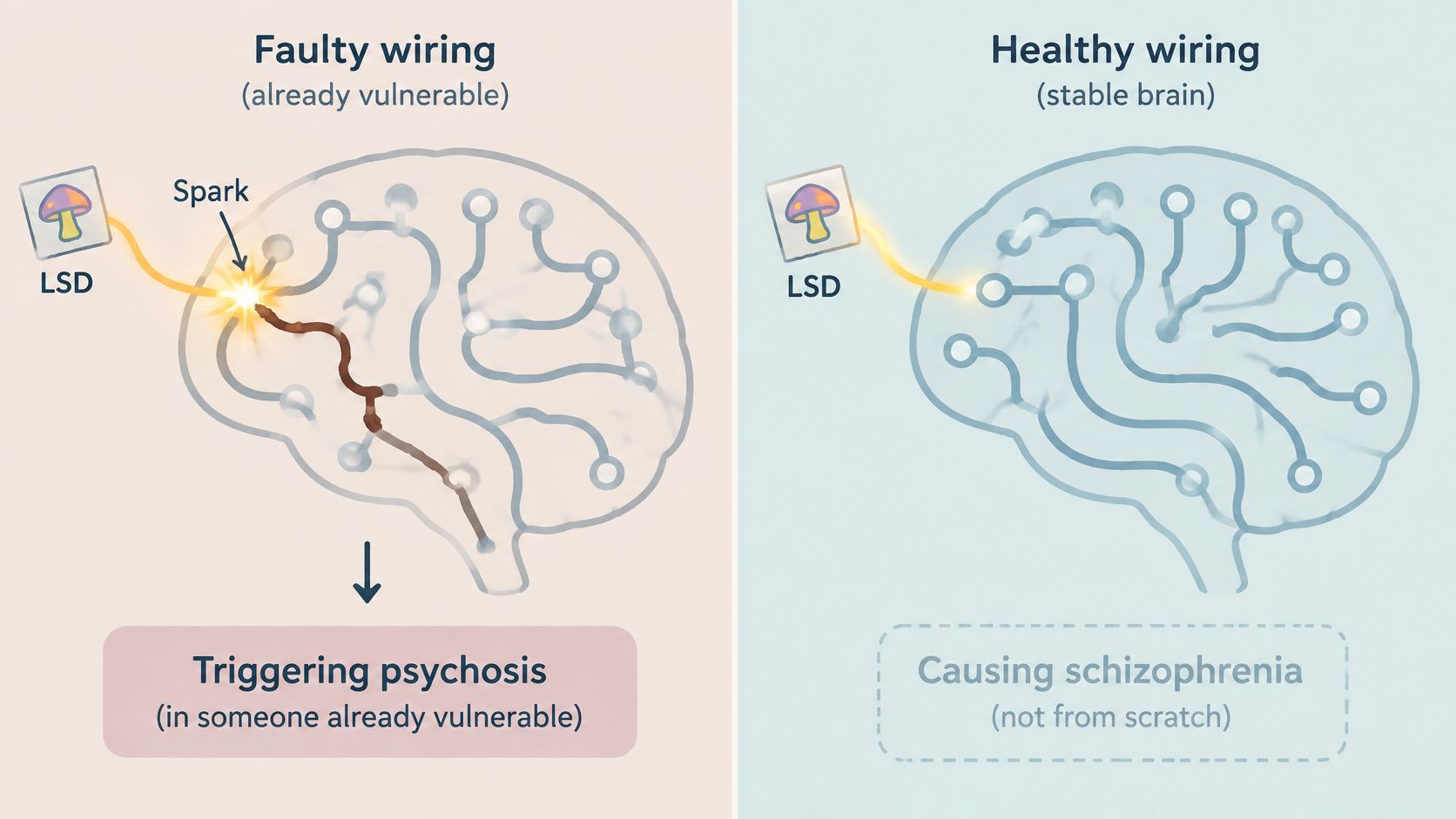
A trigger isn't proof of a complete cause
The National Institute on Drug Abuse overview of psychedelic and dissociative drugs describes limited evidence that psychedelics may trigger schizophrenia-like illness in predisposed people, while noting little evidence of long-term psychiatric problems for most users. That cautious position doesn't support either extreme: LSD always causes schizophrenia, or LSD can't contribute to serious psychiatric illness.
Say someone becomes increasingly suspicious and stops sleeping before taking LSD, then develops overt psychosis afterward. LSD may have precipitated or intensified the episode, but the earlier changes also suggest that illness could already have been developing.
What mechanisms can and can't explain
LSD acts at serotonin 5-HT2A receptors, altering perception and information processing. Downstream changes in glutamate and dopamine signalling, together with sleep disruption, are proposed contributors to destabilization in susceptible people.
These are hypotheses about how symptoms could arise, not an established pathway proving that LSD causes schizophrenia. Explaining a plausible biological mechanism doesn't tell us who will become ill or whether they would have developed the disorder without exposure.
Important unanswered questions include:
- Long-term outcomes: There are few follow-up studies capable of separating a temporary episode from an evolving disorder.
- Vulnerable participants: Small samples involving people with psychosis histories limit individual risk estimates.
- Real-world exposure: Uncertain substances, dosing patterns, and concurrent drug use complicate interpretation.
- Microdosing: Evidence specifically addressing repeated low-dose exposure and psychosis vulnerability remains limited.
When someone asks, “Can LSD cause schizophrenia?” the unresolved causal question is often whether LSD unmasks or accelerates an illness in a genetically vulnerable person. A low average incidence and serious individual risk can both be true because susceptibility isn't distributed evenly.
How Psychosis Progresses to Schizophrenia
Roughly one in four people diagnosed with substance-induced psychosis later receives a schizophrenia diagnosis, yet that figure tells an individual LSD user almost nothing about their own odds. The reason lies in the denominator: transition studies follow people who already became ill enough to be diagnosed, a group selected for vulnerability before the counting even begins.
After a psychotic episode, the clinically useful question becomes whether symptoms resolve, persist, or recur as part of a schizophrenia-spectrum or mood disorder. A clinician can't answer that from the intensity of a single experience alone.
Follow-up matters because an initial substance-induced diagnosis may not capture the person's longer-term course. It also creates an opportunity to assess sleep, mood episodes, functioning, other substances, and symptoms that began before LSD exposure.
This infographic highlights the distinction between an acute episode and a later diagnosis.
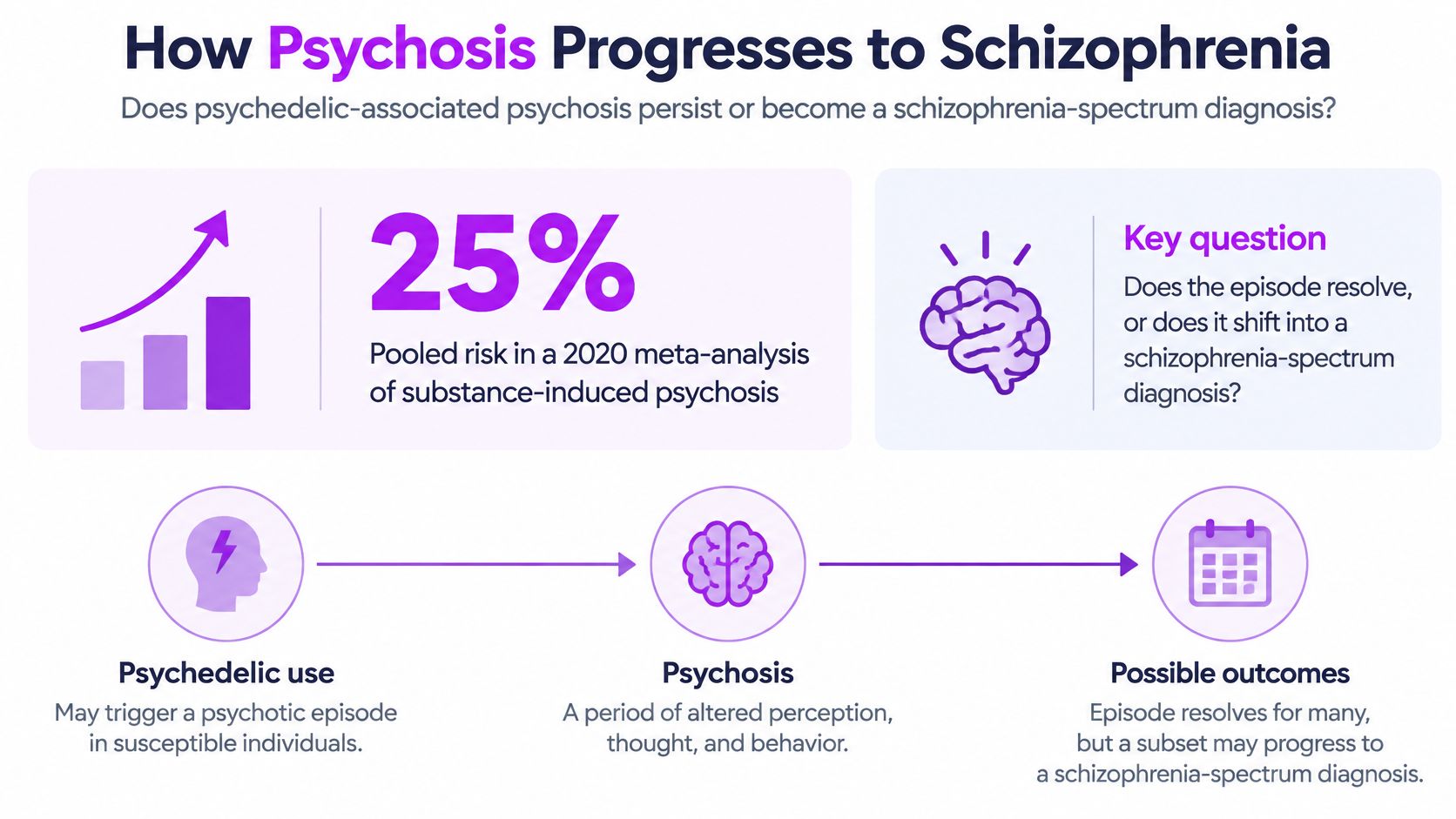
What follow-up studies measure
A 2020 meta-analysis of substance-induced psychoses found a 25% pooled transition rate to schizophrenia, with 26% after hallucinogen-induced psychosis, based on three studies and a 95% confidence interval of 14% to 43%. A Finnish hospital-register analysis of patients treated for hallucinogen-induced psychosis reported a cumulative risk in the same range.
| Group followed | Later schizophrenia outcome | Interpretation |
|---|---|---|
| People with substance-induced psychosis across substances | 25% pooled transition rate | Combines different substances and study populations |
| People with hallucinogen-induced psychosis | 26%, with a 95% confidence interval of 14% to 43% | Estimate based on three studies |
| Finnish hospital-register patients with hallucinogen-induced psychosis | Comparable cumulative risk | Reflects a hospital-treated population |
These estimates describe people who already developed substance-induced psychosis. They must not be read as a typical LSD user's probability of developing schizophrenia.
Each estimate sits on a different denominator. Hospital registers count people unwell enough to reach treatment. Pooled analyses count people already carrying a psychosis diagnosis. Neither counts everyone who has ever taken LSD, so the percentages answer a narrower question: of those who developed psychosis, how many later met criteria for schizophrenia?
The confidence interval matters for the same reason. It expresses uncertainty around the pooled hallucinogen estimate, rather than offering a precise forecast for a particular patient.
Emergency presentations identify a concerning group
An Ontario population study summarized by Bruyère followed more than 9.2 million people and found that a hallucinogen-related emergency-department visit was associated with a 21-fold higher risk of later schizophrenia, falling to 3.5-fold after adjustment for co-occurring substance use and mental-health disorders. The finding was published in 2024 and does not establish that LSD caused schizophrenia.
The change after adjustment is clinically informative. People arriving at emergency departments may already differ from the general population in psychiatric symptoms, other substance use, and underlying susceptibility.
An emergency visit therefore identifies a group needing follow-up. It doesn't isolate the drug as the sole cause, and a relative-risk comparison isn't the same as an individual's absolute probability of illness.
Persistent symptoms deserve assessment even when nobody can yet determine whether the episode is substance-induced or part of an emerging disorder.
What case reports add
A 2025 systematic review of psychedelic-induced psychosis cases identified 93 reported cases, with LSD implicated in 47.3%; among cases with follow-up, 34% later received a schizophrenia-spectrum diagnosis and 20.4% received a bipolar-disorder diagnosis. Incomplete follow-up and case-report selection limit causal interpretation.
A separate 2024 systematic review of adverse psychiatric case reports identified 17 schizophrenia-spectrum cases and 17 affective-disorder cases after psychedelic use, including cases without a known prior psychiatric history. These reports document credible severe reactions while leaving open how commonly they occur.
A missing psychiatric history isn't proof that no vulnerability existed. Someone may not have recognized earlier symptoms, received an assessment, or known their family history.
Case reports also tend to capture unusual or severe outcomes rather than representative experiences. Their value lies in describing what can happen and what clinicians should investigate, which is a different job from calculating a general user's odds.
Persistence is the safety endpoint
Distressing perceptions during intoxication and continued loss of reality testing afterward aren't interchangeable. Persistent paranoia, fixed false beliefs, hallucinations, or disorganized thinking shouldn't be dismissed as an unpleasant trip that needs more integration.
Consider someone who no longer feels intoxicated yet remains convinced that strangers are sending them coded messages. The relevant question is whether they can consider alternative explanations and function safely, regardless of how meaningful the experience felt.
A clinical assessment may include:
- A timeline: When symptoms began relative to dosing, sleep loss, and other substance use.
- Mood changes: Whether unusual energy, depression, irritability, or grandiosity accompanied the episode.
- Daily functioning: Changes in work, relationships, eating, self-care, or the ability to remain safe.
- Earlier experiences: Similar symptoms before exposure or during previous periods without drugs.
The embedded video offers additional context, and assessment remains the right step when symptoms persist.
A later diagnosis doesn't mean progression was inevitable from the outset. Clinicians need time and follow-up to clarify the pattern, and uncertainty is a reason to seek care rather than postpone it.
Harm-Reduction Steps Before Any LSD or Microdose
Not using LSD is the most direct way to avoid an LSD-triggered reaction. For people considering exposure despite the uncertainty, preparation should focus on screening, observable symptoms, and clear stopping decisions, not confidence in the intended dose.
The checklist summarizes the first decisions to make before any exposure.
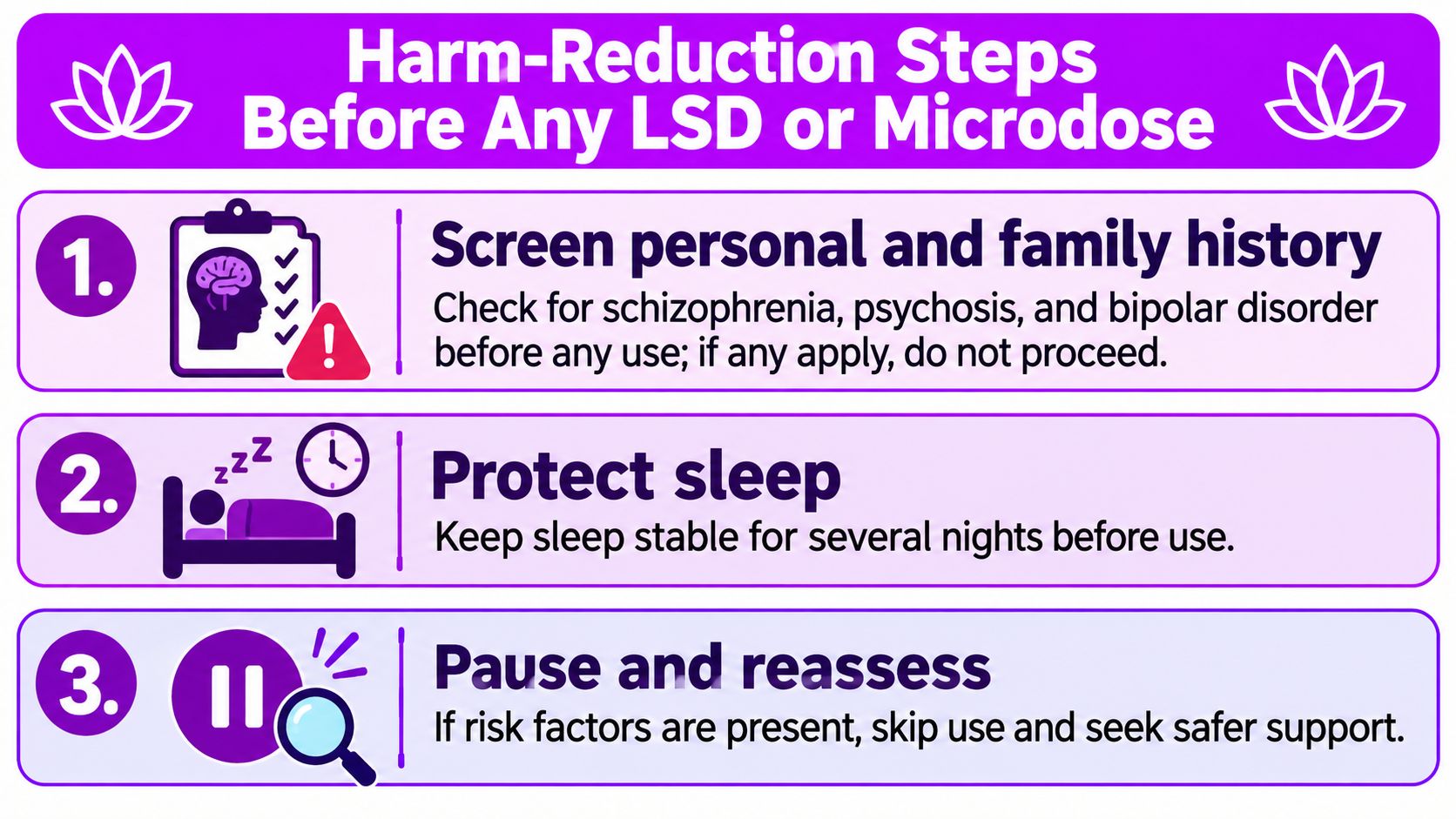
A routine that prioritizes stopping over optimizing
Screen your personal and family history. Check for schizophrenia, psychosis, and bipolar disorder before any use; if any apply, don't proceed, and discuss safer options with a clinician. Don't rely on feeling well today to override a relevant history.
Protect sleep before and afterward. Keep sleep stable for several nights around any planned exposure, because sleep loss can contribute to psychiatric destabilization. Cancel the plan if you're already sleeping poorly rather than trying to compensate later.
Avoid combining substances. Don't combine LSD with cannabis, stimulants, or alcohol, because additional substances can complicate reactions and obscure what's causing symptoms. Tell a clinician about prescribed medication too, and don't stop treatment to make room for psychedelic use.
Keep the setting predictable and support available. For any full dose, a sober, trusted person nearby can recognize distress and help obtain care; they aren't a replacement for medical supervision. Avoid environments where leaving, resting, or getting help would be difficult.
Record more than mood. One option is MicroTrack: log the dose and time, then record sleep duration, agitation, suspiciousness, and perceptual changes alongside its 10-point mood score. Use its two-phase entries to add next-day reflections, because an initially positive experience can look different after disrupted sleep.
Review the trend view each week, looking for rising anxiety, insomnia, or unusual beliefs, not just higher mood ratings. A paper journal or spreadsheet can serve the same observational purpose if entries are consistent and specific.
Stop at the first clear escalation. Don't dose through increasing suspiciousness, sleep disruption, or perceptual changes in the hope that the next dose will correct them. Seek assessment rather than adjusting the schedule yourself.
Keep the record useful to a clinician
Write observations rather than conclusions. “Slept poorly and felt watched while shopping” gives a clinician more useful information than “integration was difficult.”
A CSV export can provide a readable timeline of doses, symptoms, and sleep. It can support a conversation, but it can't determine whether you're safe to continue.
For broader preparation, use this psychedelic harm-reduction guide. These precautions may reduce avoidable risks, but they don't remove psychiatric vulnerability or establish that microdosing is safe for you.
Warning Signs and When to Seek Help Now
| Symptom | Timing | Action |
|---|---|---|
| Mild anxiety or restlessness | Resolves within 24 hours | Rest, log it, skip the next dose |
| Severe insomnia | Lasts several nights | Contact a clinician promptly |
| Paranoia or fixed false beliefs | Persists beyond the trip or returns on low doses | Urgent professional assessment |
| Hallucinations continuing after intoxication | Days or longer | Urgent professional assessment |
| Mania-like energy with grandiosity | Any time | Urgent professional assessment |
| Disorganized thinking, confusion or loss of reality testing | Any time | Emergency care immediately |
Every symptom pattern in this table means stop using LSD and don't take another dose. The timing column describes how symptoms typically present, not how long you should wait before acting. Hallucinations that continue after intoxication, symptoms that worsen quickly, or any concern about safety justify help immediately.
Mild anxiety that settles with rest and a calm environment can be recorded while you pause use. Anxiety that intensifies, prevents sleep, or turns into suspiciousness calls for a different response, even when the dose was small.
A warning sign is a reason to get assessed, not a threshold to dose around.
Don't wait for certainty
Severe insomnia lasting several nights, persistent paranoia, fixed false beliefs, and mania-like energy warrant prompt professional assessment. Grandiosity can look like believing you have exceptional powers, a special mission, or abilities that remove the normal limits on your safety.
Disorganized thinking, confusion, loss of reality testing, or any risk of harm requires emergency care. Contact local emergency services, don't drive yourself, and ask a trusted sober person to stay with you if that's safe.
When safety is uncertain: Seek help based on the symptoms you're seeing, not on whether you can prove LSD caused them.
Clinicians assess the pattern in front of them, so you don't need to establish a cause before asking for help. For a broader description of adverse experiences, review microdosing side effects. A familiar side-effect label should never be used to explain away worsening confusion or beliefs that other people can't verify.
Bring a timeline, not a self-diagnosis
If it's available, bring trend information from the last two weeks: dose times, sleep, agitation, suspiciousness, perceptual changes, and any other substances or medications. A short, factual record lets the clinician see the sequence of events rather than relying on memory during a stressful visit. Don't delay an appointment or emergency care to complete it.
If you're supporting someone else, describe observable changes calmly. Avoid arguing about a fixed belief; focus on helping them feel safe enough to accept assessment.
If you have a personal or family history of psychosis, bipolar disorder, or any warning sign from the table, don't start or continue LSD or microdosing, and speak with a clinician first. Stop rules and a scheduled review don't make continued use safe for anyone with a psychosis history, bipolar disorder, or a current warning sign, so the right step is to pause use and get a clinical assessment first.
MicroTrack offers dose logging, mood entries, later reflections, trend views, and CSV export to help you organize observations about sleep and changes in your mental state. Visit MicroTrack to keep that record ready for a clinical conversation, while treating any warning sign as a reason to seek care rather than continue experimenting.