Nervous System Dysregulation: Signs and What Helps
Your heart is still racing an hour after a minor email. Your stomach feels tight, and even though the room is quiet, your mind keeps scanning for the next problem. It's understandable to wonder whether your nervous system is stuck in a stress response, but one difficult moment can't answer that question by itself.
Nervous system dysregulation is a useful way to describe a functional pattern in which activation remains high or recovery stays difficult after a demand has passed. It isn't a single diagnosis, and symptoms such as poor sleep or a changing heart rate don't prove that anything is chronically wrong. The more useful question is whether you're seeing a persistent pattern, what might be shaping it, and what next step would help.
Table of Contents
Signs That Look Like Dysregulation
A fast heartbeat before a hard conversation can be a normal response to a real demand. If your breathing and pulse settle after the conversation ends, that's different from a pattern that continues across days, with poor sleep, easy startle, digestive upset, and difficulty winding down. Context matters: autonomic responses can be influenced by sleep, pain, psychological stress, inflammation, and the environment, so symptoms alone don't establish that you're stuck in fight-or-flight. A clinical discussion of autonomic symptoms and their overlaps emphasizes the value of recording context and interpreting fluctuations cautiously.
Use the table as a non-diagnostic prompt, not a checklist that proves a condition. Start by identifying what you notice, then check for a plausible driver before deciding what it means.
| Domain | What you may notice | Check before you label it | First action |
|---|---|---|---|
| Body | Fast resting heart rate, shallow breath, chest tightness, gut upset | Sleep loss, caffeine, pain, illness, or a recent stressor | Note those factors, then try grounding step 1 |
| Mood | Anxiety, irritability, emotional flatness, easy startle | A specific trigger versus a free-floating alarm | Rate the feeling from 0 to 10 and write down the trigger |
| Thinking | Scanning for danger, poor focus, catastrophic loops | A real upcoming demand versus a body-driven alarm | Name one concrete stressor or write “none found” |
| Behavior | Avoidance, snapping, shutdown, restless pacing | A short survival response without a recovery window | Try grounding step 2 or 3, then re-rate arousal in an hour |
| Overlap flags | Fainting, chest pain, new medication effects, or symptoms that also fit panic disorder, POTS, endocrine disease, or a sleep disorder | A medical or psychiatric condition rather than a wellness label | Don't self-diagnose; use the help-seeking guidance below |
A fast resting heart rate might follow poor sleep, caffeine, pain, illness, or stress. Mood can shift for a specific reason, while difficulty focusing might reflect an actual demand rather than a body-driven alarm. Record the surrounding circumstances before interpreting any of these as a persistent pattern.
Keep the conclusion proportional: one low mood, ordinary fatigue, or a changing heart rate doesn't prove chronic autonomic dysfunction.
How Autonomic Balance Actually Shifts
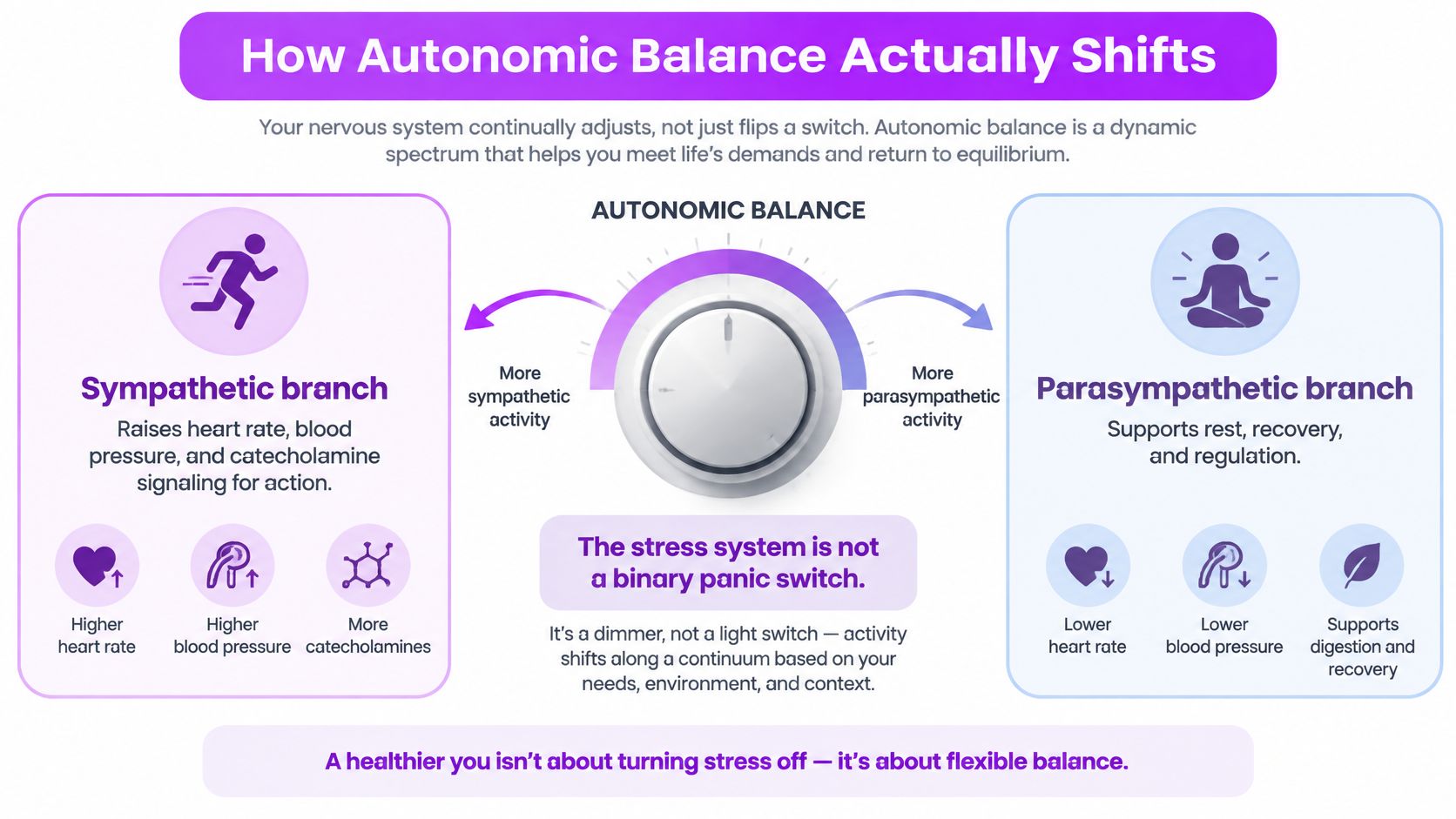
Think of the stress system as a dimmer, not a panic switch. The sympathetic branch helps prepare the body for action by raising heart rate and blood pressure and increasing catecholamine signaling. Parasympathetic activity, much of it associated with vagal regulation, supports recovery and functions such as a slower heart rate and digestion. Nervous system dysregulation can involve a persistent tilt toward sympathetic activation and away from parasympathetic regulation, interacting with the hypothalamic-pituitary-adrenal axis. It isn't just one nerve being “overactive.”
One way to observe this balance is heart-rate variability (HRV), the variation in time between heartbeats. Measures such as RMSSD and frequency-domain vagal indices offer a noninvasive proxy for autonomic activity. Lower HRV generally indicates less beat-to-beat adaptability and weaker parasympathetic modulation, but it doesn't diagnose nervous system dysregulation. A synthesis of occupational-stress studies found reduced HRV in 9 of 10 studies, while anxiety and PTSD reviews describe similar patterns of reduced HRV and altered autonomic activity. The HRV review also stresses that readings need context.
If you track HRV, keep conditions consistent: measure within the same waking window, in the same posture, for the same duration. Note sleep, illness, alcohol, exercise, and medications, since any of them may influence a short-term reading.
<iframe width="100%" style="aspect-ratio: 16 / 9;" src="https://www.youtube.com/embed/7dZHmKMLdC0" frameborder="0" allow="autoplay; encrypted-media" allowfullscreen></iframe>
Compare a rolling personal baseline with mood, sleep, and stress over time, rather than treating a single low reading as evidence of a problem. Separate a short-lived spike from a persistent change. If a deviation continues alongside difficulties in daily life, speak with a qualified clinician instead of using a metric as a reason to self-treat with psychoactive substances.
Anxiety and PTSD as Persistent Patterns
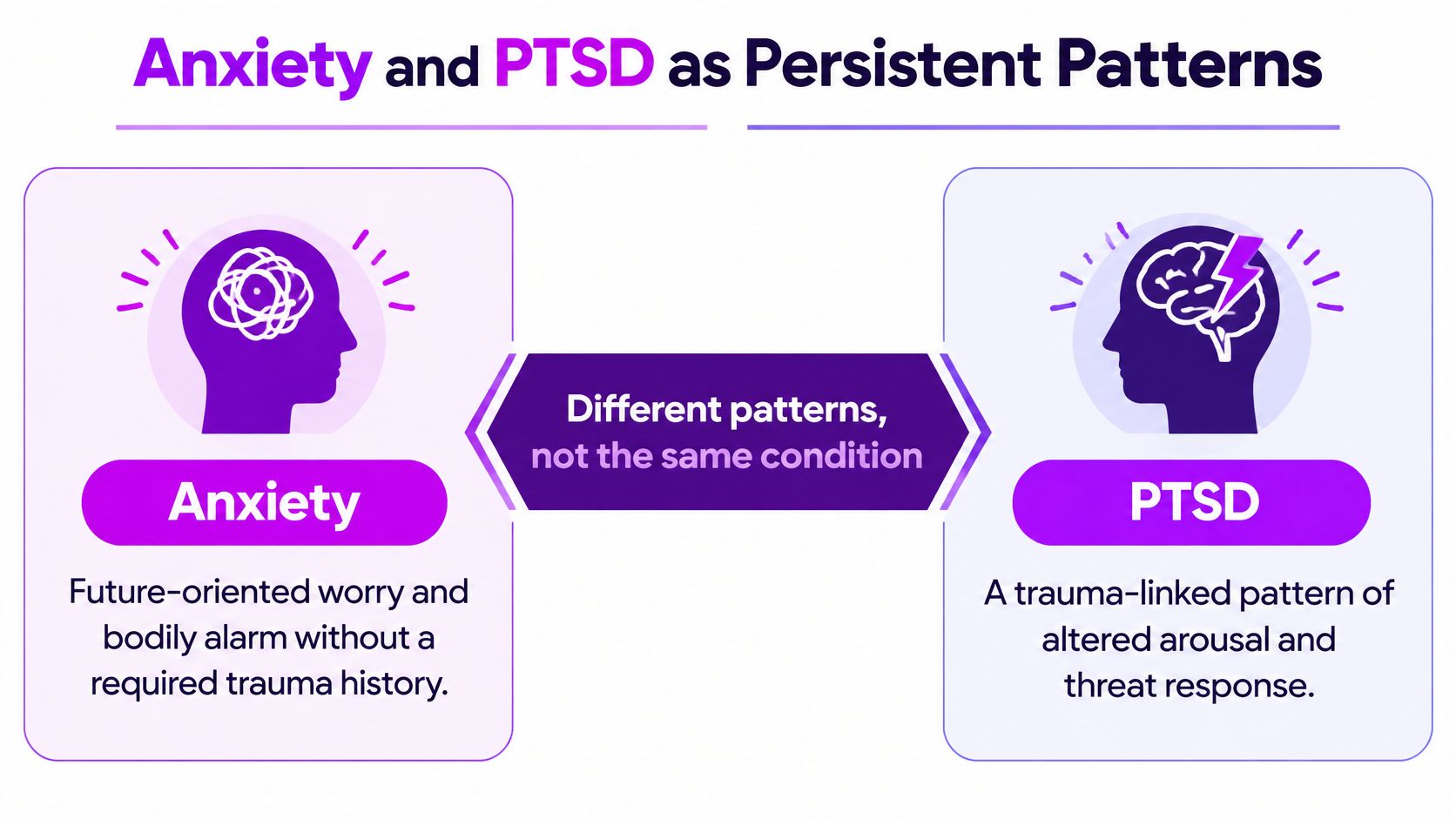
Anxiety and post-traumatic stress disorder (PTSD) can overlap, but they're not the same pattern. Anxiety often involves future-oriented worry and bodily alarm without a required trauma history. PTSD is trauma-linked and can involve persistent changes in arousal, threat detection, mood, cognition, and autonomic reactivity.
U.S. National Comorbidity Survey Replication estimates summarized by the National Institute of Mental Health indicate that 3.6% of adults experienced PTSD in the previous year, and 6.8% experienced it at some point in their lifetime. The past-year rate was 5.2% among adult women and 1.8% among adult men. Among U.S. adolescents aged 13 to 18, approximately 5.0% met lifetime PTSD criteria, including 8.0% of females and 2.3% of males; 1.5% experienced severe impairment. These figures describe PTSD, not every form of distress or nervous system dysregulation. They also don't mean that a person with poor sleep or high arousal necessarily has PTSD. The NIMH PTSD statistics offer population context, not a way to diagnose yourself.
After trauma, threat responses can become harder to switch off. The brain's amygdala-driven output may increase while prefrontal inhibitory control weakens; sleep can suffer, and noradrenergic activity, resting heart rate, and systolic blood pressure can rise. When recovery becomes harder, the next stressor may land more heavily. Inflammatory signaling involving areas such as the prefrontal cortex, insula, amygdala, and hippocampus is one possible part of this reinforcing loop, not a basis for self-diagnosis.
Nightmares, avoidance, or heightened arousal that persist for more than a month after trauma are worth discussing with a professional. Notes about mood, sleep, and triggers can help you describe what's happening, but they don't replace assessment or treatment.
Grounding Steps That Calm Arousal
These are short ways to try to downshift arousal, not treatments for PTSD, depression, or a diagnosed condition. Try one at a time, notice your response, and stop any step that makes panic worse.
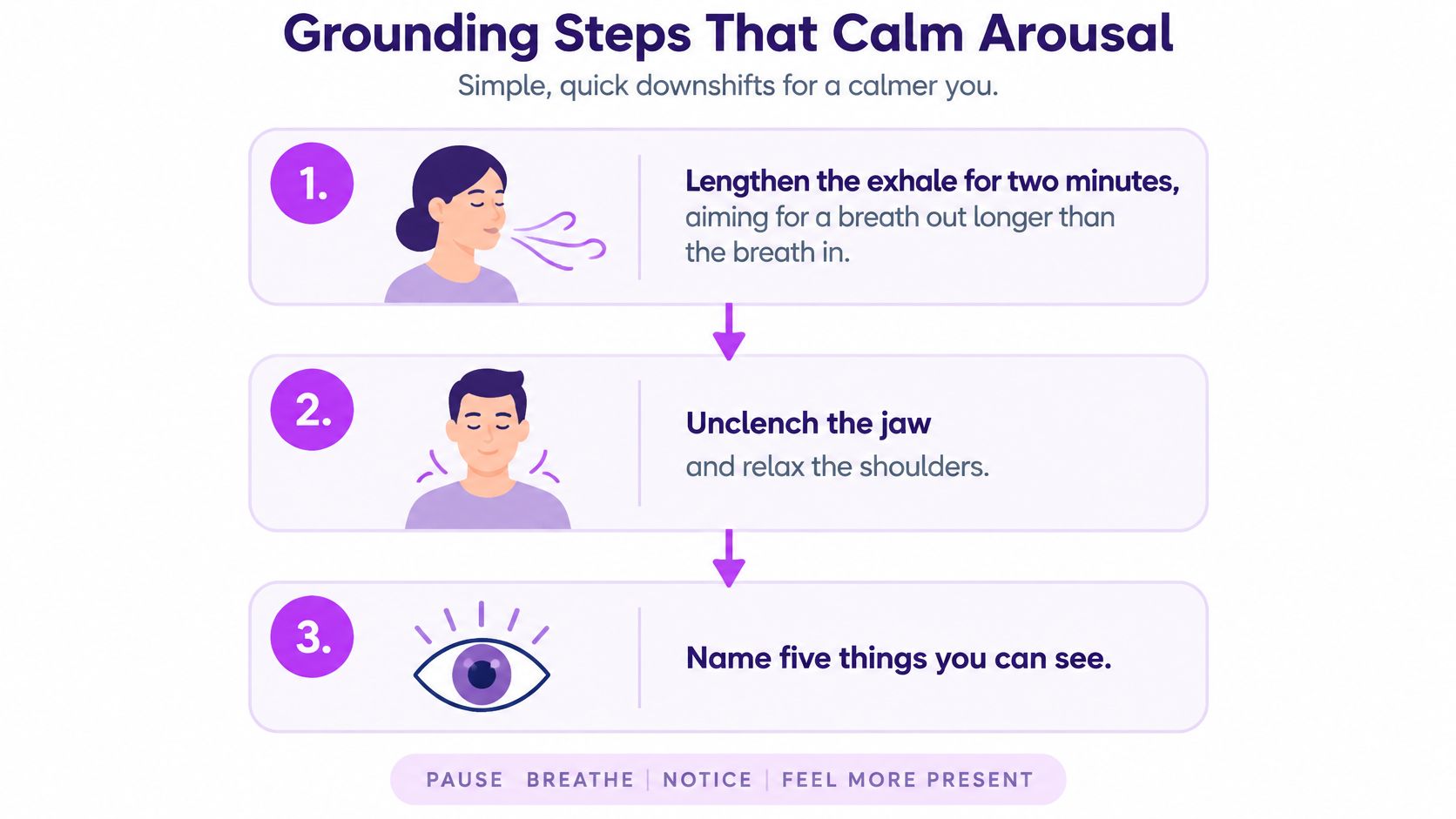
Lengthen the exhale for two minutes. Let the breath out take roughly twice as long as the breath in, without forcing a deep breath. If comfortable, try a double inhale followed by a long exhale.
Orient to the room. Name five things you can see, then notice four points of contact with the chair, floor, or another surface. This gives your attention something concrete to register besides a perceived threat.
Release a braced body. Unclench your jaw, drop your shoulders, and open your hands. You can splash cool water on your face if that feels comfortable, then notice whether the sensation changes.
Move gently. Take an easy walk for five to ten minutes, then stop and check how you feel. The aim is a manageable change of pace, not pushing through rising arousal.
Reduce inputs for the next hour. Dim bright lights, pause doomscrolling, and avoid adding more caffeine if you've already had a lot. Choose a consistent bedtime target that night, since a disrupted night can make it harder to recover.
Re-rate and record. After 20 to 60 minutes, rate your arousal from 0 to 10 and write down what changed. A brief note can help you distinguish a small shift from no change.
If chest pain, fainting, or suicidal thoughts occur, don't work through these steps instead of seeking help. Use the urgent-care guidance in the final section. If a technique increases panic, stop it. Grounding may settle a moment of arousal, but it doesn't erase trauma memories, prove that a supplement worked, or replace therapy. For more practical anxiety strategies, see these tips for anxiety relief.
What Microdosing Evidence Can and Cannot Show
The claim that microdosing “regulates the nervous system” goes beyond what controlled evidence can establish. A systematic review and meta-analysis of 24 studies and 3,681 participants found minimal effects in randomized trials on cognition, creativity, or sustained mood, with no clear immediate reduction in depressive symptoms, anxiety, or stress. Apparent benefits may not reliably exceed placebo or expectancy effects, and long-term safety remains unresolved. The systematic review and meta-analysis supports caution, not a promise of nervous-system repair.
| Source | What was found | What it does not prove |
|---|---|---|
| Systematic review of 24 studies, 3,681 participants | Randomized trials found minimal effects on cognition, creativity, and sustained mood, with no clear immediate drop in depression, anxiety, or stress | That microdosing regulates the nervous system |
| Pooled symptom estimates | Depression about −0.19 (95% CI −0.56 to 0.19), anxiety −0.20 (95% CI −1.11 to 0.71), and stress 0.02 (95% CI −0.39 to 0.43); the intervals include zero | A reliable benefit over placebo |
| Six-week LSD trial | Forty healthy adults received 10 micrograms every three days for 14 doses, and 40 received placebo; dose days brought higher energy, wellness, and irritability, but there was no credible group difference at six weeks | Durable regulation or long-term safety |
| Four-week self-blinding citizen-science study | Both microdose and placebo groups improved from baseline, with no statistically significant difference between groups | That a felt benefit equals a pharmacological effect |
In the six-week randomized trial, participants reported higher creativity, connectedness, energy, happiness, irritability, and wellness on dose days, but those immediate experiences didn't translate into a credible between-group improvement at the endpoint. The four-week self-blinding study likewise found improvement from baseline in both groups, without a significant difference between them. A participant's belief about what they took can shape perceived benefit, which is why an uncontrolled impression can't separate drug effects from expectation or broader changes in routine.
An immediate lift on a dose day isn't evidence of durable regulation. Sleep, medications, expectancy, and natural symptom fluctuation can all affect how someone feels on a particular day. If you're considering how to make sense of reported benefits, this discussion of microdosing for anxiety can provide additional context, but it doesn't change the limits of the evidence. No dose or substance is recommended here.
Build a Calm Record You Can Trust
Try an observation routine for two to four weeks. Keep the record simple enough to maintain, and choose one question beforehand, such as whether evening exercise seems to affect your mood the next morning. Keep the rating scale and question fixed, so you're not changing the yardstick to match a particular day.
Each day, record mood on the same 0-to-10 scale, sleep timing and quality, caffeine, exercise, stressful events, medications, and physical symptoms. If you're already tracking a substance, note its timing on those days and complete the same entries on non-dose days. Write down side effects when they occur, then add a short reflection later rather than relying on memory alone.
Look for repeated changes within your own record, not a single good day. A pattern can guide a conversation, but it doesn't establish that a routine or substance caused the change. Expectancy and natural fluctuations can produce a similar impression.
MicroTrack journal entries can include mood, dosage, sensations, and side effects. If a digital log would help you keep the observations together, this guide to anxiety symptom tracking offers another starting point for structured notes.
When Self-Tracking Is Not Enough
Seek emergency care for chest pain, fainting, trouble breathing, stroke-like symptoms, or thoughts of suicide or harming someone else. Don't wait for a tracking period to finish before getting urgent help.
Book a clinician promptly if nightmares, avoidance, or heightened arousal have lasted more than a month after trauma; if anxiety or low mood is interfering with work, caregiving, or sleep; or if symptoms could involve panic disorder, POTS, thyroid or other endocrine disease, or a sleep disorder. New neurological symptoms, such as weakness, seizures, or a sudden severe headache, also call for medical assessment.
Microdosing shouldn't be treated as a nervous-system fix, especially for someone with significant anxiety, depression, PTSD, a cardiovascular condition, or vulnerability to psychosis. A systematic review of 19 placebo-controlled microdosing studies found major safety gaps: it identified no long-term safety studies, and the available psilocybin microdosing studies it reviewed didn't provide blood-pressure or heart-rate data. The placebo-controlled review makes clear that an absence of obvious distress doesn't establish cardiovascular or long-term safety.
Stop a self-experiment and seek medical advice if anxiety, symptoms that could relate to blood pressure, persistent insomnia, or disturbing perceptions worsen. For an appointment, bring a timeline and notes about sleep, caffeine, medications, symptoms, and any dose timing as descriptive information, not as a self-diagnosis. A primary-care clinician can assess medical possibilities, while a trauma-informed mental health clinician can help with PTSD or severe anxiety. Self-tracking can support that conversation, but it can't replace it.
If you want a structured place to record mood, dosage, sensations, and side effects, MicroTrack can help you keep those observations together and review patterns over time. Start with a consistent, context-rich log and use what it shows to guide a conversation with a qualified clinician.