How Often Should You Microdose: Schedules and Safety

69.8% of 5,399 lifetime microdosers had microdosed within the previous year, according to the authors of the 2025 Global Psychedelic Survey, as reported by Psiconautica. That tells us people return to the practice. It doesn't tell us how often they should use it, whether it helps, or whether repeated exposure is safe.
So, how often should you microdose? There's no medically established universal schedule. For psychedelic microdosing, the useful question isn't how to fit in more doses. It's how to recognize whether a pattern is helping, doing nothing, or causing harm, without mistaking a calendar for medical guidance.
Table of Contents
- Commonly Referenced Microdosing Schedules at a Glance
- Why No Schedule Is Medically Proven and Which Beliefs to Drop
- Health Factors That Change the Right Frequency
- How to Log Planned Versus Actual Frequency
- Reading Your Logs as Helping, Neutral or Harmful
- Review Your Log with a Clinician Before Changing Anything
Commonly Referenced Microdosing Schedules at a Glance
Commonly referenced microdosing schedules and their evidence status
| Schedule | Pattern | Approx. doses per week | Evidence status |
|---|---|---|---|
| Daily | 1 dose every day | 7 | Reported in research; not a recommended default |
| Fadiman protocol | 1 day on, 2 days off | 2-3 | Widely referenced; not validated in a controlled trial |
| Stamets stack | 4 days on, 3 days off | About 4 | Community protocol; not validated in a controlled trial |
| Every-other-day | Dose one day, skip one | About 3-4 | Reported in observational studies |
| Five on, two off | 5 days on, 2 days off | 5 | Reported in a review of microdosing regimens |
| Every third day (LSD feasibility protocol) | 10 micrograms every 3 days | About 2-3 | Research protocol, not a validated recommendation |
| Two doses weekly (modified research schedule) | 2 doses per week for 6 weeks | 2 | Research design for flexibility; effectiveness unproven |
| Once weekly (psilocybin trial design) | 2 mg once weekly for 4 weeks, then 4 more weeks | 1 | Trial design; not evidence of general effectiveness |
These are reference points from practice and research, not recommendations. Read the evidence-status column before comparing frequencies. A schedule can appear in a published paper because researchers investigated it, not because they established that people should follow it.
The table also isn't a dose-conversion guide. An LSD research protocol and a psilocybin trial design involve different substances and preparations. Don't treat their amounts as interchangeable or assume that a community schedule carries the safeguards of a clinical study.
Popularity isn't proof of superiority
In the 2025 Global Psychedelic Survey, 24.3% of regular microdosers reported using the Fadiman protocol, according to the study authors published in the International Journal of Drug Policy. That describes a subgroup's behavior, not a clinical success rate.
The distinction matters because familiar names can sound authoritative. Someone may choose a named protocol because it's easy to remember, fits their working week, or appears frequently in online discussions. None of those reasons demonstrates a health benefit.
Likewise, a calendar's weekly total can obscure the spacing between exposures. Consecutive dosing days and separated dosing days may produce the same total while leaving different opportunities to observe sleep, mood, and unwanted effects.
Practical rule: Use a schedule name to describe your plan, not to justify continuing it when you feel worse.
Start by identifying what you're doing. Is your current pattern a deliberate plan, or has it drifted through extra doses, skipped days, and attempts to make up for missed entries? Write down both the intended pattern and the recent reality before considering any change.
Why No Schedule Is Medically Proven and Which Beliefs to Drop
The U.S. National Institute on Drug Abuse describes microdosing as regularly taking approximately 5-10% of a typical recreational dose, small enough to avoid hallucinations, while noting that research hasn't established whether it's safe or effective. This is a description of the practice, not a validated dosing formula.
The variation between participants is substantial. A 2019 six-week observational study found a mean interval of 6.7 days between doses, with a standard deviation of 4.8 days and a range of 1 to 34 days. Averaging those experiences doesn't reveal an ideal interval, and observing people who choose their own schedules can't establish which schedule caused an outcome.
A 2021 prospective study reported that 68 completers averaged 2.31 dosing days per week, with a range of 1 to 5. A randomized placebo-controlled mushroom study also tested twice-weekly dosing, but testing a frequency doesn't prove that it benefits everyone.
What the evidence can support
A systematic review of microdosing schedules found regimens ranging from a single dose to daily administration, rather than one agreed standard. That spread makes simple claims about the best protocol difficult to defend.
Intermittent exposure is a more defensible description of several human research protocols than daily use. However, describing what investigators tested isn't the same as recommending it to someone with depression, medication use, or other health risks.
Controlled research commonly separates exposures by at least 48 hours, and a 2024 rapid review found that no studies had established long-term microdosing safety. An interval can create observation time without proving that the exposure itself is safe.
Four beliefs to drop
- More frequent dosing means more benefit. Controlled studies haven't established reliable, durable improvements that justify automatic escalation. In your log, unclear benefit should remain unclear benefit, not become a reason to add doses.
- Every-third-day dosing is medically validated. It's a recognizable community and research pattern, not a clinical requirement. Record why you selected it rather than labeling it the correct schedule.
- The Fadiman protocol is proven superior. Familiarity doesn't establish superiority. Expectations also complicate interpretation, which is why understanding microdosing and placebo effects matters.
- Daily dosing is the standard. Its appearance in published reports doesn't make it a recommended default. A blank day on your calendar isn't a gap you need to fill.
Define an observation window before interpreting results. Lack of a noticeable benefit isn't evidence that you need more frequent exposure.
Any personal record remains an individual observation exercise, not a clinical trial. Consider a frequency change only after a predefined review and with a documented reason, preferably discussed with a clinician. Adverse effects override the review date, and no observation window obliges you to continue.
Health Factors That Change the Right Frequency
For some people, choosing a different frequency isn't the appropriate next step. The priority is deciding whether psychedelic exposure is appropriate at all.
Use this checklist to prepare for a clinical conversation, not to clear yourself for use.
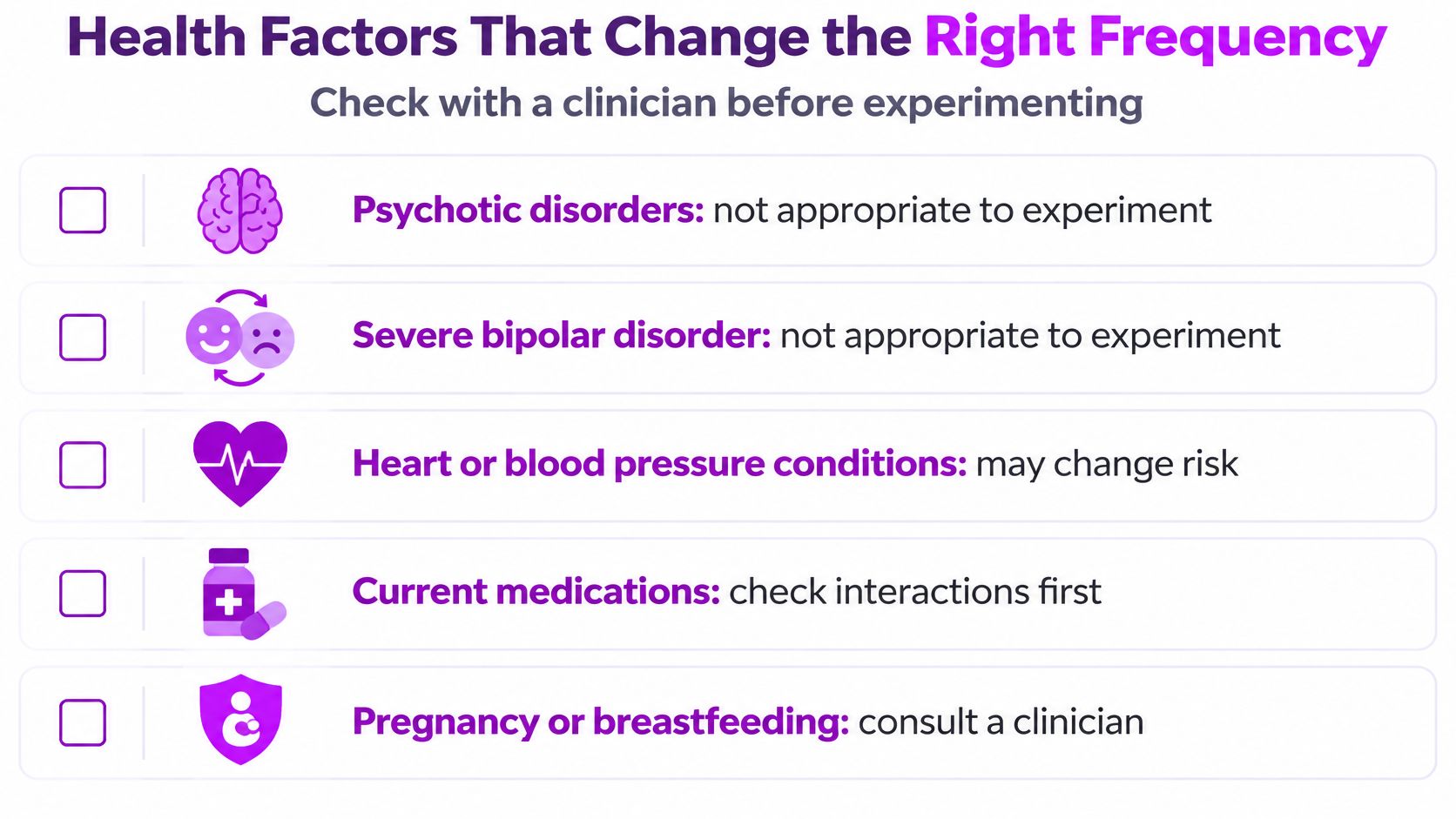
The National Center for Complementary and Integrative Health states that psilocybin isn't considered safe for people with psychotic disorders or severe bipolar disorder. It also notes that interactions with medicines used for psychiatric conditions, migraine, and neuropathic pain need better study.
Factors to bring to a clinician
- Psychiatric history. Include a personal or family history of psychosis or bipolar disorder, not just a current diagnosis.
- Heart and blood pressure conditions. Significant cardiovascular disease warrants clinical assessment. If you already have heart-rate or blood-pressure readings, bring them, but don't treat normal readings as proof of safety.
- Pregnancy or breastfeeding. Seek clinical guidance rather than assuming that a small amount creates negligible exposure.
- Current medicines and recent changes. List prescriptions, supplements, and changes in timing or amount. Don't stop prescribed treatment to accommodate microdosing.
- Persistent depression, PTSD, or anxiety. These symptoms deserve evaluation and an appropriate treatment plan, not a different dosing calendar.
Anyone in these categories should obtain clinician guidance before considering any schedule. A longer interval doesn't cancel a psychiatric vulnerability, resolve an interaction, or turn self-treatment into supervised care.
A symptom-focused overview of microdosing side effects can help you describe concerns more precisely. Bring concrete observations, such as difficulty sleeping, heightened anxiety, or changes in perception, rather than only saying a protocol didn't feel right.
This video offers additional context for the discussion.
Mark the checklist items that apply to you and take that list to a qualified clinician. Be clear about the substance involved and what you're hoping to address. The conversation may lead to a recommendation not to use psychedelics, rather than approval of a modified schedule.
How to Log Planned Versus Actual Frequency
Planned frequency is an intention. Actual frequency is what happened. Keep them separate so that an orderly calendar doesn't hide irregular exposure.
Use a structured record that leaves room for skipped days, delayed reflections, and uncertainty.
Build a record you can interpret
Record a baseline. A practical journaling starting point is one to two weeks without dosing, not a medically validated waiting period. Note ordinary sleep, mood, and anxiety so you have something other than memory to compare against.
Keep variables separate. If you're already using and a clinician considers observation appropriate, document the intended schedule without changing several factors together. Otherwise, a change in substance, amount, and timing leaves you unable to distinguish their possible contributions.
Log exposure and non-exposure. Record the date, time, substance, measured amount, sleep quality, a consistent numeric mood score, anxiety, and side effects. Mark rest days explicitly, because an empty entry could mean either no dose or missing information.
Continue observing afterward. Use the following three to five days as a practical review window for sleep and mood changes, not as a proven biological cutoff. Record what happens without assuming that every later symptom was caused by the dose.
Compare trends, not standout days. Review several weeks of entries, including non-dose days and relevant context such as illness or work stress. A particularly good afternoon doesn't establish a durable improvement.
Let adverse effects interrupt the plan. Don't increase frequency when anxiety, insomnia, low mood, or impaired focus appears. Pause or reduce exposure as appropriate with clinical guidance, and stop for serious symptoms rather than waiting to complete your record.
Why comparison matters
In a double-blind, placebo-controlled mushroom study, participants completed a two-week active period using 0.5 g of ground, homogenized dried mushrooms in capsules and a two-week placebo period using edible-mushroom capsules, separated by one week without measurements. Comparing active and placebo conditions provides a stronger basis for examining expectancy than observing repeated dosing.
A home journal can't reproduce blinding or establish causation. It can still prevent a common recording mistake: treating the intended plan as the exposure history.
For example, say you skip a planned day, add an unplanned dose later, and leave both entries blank. The calendar now describes neither event accurately. Mark each override and its reason so the completed log supports a cautious judgment of possibly helping, neutral, or harmful, rather than a retrospective impression.
Reading Your Logs as Helping, Neutral or Harmful
Consider a dose followed by poor sleep, then further disrupted nights. Don't interpret the resulting fatigue as a signal that you need another dose to restore energy. An unpleasant response isn't evidence of insufficient exposure.
Hold off on increasing frequency while you assess what happened. The interpretations below are possibilities to discuss, not diagnoses you can establish from timing alone.
Logged symptoms, what they may signal and the action to take
| Logged symptom | What it may signal | Action |
|---|---|---|
| Persistent insomnia | Dosing too close to sleep or too frequent | Add non-dose days; stop if it continues |
| Rising anxiety or panic | Frequency exceeds your tolerance | Stop dosing and contact a clinician |
| Low mood or low energy | Possible adverse effect, not insufficient dose | Hold frequency steady; do not increase |
| Impaired focus or cognition | Acute or cumulative effect | Reduce frequency and review the log |
| Gastrointestinal or physical symptoms | Individual sensitivity | Pause dosing and seek medical advice |
| Unusual perceptual changes | Dose may be too strong for you | Stop dosing and seek professional help |
| Mood destabilization or mania-like energy | Serious psychiatric risk | Stop dosing and seek urgent clinical help |
The table's explanations aren't the only possible causes. Poor sleep, anxiety, and low energy can also occur without dosing, which is why context and baseline entries matter. Conversely, you don't need to prove causation before stopping an exposure that may be harming you.
Interpret the whole pattern
Possibly helping means a desirable change appears consistently enough to discuss, without an accompanying decline in sleep, functioning, or emotional stability. Even then, a journal can't establish that the substance caused the change or that continued use is safe.
Neutral means you can't identify a meaningful, consistent difference. Keep that conclusion intact instead of redefining subtle fluctuations as success or escalating until something becomes noticeable.
Harmful includes worsening symptoms or impaired daily functioning, even if some entries describe better mood. A positive experience doesn't cancel repeated insomnia, panic, or unusual perceptions.
A useful record makes it easier to stop when needed. It shouldn't become a reason to finish a protocol despite warning signs.
Apply the practical three-to-five-day review window to later entries as well as the dosing-day entry. If you're unsure how to distinguish recurrence from coincidence, use this guide to tracing a pattern in your journal to organize observations without claiming certainty.
For low mood or poor focus, don't read “hold steady” or “reduce” as permission to continue through deterioration. Persistent or worsening symptoms warrant a pause and clinical review. If any red-flag pattern appears, stop dosing and seek advice before resuming; mania-like symptoms require urgent help.
Review Your Log with a Clinician Before Changing Anything
A completed log is material for a clinical conversation, not a prescription. Its value comes from making your exposures, symptoms, and uncertainties easier to assess.
Take the record to someone qualified
Bring your actual record and health checklist to a clinician before changing frequency. Include skipped and added doses, adverse effects, current medicines, and the problem you're hoping to address. A clinician can compare the intended schedule with actual exposure and assess whether any continued use is appropriate, especially when a health risk applies.
If clinical input supports continued observation, agree on a fixed review window. Use several weeks of consistent recording with a baseline in place, rather than continually adjusting the plan after each entry. Decide what would count as a meaningful change and what symptoms would end observation early.
A tracker can hold those observations without interpreting them as medical findings. MicroTrack is a wellness journaling and habit-tracking web application, not a medical application, and we don't provide medical advice, diagnosis, or treatment. Our Insights show mood trends across weeks and months, helping you organize a record for review rather than determine a safe schedule.
This screenshot shows the journaling interface.

Stop rule: If anxiety, insomnia, or mood changes persist, pause dosing and seek clinical help.
No schedule is universally recommended. Your record can inform a decision alongside clinical assessment, but it can't establish long-term safety or override a contraindication. A reasonable outcome may be to stop, investigate another explanation for symptoms, or pursue established treatment instead.
MicroTrack offers structured journaling to help you distinguish planned dosing from actual exposure and review mood patterns over time. Visit MicroTrack to start journaling in under a minute and build a clearer record to discuss with your clinician, without treating frequency as a target to maximize.