Microdosing Schedule Guide: Build a Calendar That Works

You've got a free week, a notebook, and several open tabs describing different microdosing routines. One says to leave days between doses. Another groups dosing days together. You're trying to choose a calendar, but the more useful question is what that calendar will help you understand.
A microdosing schedule is a logging framework, not a proven treatment. Pair it with a separate safety plan so you can record what happened, distinguish observations from expectations, and recognise when continuing isn't appropriate. This guide concerns psychedelic microdosing, not prescription medication dosing.
Table of Contents
- Microdosing Schedule Options Compared
- How to Build a Microdosing Calendar
- What to Log Each Day and How to Read It
- Adjust the Schedule Without Breaking Your Data
- When to Pause Instead of Adjust
- Decide Whether to Keep, Change or Stop Your Schedule
Microdosing Schedule Options Compared
A calendar can make one pattern easier to follow than another, but no schedule is proven to work. Treat these options as ways to organise observations and planned rest days, not as established treatment instructions.
The historical reference point is the Fadiman protocol, proposed by James Fadiman: one dosing day followed by two non-dosing days, with the next dose every third day. Those days off create time to notice how dosing and non-dosing days compare. A 2022 placebo-controlled microdosing study described this pattern as “perhaps the most popular.”
Popularity describes use, not effectiveness. In a qualitative study of microdosing practices, 38% of respondents, or 75 people, identified Fadiman as their usual regimen. That finding does not establish that the schedule is safe or beneficial.
Common microdosing schedules at a glance
The weekly counts below are calendar arithmetic, not recommended exposure. A rolling pattern may shift across weekdays, so the same days do not necessarily repeat each week.
| Schedule | Pattern | Cycle length | Dosing days per week | What to know |
|---|---|---|---|---|
| Fadiman 1-on/2-off | Dose day 1, rest days 2 and 3, then repeat | 3 days | Varies with the week's position in the cycle | Historical reference schedule for comparing dosing and non-dosing days |
| Stamets 4-on/3-off | Four consecutive dosing days, then three rest days | 7 days | 4 | Often described as a stack; the full combination is not validated |
| 5-on/2-off | Five consecutive dosing days, then two rest days | 7 days | 5 | Weekday-style arrangement reported by users, not an established treatment |
| Alternate-day | Dose every other day | 2 days | About 3 or 4 in any 7-day window, as the pattern rolls across weeks | More frequent dosing than Fadiman, with a shorter comparison window |
| Daily | Dose every day | 1 day | Every day | No scheduled rest-day comparison; continuation needs explicit review |
The Stamets stack generally refers to psilocybin-containing mushrooms, lion's mane, and niacin. A familiar name does not validate the combination. Research schedules can also differ from popular routines, as shown by a registered psilocybin microdosing trial.
Choose for observation, not reputation
Choose a pattern you can record consistently. Consider whether you can note experiences on dosing days and the following mornings, which days fit your weekly commitments, and how much time without dosing you want between observations. Also ask whether you can keep logging ordinary days, rather than only the memorable ones.
A weekday-based routine may seem convenient, but workday stress and weekend rest can complicate comparisons. A rolling pattern shifts which weekdays are dosing or rest days. That may make it harder to remember, even if the cycle itself is simple.
Practical rule: Choose a pattern for its usefulness as an observation framework, not because its name sounds authoritative.
If you proceed after clinical screening, write down one pattern before starting. Popularity and calendar convenience do not establish safety or effectiveness.
How to Build a Microdosing Calendar
Start with an end date, not an open-ended commitment. A bounded observation period gives you a planned opportunity to stop and review instead of continuing automatically.
Use this visual as a reminder of the planning sequence.
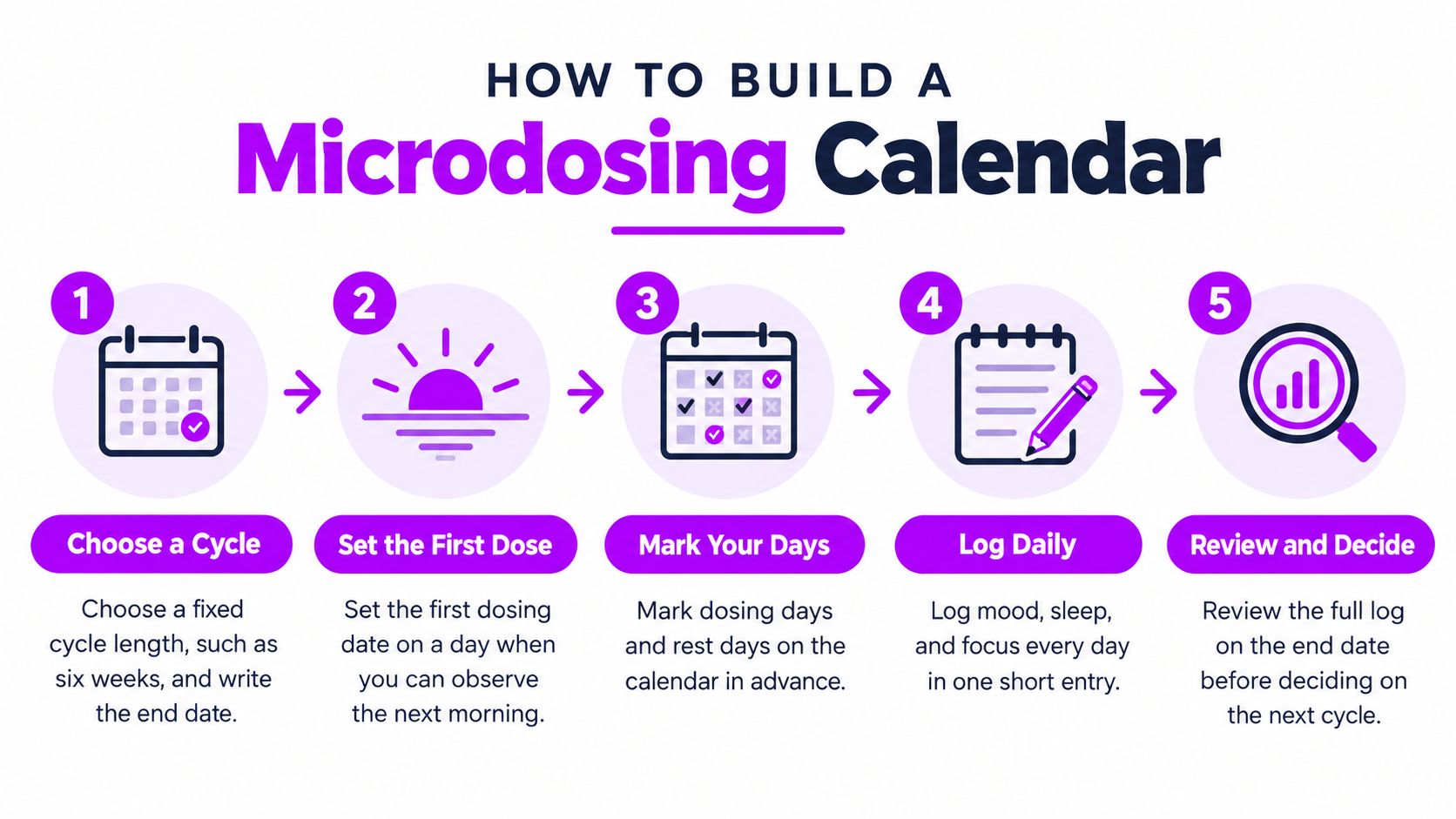
Set the calendar before collecting observations
Choose a fixed observation window. A six-week calendar is an example of a bounded review period, not a medically established course. Write the end date first so continuation requires a fresh decision.
Select an observable starting day. Choose a date when you can also record the following morning, rather than immediately before travel or a demanding shift. That makes follow-up less dependent on memory.
Mark planned dosing and non-dosing days. Keep the calendar's status separate from your journal notes, leaving the rest-day note fields blank until you make observations. A planned dose must never appear as a completed dose automatically.
Collect a baseline before starting. For example, use seven days of mood ratings on a 1-to-10 scale, sleep hours, stress notes, and caffeine records. These are suggested logging conventions, not validated thresholds for deciding whether microdosing works.
Write missed-dose and pause rules. Decide how you'll label interruptions and what concerns require clinical advice before you encounter them. This reduces the temptation to reinterpret the rules to protect a streak.
Book the review. Reserve time to examine the complete record, including adverse effects and days without dosing. Don't let a reminder become an instruction to continue.
Borrow research structure, not research dosing
A phase-1 randomised controlled LSD trial assigned 80 healthy adult men to LSD or placebo, using 14 doses over six weeks and collecting 3,231 nights of sleep data. The study used 10 µg LSD every third day, a description of its controlled protocol, not a dose recommendation.
Participants receiving LSD slept an additional 24.3 minutes on the night after dosing, with a 95% confidence interval of 10.3 to 38.3 minutes; no reduction occurred on the dosing night. Those results concern sleep in a small, healthy, all-male sample, not a general mood benefit or evidence for unsupervised psilocybin use.
The useful planning lesson is to separate immediate entries from follow-up observations.
Six-week Fadiman calendar by day number
This is the calendar arithmetic for that every-third-day structure, not a prescription.
| Week (days) | Dose days | Rest days | Doses in week |
|---|---|---|---|
| Week 1 (1-7) | 1, 4, 7 | 2, 3, 5, 6 | 3 |
| Week 2 (8-14) | 10, 13 | 8, 9, 11, 12, 14 | 2 |
| Week 3 (15-21) | 16, 19 | 15, 17, 18, 20, 21 | 2 |
| Week 4 (22-28) | 22, 25, 28 | 23, 24, 26, 27 | 3 |
| Week 5 (29-35) | 31, 34 | 29, 30, 32, 33, 35 | 2 |
| Week 6 (36-42) | 37, 40 | 36, 38, 39, 41, 42 | 2 |
Replace day numbers with real dates before using a calendar. You should be able to distinguish planned dose, planned rest, completed, skipped, and unrecorded at a glance.
For an additional video resource, keep your written plan available while viewing.
What to Log Each Day and How to Read It
Log skipped doses. An empty entry doesn't tell you whether you rested, forgot, changed your mind, or didn't bother to write anything down. Keep the planned date and actual behaviour in separate fields.
A review of microdosing evidence and practice supports treating the schedule as an observational framework rather than assuming that planned dosing occurred. Record actual timing, amount, mood, sleep, and adverse effects so deviations remain visible.
Daily fields to log and why each one matters
The scales below are suggested personal logging tools, not clinical assessments.
| Field | What to record | Why it matters |
|---|---|---|
| Dose timing | Date, clock time, amount, product and product lot if known | Separates timing changes from other observations |
| Planned versus actual | Planned dosing day and whether it was taken | Stops skipped doses being mistaken for completed dosing |
| Mood | Suggested 1-to-10 rating at the same hour daily | Provides a consistent personal comparison |
| Sleep | Hours slept and a suggested 1-to-5 quality rating | Captures sleep changes separately from daytime impressions |
| Next-day rating | Separate morning entry after each dose | Preserves delayed observations |
| Confounders | Caffeine, alcohol, exercise, illness and stress | Identifies other possible explanations |
| Context notes | Travel, deadlines, medication changes and routine changes | Helps explain unusual entries during review |
Start with the factual fields before interpreting your experience. Product information documents what you believe you used; it doesn't verify identity or potency. Likewise, recording caffeine or stress helps you notice alternative explanations but doesn't eliminate them.
Use the same wording and rating direction throughout. A structured daily entry format makes the record easier to compare than scattered notes written only when something feels remarkable.
Read groups of days, not standout moments
Compare dosing days, first non-dosing days, and second non-dosing days. As a practical starting point, review at least three complete pattern cycles, while recognising that this is an organisational minimum, not a scientifically validated threshold.
Look at averages and the spread of ratings. An average can hide alternating excellent and difficult days, and a single unusually good day doesn't establish benefit.
A personal log can reveal an association worth discussing. It can't establish that the substance caused it.
The next-day entry matters because delayed effects can be missed by same-day notes, as the sleep trial illustrates. Fill in your record at the same time each day, even when the entire entry is a skipped-dose explanation.
Adjust the Schedule Without Breaking Your Data
A missed dose is a documentation event, not a debt to repay. Mark it as skipped rather than moving it without notice or doubling up to restore the original count.
Changing frequency mid-cycle creates a different problem: you're no longer comparing the pattern you originally selected. The resulting record may still be useful, but you'll need to distinguish the periods rather than treating them as one uninterrupted experiment.
Common disruptions and how to log each one
These are suggested administrative rules, not clinically validated restart intervals. Symptoms or medical concerns override routine calendar management.
| Disruption | Adjustment | Log as |
|---|---|---|
| Missed dose | Skip it; don't double up the next day | Skipped dose |
| Travel of three or more days | As a chosen logging rule, pause and restart baseline observations on return | Paused, travel |
| Three or more nights of poor sleep | Preserve the calendar record and flag sleep; pause dosing and seek advice if sleep is worsening or concerning | Confounder, sleep |
| Illness with fever | Pause; resume baseline logging after recovery and review whether continuing is appropriate | Paused, illness |
| Wish to change pattern mid-cycle | Defer an elective switch to a new observation period, provided no safety concern requires stopping | Protocol change |
The thresholds in this table are examples for making your record consistent, not evidence that shorter disruptions are harmless. “Keep the calendar” means retain the original plan for comparison, not continue dosing despite symptoms.
Use the journal layout below to keep the disruption, decision, and explanation together.
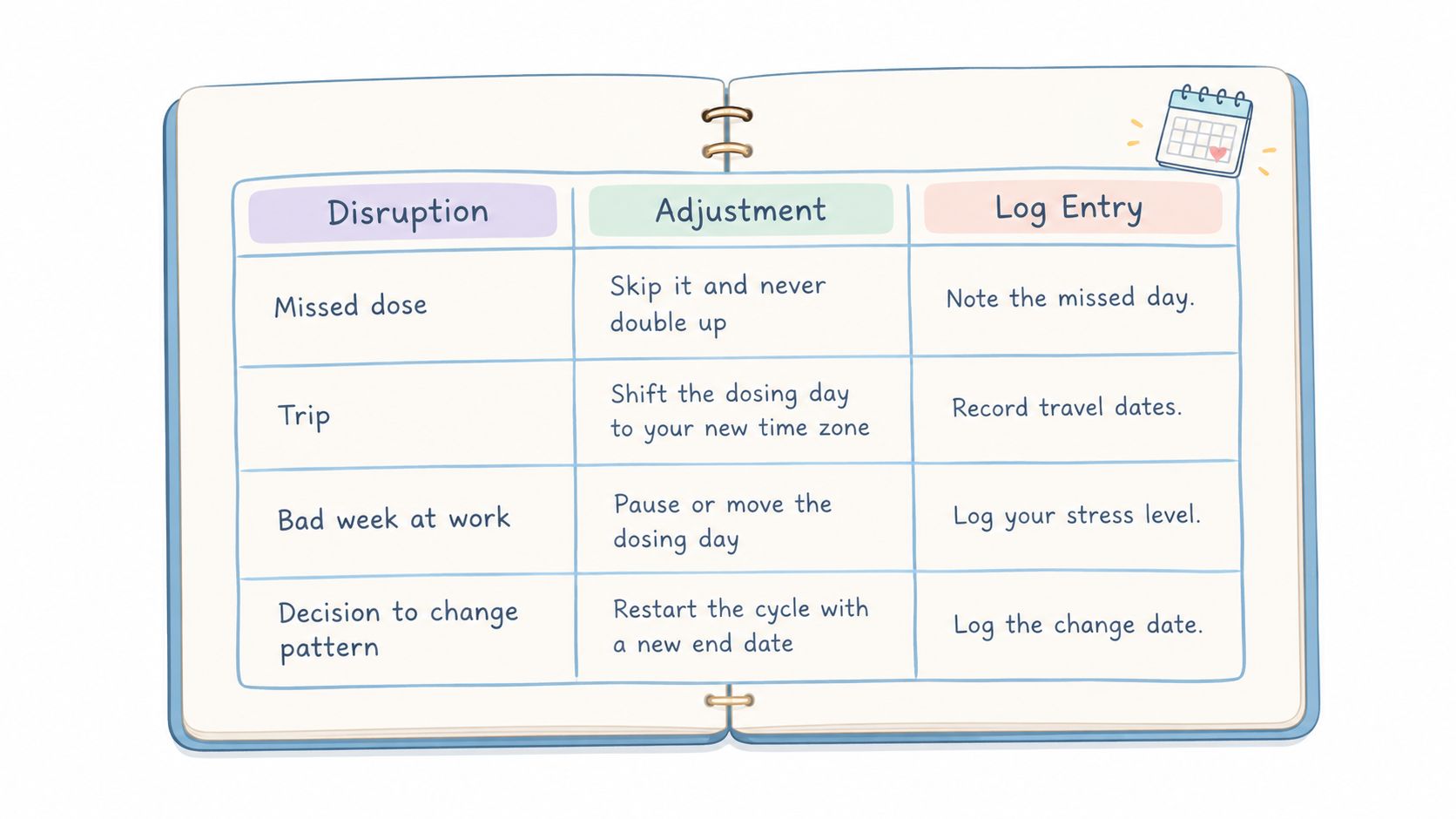
Separate ordinary disruption from a new experiment
Suppose you're following a Fadiman calendar and leave for a four-day trip. As a hypothetical logging example, mark the travel period, preserve any entries you do make, and collect a fresh baseline after returning rather than folding jet lag and disrupted sleep into your original comparison.
Review the later observation period separately. You don't need to delete the interrupted record; its value is showing why you changed course.
Avoid changing several things at once. If frequency, product, timing, and workload all change together, you won't know which difference might explain your ratings.
Also keep recording non-dosing days. Measuring only how you feel when you expect an effect makes the record less informative, especially when expectation itself may influence your assessment.
Adjustment principle: Preserve what happened, label what changed, and never rewrite the past to make the calendar look tidy.
For elective changes, finish the planned observation period before switching when it remains appropriate to continue. There's no obligation to complete it, and a safety concern is a reason to stop rather than protect comparability.
When to Pause Instead of Adjust
Consistent adherence isn't always a sensible goal. If adverse effects appear or benefit remains uncertain, taking more scheduled doses isn't an achievement.
The National Center for Complementary and Integrative Health's psilocybin guidance states that microdosing safety and effectiveness remain unclear. Reported adverse effects include insomnia, anxiety, low mood, poor focus, gastrointestinal symptoms, and impaired functioning, and psilocybin can increase blood pressure and heart rate.
Write clinical concerns into the plan
Pause and discuss the situation with a qualified clinician rather than making a calendar adjustment when any of these apply:
- Psychiatric history: A personal history of psychotic disorder or severe bipolar disorder, or a close-family history that needs screening.
- Pregnancy or breastfeeding: Don't interpret missing safety evidence as reassurance.
- Cardiovascular concerns: Uncontrolled cardiovascular disease, high blood pressure, or concerning physical symptoms.
- Medication changes: A new prescription, changed dose, or possible interaction.
- Worsening functioning: Persistent insomnia, rising anxiety, low mood, unusually heightened mood, or difficulty managing daily responsibilities.
Use this checklist as a conversation prompt, not a diagnostic tool.
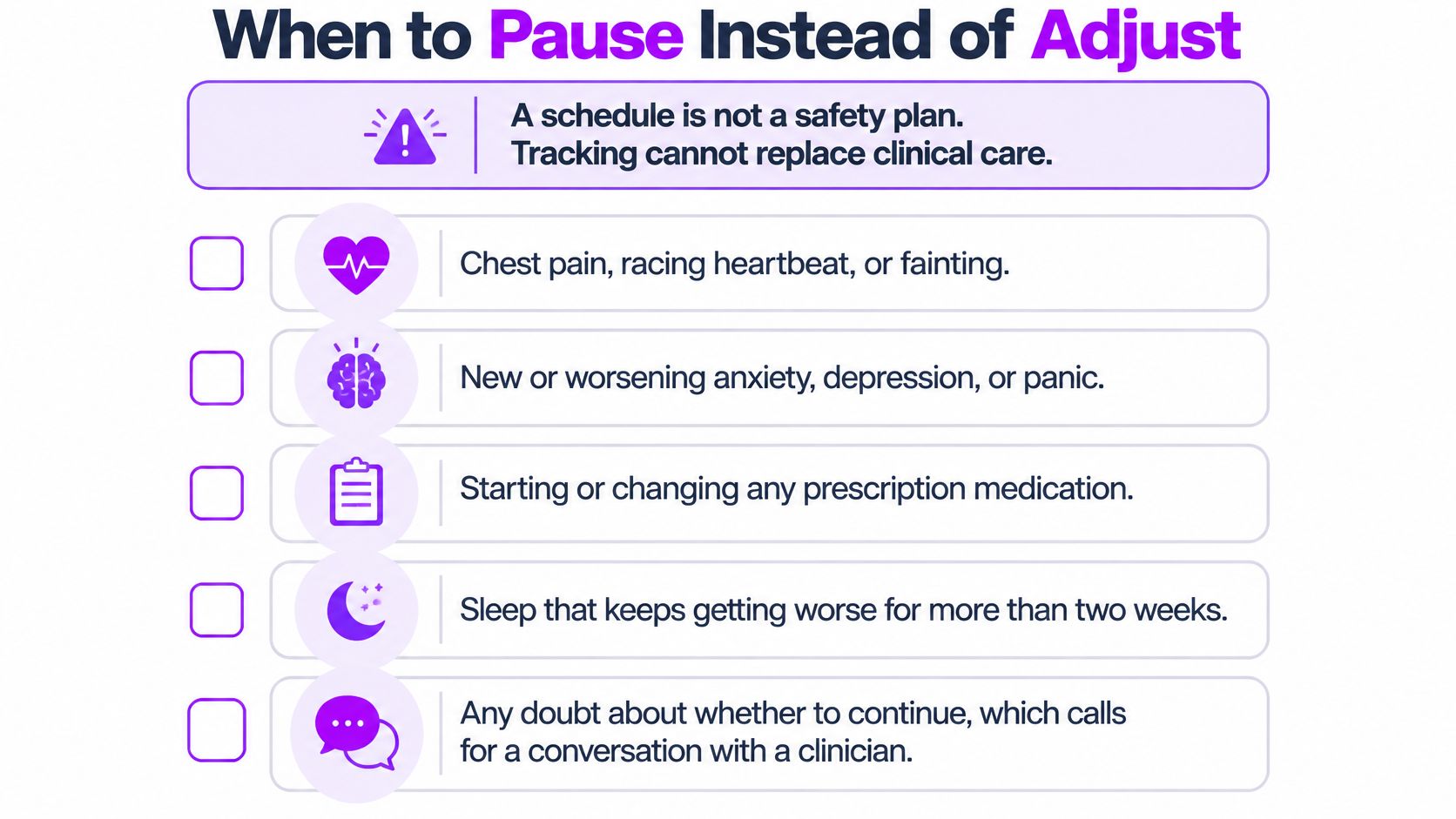
Don't wait for the duration shown in an infographic if symptoms are concerning. Chest pain, fainting, or severe psychiatric symptoms warrant urgent medical assessment, not a routine journal review.
A guide to microdosing side effects can help organise your observations for that conversation, but tracking cannot replace clinical care.
Write clinician-agreed pause triggers on the calendar's first page. A rule such as reviewing after two flagged symptoms is only an example, never permission to ignore the first serious symptom.
Similarly, three full pattern cycles may serve as a planned review point before a longer break, not a minimum exposure requirement or established safe duration. Stop earlier whenever safety or uncertainty warrants it.
Decide Whether to Keep, Change or Stop Your Schedule
At the review date, place dosing-day and non-dosing-day observations alongside missed doses, schedule changes, and symptom flags. Use the full record rather than your memory of the most encouraging day.
Apply decisions in this order:
Stop or pause for safety. If a warning sign appeared, seek appropriate clinical advice. A favourable mood rating doesn't cancel a concerning symptom.
Consider changing an impractical pattern. If the schedule was too demanding, discuss whether stopping or using a longer-rest arrangement is appropriate. Treat any later pattern as a new observation period rather than editing the previous one.
Consider keeping the logging structure. Consistent differences, few missed entries, and no apparent safety flags may justify further discussion and observation. They don't prove efficacy or establish that continued use is safe.
A weekly trend analysis approach can help you compare repeated observations without allowing one memorable entry to dominate the decision.
Before closing the review, record the decision and its reason. If you're continuing after appropriate clinical discussion, write the next observation period's dates, end date, and pause rules; if you're stopping, document that just as clearly.
Stopping is a valid result. So is concluding that the record doesn't support a confident interpretation.
MicroTrack offers a flexible calendar, skipped-dose overrides, and two-phase journal entries for recording dose details and later reflections. Visit MicroTrack to organise your planned schedule alongside what really happened, then use that record to support informed conversations about whether to continue, change, or stop.